

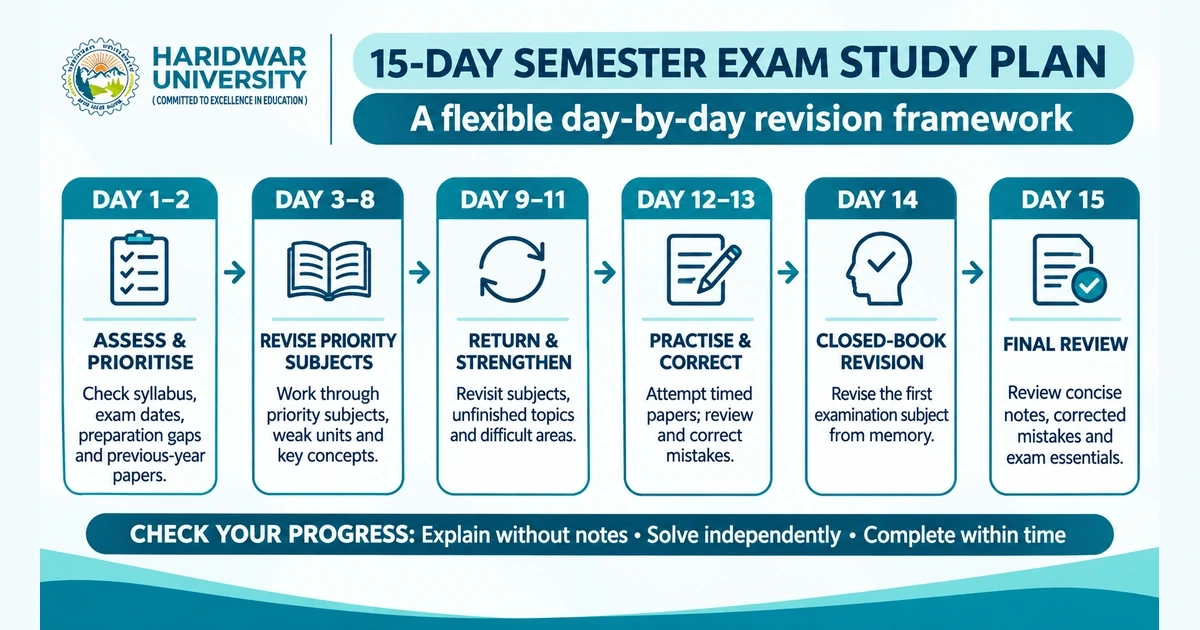
How to Prepare for Semester Exams in 15 Days: A Day-by-Day Study Plan
Dr Aadesh K. Arya
Pro Vice-Chancellor, Haridwar University
Fifteen days before a semester examination, students often face the same problem: several subjects to revise, unfinished units, previous-year question papers to solve and limited time to do everything. The immediate temptation is to study for longer hours. However, spending more time with textbooks does not automatically mean better preparation.
When I consider a short revision window, I would start with three questions: How much of the syllabus have you already covered? Which subjects need the most attention? And can you answer questions without looking at your notes?
Learning how to prepare for semester exams in 15 days is largely about making these decisions in the right order. A workable plan should help students prioritise important topics, revise what they already know, address unfinished portions and practise writing answers under examination conditions.
This guide provides a flexible 15-day study plan for university students, with adjustments for different subjects and levels of preparation.
Table of Contents
- Understanding the 15-Day Revision Challenge
- Assessing Your Syllabus Before Starting
- Prioritising Subjects and Topics
- The 15-Day Semester Exam Preparation Timetable
- Using Effective Revision Techniques
- Preparing for Different Types of Subjects
- Avoiding Common Last-Minute Preparation Mistakes
- Managing the Final 48 Hours
- Frequently Asked Questions (FAQs)
- Making Your 15-Day Revision Plan Work
Understanding the 15-Day Revision Challenge
Is 15 days enough to prepare for semester exams? It depends on how much you have studied during the semester.
A student who has attended lectures, completed assignments and understood most units is in a different position from someone opening several chapters for the first time. Both can use a 15-day plan, but they should not follow identical targets.
I would divide students' preparation into three broad situations:
| Current Preparation | Recommended Approach |
|---|---|
| Most topics already covered | Focus on revision, practice papers and weak areas |
| Some units incomplete | Revise familiar topics while covering essential unfinished units |
| Large portions untouched | Prioritise foundational and syllabus-relevant topics; avoid trying to memorise everything superficially |
The objective is not to promise complete mastery in two weeks. It is to use the available time to improve understanding, recall and examination readiness.
Assessing Your Syllabus Before Starting
Before making a timetable, spend the first day understanding exactly what needs attention. Collect the official syllabus, lecture notes, assignments, previous-year question papers and examination schedule for every subject.
Create a simple subject-wise checklist:
- Completed: Topics you understand and can explain without notes.
- Partially prepared: Topics you have studied but cannot confidently answer questions on.
- Not prepared: Topics you have not studied or understood sufficiently.
Also check the examination dates. The subject with the earliest examination may need attention before another subject that appears more difficult but has a later paper.
This initial assessment prevents an avoidable mistake: spending too much time revising familiar chapters simply because they feel comfortable.
Prioritising Subjects and Topics
Not every unit deserves equal revision time. Students should consider four factors before deciding what to study first:
- Examination schedule: Give attention to subjects whose examinations are approaching.
- Understanding: Identify topics where you repeatedly make mistakes or cannot explain the underlying concept.
- Syllabus relevance: Use the prescribed syllabus and faculty guidance to identify essential learning areas.
- Previous-year questions: Examine recurring question formats and the way topics have been assessed.
Previous-year papers are useful for understanding question styles and testing preparation. They should not be treated as a guarantee that the same questions will appear again.
I recommend preparing a priority list for each subject rather than creating one long list of chapters without an order. Students can also refer to HU's semester examination preparation guide for broader planning advice.
The 15-Day Semester Exam Preparation Timetable
The following schedule assumes that Day 15 is the day before your first examination. Adjust the subject allocation according to the number of papers, examination dates and syllabus coverage.
| Day | Main Preparation Target |
|---|---|
| Day 1 | Collect syllabuses, examination dates, notes and previous-year papers. Assess preparation in every subject. |
| Day 2 | Rank subjects and topics by examination date, difficulty and preparation gaps. Set daily targets. |
| Day 3 | Revise the first priority subject. Focus on important concepts and attempt questions without notes. |
| Day 4 | Continue the first subject. Cover weak units and practise descriptive or numerical questions. |
| Day 5 | Begin the second priority subject. Revise core concepts and prepare a list of unresolved doubts. |
| Day 6 | Continue the second subject. Attempt questions from different units and correct mistakes. |
| Day 7 | Revise the third subject or the next examination subject. Test recall from previously covered topics. |
| Day 8 | Continue the third subject. Practise questions and revisit difficult concepts. |
| Day 9 | Return to the first priority subject. Attempt a timed previous-year paper or a representative question set. |
| Day 10 | Revise the second priority subject. Review mistakes and strengthen incomplete topics. |
| Day 11 | Revise the remaining subjects, giving more time to weak or approaching papers. |
| Day 12 | Attempt timed practice papers for the earliest examinations. Check answer structure and time management. |
| Day 13 | Correct recurring mistakes, revise formulas, definitions, diagrams and key arguments. |
| Day 14 | Conduct closed-book revision of the first examination subject. Avoid starting several large unfamiliar topics. |
| Day 15 | Review concise notes, important concepts and previously corrected mistakes. Prepare examination materials and maintain a normal sleep routine. |
This is a framework, not a rigid timetable. If you have four subjects rather than six, redistribute the available sessions. If one examination is scheduled earlier, move that subject forward.
A practical daily study structure
Students attending classes or managing other responsibilities can divide their available preparation time into focused sessions:
| Session | Activity |
|---|---|
| First session | Understand or revise one priority topic |
| Second session | Solve questions or practise recalling the topic |
| Third session | Work on another subject or an unfinished unit |
| Short review | Revisit earlier topics and record mistakes |
Use focused blocks of approximately 50–60 minutes, followed by short breaks. The number of blocks should depend on your available time and concentration, not on another student's study schedule.
Using Effective Revision Techniques
A timetable tells you when to study. The method you use determines what happens during that time.
In their 2013 review of ten learning techniques, Dunlosky and colleagues identified practice testing and distributed practice as particularly useful approaches. The researchers found that repeated rereading and highlighting did not consistently produce the same benefits. Read the research review on effective learning techniques.
I recommend using these methods during the 15-day preparation period:
- Active recall: Close your textbook after studying a topic. Write down its main points, formulas or explanations from memory. Check your answers afterwards.
- Spaced revision: Return to a topic after a gap instead of revising it only once. For example, revisit a difficult chapter the following day and test yourself again several days later.
- Practice testing: Attempt previous-year questions and mock papers without looking at the solutions. Record errors and practise the questions again.
- Self-explanation: Explain a difficult concept in your own words. If you cannot explain a step or principle clearly, identify the gap and revisit it.
For a more detailed explanation, students can follow HU's guide to the active recall method and spaced repetition and its evidence-based study methods.
Preparing for Different Types of Subjects
A single revision method will not work equally well across every university subject. The way students prepare should reflect what their examinations require.
- Theory subjects: Prepare concise topic summaries, practise definitions and explanations, and write structured answers from memory.
- Mathematics and numerical subjects: Solve problems independently. Focus on selecting the correct formula, showing working steps and checking calculations.
- Engineering and technical subjects: Practise derivations, diagrams, circuit problems, coding exercises or other programme-specific applications.
- Business and management subjects: Revise concepts, frameworks and definitions, then practise applying them to case studies and practical situations.
For example, a B.Tech student may need to solve numerical problems and explain technical principles, whereas an MBA student may need to apply management concepts to a business situation. Both need independent practice, but their revision materials will differ.
Avoiding Common Last-Minute Preparation Mistakes
When time is limited, unproductive habits become more costly. Watch out for these mistakes:
- Making elaborate new notes: Spend more time understanding and testing existing material than rewriting entire chapters.
- Studying only comfortable subjects: Give attention to weak areas rather than repeatedly revising topics you already know.
- Reading previous-year answers passively: Attempt questions yourself before checking model answers.
- Following unrealistic study-hour targets: A timetable should fit around your actual academic and personal responsibilities.
- Ignoring unresolved doubts: Record difficult questions and approach faculty members or consult reliable academic material where necessary.
- Studying without checking progress: At the end of each day, verify what you can recall and apply independently.
A useful test is simple: if you cannot answer a question without looking at the notes, that topic still needs work.
Managing the Final 48 Hours
The last two days should be used for consolidation, not panic-driven changes to the entire timetable. For the subject whose examination is approaching:
- Review important concepts, definitions, formulas and diagrams.
- Attempt a small selection of questions under timed conditions.
- Revisit mistakes from earlier practice papers.
- Organise examination essentials and check the reporting time and venue.
- Avoid sacrificing sleep to complete another lengthy chapter.
The American Academy of Sleep Medicine and Sleep Research Society recommend that adults regularly obtain at least seven hours of sleep. Read the adult sleep-duration consensus recommendation. Students should avoid treating an all-night study session as a substitute for preparation.
Frequently Asked Questions (FAQs)
1. Is 15 days enough to prepare for semester exams?
It can be enough for a focused revision period if students have already covered much of the syllabus. Those with substantial unfinished portions will need to prioritise essential topics and manage expectations.
2. How many hours should I study daily before semester exams?
There is no fixed number that guarantees results. Plan focused study sessions around your classes, syllabus gaps and examination dates. Measure progress through completed topics and independent question-solving.
3. How can I complete an incomplete syllabus in 15 days?
Start by identifying essential topics, foundational concepts and areas highlighted in your prescribed syllabus. Cover them in priority order while reserving time for practice and revision.
4. Should I study one subject per day or multiple subjects?
Both approaches can work. Give one subject a longer focused session, but include shorter review sessions for other subjects so that previously studied material is not neglected.
5. Are previous-year question papers enough for semester preparation?
No. They help students understand question patterns and practise answer writing, but they cannot replace syllabus coverage, conceptual understanding or preparation for unfamiliar questions.
6. Is group study useful during the last 15 days?
It can help with difficult concepts, peer questioning and comparing solutions. However, students should still practise answering questions independently. Discussion cannot replace individual examination preparation.
7. What should I do on the day before a semester examination?
Revise concise notes, formulas, definitions and important concepts. Review previous mistakes, prepare examination essentials and get adequate sleep rather than attempting to learn the entire syllabus overnight.
Making Your 15-Day Revision Plan Work
Preparing for semester exams in 15 days requires more than a timetable pinned above a study desk. It requires students to recognise what they know, identify what needs attention and choose revision methods that demonstrate actual understanding.
I would encourage students to judge each day's preparation by three outcomes: Can you explain the topic without notes? Can you solve a related question independently? Can you complete an answer within a reasonable time?
If you can demonstrate these outcomes, your preparation is moving in the right direction. If not, adjust the next day's priorities.
The purpose of a 15-day plan is not to study every minute. It is to make the available time count.
Achieve Academic Success at Haridwar University
From structured academic calendars and modern digital library resources to faculty mentorship and student welfare support, Haridwar University provides the environment you need to excel in your semester exams and degree programmes. Admissions open for the 2027-28 academic session.