

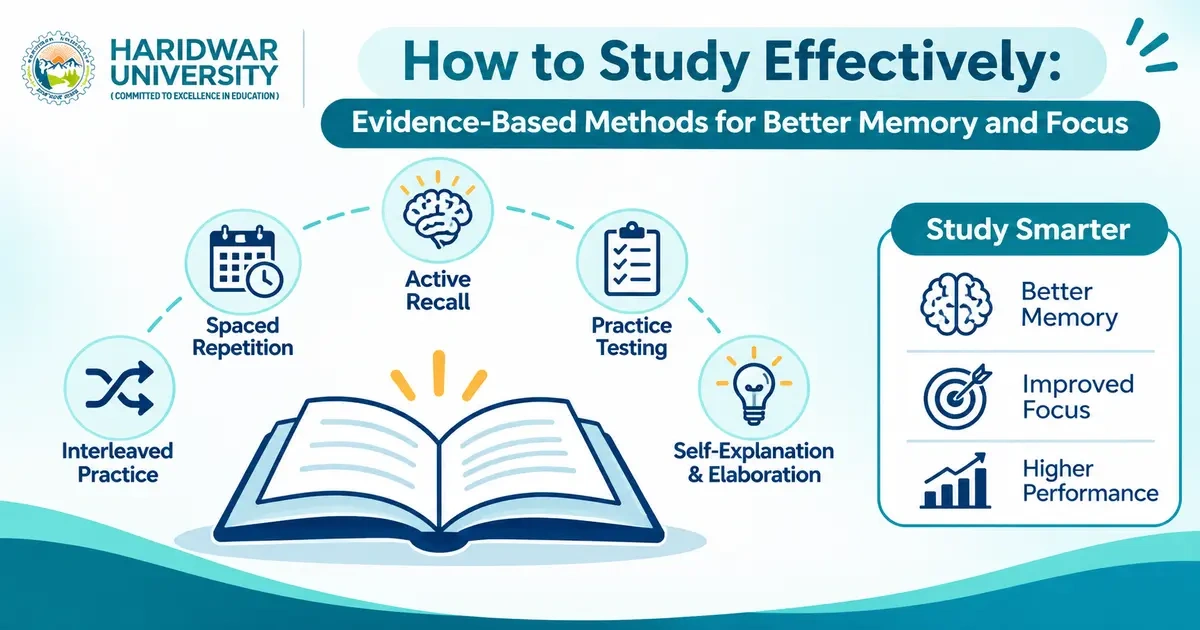
How to Study Effectively: Evidence-Based Methods for Better Memory and Focus
Mrs. Nisha Dhiman
Student Welfare Officer, Haridwar University
Students often tell themselves that they need more study hours, longer notes or another revision session. Yet, after spending an entire evening with a textbook, they may struggle to explain what they have just read. The problem is not always a lack of effort. It can be the way that effort is being used.
Learning research offers a more useful approach. Techniques such as active recall, spaced repetition and practice testing help students move beyond recognising information towards remembering and applying it. Other habits, including managing distractions and planning study sessions, make it easier to use these techniques consistently.
The most effective study routine is not necessarily the longest one. It is the one that helps students understand a topic, retrieve it without looking at their notes, and return to it before they forget it.
Table of Contents
- 1. Why Studying Longer Does Not Always Mean Learning More
- 2. Evidence-Based Study Techniques That Improve Learning
- 3. Choosing the Right Study Method for Each Subject
- 4. How to Improve Concentration While Studying
- 5. How Many Hours Should Students Study Each Day?
- 6. Building a Practical Study Routine
- 7. Common Study Habits That Waste Time
- 8. Frequently Asked Questions (FAQs)
- 9. Making Better Learning Habits Last
1. Why Studying Longer Does Not Always Mean Learning More
Reading a chapter repeatedly can make its contents feel familiar. That familiarity, however, does not always mean that the information can be recalled during an examination or used to solve a new problem.
A landmark review by John Dunlosky and colleagues, published in Psychological Science in the Public Interest, evaluated ten commonly used learning techniques. Practice testing and distributed practice received the highest utility ratings. Highlighting, underlining, and passive rereading, despite their widespread popularity among students, did not consistently improve retention or exam performance across learning contexts.
Passive Recognition vs. Active Recall
Passive study keeps information in front of your eyes; active learning forces your brain to retrieve it. A student who closes a book and explains a concept from memory tests what has actually been learnt. A student who merely rereads the same paragraph three times is practising visual recognition rather than cognitive recall.
The goal should be to measure learning progress by what you can articulate, solve, and apply independently, rather than how many hours you sat at a desk or how many pages were turned.
2. Evidence-Based Study Techniques That Improve Learning
Not every study technique carries empirical backing. The following evidence-supported methods deliver proven cognitive benefits across varied academic disciplines:
1. Active Recall
Active recall means retrieving information from memory without looking at reference notes or textbooks. After finishing a section, close the book and write down its core definitions, diagrams, formulas, or flowcharts. Then compare your notes with the source material to identify blind spots. For instance, after reading about cellular respiration, sketch the cycle from memory. The mental effort required to pull information forward strengthens neural pathways.
2. Spaced Repetition (Distributed Practice)
Instead of cramming a subject into one exhaustive 6-hour marathon, distribute revisions across deliberate intervals. A research-backed review by Shana Carpenter, Steven Pan, and Andrew Butler in Nature Reviews Psychology highlights how spacing and retrieval practice compound long-term memory formation across diverse academic settings.
| Revision Stage | Optimal Timing |
|---|---|
| First Review | The day you first study the topic (evening recall) |
| Second Review | The following day (quick self-test) |
| Third Review | 3 days later (practice questions) |
| Fourth Review | 1 week later |
| Fifth Review | 2 to 3 weeks later (prior to major unit exams) |
3. Practice Testing
Take past exam questions, mock tests, and flashcard quizzes before you feel ready. When answering questions, identify the reasoning behind incorrect options. Memorising the correct option without understanding the root error yields limited benefit on altered exam questions.
4. Interleaved Practice
Interleaving involves alternating between related problem types rather than block-practising 40 identical problems. In engineering mechanics or mathematics, solve a rotation dynamics problem, followed by a work-energy problem, and then an impulse-momentum question. This forces your brain to discriminate which formula or strategy applies.
5. Self-Explanation and Elaboration
Connect new facts to concepts you already comprehend: Why does this phenomenon occur? What would happen if this variable changed? How does this connect to real-world business or engineering systems? Explaining the underlying mechanics reveals conceptual gaps that passive copying masks.
Meta-Analysis Findings (Educational Psychology Review, 2026)
A meta-analysis by Sterre K. Ruitenburg and colleagues in Educational Psychology Review synthesised 233 effect sizes from 53 empirical studies across 7,303 learners, confirming robust positive gains for retrieval practice (g = 0.37), distributed spacing (g = 0.20), and interleaving (g = 0.40).
3. Choosing the Right Study Method for Each Subject
An effective learning strategy must fit the specific cognitive demands of the subject matter:
| Subject Domain | Effective Learning Approach |
|---|---|
| Mathematics & Engineering | Solve numerical problems without consulting worked solutions; mix related problem variants to master formula application. |
| Sciences & Medicine | Draw anatomical, chemical, or geological pathways from memory; label diagrams and explain causal mechanisms aloud. |
| Languages & Vocabulary | Digital spaced flashcards (Anki), active writing, context sentences, and oral retrieval practice. |
| Law, History & Social Sciences | Construct chronological timelines, comparative thematic matrices, and draft answer outlines from memory. |
| Commerce & Management | Apply regulatory and financial concepts to case studies, financial statement adjustments, and corporate scenarios. |
4. How to Improve Concentration While Studying
Even optimal study techniques fail when attention is fractured by constant interruptions. Setting up an environment that eliminates friction and digital noise is essential:
- Physical Distance from Your Smartphone: Place your phone outside arm’s reach or in another room. Research shows that mere proximity to a smartphone degrades cognitive bandwidth even when silent.
- Micro-Targeted Objectives: Replace vague plans like “study physics” with “derive Bernoulli’s theorem and solve 3 pipe-flow problems without notes.”
- Frictionless Workspaces: Prepare calculators, notebooks, formula sheets, and water before sitting down to eliminate task-switching excuses.
- Self-Regulated Breaks: Work in uninterrupted blocks (30–50 minutes) and take conscious 5–10 minute pauses.
- Zero Multitasking: Do not alternate between messaging, audio lectures, and problem solving. Attention-switching carries substantial cognitive residue.
A 2026 experimental study by Ali Göksu, Wisnu Wiradhany, and Anique B.H. de Bruin in Behavioral Sciences examined 176 university students comparing rigid 25-minute Pomodoro intervals against self-regulated break timing. Findings confirmed that self-regulated breaks yielded superior mood, sustained concentration, and intrinsic motivation, proving that your study cadence should match your personal fatigue rhythm rather than an arbitrary digital timer.
5. How Many Hours Should Students Study Each Day?
There is no universally fixed number of hours that guarantees academic success. Academic level, current conceptual clarity, lab loads, and semester timelines determine the required commitment. A student managing university lectures and laboratory practica requires a different cadence than an aspirant preparing full-time for entrance examinations.
Instead of replicating another student’s schedule, evaluate your daily preparation using three metrics:
- Conceptual Mastery: Can you explain today’s lecture concepts in plain language without checking notes?
- Independent Problem Solving: Did you solve unseen problems or questions without consulting solutions?
- Distributed Review: Did you dedicate 20–30 minutes to reviewing topics from last week?
6. Building a Practical Study Routine
A balanced evening routine harmonises new learning, active retrieval, and error correction. Here is an illustrative 2.5-hour evening framework:
| Time Block | Academic Activity |
|---|---|
| 5:00 – 5:45 PM | Deep reading of a new syllabus topic; identify core theorems and principles |
| 5:45 – 5:55 PM | Short cognitive break (hydrate, stretch, no social media) |
| 5:55 – 6:35 PM | Active recall: write definitions, draw diagrams, and outline arguments from memory |
| 6:35 – 6:45 PM | Short recovery break |
| 6:45 – 7:25 PM | Solve past examination problems or numerical exercises under test conditions |
| 7:25 – 7:40 PM | Audit mistakes, record error logs, and schedule the next spaced review |
For in-depth scheduling templates, review our guide on how to make a study timetable. University students preparing for mid-terms and finals can consult our semester examination preparation guide, while incoming undergraduates will benefit from our first-year academic transition guide.
7. Common Study Habits That Waste Time
Colouring entire pages creates an illusion of competence without engaging memory. Highlight sparingly and convert key concepts into questions.
Reading the same paragraph multiple times builds surface familiarity but leaves retrieval pathways unexercised. Test yourself instead.
Transcribing textbooks word for word is a low-utility mechanical task. Summarise ideas in your own words or diagram them.
Sacrificing sleep impairs memory consolidation in the hippocampus and triggers test-day brain fog. Distributed study protects sleep.
Checking messaging groups every few minutes shatters working memory, dramatically increasing the time required to understand complex material.
8. Frequently Asked Questions (FAQs)
1. What is the most effective way to study?
A combination of active recall, spaced repetition, and practice testing is the most empirically validated framework. These methods force memory retrieval and distribute learning over time rather than relying on passive rereading.
2. How can I improve concentration while studying?
Define an exact mini-goal, remove your phone from the room, gather all necessary books beforehand, work in focused blocks, and take intentional recovery breaks when attention dips.
3. What is the 3-3-3 study method?
The term is an informal routine circulating on social media describing various split-hour schedules; it is not a validated cognitive science rule. Rely on evidence-based retrieval and spacing rather than numerical catchphrases.
4. What is the 2/3, 5/7 study rule?
This is another unverified online study heuristic. No fixed ratio guarantees exam results; consistent self-testing, problem solving, and adequate sleep form the real pillars of retention.
5. How many hours should I study every day?
It depends on academic demands and syllabus timelines. Focus on completing deliberate learning units and verifying recall rather than watching clock hours pass.
6. Is studying late at night effective?
Late study works for some night chronotypes, but working late at the expense of consistent sleep disrupts memory consolidation. Prioritise a regular schedule that preserves 7 to 8 hours of sleep.
7. How can I study multiple subjects in a limited time?
Prioritise difficult topics, dedicate distinct 45-minute blocks to each subject, interleave related practice problems, and use active recall for quick revision. Avoid hopping between subjects every 10 minutes.
9. Making Better Learning Habits Last
Effective study is less about finding a magic formula and more about applying a few proven principles with discipline: read to grasp fundamentals, close the text to challenge your recall, solve problems under realistic test conditions, and revisit concepts before they fade.
Stop evaluating your preparation simply by desk hours. The decisive test is whether you can explain what you studied clearly, solve problems independently, and remember the knowledge when you need it most. That is the foundation of genuine academic excellence.
Thrive Academically and Professionally at Haridwar University
Experience student-centred academic mentoring, modern labs, digital library resources, and personalized career coaching across Engineering, Management, Pharmacy, Agriculture, and Computing. Admissions open for the 2027-28 session.