

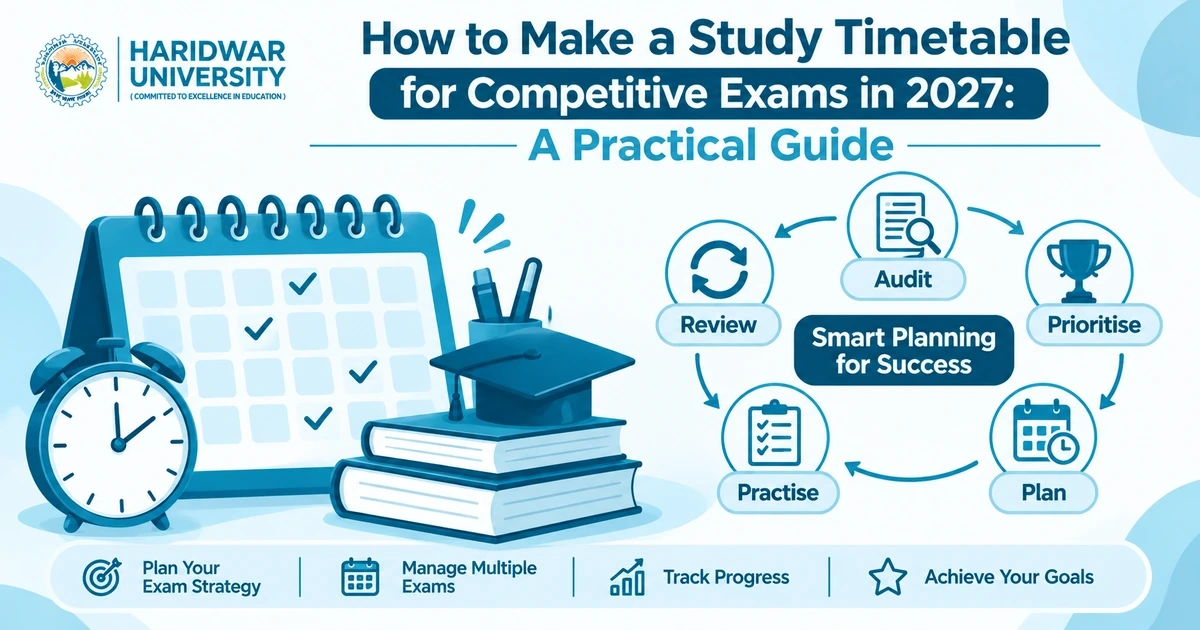
How to Make a Study Timetable for Competitive Exams in 2027
Dr. Ekta Jain
Associate Professor & HOD, Applied Science, Haridwar University
Preparing for one competitive examination is demanding. Preparing for two or three in the same academic cycle requires a different kind of planning. A student targeting JEE Main, CUET PG or a management entrance examination must consider not only the syllabus but also the order of examinations, overlapping subjects, revision time and university commitments.
The revised 2026–27 examination calendar makes this planning particularly important. Several major examinations are scheduled between December 2026 and April 2027. In my view, the most useful study timetable for competitive exams is not the one with the longest daily hours. It is the one that connects each study session to a clear examination target and can be adjusted when priorities change.
Here is how to build a personal study timetable for competitive exams in 2027.
Table of Contents
- The 2027 Exam Calendar and Its Preparation Windows
- Start With an Examination and Syllabus Audit
- Prioritise Exams According to Time and Preparation Level
- Build a Personal Daily and Weekly Study Timetable
- Manage Overlapping Syllabuses Across Multiple Exams
- Schedule Revision, Mock Tests and Buffer Time
- Adjust Your Timetable When Exam Dates Change
- Frequently Asked Questions (FAQs)
- Make Your 2027 Study Plan Work
1. The 2027 Exam Calendar and Its Preparation Windows
Before making a timetable, write down the examination dates that matter to you. The revised National Testing Agency (NTA) examination calendar for 2026–27 lists several important tests scheduled between December 2026 and April 2027. Cross-referencing these dates with our national Entrance Exam Calendar 2027 establishes clear preparation horizons.
| Examination | Tentative Examination Dates |
|---|---|
| UGC NET December 2026 | 14–18 and 21 December 2026 |
| Joint CSIR-UGC NET December 2026 | 19, 22 and 27 December 2026 |
| NIFT Entrance Examination 2027 | 10 January 2027 |
| JEE Main Session 1 | 20–24 and 28 January 2027 |
| CMAT 2027 | 7 February 2027 |
| CUET PG 2027 | 2–5, 8–9, 12, 15–19, 24–25 and 29–31 March 2027 |
| JEE Main Session 2 | 2–7 April 2027 |
The dates above are drawn from the revised NTA examination calendar published in October 2026. They represent tentative planning dates, not final examination-day confirmations. Always verify the latest updates on the official NTA Examinations Portal.
These dates clearly show why an inflexible year-long timetable fails: a student attempting UGC NET faces an intense December crunch, whereas an engineering aspirant preparing for JEE Main targets late January and early April.
2. Start With an Examination and Syllabus Audit
I recommend beginning with a concise one-page examination audit. Do not start assigning study hours to subjects until you know what each examination demands.
| Planning Detail | What to Record |
|---|---|
| Examination Date | Confirmed date or tentative calendar date |
| Syllabus Scope | Common overlapping topics vs. exam-specific unique topics |
| Preparation Status | Completed, partly prepared, or untouched |
| Practice Requirement | Previous-year papers (PYQs), sectional drills, and full-length mocks |
| Personal Availability | College lectures, lab practicals, assignments, and personal commitments |
Next, classify each topic in your target syllabus into three operational buckets:
- Strong: You understand the underlying theory thoroughly and solve standard questions with high accuracy.
- Needs Revision: You have studied the chapter but make conceptual mistakes, forget formulas, or take too long per problem.
- Not Covered: Topics you must learn from scratch.
Students balancing college degree examinations alongside competitive test prep must also coordinate internal assessments. Haridwar University students should consult the official Academic Calendar and the University Examination Schedule to prevent scheduling clashes between semester finals and national entrance exams.
3. Prioritise Exams According to Time and Preparation Level
Not every examination deserves equal study time every day. An entrance test scheduled in three weeks requires more immediate focus than one scheduled three months later. However, the nearer examination should not automatically absorb every study hour if your preparation for it is already solid.
Four diagnostic questions determine balanced priority:
- How many days remain before the examination date?
- What percentage of its core syllabus have you mastered?
- How consistently are you scoring in timed mock tests?
- Which topics are unique to this test and not covered by your secondary targets?
For instance, consider a candidate preparing for both attempts of the engineering entrance: the JEE Main January Attempt and the subsequent April attempt. As detailed in our breakdown of JEE Main Session 1 vs Session 2 Strategy, the January session warrants immediate intensive revision and full-length mocks. Yet, the student should maintain consistent progress on April topics rather than restarting from zero post-January.
4. Build a Personal Daily and Weekly Study Timetable
A functional timetable begins with honest accounting of your actual free time. A college student attending daily lectures and lab sessions cannot mirror the 10-hour schedule of a full-time dropper.
Below is a realistic weekday template providing approximately 4 hours and 15 minutes of focused study time outside regular classes:
| Time Block | Study Activity |
|---|---|
| 6:30 – 7:30 am (60 mins) | Active recall: Revise a complex formula, theorem, or previously studied chapter |
| 5:00 – 6:15 pm (75 mins) | Concept acquisition: Learn a new topic for your immediate priority examination |
| 6:30 – 7:30 pm (60 mins) | Application practice: Solve 20 to 25 topic-level questions under timed conditions |
| 8:15 – 9:00 pm (45 mins) | Secondary preparation: Study a shared subject or secondary target examination topic |
| 9:00 – 9:15 pm (15 mins) | Audit & planning: Review daily mistakes, log errors, and lay out tomorrow's tasks |
Structuring the Weekly Routine
To avoid monotony and ensure comprehensive coverage, structure study blocks across the seven days of the week:
| Day | Primary Academic Focus | Secondary Task |
|---|---|---|
| Monday | Priority exam: New concept learning | Formula and memory consolidation |
| Tuesday | Priority exam: Problem-solving drills | Secondary exam topic reading |
| Wednesday | Priority exam: Targeting identified weak areas | Shared syllabus practice |
| Thursday | Secondary exam: Exam-specific modules | Verbal reasoning / vocabulary drills |
| Friday | Weekly cumulative revision | Error-log review and re-testing |
| Saturday | Full-length or sectional timed mock test | In-depth mock analysis (90 mins) |
| Sunday | Buffer block for backlogs / uncompleted targets | Mental rest & next week's schedule planning |
Protect Sunday as a buffer: If you met your targets, take the afternoon off to recharge. If an unexpected lab submission or illness derailed your Thursday, absorb it on Sunday without pushing a backlog into the following week.
5. Manage Overlapping Syllabuses Across Multiple Exams
While several competitive examinations evaluate broad common subjects—such as Mathematics, Physics, General English, or Logical Reasoning—their testing mechanics differ substantially. Speed, question framing, depth of calculation, and negative marking formulas vary.
| Preparation Domain | Strategic Approach |
|---|---|
| Shared Concepts | Master the core theoretical foundation once, then practice questions tailored to each test's difficulty. |
| Exam-Specific Topics | Dedicate isolated, protected study blocks for unique modules (e.g., Innovation & Entrepreneurship in CMAT). |
| General Awareness | Maintain a continuous daily 25-minute reading slot rather than cramming six months of current affairs in the final week. |
| Timed Practice | Use dedicated previous-year question papers (PYQs) and mock simulators specific to each exam's CBT interface. |
For additional strategies on sustaining mental stamina across competing deadlines, read our faculty guide on how to prepare for multiple competitive exams without burning out.
6. Schedule Revision, Mock Tests and Buffer Time
A timetable that exclusively covers new syllabus chapters is fundamentally flawed. Long-term memory consolidation demands deliberate retrieval practice. Every effective weekly schedule balances three interconnected components:
- Learning: Covering new theoretical concepts and understanding primary derivations.
- Active Revision: Writing down formulas, sketching biological diagrams, or summarizing legal cases entirely from memory without consulting reference books.
- Testing: Simulating genuine test pressure through timed sectional drills and full-length CBT mocks.
The Three-Tier Error Classification System
After completing every full-length mock test, categorize every lost mark into one of three buckets: 1. Conceptual Gap (the topic requires re-learning), 2. Execution Slip (calculation error, sign mistake, or misread question despite knowing the concept), or 3. Time-Management Trap (spending 4+ minutes on a tricky question that should have been bypassed). Target your study sessions directly to eliminate execution slips and time traps.
7. Adjust Your Timetable When Exam Dates Change
National entrance calendars are frequently rescheduled due to general elections, overlapping state board examinations, or administrative updates. When an official revision notice is published by NTA or examination authorities:
- Update the confirmed date in your master academic planner immediately.
- Recalculate the remaining countdown in precise days and weeks.
- Audit your syllabus completion percentage and mock-test scoring trends.
- Shift intensive mock blocks and final revision modules to match the new countdown.
- Check whether the revised schedule conflicts with university mid-terms or project presentations.
Avoid scrapping your entire routine after a date announcement. Implement surgical adjustments to your study blocks while keeping foundational daily habits intact.
8. Frequently Asked Questions (FAQs)
1. How do I make a study timetable for competitive exams?
Begin by auditing your target examinations, official dates, and syllabus breadth. Assess your baseline proficiency across subjects, calculate your true available daily study hours outside college classes, and establish dedicated blocks for new learning, active recall, and timed mock tests. Review and recalibrate your timetable at the end of each week.
2. How many hours should I study daily for competitive exams?
There is no universal study duration. College students typically sustain 3.5 to 5 hours of highly focused daily study, whereas full-time aspirants may dedicate 6 to 8 hours. Measure daily productivity by completed chapters, solved problem sets, and error audits rather than passive desk time.
3. Can I prepare for two competitive exams at the same time?
Yes, provided the two examinations share substantial conceptual overlap (such as JEE Main and state engineering CETs, or CUET PG and national university entrance tests). Consolidate shared foundational subjects into common study sessions while reserving separate weekly blocks for test-specific topics.
4. Should I follow a daily or weekly study timetable?
Adopt both in tandem. A daily timetable establishes precise micro-blocks (what you will study in the morning or evening), while a weekly timetable ensures balanced distribution of all subjects, sectional practice, full-length mocks, and essential rest.
5. What should I do if I miss a scheduled study target?
Reallocate the missed topic to your planned weekend buffer block. Avoid artificially doubling your workload the following morning, which frequently triggers panic, superficial reading, and burnout.
6. How often should I take mock tests?
During the early foundation phase, attempt topic-wise tests weekly. As syllabus completion crosses 60%, transition to one full-length mock per week. In the final 4 to 6 weeks preceding the examination, increase frequency to 2 or 3 full-length mocks weekly, always leaving ample time for post-test error audits.
7. How should I prepare when two entrance exams are scheduled close together?
Prioritize the earlier examination heavily during its final two weeks while preserving a minimal maintenance block (30 to 45 minutes) for the second test's formulas or vocabulary. Immediately after concluding the first test, shift 100% of your focus to the secondary examination's unique topics and mocks.
9. Make Your 2027 Study Plan Work
An effective study timetable is not an exercise in aspirational graphic design; it is a live operational blueprint. At the end of every study week, conduct a rapid 10-minute self-audit:
- What did I genuinely master this week? (Count chapters, problem sets, and flashcards completed).
- Which topics consistently slowed me down or generated errors?
- Does next week's schedule align realistically with my college classes and personal energy?
Adapt your schedule based on empirical feedback. Steady, disciplined daily increments generate the compound mastery required to excel in India's most competitive national entrance examinations.
Accelerate Your Higher Education Journey
Explore world-class undergraduate and postgraduate programmes in Engineering, Computing, Management, Pharmacy, and Agriculture. Benefit from merit scholarships, career mentorship, and modern campus infrastructure at Haridwar University.