

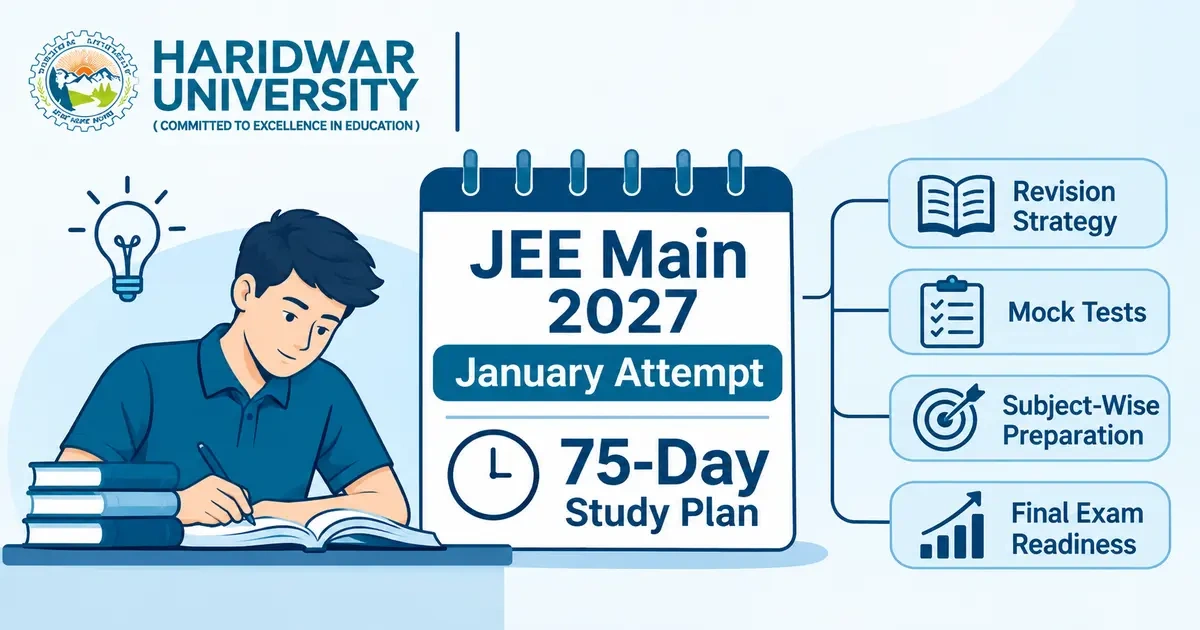
JEE Main 2027 January Attempt: 75-Day Study Plan, Revision Strategy & Mock Tests
Dr. Ekta Jain
Associate Professor & HOD, Applied Science, Haridwar University
The January session of JEE Main 2027 is closer than it may appear. With the first examination window scheduled to commence on 20 January 2027, engineering aspirants have approximately 75 days to consolidate their preparation, execute structured revision, practice high-yield previous-year questions (PYQs), and build test temperament under timed computer-based test (CBT) conditions. A vague, long-term preparation approach will no longer suffice; the immediate priority is auditing completed topics, repairing vulnerable conceptual areas, and systematically eliminating negative-marking errors.
Rather than treating the remaining weeks as an unfocused sprint to complete as many textbooks as possible, treat this critical window as a disciplined sequence of measurable weekly targets. The National Testing Agency (NTA) has notified the official syllabus and examination windows on jeemain.nta.nic.in. Below is an actionable 75-day roadmap designed to optimize your percentile in the January attempt.
Table of Contents
- JEE Main 2027 January Session: Important Dates
- The 75-Day JEE Main 2027 Study Plan
- Subject-Wise Revision Strategy for Physics, Chemistry and Mathematics
- A Practical Daily Study Routine
- Mock Tests, Previous-Year Papers and Error Analysis
- How to Adjust the Plan to Your Preparation Level
- The Final Five Days Before the Examination
- Frequently Asked Questions (FAQs)
1. JEE Main 2027 January Session: Important Dates
The National Testing Agency has scheduled JEE Main 2027 Session 1 across six primary examination dates. Your specific test slot and shift will be finalized on your individual admit card:
| Milestone Event | Scheduled Date / Window |
|---|---|
| Session 1 Examination Dates | 20, 21, 22, 23, 24 and 28 January 2027 |
| Advance City Intimation Slip | 30 December 2026 |
| Admit Card Release (Published Schedule) | 13 January 2027 |
Always verify official notifications, application corrections, and admit card releases directly on the NTA JEE Main portal. Avoid building your timetable around assumptions regarding which specific day or shift you will receive.
2. The 75-Day JEE Main 2027 Study Plan
To maximize conceptual retention and test endurance, divide the remaining 75 days into four distinct, progressive phases:
| Phase | Timeline | Core Objective & Action Points |
|---|---|---|
| Phase 1 | 6 November – 26 November | Syllabus Audit & Concept Repair: Categorize chapters into Strong, Moderate, and Weak. Focus on closing high-weightage conceptual gaps and compiling a concise formula book. |
| Phase 2 | 27 November – 24 December | Mixed Practice & Timed Speed: Transition from isolated single-chapter questions to mixed problem sets, sectional timed tests, and weekly revision loops. |
| Phase 3 | 25 December – 14 January | Full-Length Mocks & Error Elimination: Simulate real CBT exam environments with full 3-hour tests, rigorous error logging, and question selection discipline. |
| Phase 4 | 15 January – 19 January | Final Revision & Calm Readiness: Light revision of short notes, reactions, and formula sheets; rest, mental conditioning, and admit-card verification. |
Phase Breakdown Details
- Phase 1 Execution: Audit your syllabus using the official NTA checklist. Never mark a topic "strong" simply because you watched a lecture video; you must be able to solve standard numerical problems without peeking at solutions. Maintain an error journal from Day 1.
- Phase 2 Execution: Mixed chapter sets expose the common trap where students know a formula in isolation but struggle to recognize its application when mixed with other topics. Timed practice bridges this gap.
- Phase 3 Execution: Mock tests are only beneficial if they alter what you do next. If you lose marks on arithmetic slips, slow down and write clean steps; if you run out of time in Mathematics, adjust your initial section order.
- Phase 4 Execution: Do not open new reference books or attempt to cram whole chapters in the final 96 hours. Protect your sleep schedule and review high-yield summaries.
3. Subject-Wise Revision Strategy for Physics, Chemistry and Mathematics
Each of the three subjects tests cognitive skills differently. Applying a uniform study method across all three inevitably harms your aggregate score:
Physics: Conceptual Core & Numerical Application
Understand the underlying physical principle before memorizing its mathematical formula. When an answer is incorrect, categorize whether the error was conceptual misunderstanding, sign-convention failure, unit conversion error, or calculation slip. Prepare a 1-page formula sheet per chapter.
Chemistry: Tri-Partite Focus (Physical, Organic & Inorganic)
Physical Chemistry: Treat like physics with formula sheets and numerical drills. Organic Chemistry: Focus on reaction mechanisms, reagents, and named conversions systematically. Inorganic Chemistry: Rely strictly on NCERT textbooks and syllabus specifications for repeated, spaced review. Chemistry offers the highest marks-to-time ratio in the entire exam.
Mathematics: Rigorous Problem-Solving & Question Selection
Mathematics in recent JEE Main sessions has featured multi-step, calculation-heavy problems. Consistent pen-and-paper problem-solving is non-negotiable. Learn to recognize "time-trap" questions during the first scan and prioritize high-accuracy areas like Coordinate Geometry, Vectors, 3D, and Matrices.
For an in-depth foundation on long-range preparation strategies, explore our guide on JEE Main preparation strategy for engineering students.
4. A Practical Daily Study Routine
A sustainable schedule is far superior to an erratic 14-hour marathon that leads to burnout within a week. School students can integrate this around morning classes, while dropper students can expand the problem-solving blocks:
| Study Block | Recommended Focus Area |
|---|---|
| Morning Slot (Session 1) | Mathematics: High-focus analytical problem-solving and multi-step questions. |
| Midday Slot (Session 2) | Physics: Concept revision, formula derivations, and numerical application drills. |
| Afternoon Slot (Session 3) | Chemistry: NCERT textbook line-by-line review, reaction charts, and physical numericals. |
| Evening Slot (Session 4) | Timed sectional practice (30–45 min test) and comprehensive error analysis. |
| Night Review (30 mins) | Formula notebook review, updating mistake journal, and setting targets for tomorrow. |
5. Mock Tests, Previous-Year Papers and Error Analysis
Attempting 20 mock tests without analysing mistakes produces virtually zero improvement in final percentiles. Every test must be subjected to a diagnostic autopsy:
- 1. Conceptual Errors: You did not know the underlying physical rule or theorem. Action: Revisit textbook theory and resolve 5 related foundational questions.
- 2. Calculation Slips: You understood the physics/maths perfectly but made an algebraic or arithmetic slip. Action: Solve problems with clear, unhurried steps on scrap paper.
- 3. Question-Selection Mistakes: You spent 9 minutes wrestling with a tough question only to leave 3 easy questions unread at the end. Action: Implement a two-pass strategy: scan and clear all straightforward questions first.
- 4. Time-Management Failures: Spending disproportionate time on one section, leaving no time for chemistry. Action: Enforce strict time caps (e.g., Chemistry in 40–45 mins, Physics in 50–55 mins, Maths in 65–75 mins).
6. How to Adjust the Plan to Your Preparation Level
Students enter the 75-day window with vastly different starting preparation levels. Tailor your strategy accordingly:
- If Your Syllabus Is Partially Incomplete (< 60%): Do not panic and try to finish all 80 chapters superficially. Prioritize high-scoring, accessible chapters across all three subjects. Solidifying 70% of the syllabus with 90% accuracy yields a higher percentile than knowing 100% of the syllabus with 40% accuracy.
- If Most of Your Syllabus Is Complete (60% – 85%): Focus on mixed problem practice and bridging moderate chapters into strong ones. Stop re-reading notes passively; solve timed PYQs.
- If Your Syllabus Is 90%+ Complete: Shift immediately into full CBT mock test mode. Your main battle is optimizing question triage, minimizing silly mistakes, and locking in 99+ percentile performance.
Students looking forward to cutting-edge undergraduate engineering degrees can explore Haridwar University's diverse B.Tech specialisations through the Roorkee College of Engineering programmes directory.
7. The Final Five Days Before the Examination
The final 120 hours before your exam shift from expansion to mental preservation:
- No New Concepts: Under no circumstances should you start an unread chapter.
- Review Formulae & Mistakes: Re-read your personal error notebook and reaction flashcards.
- Light Practice Only: Solve a few confidence-building problems to maintain touch, but do not exhaust yourself with taxing mock exams.
- Align Circadian Rhythms: Wake up at the exact time you will need to on exam morning (typically 6:30 AM) and maintain active alertness during your allotted shift time (9:00 AM – 12:00 PM or 3:00 PM – 6:00 PM).
- Document Verification: Keep your NTA admit card, self-declaration form, original valid government photo ID, passport-size photographs, and transparent ballpoint pens ready in advance.
8. Frequently Asked Questions (FAQs)
1. Is 75 days enough to prepare for JEE Main 2027 Session 1?
Yes, particularly for revision, consolidation, and accuracy improvement. If your syllabus is partially incomplete, 75 days is ample time to secure high-weightage topics and dramatically raise your percentile if you avoid spreading your efforts too thinly.
2. How many hours should I study daily for JEE Main?
Focus on task completion rather than raw clock hours. An uninterrupted, high-intensity 7 to 9 hours of targeted problem-solving and error analysis produces vastly superior results compared to 13 hours of passive video watching.
3. When should I start taking full-length JEE Main mock tests?
Begin taking 1 full-length mock per week starting late November. Escalate to 2 mocks per week in mid-December, and 2–3 mocks per week during the first two weeks of January, always leaving an entire day between tests for diagnostic review.
4. Should I focus on Class 11 or Class 12 topics first?
Prioritize based on your syllabus audit. Generally, Class 12 topics align closely with ongoing board preparations and tend to feel fresher. Consolidate Class 12 chapters first, while concurrently revising fundamental Class 11 bridge topics (Mechanics, Chemical Bonding, Calculus).
5. Are previous-year questions (PYQs) enough for JEE Main?
PYQs from 2021 to 2026 are the single most authentic preparation resource available. They mirror the exact depth, phrasing, and trap patterns designed by NTA examiners. Master past 5-year PYQs thoroughly.
6. Should I take a mock test every single day in January?
No. Daily testing without dedicated error correction leads to mental fatigue and repeats identical errors. Take a mock test every second or third day, dedicating the intervening days to rectifying identified weaknesses.
7. What should I do if my mock test scores plateau?
Stop focusing purely on total marks. Analyze your accuracy percentage and question selection. Converting unattempted easy questions and eliminating negative marks from random guessing immediately boosts your score by 20–30 marks.
Accelerate Your Engineering Career at Haridwar University
Explore cutting-edge, industry-certified B.Tech programmes in AI & Machine Learning, Data Science, Cyber Security, CSE, and core engineering with world-class faculty and exceptional placement track records. Admissions are open for 2026-27.