

How to Apply for Exam Revaluation: Process, Fees & Rules (2026)
Mr. Sumit Chauhan
Registrar, Haridwar University
A disappointing examination result can leave an undergraduate with an uncomfortable dilemma: was the answer script evaluated fairly and thoroughly? Perhaps an answer appears to have been left unassessed, individual marks fail to reflect the depth of answers written, or marks calculation across sections seems incorrect. Before accepting a problematic grade or assuming an error cannot be rectified, students should understand the formal administrative remedies available to them.
Learning how to apply for exam revaluation is only one component of the grievance redressal framework. Depending on your specific concern, you may need to request an answer script photocopy, apply for administrative scrutiny, or report a clerical totaling discrepancy. These post-examination services are not interchangeable, and procedure, documentation, and deadlines differ across institutions. This comprehensive guide outlines the differences between evaluation review services, what records you must maintain, and Haridwar University's official rules and deadlines.
Table of Contents
- What Exam Revaluation Means
- Rechecking, Re-totaling and Revaluation: Key Differences
- Why Students Request an Answer Script Photocopy
- How to Apply for Exam Revaluation Step by Step
- Documents and Fees Required for Revaluation
- What Happens to Marks After Revaluation
- Student Rights During the Revaluation Process
- Haridwar University Revaluation Rules and Deadlines
- What to Do If Your Application Is Delayed or Rejected
- Frequently Asked Questions (FAQs)
1. What Exam Revaluation Means
Exam revaluation is a formal institutional mechanism through which an end-semester written answer script is evaluated afresh under statutory examination guidelines. It offers registered students a structured channel to seek independent reassessment when they have verifiable grounds to believe their written work was marked inaccurately or incompletely.
The exact implementation varies between universities. At many institutions, revaluation involves sending the answer booklet to a completely independent, neutral examiner who marks the paper without seeing the original examiner's score. Other universities provide scrutiny or re-totaling services, or restrict reassessment strictly to theory papers while exempting practical examinations, internal sessionals, or capstone vivas. To understand how internal and external components combine into your total score, explore our guide on continuous assessment vs final examinations.
The University Grants Commission's Compendium of UGC Regulations states that university evaluation frameworks must maintain transparency and that students should be afforded access to a photocopy of their evaluated answer script when sought through the prescribed institutional process.
2. Rechecking, Re-totaling and Revaluation: Key Differences
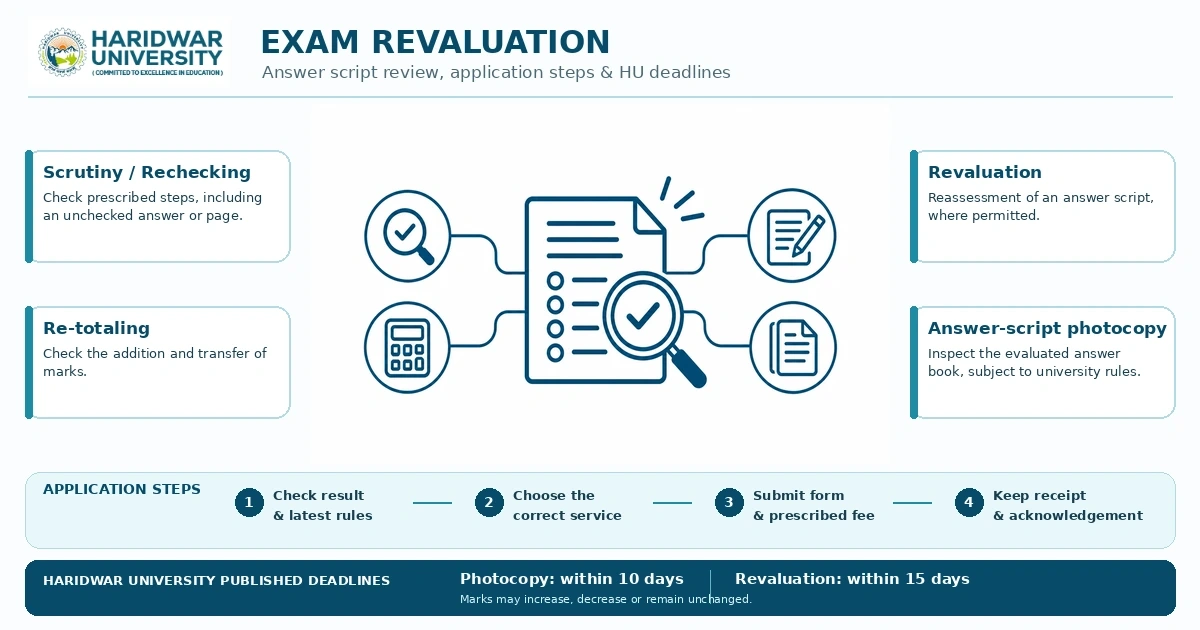
Students and parents frequently use the terms rechecking, re-totaling, and revaluation interchangeably. However, university examination secretariats treat them as distinct legal and procedural services:
| Service Type | What It Specifically Involves | Typical Use Case |
|---|---|---|
| Rechecking / Scrutiny | Administrative verification ensuring every single page and written question has been evaluated, and no section was inadvertently missed. | When an examiner failed to check an entire supplementary sheet or sub-question. |
| Re-totaling | Mathematical recalculation of all individual marks awarded and verifying the addition on the cover sheet and tabulator record. | When internal arithmetic errors or mark-entry clerical discrepancies occurred. |
| Revaluation / Re-evaluation | Complete reassessment of the student's written answers by a new independent subject examiner against the approved marking scheme. | When the student believes answers were evaluated with undue harshness or inaccurate criteria. |
| Photocopy of Answer Script | Issuing a certified physical or digital scanned copy of the evaluated answer booklet for student and mentor inspection. | Required prior to filing revaluation to verify whether grounds for reassessment exist. |
For example, if individual question marks inside your booklet sum up to 54, but your published online grade card records 44, you do not need revaluation—you need an immediate clerical re-totaling correction. Choosing the wrong service delays your resolution.
3. Why Students Request an Answer Script Photocopy
Obtaining a certified photocopy or scanned PDF of your evaluated answer script is the smartest first step before committing funds to full revaluation. Inspecting your script provides concrete clarity:
- Verifying Unchecked Answers: You can quickly see whether any response, supplementary page, or numerical sub-part was inadvertently skipped during grading.
- Reviewing Mark-Entry Arithmetic: You can verify whether the examiner accurately transposed scores from inner pages to the cover tabulation grid.
- Faculty Consultation: You can share the script with your department mentor or subject professor to obtain an objective, realistic assessment of whether filing for revaluation will likely improve your grade.
However, receiving a photocopy does not automatically trigger revaluation. If errors exist, a separate revaluation or correction petition must be submitted within the university's prescribed window.
4. How to Apply for Exam Revaluation Step by Step
To ensure your revaluation request is processed smoothly without administrative rejection, follow this methodical nine-step workflow:
- Check Official Result & Date: Download your official semester grade card from the university portal and record the exact result declaration date.
- Review the Examination Notice: Read the official notification from the Controller of Examinations specifying deadlines, eligible paper codes, and fee structures.
- Select the Appropriate Service: Decide whether your issue requires clerical re-totaling, answer script photocopy, or full academic revaluation.
- Download the Prescribed Form: Procure the official form from the university portal or examination office. Avoid outdated third-party templates.
- Complete Subject Details Meticulously: Double-check your University Enrolment Number, Roll Number, Semester, Paper Code, and Subject Title.
- Attach Required Enclosures: Attach a clean copy of your published marks card, student ID proof, and evaluated answer script copy (if required).
- Pay Prescribed Fees: Complete payment through authorized university challan, online gateway, or account transfer, and preserve transaction receipts.
- Submit Within Deadline: Submit the completed application dossier through the designated physical counter or university ERP portal before the cut-off.
- Secure Formal Acknowledgement: Obtain a stamped submission slip or digital tracking reference number for all future follow-up.
5. Documents and Fees Required for Revaluation
When compiling your revaluation dossier, ensure you have the necessary documentation organized:
- Duly filled official Revaluation / Scrutiny Application Form.
- Copy of the provisional semester grade sheet downloaded from the examination portal.
- University Student Identity Card or photo ID copy.
- Exact paper code and course title as listed on your examination hall ticket.
- Official fee payment receipt or bank challan counterfoil.
- Certified photocopy of evaluated answer script (where mandated by university rules).
Revaluation fees are levied per individual subject paper rather than per semester. Because fees vary across undergraduate disciplines and statutory councils, always check the current rates published on your institution's official portal rather than relying on informal student forums.
6. What Happens to Marks After Revaluation
Filing for revaluation carries distinct academic outcomes that students must weigh objectively. A reassessment does not guarantee an increased score; your final outcome can result in one of three possibilities:
- Marks Increase: If the secondary independent examiner awards higher marks based on the rubric, your score is revised upward, and an updated grade card is issued.
- Marks Remain Unchanged: If the reassessment score aligns with the original grade within institutional threshold tolerances, the initial result stands.
- Marks Decrease: If the second examiner marks the responses more stringently, your final score can be reduced, where university regulations make the re-evaluated score binding.
It is vital to distinguish revaluation from a supplementary or backlog examination. Revaluation reassesses an existing paper, whereas a supplementary exam offers an opportunity to sit for a fresh paper. For guidance on structuring an academic recovery plan, read our post on clearing backlogs and planning semester recovery.
7. Student Rights During the Revaluation Process
Higher education institutions are bound by established standards of administrative transparency. As an enrolled undergraduate, your rights include:
- Access to Published Regulations: Universities must publish clear, accessible examination guidelines, schedules, and fee schedules well in advance.
- Right to Answer Script Inspection: As recognised by UGC compendiums, students are entitled to obtain a copy of their evaluated answer scripts through prescribed procedural channels.
- Independent Secondary Assessment: Revaluation must be executed by an independent examiner who had no involvement in the initial evaluation of your paper.
- Formal Grievance Redressal: If an administrative delay or clerical error persists, students have the right to escalate the issue through the university's Examination Grievance Committee.
8. Haridwar University Revaluation Rules and Deadlines
Haridwar University governs all examination assessments through transparent academic ordinances published on its official web portals:
| Service Request | Haridwar University Published Deadline |
|---|---|
| Photocopy of Answer Script | Within 10 calendar days of result declaration |
| Formal Revaluation Application | Within 15 calendar days of result declaration |
Key HU institutional provisions from the official Examination Secretariat:
- Separate Applications: As specified on the official Examination Forms page, students must submit an individual revaluation form for each subject paper.
- Independent Review: Under HU’s Examination Rules and Regulations, re-evaluation is assigned to an external independent subject examiner, and revised marks are treated as final.
- Result Verification: Check provisional marks and revaluation status directly through the Examination Results Portal.
- Grading & Conversion: Learn how marks map into semester performance on the Examination Grading System page.
9. What to Do If Your Application Is Delayed or Rejected
If your revaluation status remains un-updated or you receive an unexpected rejection notice, take these structured steps:
- Verify Submission Timestamps: Confirm that your application was submitted before the 15-day cut-off and that payment was successfully credited.
- Contact the Examination Helpdesk: Visit or write to the Controller of Examinations with your application reference number, receipt, and roll number.
- Request Written Grounds: If rejected, politely request the specific administrative reason (e.g., incorrect paper code, incomplete fee, or missed deadline).
- Escalate Through Grievance Redressal: If an administrative oversight occurred, file a formal petition through your department Dean or the Student Welfare Office.
Always maintain a calm, documented approach with clear supporting evidence. Clear records ensure rapid resolution.
10. Frequently Asked Questions (FAQs)
1. Can I apply for revaluation without requesting a photocopy first?
At Haridwar University, you can submit a revaluation application directly within 15 days of result declaration. However, requesting an answer script photocopy (within 10 days) is strongly recommended so you and your mentor can verify whether viable grounds for reassessment exist.
2. Can marks decrease after exam revaluation?
Yes. Under university examination ordinances, revaluation results replace original scores. If an independent secondary examiner awards lower marks based on the syllabus rubric, your score can decrease. Apply only when confident of under-marking.
3. How long does the revaluation process take?
Processing timelines depend on examiner availability and session schedules, typically concluding within 3 to 5 weeks. Revised scores are updated on the university portal and reflected in modified grade cards.
4. Can I apply for revaluation in multiple subjects?
Yes. Students may apply for revaluation in multiple theory subjects. Note that Haridwar University requires a separate revaluation form and fee receipt for each subject paper.
5. Can practical, project, or internal assessment marks be re-evaluated?
No. Revaluation applies strictly to written end-semester theory papers. Practical lab examinations, vivas, continuous internal assessment, and project evaluations cannot be sent for revaluation once declared.
6. What should I do if I miss the 15-day revaluation deadline?
Deadlines are strictly observed to preserve examination schedules. If you miss the cut-off due to extraordinary circumstances (e.g., medical hospitalisation), approach the Examination Department immediately with formal proof to inquire whether special condonation applies.
7. Does applying for revaluation guarantee that I will pass?
No. Revaluation is an objective reassessment of your existing written booklet, not an automatic grant of grace marks. Improvement depends entirely on the academic merit of your answers.
Achieve Academic Excellence with Haridwar University
Haridwar University provides student-focused academic policies, transparent evaluation standards, and world-class faculty mentoring across technology, computing, business, and health sciences. Admissions are open for the 2026-27 session.