

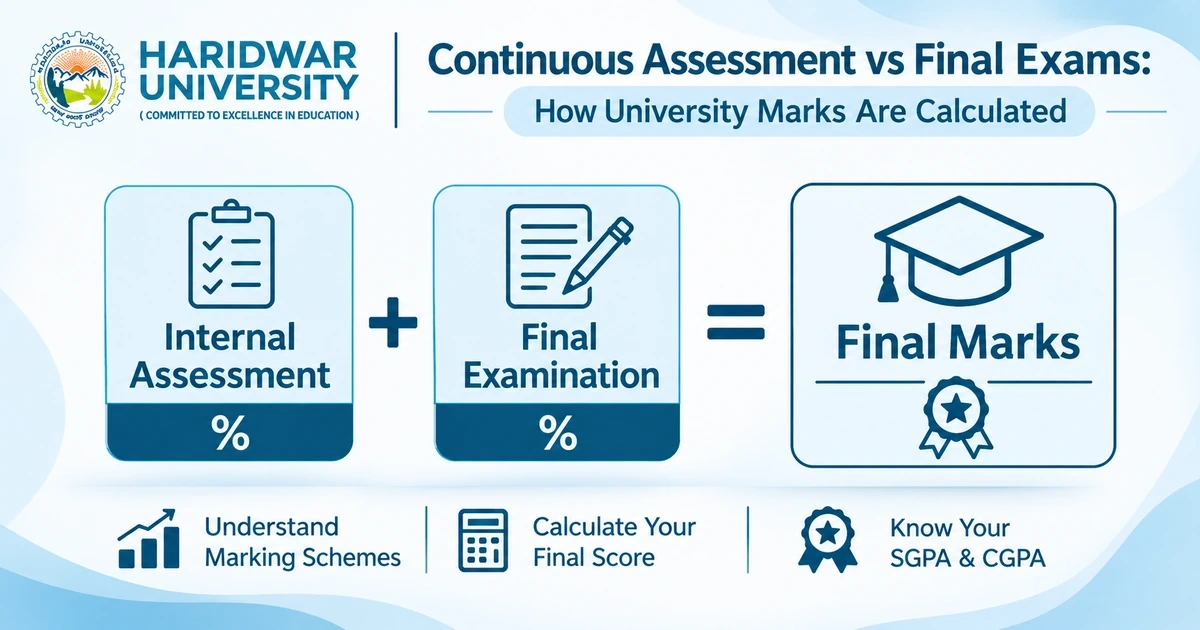
Continuous Assessment vs Final Exams: How University Marks Are Calculated
Mr. Sumit Chauhan
Registrar, Haridwar University
A student can perform consistently in class, submit assignments diligently on time, and still feel uncertain about the marks shown on a semester grade card. The reason is often straightforward: a university result combines marks from multiple assessment components across the term, and the final end-semester examination is only one part of that calculation.
Continuous assessment vs final exams is therefore not just a comparison between two testing methods. It is about understanding how modern universities evaluate academic performance across a 15-week semester, assign weightage to continuous coursework versus term-end exams, and mathematically calculate course results, SGPA, and cumulative CGPA. Because there is no single monolithic marks distribution followed across all Indian higher education institutions, knowing your specific university's evaluation structure is essential to protecting your grade card.
Table of Contents
- What Is Continuous Assessment in Higher Education?
- What Is Internal Assessment and What Does It Include?
- Continuous Assessment vs Final Examinations
- How Universities Calculate Final Marks
- Understanding 20:80, 30:70, 40:60 and 50:50 Marking Schemes
- Worked Examples of Internal and Final Examination Marks
- How Marks Are Converted into Grades, SGPA and CGPA
- What Happens If You Score Poorly in Internal Assessment?
- How to Check Your University's Assessment and Examination Rules
- Frequently Asked Questions (FAQs)
1. What Is Continuous Assessment in Higher Education?
Continuous assessment is the systematic evaluation of a student's learning progress at multiple milestones throughout an academic course, rather than relying exclusively on a single high-stakes written test at the end of the semester. It provides faculty members with regular opportunities to evaluate comprehension, diagnostic progress, and practical problem-solving capabilities while instruction is actively ongoing.
Depending on the programme and curriculum structure, continuous assessment typically encompasses:
- In-Class Assessments: Mid-term exams, sessional tests, unit tests, and surprise quizzes.
- Written Deliverables: Case study analyses, research term papers, homework problem sets, and tutorial submissions.
- Verbal Demonstrations: Individual seminars, slide presentations, group debates, and viva voce examinations.
- Laboratory Practical Work: Experimental logs, laboratory notebooks, practical setups, and code execution reviews.
- Applied Projects: Capstone design models, mini-projects, industrial case studies, and field survey reports.
- Class Attendance and Engagement: Formative classroom participation where officially mandated by the university scheme.
The core objective is holistic evaluation. While a timed written exam assesses theoretical recall under pressure, continuous coursework tests application, persistence, and continuous mastery. The University Grants Commission (UGC) document on Evaluation Reforms in Higher Educational Institutions emphasises combining formative continuous evaluation with summative term-end tests to create authentic, outcome-based student assessment.
2. What Is Internal Assessment and What Does It Include?
Internal assessment refers to the formal evaluation conducted directly by the university department, teaching faculty, and institutional examiners during the active instructional term. Continuous internal evaluation is the structured mechanism through which internal assessment is operationalised.
The components of internal assessment are tailored to the discipline:
- In theory courses (e.g., Mathematics, Business Law, Humanities), internal assessment relies heavily on sessional written examinations, research assignments, and classroom quizzes.
- In laboratory-based courses (e.g., Computer Science, Mechanical Engineering, Chemistry, Nursing, Pharmacy), it centres on experiment design, weekly lab records, practical bench performance, and internal practical vivas.
- In management and professional courses, it often incorporates live industry projects, business simulations, presentations, and team case analyses.
A critical distinction students must understand is the difference between an assessment activity and its weighted contribution. An instructor may administer three quizzes and two assignments, but that does not mean each task contributes equally to your semester grade. The university's approved course scheme defines the exact proportion of each component.
3. Continuous Assessment vs Final Examinations
Both assessment models serve complementary roles in capturing an authentic profile of academic achievement, but they evaluate learning through distinct mechanisms:
| Comparative Dimension | Continuous Assessment | Final Examination |
|---|---|---|
| Evaluation Timing | Conducted iteratively throughout the semester (Weeks 1 to 14). | Conducted during a formal exam window at term conclusion. |
| Primary Purpose | Formative: tracks ongoing progress, identifies weaknesses, and guides learning. | Summative: measures comprehensive mastery across the entire course syllabus. |
| Standard Formats | Quizzes, mid-terms, case studies, coding labs, presentations, and projects. | Standardised formal written papers, end-term practical vivas, or capstones. |
| Grading Basis | Distributed across multiple varied evaluation tasks over time. | Determined primarily by performance within a single 2-to-3 hour testing session. |
| Student Preparation | Requires steady weekly discipline, timely submissions, and active attendance. | Demands intensive end-term revision, syllabus synthesisation, and timed writing speed. |
Neither assessment format operates in isolation. While end-semester exams test comprehensive recall and synthesis, internal continuous marks protect consistent learners from being penalised if illness or anxiety strikes during exam week.
4. How Universities Calculate Final Marks
In most Indian universities, a course is assigned a total maximum score (commonly 100 marks per subject, though modular courses may carry 50, 75, or 150 marks). The final course score is the mathematical sum of the scaled internal assessment marks and the end-semester examination marks.
Consider a standard university subject carrying 100 total marks with a 30:70 marks distribution:
- Maximum Internal Assessment Score: 30 Marks
- Maximum End-Semester Exam Score: 70 Marks
If a student secures 25 out of 30 in their internal sessional evaluation, and scores 51 out of 70 in the university theory examination, their combined total is:
The arithmetic itself is straightforward, but the underlying weightage distribution determines which component carries the greatest risk. For a detailed guide on interpreting semester transcripts, read our tutorial on how to read university mark sheets and grade cards correctly.
5. Understanding 20:80, 30:70, 40:60 and 50:50 Marking Schemes
Assessment ratios vary substantially across disciplines, regulatory councils (such as AICTE, PCI, BCI, and INC), and study modes. Common structures across higher education include:
| Ratio (Internal : Final) | Marks Breakdown (out of 100) | Typical Application Context |
|---|---|---|
| 20 : 80 | Internal: 20 | Final Exam: 80 | Traditional university theory courses and state universities. |
| 30 : 70 | Internal: 30 | Final Exam: 70 | Standard engineering, computing, and UGC Open & Distance Learning formats. |
| 40 : 60 | Internal: 40 | Final Exam: 60 | NEP-aligned undergraduate models and continuous evaluation universities. |
| 50 : 50 | Internal: 50 | Final Exam: 50 | Laboratory practicals, workshops, capstone projects, and clinical rotations. |
At Haridwar University, the official Academic Calendar schedules two defined Continuous Internal Evaluation (CIE) milestones during each semester—structured at approximately 40% and 80% syllabus progression points—prior to the final end-semester theory examinations. Note that these syllabus progress percentages reflect evaluation timing rather than the marks weightage formula; always consult your department syllabus document for exact weightages.
6. Worked Examples of Internal and Final Examination Marks
To see how internal versus final exam performance impacts your outcome, examine two contrasting student scenarios in a course using a 40:60 marking scheme (Total = 100 marks):
Case A: Consistent Coursework with Solid Final Performance
Student A attends classes, completes projects on schedule, and scores well on unit tests:
- Internal Assessment (out of 40): 35 marks (87.5%)
- Final Examination (out of 60): 42 marks (70.0%)
- Combined Score: 35 + 42 = 77 / 100 → Grade A (Grade Point: 8.0)
Case B: Weak Coursework Seeking Last-Minute Recovery
Student B misses sessional tests, skips assignments, and attempts to cram entirely during final exam week:
- Internal Assessment (out of 40): 16 marks (40.0%)
- Final Examination (out of 60): 42 marks (70.0%)
- Combined Score: 16 + 42 = 58 / 100 → Grade B (Grade Point: 6.0)
Notice the stark difference: despite earning identical marks (42/60) in the final exam, Student A graduates with an 8.0 Grade Point, while Student B receives a 6.0 Grade Point purely because of poor continuous assessment. Over a 4-year degree, this gap compounds into a major difference in final CGPA, placement eligibility, and scholarship qualification.
7. How Marks Are Converted into Grades, SGPA and CGPA
Modern universities do not simply report percentage marks; they translate combined numerical marks into letter grades, grade points, and semester performance averages:
- Grade & Grade Point: Each numerical score corresponds to a letter grade (e.g., O, A+, A, B+, B, C, P, F) and a corresponding Grade Point on a 10-point scale.
- Credit Points: The Grade Point earned in a course is multiplied by the course's academic credits:
Credit Points = Grade Point × Course Credits
- SGPA (Semester Grade Point Average): Calculated by dividing total credit points earned in a semester by total registered credits:
SGPA = Σ(Credit Points) ÷ Σ(Course Credits)
- CGPA (Cumulative Grade Point Average): The cumulative weighted average across all completed semesters.
As documented on Haridwar University's official Examination Grading System page, consider a student who earns 139 credit points across 20 registered semester credits: their semester performance is calculated as 139 ÷ 20 = 6.95 SGPA.
Haridwar University CGPA Conversion Formula: The official university formula to convert cumulative grade point average into percentage is:
Percentage (%) = (CGPA − 0.5) × 10
8. What Happens If You Score Poorly in Internal Assessment?
Suffering a poor internal score creates serious academic complications that a strong final exam score cannot always fix. Depending on your university's statutory examination ordinances:
- Separate Passing Minimums: Many technical and health science programmes (such as Pharmacy and Nursing) mandate achieving a separate minimum passing percentage (e.g., 40% or 50%) in internal evaluation as an absolute prerequisite to appear in the end-semester exam.
- Irreversible Internal Marks: Unlike end-semester exams, which can often be re-attempted during supplementary or backlog examination sessions, internal assessment marks are typically locked once the semester concludes. If you earn weak internal marks, they may permanently pull down your score even if you re-appear for the final paper.
- Detention Due to Attendance Shortage: Poor internal performance often correlates with low attendance. Haridwar University requires 75% average attendance across all courses to qualify for end-semester admit cards.
If you face backlogs or need to plan an academic recovery, consult our guide on how to recover from backlogs after failing a semester.
9. How to Check Your University's Assessment and Examination Rules
Never rely on word-of-mouth advice, peer group rumours, or unverified social media calculators. Always review published academic regulations directly through your institution's official channels.
At Haridwar University, students and prospective applicants can access authoritative academic documents directly:
- Review overall academic policies on the UG/PG Programme Guidelines page.
- Inspect formal rules governing examinations and unfair means on the Examination Rules and Regulations portal.
- Track sessional test windows, practical exams, and semester theory dates via the official Academic Calendar.
- Explore degree curricula and course credit distributions through the Academic Programmes Directory.
- Access semester results, grade cards, and official notifications at the Examination Results Portal.
10. Frequently Asked Questions (FAQs)
1. Is continuous assessment the same as internal assessment?
The terms are closely related but not identical. Continuous assessment describes when and how evaluation happens—iteratively throughout the learning term. Internal assessment refers to who conducts it—the institution's own faculty. Continuous internal assessment (CIA) is the operational combination of both.
2. Does every university follow a 30:70 marking scheme?
No. While 30:70 is common across engineering and distance-learning frameworks, regular universities utilise 20:80, 40:60, or 50:50 splits depending on programme regulations, laboratory components, and autonomous university frameworks.
3. Do assignments count towards final semester marks?
Yes. Where an approved course syllabus designates written assignments or case studies as components of continuous evaluation, their scores contribute directly to the total internal assessment score on your final grade sheet.
4. Can a high final exam score compensate for low internal marks?
Not always. While strong final marks help if only an aggregate passing score is required, programmes with mandatory component-wise cut-offs (e.g., minimum 40% in internal evaluation) will record a backlog if the internal minimum is not met.
5. Are practical and theory subjects assessed in the same way?
No. Practical subjects usually assign higher weightage to continuous bench performance, lab records, and vivas (often 50:50 or 60:40), whereas theory courses typically allocate greater weightage to written term-end papers.
6. What is the difference between SGPA and CGPA?
SGPA represents the credit-weighted academic score for a single semester, whereas CGPA reflects the cumulative credit-weighted average across all completed semesters of your degree programme.
7. Where can students check their internal and final examination marks?
Students can check verified marks through their official student ERP portal, semester grade cards, and official university examination notices. If discrepancies appear, raise them with your department before semester grades are finalised.
Excel in Your Degree with Structured Academic Mentorship
At Haridwar University, transparent continuous evaluation, state-of-the-art laboratory facilities, and dedicated faculty guidance help students build top academic standing and career-ready profiles. Admissions are actively open for the 2026-27 session.