

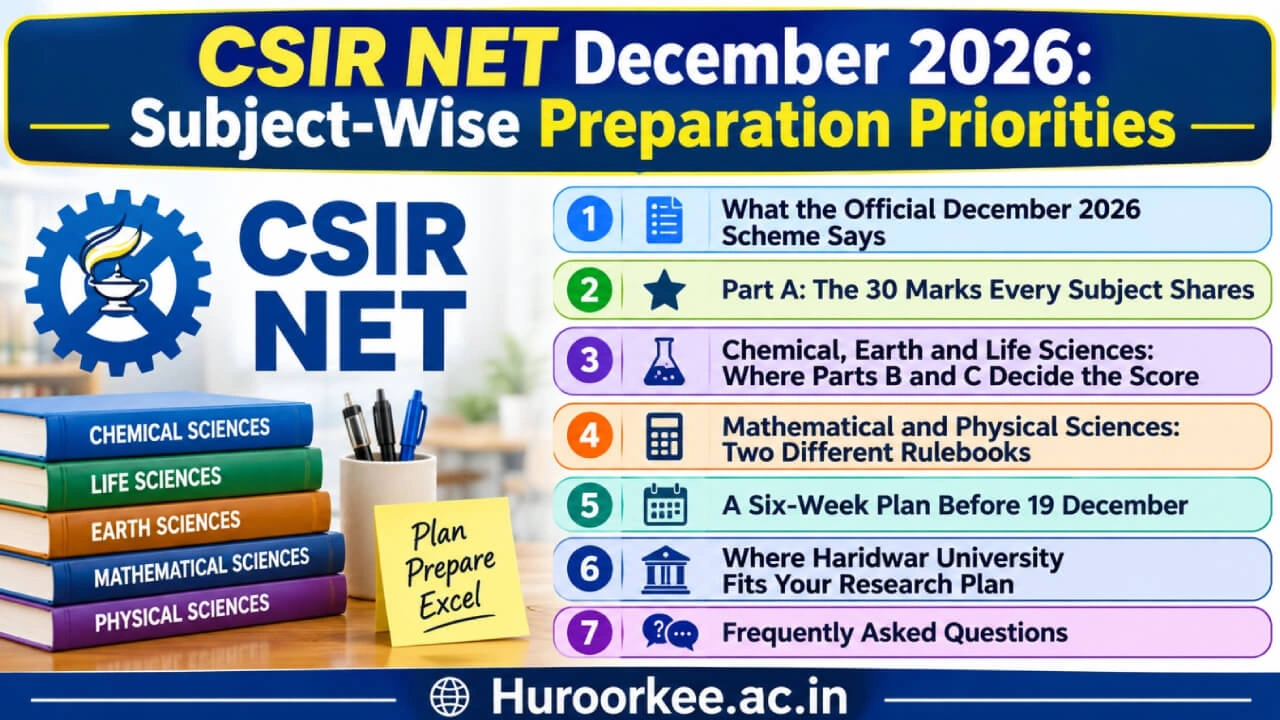
CSIR NET December 2026: Subject-Wise Preparation Priorities
Mr. Prajwal Chaudhary
Training & Placement Manager, Haridwar University
Subject-Wise CSIR Net Preparation starts with an uncomfortable fact: the five papers share a name and a 200-mark total, and almost nothing else. Each discipline carries its own question count, sectional attempt limit, and penalty rule, so a revision blueprint copied from a peer in another science stream can quietly cost you critical marks. The Joint CSIR-UGC NET examination is scheduled for 19, 22, and 27 December 2026, exactly six weeks from early November. Every structural parameter below originates directly from the official NTA Information Bulletin and Haridwar University academic notifications.
| Item | Detail (December 2026 Cycle) |
|---|---|
| Exam Dates | 19, 22 and 27 December 2026 (Tentative) |
| Testing Shifts | Morning: 9:00 am to 12:00 noon | Afternoon: 3:00 pm to 6:00 pm |
| Mode and Length | Computer-Based Test (CBT), 180 minutes duration, 200 maximum marks |
| Late-Fee Application Window | 6 to 9 November 2026 (Late fee: ₹500) |
| Application Correction Window | 10 to 12 November 2026 |
Table of Contents
- What the Official December 2026 Scheme Says
- Part A: The 30 Marks Every Subject Shares
- Chemical, Earth and Life Sciences: Where Parts B and C Decide the Score
- Mathematical and Physical Sciences: Two Different Rulebooks
- A Six-Week Plan Before 19 December
- Where Haridwar University Fits Your Research Plan
- Frequently Asked Questions (FAQs)
1. What the Official December 2026 Scheme Says
Each CSIR NET question paper comprises three distinct sections: Part A evaluates general research aptitude common across all disciplines. Part B assesses basic subject curriculum through conventional objective multiple-choice questions. Part C introduces higher-order scientific application problems where candidates analyze experimental data, multi-step chemical reactions, or theoretical models. Test papers are presented bilingually in Hindi and English, with the English rendering remaining authoritative if ambiguities arise.
The single most crucial operational trap is the strict sectional attempt limit. NTA provides significantly more questions than candidates are permitted to answer. Crucially, if a candidate answers more than the permitted quota within any section, only the first attempted questions up to the limit are graded; all subsequent responses are discarded automatically.
| Subject & Code | Questions Given (Part A / B / C) | Attempt Limit (Part A / B / C) | Total to Attempt |
|---|---|---|---|
| Chemical Sciences (701) | 20 / 40 / 60 | 15 / 35 / 25 | 75 |
| Earth, Atmospheric, Ocean & Planetary Sciences (702) | 20 / 50 / 80 | 15 / 35 / 25 | 75 |
| Life Sciences and Bio-Technology (LS-BT 703) | 20 / 50 / 75 | 15 / 35 / 25 | 75 |
| Mathematical Sciences (704) | 20 / 40 / 60 | 15 / 25 / 20 | 60 |
| Physical Sciences (705) | 20 / 25 / 30 | 15 / 20 / 20 | 55 |
Confirm testing shifts and reporting instructions directly on the official CSIR NET Portal. Do not finalize travel or lodging bookings until your official e-Admit Card verifies your designated exam date and shift.
2. Part A: The 30 Marks Every Subject Shares
Part A carries 30 aggregate marks across all five disciplines: candidates choose 15 questions from 20 available items. Each correct response yields +2 marks, with a deduction of 0.5 marks (−25%) for wrong answers. The official NTA syllabus focuses on general science aptitude, graphical reasoning, quantitative comparisons, numerical sequences, and spatial puzzles. Because Part A requires no advanced subject specialization, it represents the most cost-effective score booster during the final six weeks.
No Sectional Cut-Offs
NTA mandates no individual sectional cut-offs for Part A, B, or C. All earned scores accumulate into a composite total against a minimum overall qualifying benchmark of 33% for General, EWS, and OBC candidates, and 25% for SC, ST, and PwD candidates. While a mediocre Part A is not disqualifying, securing 20 to 24 marks from this section provides a crucial cushion for JRF cut-offs.
3. Chemical, Earth and Life Sciences: Where Parts B and C Decide the Score
Chemical Sciences, Earth Sciences, and Life Sciences share an identical structural skeleton: 15 questions in Part A (30 marks), 35 in Part B (70 marks), and 25 in Part C (100 marks). However, the internal question choice and penalty structures require sharply contrasting strategies:
Chemical Sciences (Code 701)
In Chemical Sciences, Part B presents 40 questions to attempt 35—meaning candidates can bypass only five questions. This demands comprehensive syllabus coverage across Organic, Inorganic, and Physical Chemistry. In contrast, Part C provides 60 questions to choose 25 (4 marks each with −1 negative marking), granting freedom to pick specialized high-accuracy units such as Spectroscopy, Organometallics, or Quantum Chemistry.
Earth, Atmospheric, Ocean and Planetary Sciences (Code 702)
Earth Sciences provides the most generous question pool in Part C (80 questions to choose 25), but couples it with the most aggressive penalty: −1.32 marks (33% negative marking) per incorrect answer. Mathematically, attempting an uncertain Part C question pays off only if your confidence exceeds 75%. Exercise disciplined restraint; avoid speculative guessing.
Life Sciences and Bio-Technology (LS-BT Code 703)
The updated December 2026 bulletin presents the consolidated Life Sciences and Bio-Technology (LS-BT) examination paper. This single test covers candidates across Biochemistry, Microbiology, Biotechnology, Genetics, Plant Biology, and Zoology, with DBT fellowships integrated into the merit roster. Part B offers 50 questions (attempt 35) and Part C offers 75 questions (attempt 25), with a uniform 25% negative marking penalty. Candidates preparing from pre-merger notes must cross-verify topic headings against the official syllabus published on CSIR HRDG.
4. Mathematical and Physical Sciences: Two Different Rulebooks
Mathematical Sciences (Code 704): Zero Negative Marking in Part C
Mathematical Sciences operates under a unique scoring mechanism. Part B contains 40 questions (attempt 25, 3 marks each, −0.75 deduction). Part C provides 60 advanced questions where candidates attempt 20 items worth 4.75 marks each with zero negative marking. Consequently, candidates must attempt all 20 permitted Part C questions. However, Part C questions feature one or more correct options; full credit is awarded only when every correct alternative is selected. Partial credit is not granted.
Physical Sciences (Code 705): High Weightage per Problem
Physical Sciences presents the most compact test: 75 total questions to attempt 55. Part B contains 25 questions (attempt 20 at 3.5 marks each, −0.875 deduction), and Part C has 30 problems (attempt 20 at 5.0 marks each, −1.25 deduction). Dividing 180 test minutes across 55 questions grants approximately 3.3 minutes per question (compared to 2.4 minutes in other disciplines). Spend this additional time writing out multi-step derivations in Classical Mechanics, Electrodynamics, and Quantum Physics.
For an in-depth exploration of fellowship stipends and lecture eligibility criteria, consult our companion analysis on CSIR NET JRF vs Lectureship: Career & Fellowship Guide.
5. A Six-Week Plan Before 19 December
From early November to the 19 December commencement window spans an intensive six-week sprint divided into three structured phases:
| Preparation Phase | Timeline | Primary Academic Focus |
|---|---|---|
| Weeks 1 & 2: Audit & Core Review | 7 to 20 November | Audit syllabus into strong, shaky, and unread units; resolve result-awaited university attestation forms; finalize reference cheat-sheets. |
| Weeks 3 & 4: Part C Problem Solving | 21 Nov to 4 December | Transition from theory to timed problem sets. Practice selecting Part C questions within 60 seconds; execute all manual numerical calculations without calculators. |
| Weeks 5 & 6: Full Rehearsals & Logistics | 5 to 18 December | Undertake 3 full-length 180-minute CBT simulations with discipline-specific attempt limits; print e-Admit Cards; verify exam centre transit routes. |
Haridwar University students requiring documentation endorsements or mental wellness support during crunch periods can connect with the Student Welfare Service, which operates dedicated care desks in every academic block with a pledged 24-hour turnaround.
6. Where Haridwar University Fits Your Research Plan
Roorkee serves as one of three official Uttarakhand test cities on NTA's exam centre roster, alongside Dehradun and Haldwani. For scholars seeking doctoral pathways post-NET qualification, Haridwar University's recognized research infrastructure provides advanced laboratory facilities and dedicated faculty mentorship.
Per Haridwar University's published Fees and Scholarships Schedule 2026-27, research and postgraduate programmes are structured with complete transparency:
| Programme | Year 1 Fee | Year 2 Fee | Year 3 Fee |
|---|---|---|---|
| Ph.D. (All Approved Disciplines) | ₹1,00,000 | ₹90,000 | ₹90,000 |
| M.Pharm (Pharmaceutics) | ₹1,57,000 | ₹1,40,000 | — |
| M.Sc. Agriculture (Agronomy) | ₹77,000 | ₹60,000 | — |
Scholars with 4-year undergraduate degrees can review eligibility in our guide to Ph.D. admission after a 4-year bachelor's degree, or compare eligibility requirements against the humanities syllabus in our UGC NET Examination Guide.
7. Frequently Asked Questions (FAQs)
When is CSIR NET December 2026 scheduled?
The Joint CSIR-UGC NET December 2026 examination is scheduled for 19, 22, and 27 December 2026 in morning (9:00 am – 12:00 noon) and afternoon (3:00 pm – 6:00 pm) shifts. Exact discipline shift schedules appear on candidate admit cards.
Can candidates still apply for the December 2026 examination?
The late-fee registration window is open from 6 to 9 November 2026 with a supplementary ₹500 late charge, followed by the application correction facility from 10 to 12 November 2026.
How many total questions can an applicant attempt?
Candidates may attempt up to 75 questions in Chemical Sciences, Earth Sciences, and Life Sciences & Bio-Technology; up to 60 in Mathematical Sciences; and up to 55 in Physical Sciences. Answers exceeding these sectional quotas are automatically disregarded.
How does negative marking operate across CSIR NET papers?
Most sections deduct 25% of the question value for incorrect answers. However, Earth Sciences Part C deducts 33% (−1.32 marks), while Mathematical Sciences Part C carries zero negative marking.
Is there a sectional cut-off for Part A, Part B, or Part C?
No. NTA sets no individual sectional cut-offs. Cumulative marks across all three parts determine rank, subject to a minimum aggregate qualifying benchmark of 33% for General/EWS/OBC and 25% for SC/ST/PwD candidates.
What major change was introduced for Life Sciences?
Life Sciences is now designated as Life Sciences and Bio-Technology (LS-BT Code 703), combining classical biological sciences with applied biotechnology and incorporating Department of Biotechnology (DBT) fellowship awards.
What documents and stationery are permitted inside the examination hall?
Candidates must bring a printed e-Admit Card with completed self-declaration, two passport-sized photographs matching their application profile, original valid government photo ID, and a simple transparent ballpoint pen. Calculators and digital watches are strictly barred.
What is the current monthly CSIR Junior Research Fellowship (JRF) stipend?
Qualifying JRF scholars receive ₹37,000 per month for the initial two years plus an annual contingency grant of ₹20,000. Upon successful research evaluation, the fellowship converts to Senior Research Fellow (SRF) at ₹42,000 per month for subsequent years.
Can graduates with 4-year bachelor's degrees appear for CSIR NET?
Yes. Candidates completing a four-year bachelor's degree with at least 75% aggregate marks (5% relaxation for reserved categories) are eligible for JRF awards and Ph.D. admission, though not for direct Assistant Professor appointments.
Pursue Advanced Scientific & Doctoral Research
Join Haridwar University's distinguished doctoral programmes in Science, Technology, and Applied Disciplines. Access modern laboratory infrastructure, research grants, and direct academic mentorship in Uttarakhand.