

PhD After a 4-Year Degree in India: 75% Eligibility & Direct Admission Without a Master's (2026)
Mr. Sumit Chauhan
Registrar, Haridwar University
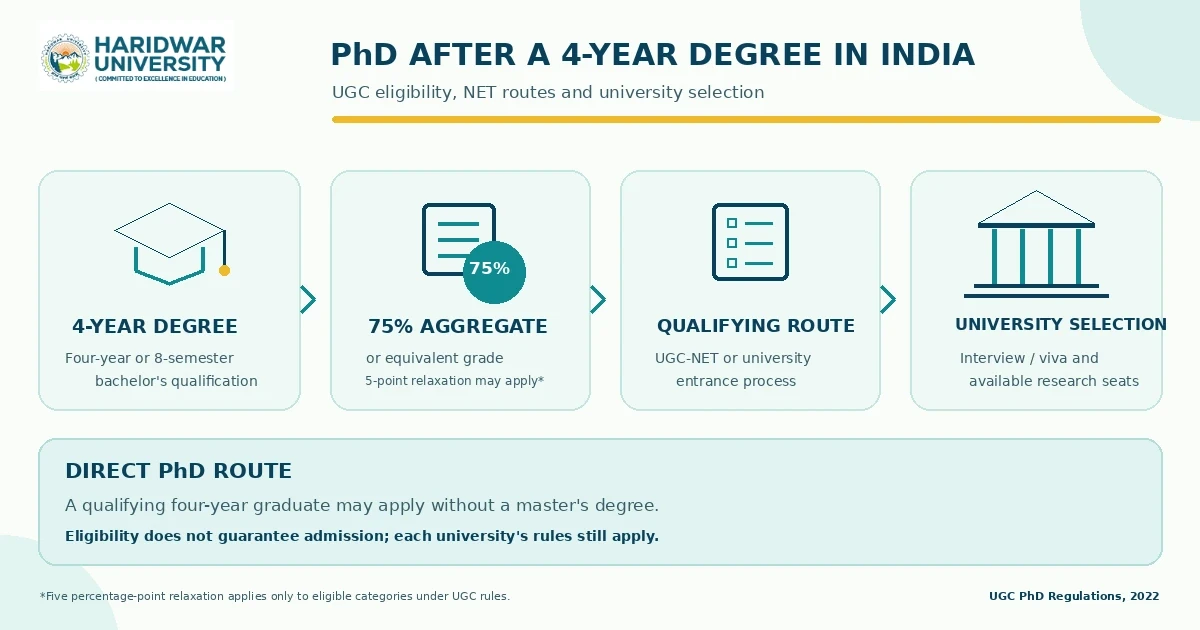
A four-year bachelor’s degree can now provide a direct route to doctoral research in India without requiring students to earn a master’s degree first. Under the University Grants Commission (UGC) Minimum Standards and Procedure for Award of Ph.D. Degree Regulations, 2022, graduates of an approved four-year or eight-semester undergraduate programme may seek PhD admission with at least 75% aggregate marks or an equivalent grade, subject to statutory relaxation policies.
This regulatory change fundamentally transforms the higher education trajectory in India. Students who traditionally spent five to six years completing a three-year bachelor’s degree and a two-year master’s degree before sitting for doctoral entrance exams can now accelerate their research careers. However, a four-year bachelor’s degree constitutes an eligibility pathway, not an automatic admission guarantee. Institutional research vacancies, national entrance tests (such as UGC-NET and CSIR-NET), research proposal evaluations, and departmental viva voce examinations remain decisive.
Table of Contents
- Understanding the Direct PhD Route After a Four-Year Degree
- UGC Eligibility Criteria for Direct PhD Admission
- Honours vs Honours with Research: Does the Degree Title Matter?
- UGC-NET Eligibility and the Three Qualification Categories
- Direct PhD Admission Process After Graduation
- Four-Year Bachelor’s Route vs Master’s Route
- Who Should Consider Skipping a Master’s Degree?
- Frequently Asked Questions
- Making an Informed Decision About Direct PhD Entry
1. Understanding the Direct PhD Route After a Four-Year Degree
The statutory foundation for direct doctoral entry is established in the UGC (Minimum Standards and Procedure for Award of Ph.D. Degree) Regulations, 2022, formally notified on 7 November 2022. The regulations officially recognise a 4-year/8-semester bachelor’s qualification as a qualifying credential for PhD registration.
This creates two distinct educational models in India:
- The 3-Year Degree Track: Graduates completing a traditional three-year bachelor’s degree (such as standard B.A., B.Sc., or B.Com.) must first complete a 2-year master’s degree (or 4-semester post-graduate degree) with at least 55% marks to qualify for PhD admissions.
- The 4-Year Degree Track: Graduates completing an approved four-year undergraduate programme (such as B.Tech., B.E., or 4-year NEP-aligned B.Sc./BCA/BBA Honours) with 75% marks can bypass the master’s degree and apply directly for doctoral research.
To see how multiple exit qualifications, credit tiers, and certificate awards operate across different stages of undergraduate study, explore our comprehensive guide on 4-year UG degree exit options and credit requirements.
2. UGC Eligibility Criteria for Direct PhD Admission
The primary benchmark for direct doctoral entry without a master’s degree is an aggregate score of 75% marks or an equivalent grade (such as a 7.5 CGPA on a 10-point scale) in your four-year undergraduate programme.
The UGC regulations provide a statutory 5 percentage-point relaxation (lowering the qualifying threshold from 75% to 70%) for candidates belonging to SC, ST, OBC (non-creamy layer), differently-abled, and Economically Weaker Section (EWS) categories.
| Qualifying Academic Route | Standard UGC Eligibility Benchmark | Relaxed Category Minimum |
|---|---|---|
| 4-Year / 8-Semester Bachelor’s Degree (Direct Route) | 75% aggregate marks or equivalent grade | 70% aggregate marks |
| 2-Year Master’s Degree (following a 3-year bachelor’s) | 55% aggregate marks or equivalent grade | 50% aggregate marks |
| 1-Year Master’s Degree (following a 4-year bachelor’s) | 55% aggregate marks or equivalent grade | 50% aggregate marks |
These figures establish the statutory minimum threshold. Individual admitting universities retain academic autonomy to prescribe departmental entrance cut-offs, research proposal criteria, and subject-matter viva voce evaluations.
3. Honours vs Honours with Research: Does the Degree Title Matter?
A common point of confusion is whether only students with an “Honours with Research” designation on their degree certificate qualify for direct PhD entry. The UGC PhD Regulations, 2022 explicitly specify a four-year or eight-semester bachelor’s degree with 75% marks; they do not mandate that the exact words “with Research” appear in the degree title.
Consequently, graduates of professional four-year degrees (such as B.Tech., B.E., or standard 4-year Honours) meeting the 75% threshold are legally eligible. For a detailed breakdown of how research-intensive fourth-year coursework is structured, see our guide on Honours with Research degree curricula.
Building Real Research Preparedness
While the title itself is not the sole statutory determinant, candidates who have written an undergraduate dissertation, completed research methodology training, and presented papers at conferences stand a far higher chance of clearing competitive doctoral interviews.
At Haridwar University, undergraduate students engage in faculty-guided research through the university’s Shodh Club and participate actively in institutional research and innovation initiatives. Undergraduates looking to publish their first scholarly manuscript can also follow our practical walkthrough on how to write a research paper as an undergraduate.
4. UGC-NET Eligibility and the Three Qualification Categories
National testing rules under the National Testing Agency (NTA) formally permit final-semester students and graduates of four-year bachelor’s degrees to sit for the UGC-NET examination, provided they have at least 75% marks (or 70% for relaxed categories).
| UGC-NET Category | Conferred Eligibility | Applicability to 4-Year Graduates |
|---|---|---|
| Category 1 | Junior Research Fellowship (JRF), Assistant Professor eligibility & PhD admission | Eligible for JRF & PhD only |
| Category 2 | Assistant Professor eligibility & PhD admission | Eligible for PhD admission only |
| Category 3 | PhD admission only | Eligible for PhD admission only |
Critical Teaching Eligibility Restriction
NTA and UGC guidelines stipulate that candidates qualifying UGC-NET on the basis of a four-year bachelor’s degree are not eligible for appointment as Assistant Professor immediately through this route. They can receive the prestigious JRF monthly stipend and secure PhD admission, but direct assistant professorship recruitment requires a master’s degree or completed doctorate under UGC career regulations.
Under the current NTA admission framework, Category 2 and Category 3 NET scores can replace university-level written entrance tests, with final admission calculated as 70% weightage for NET score and 30% weightage for interview/viva voce. NET scores for PhD admission remain valid for one year.
5. Direct PhD Admission Process After Graduation
Navigating direct PhD admission requires systematic planning across six practical stages:
1. Verify Academic Transcript & Aggregate Score
Verify that your 8-semester transcript confirms at least 75% aggregate marks (or 70% for reserved categories). Keep certified marksheets and provisional degree certificates ready.
2. Choose Your Research Discipline & Topic
UGC guidelines permit four-year bachelor’s graduates to appear in the NET subject in which they want to pursue a PhD, regardless of their undergraduate major. Confirm that the target university offers doctoral research in that specialization.
3. Check Departmental Vacancies & Research Guides
Under UGC rules, doctoral scholars can only be registered under approved faculty guides (Professors, Associate Professors, or Assistant Professors with required publications). Inspect available supervisor slots before applying.
4. Entrance Examination or Exemption Path
Apply through national qualifying scores (UGC-NET / CSIR-NET / GATE) or the university’s independent entrance test (such as Haridwar University’s HURET).
5. Formulate a Strong Research Proposal
Draft a comprehensive research statement (5 to 10 pages) defining the research problem, literature review, proposed scientific methodology, expected contributions, and required laboratory apparatus.
6. Defend Your Work at the Departmental Interview
Appear before the Research Advisory Committee (RAC). Selection evaluates research aptitude, fundamental disciplinary mastery, and the viability of the proposed investigation.
To review intake specializations, eligibility, and entrance guidelines at Haridwar University, explore our official doctorate programmes portal and the dedicated about doctoral program overview.
Advance Your Research Ambitions at Haridwar University
Explore high-impact doctoral fellowships, state-of-the-art laboratories, and expert research mentorship across engineering, pharmacy, and science.
Explore Doctoral Programmes & Guidelines →6. Four-Year Bachelor’s Route vs Master’s Route
While skipping a master’s degree saves up to two years, each pathway offers distinct academic advantages:
| Decision Parameter | Direct 4-Year Bachelor’s Route | Traditional Master’s Route |
|---|---|---|
| Prerequisite Degree | 4-year / 8-semester bachelor’s degree | 3-year bachelor’s + 2-year master’s (or 4+1 master’s) |
| Academic Threshold | 75% aggregate marks (70% for relaxed categories) | 55% in master’s (50% for relaxed categories) |
| Total Study Time Saved | Saves 1 to 2 years of formal university study | Standard timeline; no accelerated time saving |
| Research Immersion Depth | Relies on undergraduate capstones and projects | Deepens subject literature review and master’s thesis |
| Assistant Professor Eligibility | Not immediately eligible via NET | Directly eligible upon qualifying NET |
7. Who Should Consider Skipping a Master’s Degree?
Direct doctoral admission is tailored for self-directed students with clear research focus. You should strongly consider this pathway if you meet these five conditions:
- Consistent Academic Excellence: You have comfortably maintained ≥75% marks across your four-year undergraduate coursework.
- Clear Research Problem: You have identified a precise, viable research problem rather than a vague thematic interest.
- Prior Dissertation Experience: You have completed a major project, laboratory investigation, or supervised senior thesis.
- Targeted Faculty Alignment: You have identified university research labs and prospective research supervisors actively publishing in your topic.
- Preparedness for Independent Study: You possess the intellectual stamina and writing discipline required for a multi-year doctoral thesis.
If you feel you need deeper coursework exposure, laboratory training, or time to clarify your scholarly direction, enrolling in a focused master’s programme is a prudent step that strengthens your profile.
8. Frequently Asked Questions
1. Can I do a direct PhD after four-year graduation in India?
Yes. Under the UGC PhD Regulations, 2022, candidates who graduate from a 4-year or 8-semester bachelor’s degree with at least 75% aggregate marks (or equivalent grade) can apply directly for PhD admission.
2. Can I do a PhD without a master’s degree in India?
Yes, provided you complete a four-year bachelor’s degree with the required marks. Graduates of a three-year undergraduate degree cannot apply directly; they must complete a master’s degree first.
3. Is UGC-NET compulsory for direct PhD admission?
Not in every case. While many institutions accept UGC-NET / CSIR-NET / GATE scores, UGC regulations permit higher education institutions to admit scholars through their own PhD entrance tests (such as Haridwar University’s HURET) and interview procedures.
4. Can I apply for a direct PhD with 70% marks?
Yes, if you belong to SC, ST, OBC (non-creamy layer), differently-abled, or EWS categories. The UGC provides a 5 percentage-point relaxation, lowering the threshold from 75% to 70% for eligible categories.
5. Can I get a JRF after a four-year bachelor’s degree?
Yes. Candidates qualifying under Category 1 of UGC-NET with a 4-year bachelor’s degree are fully eligible for the award of Junior Research Fellowship (JRF) and government monthly research stipends.
6. Can I become an Assistant Professor after qualifying NET through a four-year degree?
No. The NTA and UGC specify that candidates qualifying NET on the basis of a four-year bachelor’s degree are eligible for JRF and PhD admission only, but not for direct appointment as Assistant Professor. Direct teaching recruitment requires a master’s degree or completed PhD.
7. Can I pursue a PhD in a subject different from my bachelor’s discipline?
Yes. NTA guidelines permit four-year bachelor’s graduates to appear in the UGC-NET subject of their intended research area, irrespective of their undergraduate degree major, subject to admitting university departmental guidelines.
9. Making an Informed Decision About Direct PhD Entry
The direct four-year undergraduate PhD route broadens opportunities for ambitious Indian scholars. It offers a streamlined progression into cutting-edge research, eliminates redundant coursework, and accelerates entry into scientific research institutes and corporate innovation laboratories.
My fundamental advice as Registrar is to verify three critical parameters before submitting your application: ensure your four-year degree transcript verifies ≥75% marks, confirm that the receiving department has active research guides in your field, and assess whether you are prepared for independent research. Accelerated entry is an invaluable advantage when backed by authentic scholarly dedication.
Accelerate Your Research Career at Haridwar University
Explore UGC-recognized doctoral programmes, modern research laboratories, faculty mentorship, and transparent admission pathways tailored for future scientific and academic leaders.