

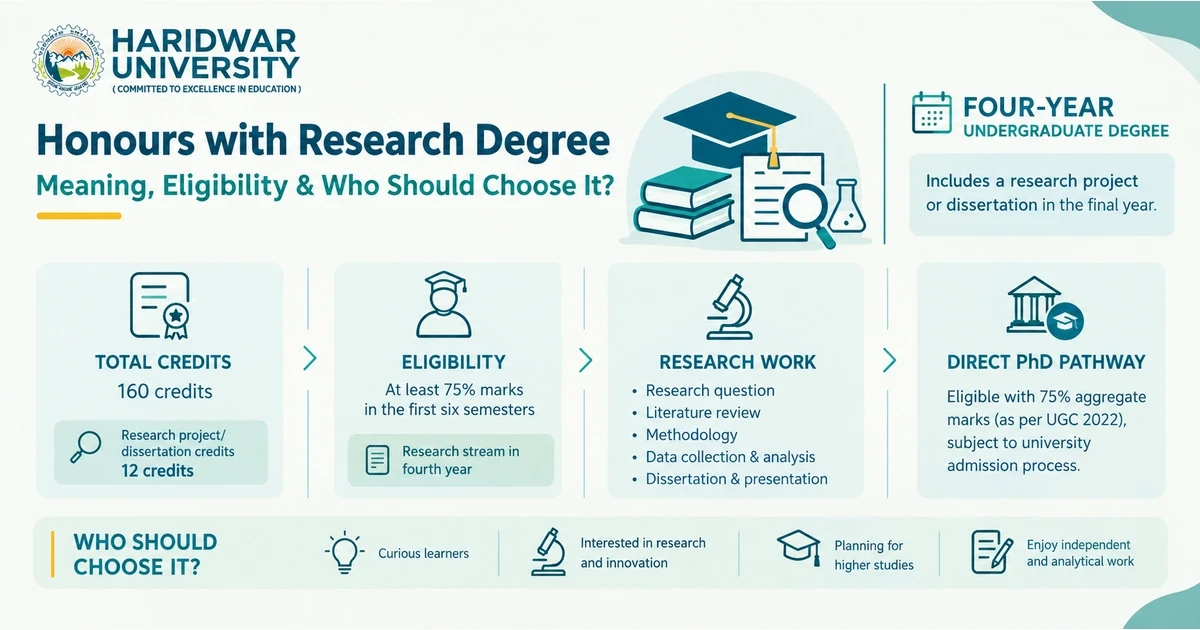
A four-year undergraduate degree can offer far more than an extra year of conventional classroom lectures. Under the University Grants Commission (UGC) Curriculum and Credit Framework for Undergraduate Programmes (CCFUP), high-performing students who meet prescribed academic criteria can choose a dedicated fourth-year research track, graduating with an Honours with Research degree.
The distinction is profound: rather than enrolling in standard elective coursework, research-track students undertake an original, faculty-mentored dissertation or experimental project in their major subject. But is this pathway right for every undergraduate? Research demands intellectual curiosity, patience, empirical rigor, and comfort with navigating open-ended scientific inquiries. This guide explains how the qualification functions, the credit requirements, eligibility criteria, direct PhD admission avenues, and what students must evaluate before selecting a university.
Table of Contents
- Understanding the Honours with Research Degree
- Honours vs Honours with Research: What Sets Them Apart
- Eligibility and the Fourth-Year Research Pathway
- What Students Actually Do During the Research Year
- Direct PhD Eligibility After a Four-Year Degree
- Who Should Choose the Research Route
- Choosing a University for Honours with Research
- Frequently Asked Questions (FAQs)
- Making the Fourth Year Count
1. Understanding the Honours with Research Degree
An Honours with Research degree is a 4-year, 8-semester undergraduate qualification that integrates a substantial faculty-supervised dissertation or experimental research project into the final year.
Under the UGC CCFUP architecture aligned with the National Education Policy (NEP 2020), students earn a minimum of 160 total credits to complete a four-year bachelor's degree. In the Honours with Research track, exactly 12 credits in the seventh and eighth semesters are dedicated to the research dissertation. Students who opt out of research complete equivalent advanced disciplinary courses instead.
This structure moves undergraduates beyond rote memorization, teaching them to formulate scholarly questions, review peer-reviewed scientific literature, design sound methodologies, and defend experimental findings before academic panels.
2. Honours vs Honours with Research: What Sets Them Apart
Both pathways follow an identical 4-year duration and require 160 credits. The crucial distinction lies in the academic curriculum of the fourth year:
| Comparison Dimension | 4-Year Regular Honours | 4-Year Honours with Research |
|---|---|---|
| Programme Duration | 4 Years (8 Semesters) | 4 Years (8 Semesters) |
| Core Academic Focus | Advanced disciplinary coursework and professional electives | Advanced disciplinary theory plus empirical research dissertation |
| Year 4 Deliverable | Standard classroom lectures, seminars, and written examinations | Supervised research dissertation, project defense, or publication |
| 12 Final-Year Credits | Earned through 3 to 4 prescribed lecture/practical courses | Earned directly from the 12-credit research dissertation |
| Best Suited For | Students targeting immediate corporate industry placement | Students aiming for direct PhD admission, R&D roles, or academic careers |
Neither option is inherently superior. A student wanting to enter commercial software development may choose regular Honours to maximize exposure to elective frameworks. Conversely, a student pursuing advanced artificial intelligence, computational drug discovery, or doctoral studies will benefit immensely from a published dissertation.
3. Eligibility and the Fourth-Year Research Pathway
Entry into the Honours with Research track is selective and earned through sustained academic excellence during the first three years:
UGC Academic Thresholds
- Cumulative Grade Threshold: Under UGC guidelines, students must secure a minimum of 75% marks (or equivalent CGPA of ~7.5 and above) across the first six semesters to opt for the fourth-year research stream.
- Faculty Guidance: The department must assign a recognized permanent faculty member to supervise the student's project.
- Departmental Infrastructure: UGC mandates that departments offering undergraduate research must possess robust laboratory resources, scientific journal subscriptions, and at least two permanent faculty members recognized as PhD supervisors.
Students can also accumulate and transfer modular credits seamlessly across semesters through the Academic Bank of Credits (ABC) system.
4. What Students Actually Do During the Research Year
Undergraduate research goes far beyond summarizing internet articles. It follows the exact empirical methodologies practiced by doctoral researchers:
At Haridwar University, students engage through university-funded initiatives, innovation centers, and student research clubs highlighted in our overview of research and innovation at Haridwar University.
5. Direct PhD Eligibility After a Four-Year Degree
One of the most consequential reforms under the UGC (Minimum Standards and Procedures for Award of Ph.D. Degree) Regulations, 2022 is the creation of a direct doctoral route for graduates of four-year bachelor's degrees:
Direct PhD Admission Norms
Graduates with a 4-year / 8-semester bachelor's degree who achieve a minimum of 75% marks in aggregate (or equivalent grade point average) are legally eligible to apply directly for PhD programmes in Indian universities without first completing a 2-year Master’s degree.
Crucial Note: Direct PhD eligibility applies to all qualifying 4-year degree holders with 75% marks (including regular 4-year Honours). However, candidates possessing an Honours with Research degree hold a major competitive advantage during doctoral entrance interviews and research proposal assessments because they already have a completed thesis and proven methodology skills.
6. Who Should Choose the Research Route
Before enrolling in the research stream in the fourth year, assess your academic temperament:
Choose Honours with Research If:
- You plan to pursue a PhD or academic teaching and scientific career.
- You are targeting R&D divisions in technology, pharmaceuticals, agriculture, or engineering.
- You enjoy experimental laboratories, writing code models, statistical analysis, and writing papers.
- You want a head start for competitive scholarship grants and prestigious international master's fellowships.
Choose Regular Honours If:
- Your primary goal is entering commercial employment, sales, corporate management, or civil services.
- You prefer structured coursework, exams, and case studies over independent unstructured research.
- You wish to take broader multidisciplinary electives across computing, business, or humanities.
7. Choosing a University for Honours with Research
Not every institution that advertises a four-year degree has the research ecosystem to support an Honours with Research qualification. Before enrolling, ask the admissions office and department heads these key questions:
- Recognized PhD Supervisors: Does the department have permanent professors with proven doctoral supervision records?
- Laboratory Infrastructure: Are computing clusters, modern instrumentation, and certified software tools accessible to undergraduates?
- Library & Database Subscriptions: Does the university provide active access to IEEE Xplore, ScienceDirect, Springer, and Scopus?
- Formally Approved NEP Framework: Has the university's Academic Council formally implemented the UGC CCFUP regulations for your specific branch?
Prospective students can explore our approved degrees, multidisciplinary minors, and curriculum regulations across all academic programmes at Haridwar University.
8. Frequently Asked Questions (FAQs)
Is an Honours with Research degree always 4 years long?
Yes. Under the UGC undergraduate curriculum framework, the Honours with Research degree requires completing 8 full semesters (4 years) with a minimum of 160 total credits.
What are the eligibility requirements to enter the research stream?
Under UGC guidelines, students must secure at least 75% marks (or equivalent CGPA) across their first six semesters to be eligible for the fourth-year research project/dissertation track.
How many credits are dedicated to the research dissertation?
Exactly 12 credits of the 160-credit undergraduate degree are assigned specifically to the supervised research dissertation in the fourth year.
Is an Honours with Research degree better than a regular Honours degree?
Neither is inherently better. The research track is tailored for students aiming for PhDs, innovation labs, or academic careers. Regular Honours is ideal for students seeking advanced multi-course industry preparation.
Can I apply for a PhD directly after a 4-year Honours with Research degree?
Yes. Under the UGC PhD Regulations 2022, candidates who finish a 4-year bachelor's degree with at least 75% aggregate marks are eligible to apply directly for PhD admission without a master's degree.
Can students from 4-year regular Honours also apply for a direct PhD?
Yes. Any qualifying 4-year bachelor's degree holder with 75%+ marks satisfies the statutory direct PhD eligibility criterion under UGC rules. However, candidates with research project experience typically perform better during entrance evaluations.
Does every university offer Honours with Research in all courses?
No. Offering the research pathway requires formal Academic Council approval, specialized laboratories, and at least two permanent recognized PhD supervisors in the department. Always verify availability for your specific course.
9. Making the Fourth Year Count
The Honours with Research qualification is at its best when the investigation tackles a genuine problem, is guided by an engaged faculty mentor, and has access to modern research tools. It provides early immersion into how knowledge is discovered, validated, and shared with the global scholarly community.
Do not select the research track simply because it sounds prestigious. Select it if you are excited to spend a full academic year diving deep into an unsolved question. A well-executed research project turns your undergraduate journey into a transformative foundation for lifelong intellectual and career impact.
Elevate Your Academic Journey at Haridwar University
Explore NEP-aligned 4-year undergraduate degree tracks with advanced research mentorship, modern laboratories, and vibrant innovation centers.