

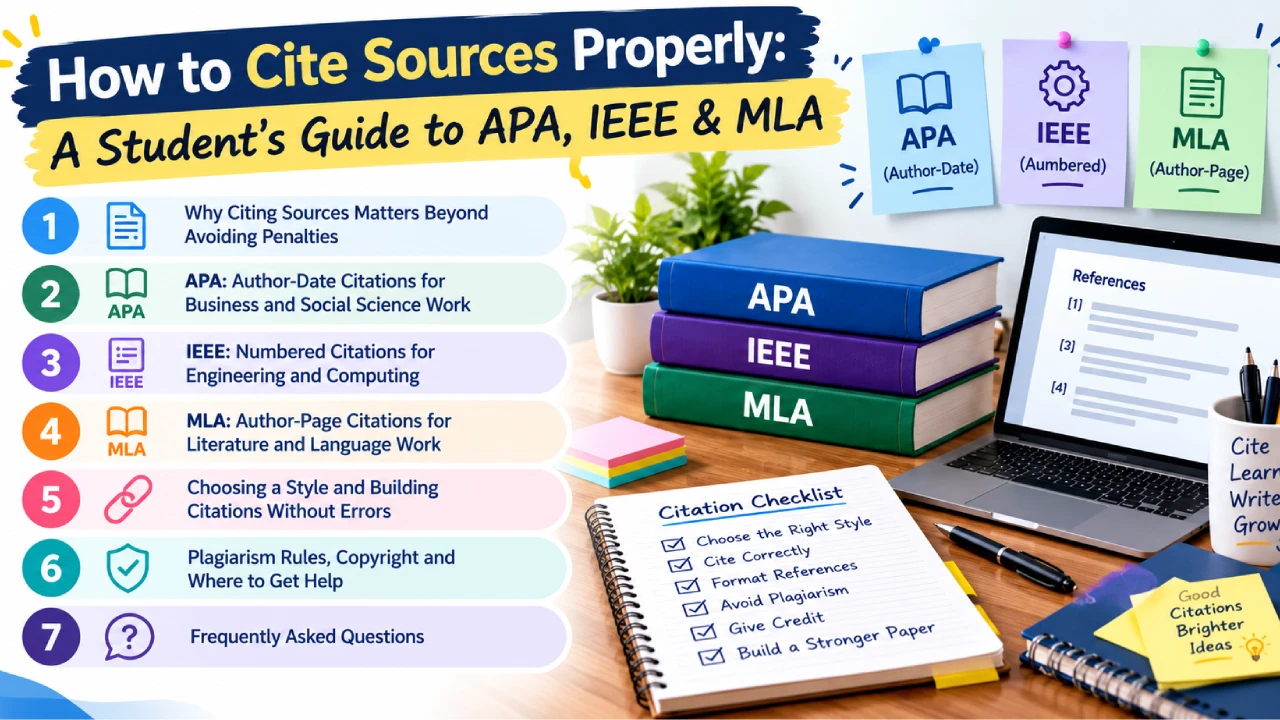
Most students never set out to plagiarise intentionally. The breakdown happens in small, hurried compromises: you copy an insightful paragraph while researching at midnight, forget to record the page number or DOI, promise yourself you will format the bibliography before submission, and then the final deadline strikes. Learning how to cite sources properly across APA, IEEE, and MLA is the ultimate antidote to submission panic, and the mechanics are far less intimidating than they appear.
Each academic referencing style is simply an agreed-upon recipe designed to tell your reader three things unambiguously: who originated the concept, when it was published, and where the evidence can be verified. Authored from the Training & Placement desk at Haridwar University (HU), this comprehensive guide walks through the conventions of the three referencing systems you will encounter across engineering, management, and humanities coursework, outlines statutory UGC academic integrity standards, and provides a foolproof pre-submission checklist.
Table of Contents
- Why Citing Sources Matters Beyond Avoiding Penalties
- APA: Author-Date Citations for Business and Social Science Work
- IEEE: Numbered Citations for Engineering and Computing
- MLA: Author-Page Citations for Literature and Language Work
- Choosing a Style and Building Citations Without Errors
- Plagiarism Rules, Copyright and Where to Get Help
- Frequently Asked Questions (FAQ)
1. Why Citing Sources Matters Beyond Avoiding Penalties
In undergraduate assignments, students often view citations defensively—as a chore performed solely to avoid plagiarism software warnings. In professional environments, industry research labs, and academic publishing, citation performs three far more critical, constructive functions:
- Intellectual Integrity & Attribution: It gives formal credit to the thinkers, researchers, and engineers whose foundational data, formulas, and arguments you build upon.
- Auditability & Traceability: It establishes a verifiable paper trail that allows evaluators, peers, or corporate supervisors to independently locate the primary source and inspect your evidence.
- Distinguishing Your Unique Contribution: Clear citation visibly demarcates between preexisting domain literature and your original findings, experimental data, or synthesis.
In corporate boardrooms and technical engineering reviews, a manager will invariably question: “Where did this benchmark metric or market projection originate?” Answering “somewhere on the internet” destroys professional credibility instantly. Proper citation habits built during college translate directly into executive rigor.
What Truly Counts as a Source?
Any external intellectual property requires citation. This encompasses:
- Printed books, peer-reviewed journal papers, and conference proceedings.
- Institutional whitepapers, industry standards, patents, and government gazettes.
- Public datasets, open-source GitHub code repositories, and algorithmic libraries.
- Faculty lecture slides, recorded webinars, and even your own previously submitted assignments (to avoid self-plagiarism).
Quoting vs. Paraphrasing vs. Summarising
Mastering the mechanical distinction between how you integrate source material ensures clean writing:
| Method | Rules & Mechanics | Required In-Text Pointer |
|---|---|---|
| Direct Quote | Reproduces identical wording verbatim. Must be enclosed within quotation marks (or formatted as an indented block if exceeding 40 words). | Author + Year + Exact Page Number (e.g., p. 45) |
| Paraphrase | Translates another author's specific concept entirely into your own authentic voice and original sentence syntax. Simply replacing three synonyms is patchwriting and constitutes plagiarism. | Author + Year (Page optional but recommended for long works) |
| Summary | Condenses the overarching findings or core thesis of a comprehensive chapter or study into a concise broad takeaway. | Author + Year / Numbered reference pointer |
Pro-tip for clean paraphrasing: Read the source, close the document completely, draft your understanding onto a blank screen from memory, and only then reopen the original to confirm technical accuracy without matching phrasing.
2. APA: Author-Date Citations for Business and Social Science Work
The American Psychological Association (APA 7th Edition) format is the prevailing standard across business administration (BBA/MBA), economics, psychology, social sciences, and education. It operates on an Author-Date citation structure designed to emphasize chronological currency.
APA In-Text Formatting Conventions
APA allows two narrative styles for citing within your body paragraphs:
- Parenthetical Citation: The author and year appear in parentheses at the sentence boundary:
(Grady et al., 2019). - Narrative Citation: The author’s surname is integrated directly into your sentence logic:
Grady et al. (2019) discovered that....
Author Rules: For works with one or two authors, cite both names every time (Sharma & Patel, 2024). For works with three or more authors, APA 7th edition immediately abbreviates from the first citation using the first author’s surname followed by “et al.” (Verma et al., 2023). For direct quotes, always append the page locator: (Jones, 2015, p. 4). Learn more on APA author-date principles.
The APA References List
Your reference list appears at the end of the document on a new page titled References. Entries are arranged in strict alphabetical order by the first author's surname. Key structural elements include:
- Author surnames with initials: e.g., Chaudhary, P., & Verma, H.
- Publication year enclosed in parentheses: e.g., (2026).
- Article titles written in sentence case (only capitalize the first word and proper nouns).
- Journal title and volume number italicized: e.g., Harvard Business Review, 102(4), 45–58.
- Mandatory Digital Object Identifier (DOI) formatted as an active HTTPS hyperlink:
https://doi.org/10.xxxx/xxxx.
Grady, J. S., Her, M., Moreno, G., Perez, C., & Yelinek, J. (2019). Emotions in storybooks: A comparison of storybooks that represent ethnic and racial groups in the United States. Psychology of Popular Media Culture, 8(3), 207–217. https://doi.org/10.1037/ppm0000185
Consult official APA journal article reference models for book chapters and web pages.
3. IEEE: Numbered Citations for Engineering and Computing
The Institute of Electrical and Electronics Engineers (IEEE) style is the universal standard across electrical, electronics, mechanical, computer science, and civil engineering disciplines. In B.Tech, M.Tech, and MCA project reports at Haridwar University, IEEE formatting is overwhelmingly the standard.
How IEEE Numbered Pointers Function
Unlike author-date systems, IEEE uses bracketed numbers corresponding strictly to the order of citation appearance:
-
Sequential Order: Sources are numbered in square brackets sequentially as they appear in the manuscript text:
[1],[2],[3]. - Re-using Identifiers: When you refer back to a previously cited document later in the paper, you re-use its original assigned number (e.g., “as demonstrated in [1]”).
-
Syntax Rules: Write “as discussed in [3]” rather than “in reference [3]”. When citing multiple works simultaneously, format each within independent brackets: write
[1], [4]or[1]–[5]for a continuous range.
The IEEE Reference List
The IEEE reference list is ordered numerically, not alphabetically. Each bracketed numeral matches its first appearance in the manuscript.
[1] A. B. Author and C. D. Coauthor, “Title of paper,” Abbrev. Journal Title, vol. x, no. x, pp. xxx–xxx, Month, Year, doi: 10.xxxx/xxxx.
Concrete Example:
[1] M. K. Sen and P. K. Singhal, “Design and analysis of dual-band microstrip antenna for 5G communications,” IEEE Trans. Antennas Propag., vol. 70, no. 5, pp. 3421–3429, May 2022, doi: 10.1109/TAP.2022.3145678.
Note that author initials precede the surname (e.g., A. B. Author). Up to six authors are listed before using “et al.” For authoritative guidelines on citing IEEE conference papers, technical standards, and patents, refer to the official IEEE Reference Guide.
HU Library access: Haridwar University Central Library subscribes to the IEEE Xplore digital library. Students can pull preformatted citation files directly from IEEE Xplore—always check the downloaded text against the official guide to correct automated formatting artifacts.
4. MLA: Author-Page Citations for Literature and Language Work
Established by the Modern Language Association (MLA 9th Edition, 2021), this format is the universal standard for literature, linguistics, media studies, humanities, and cultural analysis. It utilizes an Author-Page system designed to locate precise textual passages.
MLA In-Text Rules: No Commas, Precise Page Locators
In MLA, no comma or “p.” abbreviation separates the surname and the page number:
- Parenthetical:
(Smith 14). - Narrative: If the author is introduced in your prose (“According to Smith...”), only the page is placed in brackets:
(14). - Online/Unpaginated: For websites without pagination, cite the author’s surname alone:
(Sharma). - Three or More Authors: Cite the first author followed immediately by et al.:
(Bhardwaj et al. 88).
The Concept of “Containers” in Works Cited
MLA simplifies referencing by evaluating every source through nine core elements organized within “containers” (e.g., an article sits inside a journal container, an episode sits inside a television series container):
- Author.
- Title of source.
- Title of container,
- Other contributors,
- Version,
- Number,
- Publisher,
- Publication date,
- Location (Page numbers, DOI, or URL).
Goldman, Anne. “Questions of Transport: Reading Primo Levi Reading Dante.” The Georgia Review, vol. 64, no. 1, 2010, pp. 69–88. JSTOR, www.jstor.org/stable/41403188.
Step-by-step templates are outlined on the MLA Works Cited quick guide.
5. Choosing a Style and Building Citations Without Errors
To summarize the core visual differences across the three major styles:
- APA (Business / Social Sciences): Emphasizes Author + Year →
(Verma, 2024) - IEEE (Engineering / Tech / Computing): Emphasizes Numeric Placement →
[1] - MLA (Humanities / Literature / Languages): Emphasizes Author + Page →
(Verma 42)
Crucial department rule: Haridwar University’s academic regulations do not mandate a single blanket referencing style across the entire institution. Citation conventions are governed by individual faculties. The following table illustrates typical discipline pairings alongside transparent programme fee schedules from HU’s Fees & Scholarships page (verified for 2026-27):
| Academic Programme | Prevailing Style | Year 1 Total | Later Years |
|---|---|---|---|
| B.Tech. (Hons.) Computer Science & Engg. | IEEE (Numbered) | ₹1,32,000 | ₹1,15,000 / year |
| M.Tech. Computer Science & Engg. | IEEE (Numbered) | ₹78,000 | ₹70,000 in Year 2 |
| BBA (with AI Specialisation) | APA (Author-Date) | ₹82,000 | ₹65,000 / year |
| MBA (with AI Integration) | APA (Author-Date) | ₹1,77,000 | ₹1,60,000 in Year 2 |
The 5-Minute Pre-Submission Citation Audit
Before converting your project or thesis to PDF, execute this five-step quality check:
- One-to-One Match: Every in-text pointer must have an identical entry in the bibliography, and no phantom entry should sit in the references without an in-text citation.
- Zero Style Mixing: Never combine APA author-date and IEEE bracketed numerals in a single document. Maintain 100% stylistic uniformity.
- Hyperlink Test: Click every DOI link in your reference list to verify that the URL resolves directly to the publisher’s official page.
- Name Spelling Consistency: Confirm author surname spellings match exactly between in-text callouts and the final bibliography.
- Institutional Support: If missing a citation detail, reach out to the HU Central Library Reference Service (available online and offline to all registered students). If you are preparing your inaugural publication, review our companion guide on how to write a research paper as an undergraduate.
6. Plagiarism Rules, Copyright and Where to Get Help
Diligent citation practices are not merely academic etiquette—they safeguard your degree against severe disciplinary penalties under Indian national regulations. The University Grants Commission (UGC) Promotion of Academic Integrity and Prevention of Plagiarism in Higher Educational Institutions Regulations, 2018 defines strict, graded penalties for academic manuscripts, dissertations, and project submissions:
| Severity Level | Similarity Percentage | Prescribed Statutory Penalty |
|---|---|---|
| Level 0 | Similarities up to 10% | Minor similarities. Zero penalty imposed. |
| Level 1 | Above 10% to 40% | Script rejected; student required to submit a revised manuscript within a specified period not exceeding 6 months. |
| Level 2 | Above 40% to 60% | Student debarred from submitting revised manuscript for a period of one full year. |
| Level 3 | Above 60% | Immediate cancellation of student registration for the degree programme. |
Under the UGC 2018 Academic Integrity Regulations, similarity detection software excludes legitimate components: bibliographies, quotations within quotes, references, mathematical equations, and generic terms. For an in-depth breakdown of AI detection thresholds in higher education, consult our analysis on plagiarism and AI detection in university submissions.
Citation Is Not Legal Permission: Copyright Fair Dealing
Adding a citation credits the original author, but it does not legally entitle you to copy wholesale chapters or proprietary graphics. Under Section 52 of the Indian Copyright Act, 1957, reproduction is protected under fair dealing specifically for private study, non-commercial academic research, criticism, or review.
Review the official Copyright Office statutory exceptions directory before incorporating extensive external figures or proprietary datasets into public thesis repositories.
Student Welfare and Academic Excellence at Haridwar University
While Haridwar University does not operate a standalone commercial writing centre, the Student Care Centre (SCC) located within each academic block guarantees a 24-hour turnaround on administrative and student welfare inquiries via the Student Welfare Service desk.
Academic rigor carries tangible financial rewards: HU awards a prestigious ₹5,000 Academic Excellence Award to students securing 85% or higher in semester examinations, provided all subjects are cleared on the first attempt. Rigorous citation protects your grades and paves the way for semester honors!
7. Frequently Asked Questions (FAQ)
1. What is the fundamental difference between a citation and a reference?
A citation is the concise pointer placed directly inside your narrative sentence (such as (Smith, 2024) or [2]). A reference is the exhaustive bibliographical entry located in the reference list (or Works Cited page in MLA) at the end of the manuscript providing author names, title, journal, volume, page range, and DOI.
2. Do I need to cite common knowledge?
Facts, historical dates, and universally accepted scientific laws widely known by general audiences or any practitioner in your discipline (e.g., “water boils at 100°C at sea level” or “India achieved independence in 1947”) do not require citation. However, specific empirical findings, experimental rates, or controversial interpretations always require a cited source.
3. Can I mix APA and IEEE styles within the same report?
No. You must choose one single referencing format required by your department or publisher and apply it consistently from the title page to the bibliography. Mixing author-date parentheticals with bracketed numbers violates academic style standards.
4. What does “et al.” mean and when should I use it?
“Et al.” is an abbreviation of the Latin phrase et alia, meaning “and others.” In APA 7th edition, it is used in-text from the very first citation for any source having three or more authors. In MLA 9th, it is used for three or more authors in both in-text pointers and Works Cited entries. In IEEE, it is typically used in the reference list when an article has more than six authors.
5. Is a Digital Object Identifier (DOI) compulsory in references?
Whenever a published journal article or conference paper has an assigned DOI, including it is compulsory in APA and IEEE and highly recommended in MLA. In APA 7th, DOIs must always be formatted as live HTTPS hyperlinks (e.g., https://doi.org/10.xxxx/xxxx).
6. How is academic plagiarism penalized in Indian universities?
UGC 2018 regulations enforce graded bands: Level 0 (up to 10% similarity) incurs no penalty; Level 1 (10% to 40%) requires script revision within 6 months; Level 2 (40% to 60%) debars the student from resubmitting for one year; and Level 3 (above 60%) leads to permanent cancellation of degree registration.
7. Does properly citing an image or long text make using it legal?
No. Citation satisfies ethical attribution but does not bypass copyright law. Reproducing extensive proprietary graphics, software code, or entire book chapters requires formal written permission from the copyright holder unless covered under statutory “fair dealing” for research or criticism (Section 52 of Indian Copyright Act).
8. How do I cite a website or online article with no named individual author?
If an organization or government ministry authored the content, use the organizational name (e.g., “Ministry of External Affairs, 2024”). If no author exists at all, APA uses the first few words of the title in quotation marks in-text, while MLA begins the Works Cited entry directly with the source title in quotation marks.
9. Where can Haridwar University students access hands-on citation support?
Start by confirming the required referencing style with your course instructor. For bibliographic database queries, utilize the HU Central Library’s Reference Desk. For campus administrative and student queries, the Student Care Centre (SCC) in each academic block assists students within 24 hours. Explore our HU Library & Digital Learning Resources guide.
Elevate Your Academic & Research Potential at Haridwar University
From world-class IEEE and digital library subscriptions to faculty mentorship across engineering, computing, management, and pharmacy, Haridwar University fosters research excellence and global academic readiness.