

A successful seminar presentation does far more than transfer dense paragraphs from a research paper onto a set of PowerPoint slides. It helps an audience understand a complex technical problem, follow a logical chain of reasoning, and retain the key findings long after the session concludes. Yet students frequently spend hours formatting animations while leaving too little time to organise their core argument or rehearse their delivery.
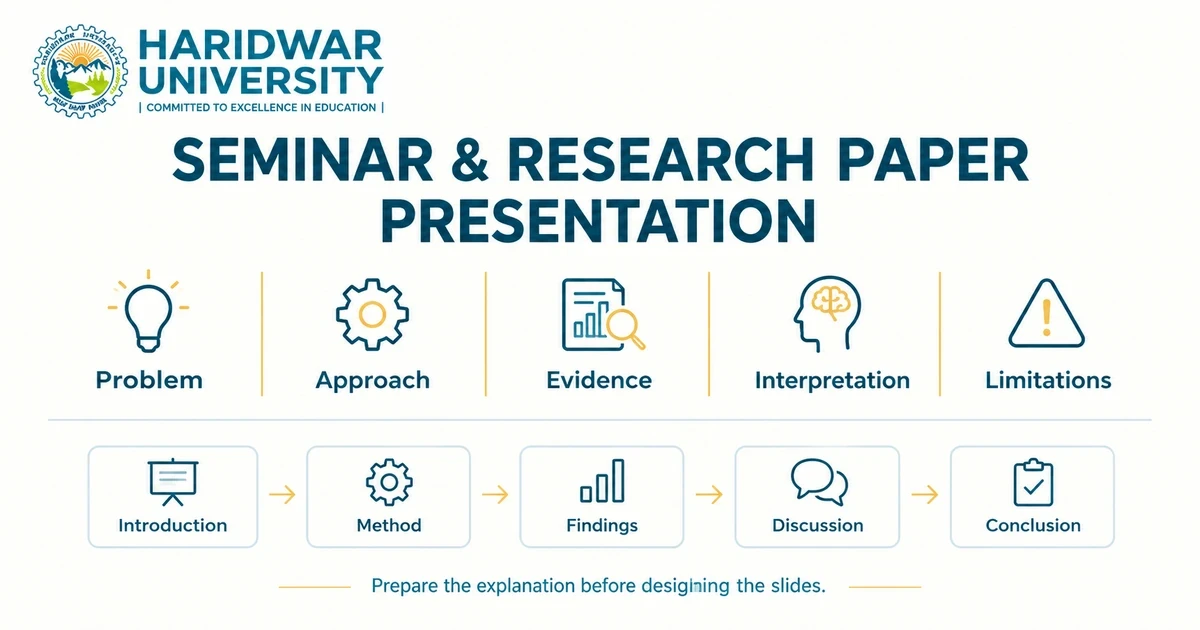
If you are learning how to present a seminar or research paper, start with three foundational questions: What must the audience understand? Which evidence validates your message? How much speaking time do you have? Preparing a coherent explanation before designing visual slides ensures your academic presentation informs and engages evaluators. To complement this guide, students writing original manuscripts should also review our step-by-step walkthrough on how to write a research paper for undergraduates.
Table of Contents
- Understanding the Purpose of a Seminar vs Research Paper Presentation
- Preparing the Content Before Building Slides
- A Practical Format for Seminar and Research Paper Slides
- How to Start a Seminar Presentation with Confidence
- Presenting Technical Information, Methods and Results Clearly
- Presentation Design Rules That Improve Readability
- Speaking, Timing and Handling Questions
- A Sample Seminar Presentation Outline
- Common Presentation Mistakes to Avoid
- Frequently Asked Questions (FAQs)
- Final Presentation Checklist
1. Understanding the Purpose of a Seminar vs Research Paper Presentation
A seminar presentation usually explains and discusses a broader subject, engineering concept, or domain literature. A research paper presentation has a narrower, more rigorous task: communicate a specific research question, methodology, experimental evidence, and conclusions of a defined study.
| Seminar Presentation | Research-Paper Presentation |
|---|---|
| Explains an overarching topic, state-of-the-art framework, or technological challenge. | Communicates a specific empirical, computational, or theoretical investigation. |
| Synthesises multiple academic papers, surveys, and textbooks. | Centres predominantly on one primary research publication or original project build. |
| Focuses on core engineering principles, system architecture, and industry use cases. | Focuses heavily on experimental setup, baseline comparisons, evaluation metrics, and limitations. |
| May feature live demonstrations, case studies, or general peer discussion. | Must represent the published data with strict academic integrity and methodological precision. |
Regardless of the specific format, every technical presentation must answer one decisive question: What single insight or takeaway should the audience retain when the presentation ends? This guiding principle determines what to highlight and what details to omit.
2. Preparing the Content Before Building Slides
Before opening PowerPoint, Canva, or LaTeX Beamer, review your departmental guidelines. Note the exact presentation duration, evaluation rubric, required slide template, and scheduled Q&A window. Classroom seminars, capstone defenses, and peer-reviewed conference tracks enforce very different constraints.
The 1-Page Narrative Outline Rule
Distill your topic into a one-page written outline containing a single central proposition and 3 to 5 supporting pillars. For engineering and computing subjects:
- Define the engineering bottleneck or scientific gap clearly.
- Explain why existing approaches fall short.
- Outline the specific methodology or system proposed.
- Present the quantifiable evidence demonstrating performance.
If an idea cannot be explained simply in an outline, fancy slide transitions will not salvage it. Maintain rigorous academic honesty: verify benchmark figures, cite published authors, and review our institutional policies on plagiarism and AI detection in university assignments.
3. A Practical Format for Seminar and Research Paper Slides
While slide counts must adapt to your assigned time limit, this proven 10-slide architectural framework serves as an ideal foundation for a standard 10-to-12-minute technical presentation:
| Slide # & Title | Core Purpose | Essential Elements to Include |
|---|---|---|
| 1. Title Slide | Topic introduction | Concise title, presenter name, roll number, academic department, university logo, and guide details. |
| 2. Context / Background | Establish relevance | Real-world domain context, why this topic matters, and current industry significance. |
| 3. Problem Statement | Frame the objective | Explicit technical gap, hypothesis, research questions, or seminar goals. |
| 4. Literature Review | Survey existing knowledge | Key milestones, contemporary frameworks, baseline benchmarks, and unresolved limitations. |
| 5. Methodology / Approach | Explain the solution | System architecture, block diagram, mathematical formulation, algorithm, or experimental protocol. |
| 6–7. Results & Findings | Present concrete evidence | Performance curves, comparison tables, evaluation metrics, and verified empirical outcomes. |
| 8. Discussion & Limitations | Critical interpretation | What the results signify, practical constraints, edge cases, and computational trade-offs. |
| 9. Conclusion & Future Scope | Reinforce primary message | Summarised conclusions, societal or industrial utility, and suggested directions for further inquiry. |
| 10. References & Acknowledgments | Attribute scholarly credit | Standard IEEE / APA citations for primary papers, funding support, and faculty mentorship. |
4. How to Start a Seminar Presentation with Confidence
The first 60 seconds establish your academic credibility. Lengthy personal greetings, profuse apologies for nervousness, or generic inspirational quotes consume precious time without advancing your argument.
The 4-Part Professional Opening
- Concise Greeting & Affiliation: Name, degree programme, and institutional affiliation.
- Direct Topic Statement: State the exact technical subject or research question.
- Significance: Explain in one sentence why solving this issue matters right now.
- Roadmap Preview: Outline the progression of your talk in three clear beats.
Sample Verbatim Opening:
"Good morning, respected members of the evaluation committee and fellow peers. I am Aryan Sharma from the Department of Computer Science & Engineering. Today, I will present our investigation into automated surface-defect classification using lightweight convolutional vision transformers. I will begin by examining the latency bottlenecks in industrial inspection lines, introduce our hybrid attention mechanism, and conclude with benchmark comparisons against baseline models on real factory datasets."
5. Presenting Technical Information, Methods and Results Clearly
Technical presentations derail when speakers overwhelm listeners with uncontextualised formulas, dense code blocks, or raw data tables. The remedy is sequential pedagogical pacing:
6. Presentation Design Rules That Improve Readability
Slides are visual aids designed to amplify spoken delivery, not a teleprompter for the speaker. If your audience must read paragraphs while listening to you speak, they will absorb neither.
- One Core Message per Slide: Dedicated slides prevent visual crowding and maintain cognitive focus.
- Bullet Phrases over Paragraphs: Use concise, scannable text fragments rather than verbatim transcript sentences.
- High Contrast & Clean Typography: Use dark charcoal text on crisp white or light backgrounds. Avoid neon palettes or ornate fonts.
- Label Every Axis & Unit: Every graph must clearly indicate metric units (e.g., Latency in ms, Accuracy in %, F1-Score).
- Discard Decorative Clutter: Eliminate floating clip art, stock gifs, or spinning transitions that do not clarify technical mechanics.
While popular guidelines like the 6×6 rule (no more than 6 lines, 6 words per line) offer helpful heuristics, engineering diagrams and mathematical proofs naturally require customized formatting. Focus on legibility from the back row of an auditorium over dogmatic word counts.
7. Speaking, Timing and Handling Questions
Poised delivery stems from structured rehearsal, not innate stage charisma. Practicing aloud with a stopwatch reveals tongue-twisting phrasing, weak transitions, and timing overruns.
Handling the Q&A Session Like a Scholar
Examiners evaluate your technical command through how you respond to probing inquiries:
- Listen Completely: Never interrupt a committee member mid-question. Wait two seconds before responding.
- Acknowledge Unexplored Boundaries: If an evaluator asks about an edge case you did not test, reply honestly: "We did not evaluate performance under non-linear loads in this study; however, based on our mathematical model, we would anticipate increased variance."
- Never Guess or Fabricate: Fabricating numbers damages academic credibility instantly. Humility paired with empirical rigor always scores higher.
8. A Sample Seminar Presentation Outline
Here is an illustrative slide-by-slide progression for a student seminar on Machine Learning in Healthcare Diagnostics:
- Slide 1: Title, presenter details, department, and university credentials.
- Slide 2: Diagnostic imaging challenges and diagnostic latency in acute clinical care.
- Slide 3: Seminar objective: evaluating deep learning frameworks in medical triage.
- Slide 4: Core principles of Convolutional Neural Networks (CNNs) in pattern recognition.
- Slide 5: Standard data pre-processing, patient privacy de-identification, and data augmentation.
- Slide 6: Exemplar architecture: ResNet vs Vision Transformer configurations.
- Slide 7: Reported empirical findings: Sensitivity, Specificity, and AUC-ROC curves.
- Slide 8: Clinical limitations: Dataset bias, explainability gaps, and regulatory hurdles.
- Slide 9: Summary takeaways: Opportunities for assistive, doctor-in-the-loop diagnostics.
- Slide 10: Primary peer-reviewed references and departmental acknowledgments.
9. Common Presentation Mistakes to Avoid
Avoid these common pitfalls that compromise student seminar grades:
10. Frequently Asked Questions (FAQs)
How do I prepare to present an academic seminar for the first time?
Start by confirming the topic, assessment rubric, and time limits. Draft a 1-page narrative outline before touching presentation software, build slides with 1 core takeaway per slide, and rehearse out loud with a stopwatch at least three times.
What is the standard slide structure for a research paper presentation?
A standard 10-slide framework includes: Title, Context, Problem Statement, Related Work, Proposed Methodology, System Architecture, Experimental Results, Discussion & Limitations, Conclusions, and Scholarly References.
How should I open my seminar presentation?
Use a crisp 4-part opening: greet the committee, state your name and department, present your research problem, and preview your talk's trajectory. Avoid long apologies or unrelated motivational quotes.
How many slides should I prepare for a 10-minute presentation?
Aim for 8 to 10 slides. In technical engineering topics, spending 60 to 90 seconds per slide allows sufficient time to explain complex block diagrams and performance metrics without rushing.
What is the main difference between a seminar and a research paper defense?
A seminar covers a broader educational topic synthesizing multiple survey papers and industry tools. A research defense focuses strictly on defending a specific investigation, including experimental methodology, validity, and limitations.
How can I present complex mathematical equations and algorithms clearly?
Define every variable before displaying the equation, highlight key terms with color callouts, and explain the physical intuition behind what the formula optimizes before walking through the derivation.
What should I do if a faculty evaluator asks a question I cannot answer?
Never guess or attempt to mislead the panel. Acknowledge the question thoughtfully: "That is an insightful observation. While our experiments focused on static conditions, investigating dynamic workloads is an essential next step that we plan to explore."
11. Final Presentation Checklist
Run through this quick pre-presentation checklist 24 hours before your presentation slot:
- [ ] Slide Order: Logical progression from problem definition to experimental conclusion.
- [ ] Typography & Readability: High contrast text visible on room projectors.
- [ ] Visual Formatting: All charts feature labeled axes, measurement units, and legends.
- [ ] Timing Validation: Total speaking time sits safely inside the allotted window with 2–3 minutes reserved for Q&A.
- [ ] Hardware Verification: Presentation file exported as PDF/PPTX and backed up on a USB flash drive and cloud storage.
- [ ] Verbal Polish: Practiced aloud to refine speech clarity and confidence. Read our guide on communication and personality development for public speaking strategies.
Foster Cutting-Edge Research at Haridwar University
From world-class laboratories and faculty-mentored innovation projects to state-of-the-art academic programmes, Haridwar University empowers tomorrow's engineers and researchers.