

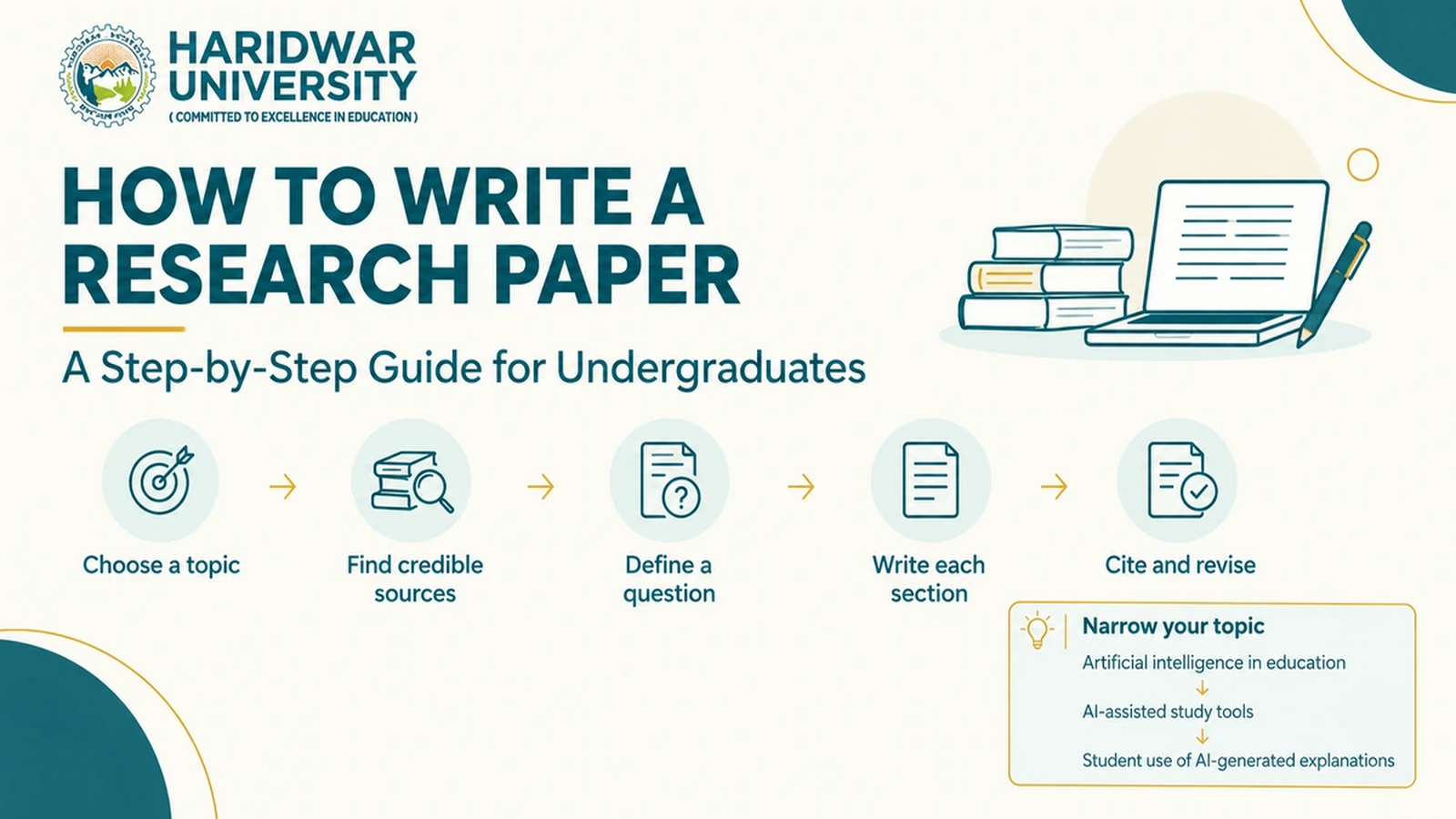
Writing your first academic paper can feel more daunting than the coursework itself. You may thoroughly understand the underlying subject matter, yet struggle with what to read, how to structure your argument, or what belongs in each specific section. Learning how to write a research paper becomes vastly more manageable when you treat it as a disciplined sequence of decisions rather than one monolithic writing assignment.
In this guide from the Department of Computer Science & Engineering at Haridwar University, we walk step by step through the scholarly process—from narrowing a viable topic and critically assessing peer-reviewed sources to organizing your manuscript, citing literature ethically, and using AI tools responsibly. These principles empower undergraduate scholars across engineering, computer applications, pharmacy, management, and basic sciences.
Table of Contents
- • 1. What an Undergraduate Research Paper Should Achieve
- • 2. How to Choose and Narrow a Research Topic
- • 3. How to Find and Evaluate Research Sources
- • 4. How to Develop a Research Question and Outline
- • 5. How to Write Each Section of a Research Paper
- • 6. How to Cite Sources and Maintain Academic Integrity
- • 7. How to Use AI Tools Responsibly During Research
- • 8. How to Revise and Prepare the Final Paper
- • 9. Undergraduate Research Paper Checklist
- • 10. Frequently Asked Questions (FAQs)
1. What an Undergraduate Research Paper Should Achieve
A research paper is fundamentally different from a classroom essay or a compilatory report. It does not merely string together facts copied from textbooks and websites. Instead, an authentic paper poses a focused question, critically examines empirical evidence, articulates an investigative methodology, and constructs a reasoned conclusion.
Crucially, undergraduate scholars are not expected to invent Nobel-calibre breakthroughs. A rigorously scoped undergraduate paper might benchmark two competing software algorithms, analyze an open-access public dataset, execute a systematic literature survey on an emerging engineering challenge, or report experimental findings from a laboratory prototype. What matters is that the inquiry has a defined purpose and every claim is substantiated by evidence.
Three Foundational Questions to Answer Before Writing:
- The Academic Task: Is this an exploratory literature review, an experimental bench study, an observational survey, or a technical engineering system report?
- The Structural Requirements: What are the word counts, target formatting styles (e.g., IEEE, APA), submission deadlines, and mandatory sections mandated by your faculty guide?
- The Core Contribution: Are you evaluating existing published findings, benchmarking performance metrics, or reporting original laboratory outcomes?
At Haridwar University, students can explore the university’s active research and innovation ecosystem and published research promotion policy for institutional guidelines and funding grants. Consult with your departmental faculty mentor early to align your paper with ongoing institutional research clusters.
2. How to Choose and Narrow a Research Topic
Broad topics produce the weakest first drafts because they leave too much ground uncovered. A broad subject like "Artificial Intelligence in Education" encompasses curriculum design, machine learning assessment, student psychology, interface accessibility, and data privacy. Attempting to address all of them produces a superficial survey.
To craft a compelling paper, systematically narrow your subject by focusing on a specific technical challenge, demographic group, context, or analytical comparison:
The 4-Stage Topic Refinement Framework
How to transition from a generic concept to a precise, publishable research question.
| Refinement Stage | Illustrative Engineering/CS Example |
|---|---|
| 1. Broad Subject | Artificial Intelligence in Education |
| 2. Focus Area | AI-Assisted Study Tools and Automated Feedback |
| 3. Specific Issue | Student Evaluation of AI-Generated Explanations in Programming Labs |
| 4. Research Question | How do undergraduate engineering students evaluate the conceptual accuracy of AI-generated code explanations when debugging introductory data structures? |
Before finalizing your topic, perform preliminary search queries on academic indices to ensure adequate literature exists. If your query returns 50,000 papers, narrow your criteria further; if it yields zero hits, reframe your terminology.
3. How to Find and Evaluate Research Sources
Searching the web is not the same as conducting scholarly research. Commercial search engines prioritize popularity and commercial SEO; academic investigation requires credibility, reproducibility, and peer validation.
Anchor your literature search in authoritative digital repositories: IEEE Xplore, ScienceDirect, PubMed, SpringerLink, ACM Digital Library, and Google Scholar. Utilize advanced Boolean operators (AND, OR, NOT) alongside precise technical phrases to filter noise.
Build a Systematic Literature Matrix
Never read research papers passively without taking structured notes. Maintain an active spreadsheet or literature matrix recording five critical elements for every study you examine:
- Core Objective: What specific hypothesis or design problem were the authors investigating?
- Methodology & Dataset: What experimental framework, sample size, or dataset did they employ?
- Principal Findings: What were the quantified, verified conclusions?
- Acknowledged Limitations: Where did the authors admit their technique breaks down or needs further study?
- Relevance to Your Paper: How does this paper support, challenge, or contextualize your own investigation?
Synthesizing literature means comparing perspectives—identifying where leading scholars agree, where experimental data diverges, and where unresolved gaps remain. For broader research activities on campus, explore how Haridwar University supports student scholars through the Research and Innovation Centre.
4. How to Develop a Research Question and Outline
A research question serves as the spine of your manuscript. Avoid vague inquiries like "Is cloud computing useful for businesses?" Instead, specify the technical parameters: "What are the latency and cost trade-offs of deploying microservices on serverless architectures compared to containerized Kubernetes clusters for real-time telemetry?"
Once your core question is established, draft a structured multi-level outline before writing your first sentence. Outlining reveals logical gaps and redundant sections while they are still effortless to reorganize.
Standard Scientific Paper Architecture (IMRAD Format):
- Introduction: Problem statement, real-world context, technical significance, and research objectives.
- Literature Review: Critical analysis of existing frameworks, benchmarking studies, and identified knowledge gaps.
- Methodology: System architecture, experimental setup, algorithmic design, and data validation techniques.
- Results / Findings: Empirical observations, graphical benchmarks, performance metrics, and statistical analysis.
- Discussion: Interpreting what the results mean, contextualizing against prior work, and dissecting anomalies.
- Conclusion & Future Scope: Direct answers to the research question, practical implications, and next steps.
5. How to Write Each Section of a Research Paper
Professional researchers rarely write their manuscripts from front to back. A highly effective drafting sequence is to tackle the Methodology and Results first (while experimental setups are fresh), followed by the Discussion and Introduction, composing the Abstract and Title last.
- Title: Be concise, descriptive, and accurate. Avoid sensationalist headlines; include key keywords that allow other scholars to discover your paper via academic search engines.
- Abstract: A standalone 150-to-250-word synthesis summarizing: (1) context and problem, (2) primary objective, (3) methodology, (4) key findings, and (5) concluding takeaway.
- Introduction: Establish the scope, articulate the specific engineering or scientific bottleneck, and explicitly state your contribution. Avoid spending paragraphs restating elementary domain trivia.
- Literature Review: Group studies thematically rather than providing a disjointed list of paper-by-paper summaries. Explain how prior literature informs your methodology.
- Methodology: Provide sufficient technical granularity—hardware configurations, software versions, mathematical formulations, and dataset splits—so that an independent researcher could replicate your experiments.
- Results & Discussion: Present factual findings cleanly using high-resolution charts and comparison tables. In the discussion, explain why the results occurred and address potential threats to validity.
- Conclusion & References: Reiterate the definitive answer to your inquiry, summarize practical engineering contributions, and format every citation according to strict venue specifications.
6. How to Cite Sources and Maintain Academic Integrity
Citation is not an administrative afterthought; it is an integral pillar of the scientific method. Proper attribution situates your research within the global academic dialogue, credits intellectual predecessors, and shields your work from accusations of academic misconduct.
Adhere strictly to the citation format mandated by your discipline: IEEE style (numerical brackets) for engineering, technology, and computer science, or APA style (author-date) for life sciences and management. Adopt citation management software like Zotero, Mendeley, or BibTeX early in your college career to automate reference formatting and eliminate bibliography mismatch errors.
Remember that paraphrasing does not exempt you from providing a citation. Even when rephrasing ideas in your own words, the underlying conceptual intellectual property belongs to the original author and must be credited. Plagiarism detection tools (such as Turnitin and DrillBit) deployed across Haridwar University audit submitted manuscripts for semantic similarity; maintaining strict integrity protects your degree and academic reputation.
7. How to Use AI Tools Responsibly During Research
Generative AI platforms can serve as valuable cognitive assistants: they can assist in debugging code snippets, suggesting exploratory search strings, or clarifying dense mathematical notation. However, they cannot conduct authentic scientific research, evaluate experimental veracity, or substitute for your critical thinking.
Three Golden Rules for AI in Academic Research:
- Independently Verify Every Single Citation: Large Language Models notoriously fabricate convincing academic citations, author names, and DOIs (hallucinations). Never include a source in your references that you have not personally fetched, opened, and validated.
- Protect the Creative Core: Never pass off AI-generated paragraphs, data figures, or algorithmic analyses as your own intellectual labor. Misrepresenting synthetic text as original human writing breaches university academic codes.
- Comply with Institutional Disclosure Guidelines: Always review departmental and journal submission policies. If AI tools were utilized for language polishing or code testing, disclose their application transparently in your acknowledgments or methodology section.
8. How to Revise and Prepare the Final Paper
A first draft is merely an initial working prototype. High-impact research papers emerge during rigorous iterative revision. Schedule your writing timeline so you have at least 48 to 72 hours between completing your first draft and beginning final proofreading.
Execute your revision in three distinct structural passes:
- The Macro Structural Audit: Does each section logically advance the core research question? Are the transitions between literature review, methodology, and results cohesive?
- The Evidence & Rigor Audit: Is every factual assertion substantiated by an in-text citation or experimental data point? Are chart axes properly labelled and units verified?
- The Micro Compliance Audit: Verify margins, typography, heading hierarchy, caption formats, and bibliography styles against your target conference or journal template.
Seek critical peer feedback: invite a senior research scholar or departmental faculty mentor to review your manuscript. Fresh eyes invariably catch unstated assumptions and ambiguities that the primary author overlooks. At Haridwar University, students can also participate in the Shodh Research Club to present working papers and receive peer critiques before formal conference submissions.
9. Undergraduate Research Paper Checklist
Before submitting your manuscript for departmental grading or conference review, ensure you have checked every item on this quality checklist:
- ✓ Focused Scope: Poses a clear, answerable research question with a defined technical objective.
- ✓ Peer-Reviewed Literature: Anchored in credible academic journals and conference proceedings.
- ✓ Reproducible Methodology: Explains experimental tools, algorithms, and parameters clearly.
- ✓ Rigorous Citations: Every factual claim is accurately cited in the prescribed format (e.g., IEEE/APA).
- ✓ Authentic Data: Reports genuine, verifiable experimental or survey results without fabrication.
- ✓ Responsible AI Adherence: Verified all synthetic search outputs and disclosed AI assistance appropriately.
- ✓ Rigorous Proofreading: Audited manuscript for grammatical clarity, typographic formatting, and structural flow.
An impactful undergraduate paper does not need to be the most complex or mathematically dense manuscript in the library. What defines outstanding scholarship is a well-defined question, meticulous evidentiary support, intellectual honesty, and conclusions that remain grounded in what the data demonstrates. Approach each stage systematically, and the writing process transforms from a burden into an intellectual milestone.
10. Frequently Asked Questions (FAQs)
How do I start a research paper as an undergraduate?
Start by reviewing assignment parameters, selecting a manageable topic, and reading a focused set of peer-reviewed papers. Use that preliminary reading to formulate a specific, answerable research question before drafting your outline and introduction.
What are the main steps in writing a research paper?
The process generally includes selecting a topic, reviewing existing literature, defining a specific question, planning the method or approach, analysing evidence, drafting sections logically, citing sources accurately, and revising the final draft.
How many sources should an undergraduate research paper include?
There is no universal number. The appropriate number depends on the subject discipline, paper length, research question, and availability of evidence. Prioritise peer-reviewed, credible, directly relevant sources over a long list of low-quality citations.
What is the difference between a research paper and a project report?
A research paper develops and communicates an evidence-based argument or scientific investigation. A project report documents a specific project's technical objectives, architecture design, implementation, and evaluation. While sections may overlap, follow the exact guidelines prescribed for your course.
Can I use AI to write a research paper?
Only to the extent explicitly permitted by your institution and course regulations. AI tools can assist with brainstorming or explaining concepts, but you must independently verify all citations, preserve your own analytical thinking, and disclose AI assistance where required.
Which format should I use for a research paper?
Use the formatting and citation style mandated by your department, faculty supervisor, conference, or target journal (e.g., IEEE for engineering/CS, APA for social sciences). Do not mix formats or adopt one simply because it is familiar.
Can an undergraduate publish a research paper?
Yes, undergraduate students regularly contribute to publishable research in peer-reviewed journals and conferences. Publication depends on methodological rigor, originality, faculty mentorship, and adhering to ethical standards. Completing a paper does not guarantee acceptance, but quality mentorship greatly improves outcomes.
Foster Innovation & Research Excellence at Haridwar University
Haridwar University provides advanced laboratory facilities, dedicated faculty research mentorship, incubation funding, and patent filing support across degree programmes.