

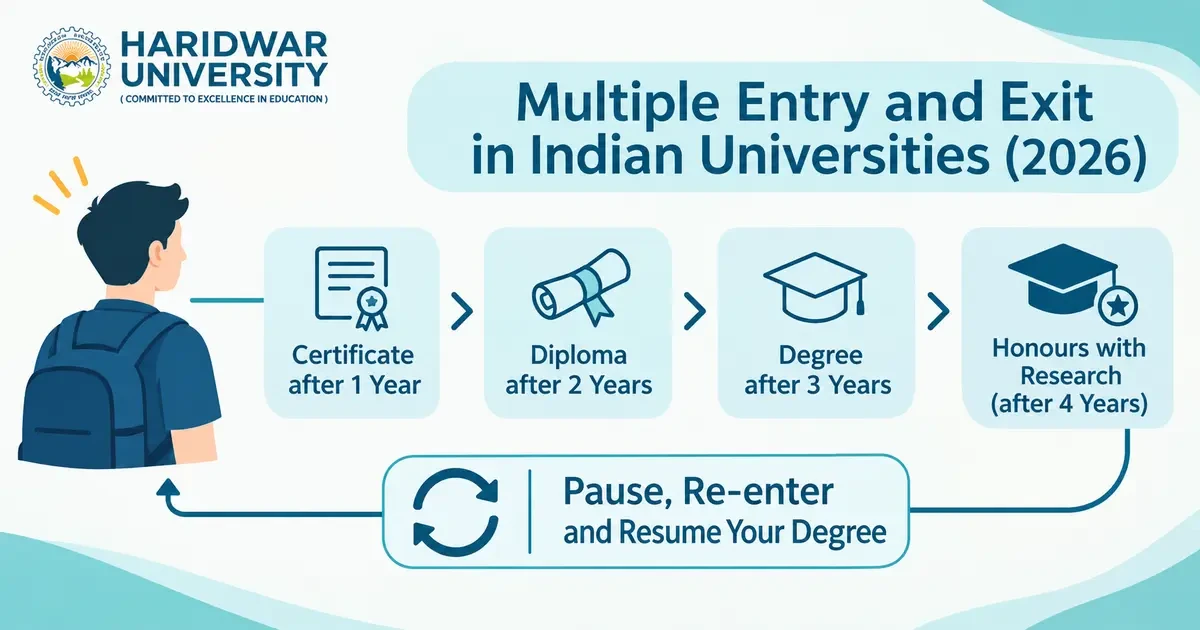
Multiple Entry and Exit in Indian Universities (2026): How to Pause and Resume Your Degree
Mr. Sumit Chauhan
Registrar, Haridwar University
A student may commence an undergraduate degree with immense focus and ambition, yet encounter unforeseen life changes along the way. Urgent family obligations, unexpected financial strains, health recuperation, relocation, or an evolving career trajectory can make continuous, uninterrupted campus attendance difficult. In these moments, students face a critical worry: if I leave college now, will the semesters I have already completed count for anything when I return?
India’s higher education architecture increasingly recognises that learning journeys rarely follow an uninterrupted straight line. The University Grants Commission’s (UGC) Guidelines for Multiple Entry and Exit in Academic Programmes, notified in July 2021 under NEP 2020, establish progressive exit qualifications and digital credit banking. However, flexibility should never be confused with an unconditional right to leave and re-enter without rules. In this guide, I explain what students must verify before taking a break, how to protect their academic transcripts, and how to execute a seamless return.
Table of Contents
- What Each Exit Can Award Under the UGC Framework
- A Break in Education Does Not Have to Mean Starting Again
- The Difference Between Academic Leave and Formal Exit
- What Students Should Do Before Leaving College
- How to Prepare for Returning to Higher Education
- Changing Universities or Programmes Requires More Than a Credit Record
- Common Mistakes That Can Complicate a Return
- Planning an Academic Break Without Losing Direction
- Frequently Asked Questions
- A More Flexible Route Back to Education
1. What Each Exit Can Award Under the UGC Framework
Under the UGC’s Multiple Entry and Exit System (MEES), undergraduate education is divided into progressive milestones. Eligible students who complete a designated academic stage can receive an interim credential rather than leaving with nothing to show for their efforts:
| Completed Stage of Study | Conferred Exit Award | Core Credit & Skill Condition |
|---|---|---|
| After Year 1 (Semesters 1 & 2) | Undergraduate Certificate | 40 credits + ≥4 vocational/skill credits |
| After Year 2 (Semesters 3 & 4) | Undergraduate Diploma | 80 credits + ≥4 vocational/skill credits |
| After Year 3 (Semesters 5 & 6) | Bachelor’s Degree | 120 credits across core major and minors |
| After Year 4 (Semesters 7 & 8) | Bachelor’s Degree with Honours / Research | 160 credits total, including NCrF Level 6 credits |
For an extensive walkthrough of how fourth-year research roadmaps operate alongside three-year degrees, explore our explainer on 4-year UG degree exit options and credit requirements.
2. A Break in Education Does Not Have to Mean Starting Again
Prior to NEP 2020, dropping out of college after two years essentially wiped out a student’s academic efforts. Returning meant starting from semester one. The UGC’s July 2021 guidelines fundamentally challenge this rigidity, ensuring that earned academic learning is digitally catalogued and preserved.
This mobility is enabled by the Academic Bank of Credits (ABC), where earned course credits are deposited following semester examinations. To learn how to set up your personal 12-digit student profile on DigiLocker, consult our step-by-step guide on how to create and use your ABC account.
However, one foundational truth must be emphasized: a digital credit ledger is not an automatic admission card. ABC facilitates credit storage; the admitting higher education institution retains the statutory authority to evaluate curriculum equivalence, verify seat availability, and decide whether to grant re-entry. Read our parent analysis on credit transfer and the Academic Bank of Credits.
3. The Difference Between Academic Leave and Formal Exit
Before stepping away from campus, students must recognize the legal and administrative distinctions between pausing studies temporarily and exiting formally:
● Academic Leave (Temporary Hiatus)
The student remains formally enrolled in the university while taking an approved semester break (e.g., medical leave or internship semester). You retain your roll number, and resuming requires a simple reporting application rather than a full admission cycle.
● Formal Exit (Interim Award)
The student formally withdraws from the program at an approved exit point (e.g., Year 1 or 2), completing university clearances and receiving an Undergraduate Certificate or Diploma alongside certified grade transcripts.
● Re-Entry (Lateral Resumption)
The learner applies to resume their degree, presenting banked ABC credits. The institution evaluates curriculum equivalence against current syllabi, confirms seat availability, and grants lateral entry into Year 2, 3, or 4.
Registrar’s Caution: Never assume that simply stopping attendance constitutes an “approved break.” Unauthorized absence leads to administrative de-registration and marks you as an irregular or dropped student. Always secure written institutional sanction before discontinuing attendance.
4. What Students Should Do Before Leaving College
Protecting your hard-earned academic progress must be handled systematically before you vacate the campus:
1. Meet the Academic Dean or Registrar’s Office
Submit a formal letter detailing the cause of your hiatus and request written guidance on whether an academic leave of absence or formal exit is appropriate.
2. Secure Stamped Official Transcripts
Obtain certified physical copies of your semester marksheets, grade cards, and official transcripts. Do not rely solely on online student portals that may be disabled upon withdrawal.
3. Reconcile Credits on the ABC Portal
Log in to DigiLocker or abc.gov.in and confirm that every completed semester course is uploaded by the university examination division before departing.
4. Complete Institutional No-Dues Clearance
Clear library book returns, hostel check-outs, lab inventory dues, and tuition balances to obtain an unencumbered clearance certificate.
5. Clarify Re-Entry Timeframes & Syllabus Policies
Confirm the maximum permissible hiatus duration (standard UGC limit is up to 7 years) and determine whether syllabus updates during your absence will require bridge modules.
Students should familiarize themselves with Haridwar University’s officially published academic regulations on our UG and PG programme guidelines page.
5. How to Prepare for Returning to Higher Education
Resuming your degree after an academic pause should be treated as a structured academic planning project. Begin preparations at least 3 to 4 months before the start of the semester in which you plan to re-enroll:
- Returning to the Same University: Contact your original department and submit your prior enrollment records. The Academic Council will confirm which semester you will enter and whether course code changes necessitate supplementary audit courses.
- Transferring to a New Institution: Share your complete syllabi and transcripts with the target institution’s admissions office. Request a written Credit Equivalence Matrix detailing exactly how many past credits will be accepted.
- Monitoring the 7-Year Validity Clock: UGC and ABC regulations stipulate that credits have a shelf life of up to seven years. Ensure you re-enter well before this deadline expires.
Explore NEP-Aligned Undergraduate Degrees at Haridwar University
Discover future-ready B.Tech Honours, BCA, BBA, B.Com, and Allied Health programmes featuring complete ABC credit mobility.
Explore All Academic Programmes →6. Changing Universities or Programmes Requires More Than a Credit Record
A common misconception among students is assuming that because an ABC ledger exists, any university in India must automatically admit them into Year 2 or Year 3. This is false.
Higher education institutions possess academic autonomy to establish course prerequisites. Two subjects sharing identical titles across different universities often differ significantly in laboratory hours, theoretical depth, and assessment methods. When assessing lateral mobility, admitting universities review:
- Course Equivalence: Whether the completed courses cover at least 70% to 80% of the target institution’s core syllabus.
- Credit Parity: Whether the credit weights (theory vs practical hours) match the receiving university’s semester matrix.
- Seat Sanction Limits: Whether the regulatory council (AICTE, PCI, INC) allows lateral intake capacity in that academic cohort.
Never withdraw from an existing college or commit non-refundable fees until the new university provides written, stamped confirmation of lateral credit acceptance. Prospective applicants can review course offerings and eligibility requirements across our academic programmes directory.
7. Common Mistakes That Can Complicate a Return
In my experience reviewing student academic files, several avoidable mistakes repeatedly derail smooth re-entry into higher education:
Mistake 1: Vanishing Without Written Sanction
Students stop attending classes assuming they can return later. Without formal leave paperwork, the student is marked as an unapproved dropout.
Mistake 2: Storing Only Phone Screenshots
Digital portal screenshots are unverified. Admissions committees require stamped transcripts, migration certificates, and signed grade sheets.
Mistake 3: Letting the 7-Year Clock Lapse
Credits expire once their statutory validity period lapses. Students must resume their studies before the 7-year ceiling closes.
Mistake 4: Missing University Admission Windows
Lateral entry admissions follow strict university calendar schedules. Waiting until semester classes begin eliminates seat availability.
8. Planning an Academic Break Without Losing Direction
Taking an academic hiatus should be a deliberate, strategic decision rather than a reactive surrender to short-term stress. When structured correctly, a break can provide the time needed to resolve personal challenges, gain real-world industry experience, or recalibrate career goals.
Ensure your family discusses the financial implications of taking a break and understands the fee structures of returning semesters. At Haridwar University, all program tuition schedules and merit concession rules are published transparently on our fees and scholarships page, and parents can consult our admission overview for administrative protocols.
9. Frequently Asked Questions
1. Can I take a break from college and continue the same degree later?
Yes. Under the UGC Multiple Entry and Exit framework, students can pause their studies through approved academic leave or formal exit and resume their degree later, provided they secure written institutional approval and re-enter within the permissible credit-validity period.
2. Will I lose my completed semesters if I discontinue college?
Not necessarily. Under NEP 2020 guidelines, eligible completed course credits are uploaded to your DigiLocker-linked Academic Bank of Credits account. These credits remain preserved for future redemption toward an undergraduate award.
3. Can I resume my degree at a different university?
Yes, but credit acceptance is subject to the receiving university’s evaluation. The new institution assesses course syllabus equivalence, credit values, and available vacant seats before approving lateral admission.
4. Do I need an ABC account before leaving college?
Yes. You must ensure your 12-digit APAAR/ABC ID is linked to your university examination record and verify that all earned credits appear on your dashboard before leaving campus.
5. Can I return to college after several years?
Under UGC regulations, credits typically remain valid for up to 7 years. You must apply for re-entry within this window and comply with any updated curriculum requirements.
6. What documents should I keep when leaving a degree programme?
Retain stamped semester marksheets, official transcripts, ABC credit statements, fee clearance receipts, formal withdrawal or leave approval letters, and syllabus copies for credit mapping.
7. Does an ABC ID guarantee admission after a study break?
No. The ABC platform is purely a credit repository. Admission, seat allocation, and qualification conferral remain under the authority of the admitting university.
8. Can I change my subject when I return to university?
Yes, provided you satisfy the eligibility criteria of the new discipline. Previously completed general education or multidisciplinary credits may transfer, while core departmental courses must be completed afresh.
10. A More Flexible Route Back to Education
Higher education should empower students, not penalize them for unexpected life events. The multiple entry and exit architecture provides an invaluable safety net, converting years of study into durable academic equity.
At Haridwar University, our academic administration actively supports students through digital credit mobility, transparent exit credentials, and personalized counseling. The most important step is to make an informed, well-documented decision before leaving campus, ensuring that when the time comes to resume your academic journey, your pathway forward is clear, welcoming, and certain.
Resume Your Education with Confidence at Haridwar University
Explore flexible undergraduate programmes, transparent lateral entry credit transfers, merit scholarships up to 80%, and supportive academic guidance tailored for your journey.