

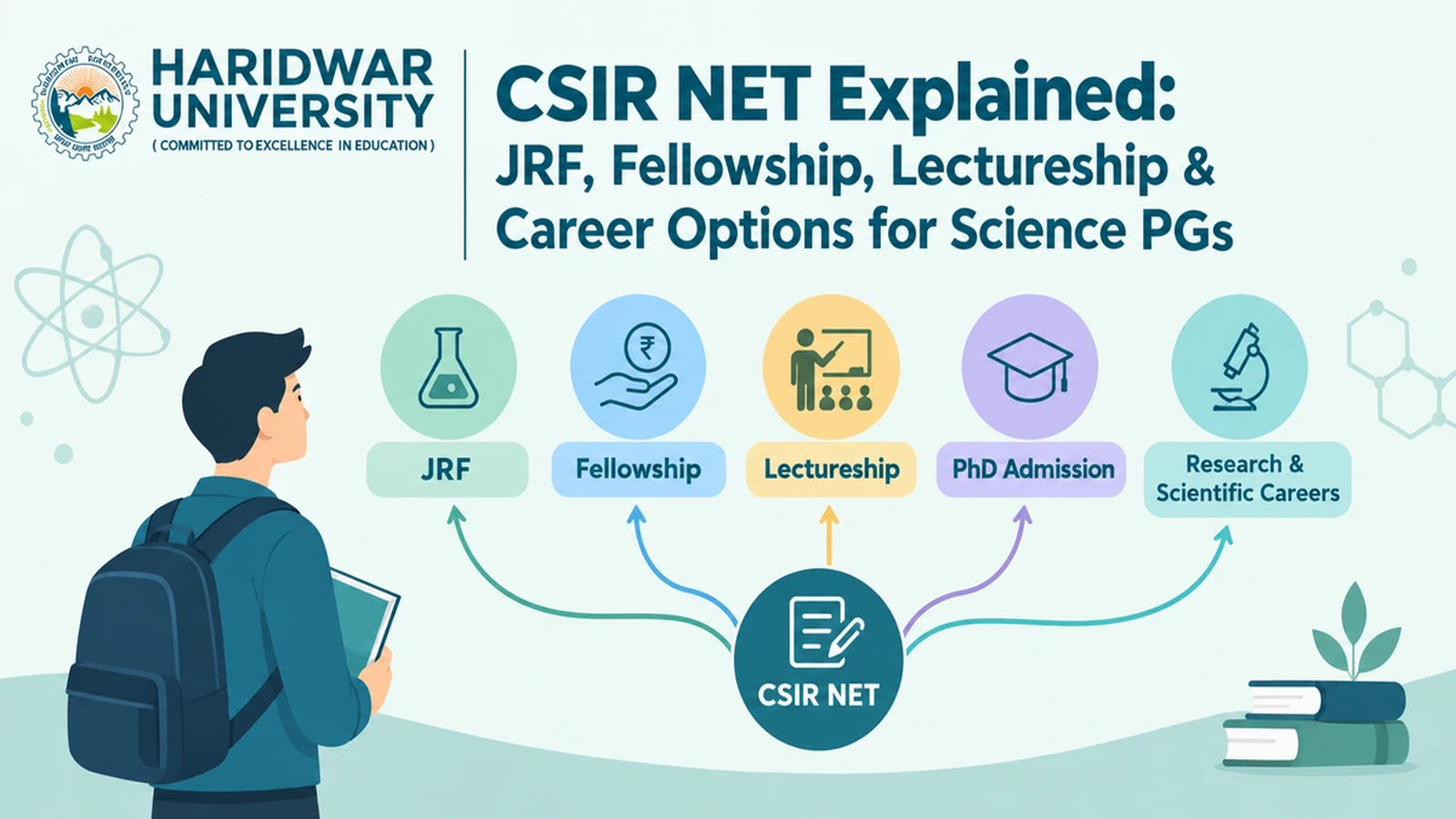
For a science postgraduate, CSIR NET is more than another competitive examination. I see it as a qualification that can influence what comes next: a Junior Research Fellowship, an academic teaching route, PhD admission, or further scientific research. The important point is that these outcomes are not interchangeable, and clearing CSIR NET does not itself amount to a job appointment.
The current Joint CSIR-UGC NET examination covers major core science disciplines including Chemical Sciences, Earth Sciences, Life Sciences, Mathematical Sciences, and Physical Sciences. Official results distinguish three distinct outcome categories: JRF, Assistant Professor eligibility, and PhD admission.
Important 2026 Academic Update: According to the official CSIR-HRDG notification on the Joint CSIR-UGC-DBT JRF-NET examination, a unified examination merging CSIR-NET Life Sciences and DBT-BET is intended to begin from the December 2026 cycle.
Table of Contents
- • CSIR NET Is a Career Qualification, Not a Job Guarantee
- • CSIR NET Gives Science PGs Different Academic Pathways
- • JRF and Lectureship Lead to Different Next Steps
- • The CSIR NET JRF Fellowship Supports a Research Path
- • CSIR NET Lectureship Creates an Assistant Professor Eligibility Route
- • PhD Is a Major Pathway After CSIR NET
- • Research and Scientific Careers Extend Beyond Universities
- • Government and Industry Opportunities Require Separate Recruitment
- • What Science PGs Should Do After Qualifying CSIR NET
- • CSIR NET Makes More Sense When Matched to a Career Goal
- • Frequently Asked Questions (FAQs)
- • Your CSIR NET Qualification Is a Starting Point, Not the Destination
1. CSIR NET Is a Career Qualification, Not a Job Guarantee
One misconception I regularly see among postgraduate students is the assumption that qualifying CSIR NET means receiving a teaching or research job. It does not.
The examination determines eligibility for specific academic and research pathways. The subsequent appointment, PhD admission, or research position depends on the relevant institution, vacancy, eligibility conditions, and selection process.
The distinction matters across the three qualifying categories:
The official CSIR-HRDG cut-off notices confirm these three categories and separately publish subject-wise cut-offs for Chemical, Earth, Life, Mathematical, and Physical Sciences.
I would therefore advise students to ask a more useful question than “What job will I get after CSIR NET?” Ask: “Which career route does my qualification support, and what should I do next?”
2. CSIR NET Gives Science PGs Different Academic Pathways
A science postgraduate can approach CSIR NET with very different objectives. One student may want funded research and a PhD. Another may be primarily interested in teaching. A third may want to enter scientific R&D and use the qualification alongside other technical or research credentials.
That is why the qualification should be viewed as a systematic pathway:
Science PG → CSIR NET → Qualification Category → JRF / Assistant Professor Eligibility / PhD Route → Research, Teaching, or Scientific Career
The latest official cut-off framework is particularly useful here because it does not treat every qualified candidate as having exactly the same outcome. The three categories have different professional implications.
For students considering doctoral research at Haridwar University, the university's doctorate programme states that candidates qualified in UGC-NET, including JRF, or CSIR-UGC NET, including JRF, can be exempted from the HURET written test and proceed through the applicable interview process, subject to the university's admission requirements. You can also explore how this aligns with postgraduate programmes at Haridwar University.
3. JRF and Lectureship Lead to Different Next Steps
JRF and Lectureship are often mentioned together, but I would not advise students to treat them as the same career outcome.
A Junior Research Fellowship (JRF) is fundamentally connected with funded research. The Assistant Professor eligibility (Lectureship) route is connected with academic teaching recruitment. This distinction changes what you should do immediately after qualifying:
- If you qualify for JRF: Start identifying suitable research areas, prospective faculty supervisors, and funded PhD openings.
- If you qualify for Assistant Professor eligibility: Monitor relevant faculty vacancy notifications and understand institution-specific recruitment requirements and academic scoring criteria.
- If you qualify for PhD admission: Focus on identifying suitable doctoral programmes and completing the relevant admission process within the validity window.
The official CSIR-HRDG framework confirms that the JRF route has a defined fellowship structure, while recent results separately identify Category 2 for Assistant Professor eligibility and Category 3 for PhD admission.
4. The CSIR NET JRF Fellowship Supports a Research Path
For students considering scientific research, the fellowship is one of the most tangible benefits of a JRF qualification.
Under current CSIR-HRDG JRF guidelines, fellowship support includes:
JRF (Years 1 & 2)
₹37,000 / month
Plus an annual contingency grant of ₹20,000 per fellow.
SRF (Year 3 Onwards)
₹42,000 / month
Subject to progress assessment committee review and PhD registration conditions.
This is an important point for students comparing research with conventional employment: a JRF should not be described as a permanent job. It is a fellowship supporting a defined research pathway.
The practical progression sequence is usually:
Practical Sequence: JRF → Research Institution → PhD/Research Registration → Research Progress Assessment → Possible SRF Progression → Doctoral Completion → Postdoctoral, Academic, or Advanced Research Opportunities.
5. CSIR NET Lectureship Creates an Assistant Professor Eligibility Route
The teaching route is distinctly different. A CSIR NET qualification in the relevant category can establish eligibility for Assistant Professor recruitment under the applicable rules, but it does not automatically place a candidate on a university payroll.
I make this distinction because candidates sometimes pause their efforts once they receive their NET certificate. In reality, that is where the active recruitment phase begins.
Faculty recruitment involves academic qualifications, subject specialization, institutional criteria, sanctioned vacancies, formal applications, interviews, and academic performance indicators (API). The exact rules must always be checked against the specific recruitment notification.
Students interested in academic teaching can also read HU's related guide on how to become an Assistant Professor in an engineering college in India, as well as our detailed analysis of UGC NET eligibility and preparation strategy, which discuss the qualification, recruitment, and professional-development side of an academic career.
6. PhD Is a Major Pathway After CSIR NET
For many science postgraduates, the strongest reason to pursue CSIR NET is the research pathway. A PhD turns subject knowledge into sustained research capability. It requires formulating a research question, conducting a literature review, developing methodologies, experimentation or theoretical analysis, interpretation, and scholarly publication. A NET qualification can therefore be the beginning of a longer academic journey rather than its endpoint.
At Haridwar University, the doctoral programme specifies postgraduate eligibility requirements and recognises national-level qualifications including CSIR-UGC NET for exemption from the written HURET stage, subject to the university's stated admission process. Students interested in this route can explore the HU doctorate programme and its active research environment spanning science, materials, engineering, and applied research disciplines.
7. Research and Scientific Careers Extend Beyond Universities
A CSIR NET qualification can also form part of a broader research profile. Science graduates build careers in:
- National research institutes and CSIR laboratories
- University and institutional R&D laboratories
- Funded scientific and sponsored research projects
- Biotechnology, pharmaceutical, and healthcare formulation research
- Advanced materials research, nanotechnology, and analytical testing laboratories
However, I would avoid telling students that CSIR NET automatically qualifies them for every government laboratory, PSU, or scientific organisation. It does not.
Organisations such as DRDO, ISRO, BARC, ICMR, or national laboratories publish their own independent recruitment notices, eligibility criteria, and selection procedures. CSIR NET may be accepted or weighted for a particular opportunity, but the specific recruitment notification remains the final authority. This is also why hands-on laboratory skills, publications, computational ability, and domain expertise become increasingly valuable after postgraduate study.
8. Government and Industry Opportunities Require Separate Recruitment
Government scientific careers deserve a clear distinction. A student may see CSIR NET mentioned alongside premier research bodies and assume that NET is a universal government appointment ticket. I strongly discourage that assumption.
A disciplined candidate should verify this 5-point checklist for any advertised opportunity:
- The organisation's current vacancy notification: Verify the post title, department, and opening details.
- Educational qualification required: Check whether specific M.Sc./M.Tech specializations or minimum percentages are mandated.
- Whether NET/JRF is explicitly accepted or required: Determine if NET score is a mandatory cutoff or provides weightage.
- Age limits and applicable category relaxations: Review reservation and age criteria.
- The organisation's selection procedure: Clarify whether selection involves a written test, presentation, or technical interview.
The same principle applies to industry. A biotechnology, pharmaceutical, materials, or scientific R&D employer values postgraduate research experience, laboratory competence, and domain knowledge, but private-sector hiring is employer-specific. NET strengthens your technical profile—it does not substitute for the recruitment process.
9. What Science PGs Should Do After Qualifying CSIR NET
I recommend treating the first few weeks after qualification as an active planning period rather than simply celebrating the result:
10. CSIR NET Makes More Sense When Matched to a Career Goal
The strongest preparation strategy begins before the examination. I encourage postgraduate students to decide early whether they are primarily preparing for research, college-level teaching, doctoral study, or a broader industrial R&D career. That decision affects how you deploy your score and qualification certificate later.
Furthermore, candidates in Life Sciences and Biotechnology should closely track structural exam changes. The CSIR-HRDG notice dated 13 January 2026 confirms that the merger of CSIR-NET Life Sciences and DBT-BET into the Joint CSIR-UGC-DBT JRF-NET is intended to take effect from the December 2026 examination cycle.
Students in Life Sciences and Biotechnology should therefore follow official portal notifications rather than relying solely on older examination manuals.
Frequently Asked Questions (FAQs)
Is CSIR NET a job examination?
No. It is an eligibility examination connected with JRF, Assistant Professor eligibility, and PhD admission categories. Employment still requires going through the relevant recruitment and selection process.
What is the CSIR NET JRF stipend?
The current CSIR-HRDG JRF guidelines specify ₹37,000 per month for the first two years, along with an annual contingency grant of ₹20,000 per fellow. Upon progression to SRF, the fellowship increases to ₹42,000 per month.
Can CSIR NET JRF candidates pursue a PhD?
Yes. JRF is specifically aligned with a research pathway, and fellowship continuation is directly connected with meeting applicable research and PhD-registration requirements at an accredited institution.
Can CSIR NET help me become an Assistant Professor?
A relevant Assistant Professor eligibility category can support applications for faculty positions, but qualifying does not guarantee an immediate appointment. The employing institution's recruitment notification determines the exact selection criteria.
Is CSIR NET useful for PhD admission?
Yes. Current CSIR NET results distinguish a PhD-admission-only category, while Category 2 also combines Assistant Professor eligibility with PhD admission. Many universities also exempt NET qualifiers from written entrance tests.
Does CSIR NET guarantee a government job?
No. Government scientific organisations have their own recruitment notifications, eligibility requirements, and selection processes.
What should Life Sciences and Biotechnology students know in 2026?
According to the official CSIR-HRDG notice on the Joint CSIR-UGC-DBT JRF-NET examination, the merger of CSIR-NET Life Sciences and DBT-BET is intended to begin from the December 2026 cycle. Candidates should monitor official updates for detailed syllabus and application guidelines.
12. Your CSIR NET Qualification Is a Starting Point, Not the Destination
For a science postgraduate, CSIR NET is best understood as a career pathway rather than a single job examination. A JRF qualification can support funded research and a PhD journey, while the Assistant Professor route can support applications for academic positions. PhD admission and scientific research offer further directions, each with their own requirements.
My advice to students is straightforward: do not stop at the qualification certificate. Decide what you want that qualification to help you build. If research interests you, start identifying suitable doctoral and research environments. If teaching is your goal, understand faculty recruitment and develop the academic profile institutions expect. If scientific R&D interests you, examine individual recruitment criteria and build practical research capability alongside your postgraduate knowledge.
The real value of CSIR NET begins after you qualify, when you use the result deliberately to shape the academic or scientific career you want.
Ready to Advance Your Scientific Career & Research?
Haridwar University provides advanced doctoral research environments, state-of-the-art laboratories, and comprehensive postgraduate programs with direct pathways for NET/JRF qualified scholars. Connect with our academic advisors today.