

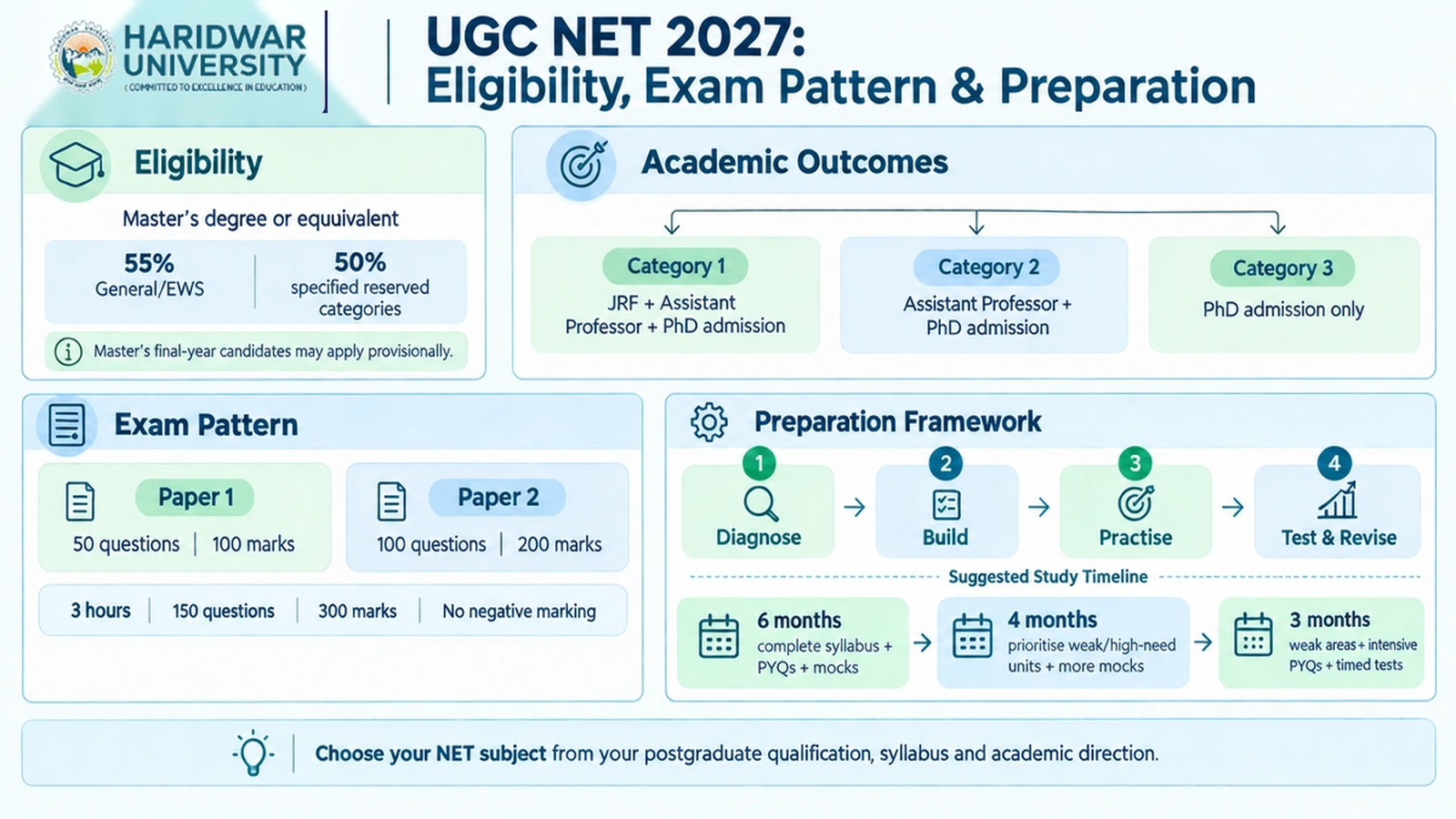
If you are pursuing or have completed a postgraduate degree and are considering UGC NET 2027, I would begin with a simple question: what do you want NET to help you achieve? UGC NET is not simply another competitive examination. Depending on the qualifying category, it can lead towards Assistant Professor eligibility, PhD admission, and, for eligible candidates, Junior Research Fellowship (JRF). The National Testing Agency (NTA) conducts the examination on behalf of the University Grants Commission (UGC).
That distinction matters because your preparation should start with your postgraduate subject and long-term career objective, not with a random collection of coaching notes. In this comprehensive guide, I will break down UGC NET eligibility, syllabus, exam pattern, and preparation strategy from the perspective of a PG student systematically planning for 2027.
Table of Contents
- • UGC NET Is a Career Route for Postgraduate Students
- • UGC NET Eligibility Depends on Your PG Qualification
- • UGC NET Offers Different Academic Outcomes
- • UGC NET Exam Pattern Has Two Different Preparation Demands
- • UGC NET Syllabus Requires Paper 1 and Subject-Specific Paper 2
- • PG Students Should Choose Their NET Subject Carefully
- • A Practical UGC NET Preparation Strategy for PG Students
- • A 3-Month, 4-Month, and 6-Month Study Plan
- • PYQs and Mock Tests Should Shape the Final Preparation Stage
- • UGC NET Preparation Can Fit Alongside a Postgraduate Degree
- • Frequently Asked Questions (FAQs)
- • Build Your Preparation Around the Career You Want
1. UGC NET Is a Career Route for Postgraduate Students
I often advise students not to treat a qualification exam as the career itself. UGC NET is a gateway, and what lies beyond that gateway depends directly on the specific category in which you qualify.
Under the current National Testing Agency (NTA) framework, UGC NET determines eligibility across three distinct qualifying tiers:
For Category 2 and Category 3 candidates, NET marks can be utilised directly as part of the Ph.D. admission evaluation, with 70% weightage allocated to NET test performance and 30% to the university or higher educational institution (HEI) interview or viva-voce, as established in the current UGC guidelines.
Before opening your first preparation textbook, decide whether your primary target is college-level teaching, funded doctoral research, Ph.D. enrollment, or a combination of all three.
2. UGC NET Eligibility Depends on Your PG Qualification
Under the official eligibility framework, educational qualification requirements are defined with strict minimum aggregate thresholds:
- General / Unreserved / General-EWS Candidates: Must secure at least 55% marks (without rounding off) in Master's degree or equivalent examination from UGC-recognised universities/institutions.
- Reserved Categories (OBC-NCL, SC, ST, PwD, Third Gender): Must secure at least 50% marks (without rounding off) in their qualifying postgraduate degree.
There is an indispensable provision for students currently pursuing their Master's degree: candidates who are in the final year of their Master's, or those who have appeared in the final semester examinations and are awaiting results, can apply provisionally. Such candidates are admitted provisionally and must complete their Master's degree with the requisite percentage within the timeframe stipulated by NTA.
Age Limit Regulations: For the award of Junior Research Fellowship (JRF), an upper age limit applies (typically 30 years with up to 5-year relaxations for OBC-NCL, SC, ST, PwD, women candidates, and applicants with research/armed service experience). Importantly, there is no upper age limit for candidates applying solely for Assistant Professor eligibility or Ph.D. admission.
Because minor criteria and dates update across cycles, I recommend reviewing the latest official notifications on the NTA UGC-NET Information Bulletin portal and official NTA release circulars before filing your 2027 application form.
3. UGC NET Offers Different Academic Outcomes
Clearing the UGC NET does not automatically hand you an appointment letter as an Assistant Professor. This is a critical distinction that every prospective academic must understand.
NET provides the statutory national eligibility benchmark; actual faculty appointments are governed by the recruitment ordinances, academic screening criteria (API/Academic Performance Indicators), and interview selections of individual central, state, or private universities and colleges.
If your postgraduate foundation is rooted in engineering, technology, or computer science disciplines, I also suggest reading Haridwar University's comprehensive roadmap on how to become an Assistant Professor in an engineering college in India to understand AICTE norms versus UGC guidelines.
4. UGC NET Exam Pattern Has Two Different Preparation Demands
The NTA conducts UGC NET as a single Computer-Based Test (CBT) lasting 3 continuous hours (180 minutes) without any scheduled break. The exam comprises two distinct objective-type multiple-choice papers:
Key examination rules to note:
- Each question carries 2 marks.
- There is NO negative marking for incorrect responses under the current examination scheme.
- Questions are presented in bilingual medium (English and Hindi), except for language-specific discipline papers.
This structure dictates an immediate strategy: do not prepare for Paper 1 and Paper 2 in the same way. Paper 1 requires wide conceptual familiarity and speed across 10 diverse modules. Paper 2 demands deep academic mastery and nuanced conceptual recall in your chosen discipline.
5. UGC NET Syllabus Requires Paper 1 and Subject-Specific Paper 2
Paper 1 consists of 10 standard units: Teaching Aptitude, Research Aptitude, Comprehension, Communication, Mathematical Reasoning & Aptitude, Logical Reasoning, Data Interpretation, Information & Communication Technology (ICT), People, Development and Environment, and Higher Education System.
Paper 2 is strictly aligned with the detailed syllabus of your chosen subject. Because Paper 2 carries twice the total marks (200 out of 300), your subject command will dictate whether you qualify for JRF or miss the cutoff entirely.
Always rely on the authentic syllabus released on the official UGC NET syllabus directory rather than secondary coaching summaries. Print the PDF syllabus, divide each unit into distinct sub-modules, and map each topic directly against your existing Master's semester notes.
6. PG Students Should Choose Their NET Subject Carefully
Subject selection is one of the earliest and most consequential decisions in your preparation journey. As per NTA rules, candidates should generally appear in the subject of their post-graduation. The NTA provides an extensive schedule of subject codes across humanities, commerce, management, computer science, and social sciences.
Before locking in your subject code, apply these three checks:
- Your Postgraduate Specialisation: Ensure your core Master's coursework covers at least 70% of the Paper 2 syllabus units.
- The NET Subject Code & Detailed Curriculum: Review the official syllabus document to verify which optional modules best match your thesis and elective subjects.
- Long-Term Academic and Teaching Trajectory: Consider the discipline in which you intend to teach, publish papers, or pursue doctoral research over the next decade.
Never choose an unfamiliar subject simply because coaching circles claim its cutoff was lower in the preceding cycle. True familiarity and subject affinity make sustained 6-month revision manageable and productive.
Prospective students evaluating Master's pathways can explore Haridwar University's postgraduate programmes guide to understand how robust postgraduate curricula integrate academic rigor with national examination readiness.
7. A Practical UGC NET Preparation Strategy for PG Students
Rather than relying on generic slogans like "study consistently for 8 hours daily", I advocate a 4-stage systematic methodology that can be measured and tracked week by week:
Stage 1: Diagnose (Week 1)
Download the official syllabus and attempt one recent previous-year question paper (PYQ) under timed conditions without prior revision. This establishes an honest baseline score and highlights immediate weak modules in Paper 1 and Paper 2.
Stage 2: Build Foundation (Months 1–3)
Work through Paper 2 syllabus units using standard academic textbooks and Master's lecture notes. Concurrently, allocate 60–90 minutes daily to Paper 1 topics, mastering Teaching Aptitude, Research Methodologies, and Data Interpretation.
Stage 3: Practise & Reinforce (Months 4–5)
Transition from passive reading to active problem solving. Solve topic-wise PYQs from the past 5 years. Understand the phrasing of assertion-reason and match-the-column questions, which frequently differentiate top scorers.
Stage 4: Simulate & Revise (Final Month)
Attempt full-length 3-hour computer-based mock tests in the exact exam slot (9 AM–12 PM or 3 PM–6 PM). Maintain an Error Notebook documenting recurring mistakes, missed conceptual nuances, and time-management bottlenecks.
An Error Notebook divided into three columns—Topic / Question Type, Nature of Error (Conceptual vs. Careless), and Corrective Takeaway—proves far more valuable in the final 15 days before the exam than piles of unread coaching handouts.
8. A 3-Month, 4-Month, and 6-Month Study Plan
Students frequently ask: "Can I clear UGC NET in 3 months?" The answer depends entirely on your existing postgraduate conceptual foundation and available study hours.
9. PYQs and Mock Tests Should Shape the Final Preparation Stage
Previous-Year Questions (PYQs) must be treated as a rigorous diagnostic mirror rather than an exercise in memorising past questions. After completing every PYQ exercise, subject yourself to this five-point diagnostic audit:
- Which specific syllabus unit or sub-topic produced the question?
- Did I understand the core theory, but misread the negative stem or conditional phrasing?
- Did I eliminate distractor options methodically, or did I guess prematurely?
- Did I consume excessive time on this specific question at the cost of simpler questions downstream?
- Was the lapse conceptual (knowledge gap) or factual (date, formula, or author omission)?
Because the exam has no negative marking, train yourself to make high-probability educated attempts on difficult items through process-of-elimination, ensuring zero unattempted questions at the end of 180 minutes.
10. UGC NET Preparation Can Fit Alongside a Postgraduate Degree
Postgraduate students do not need to pause their lives or wait until degree completion to embark on NET preparation. In reality, your regular postgraduate coursework is the best foundation for Paper 2:
- Semester Lecture Notes: Serve as first-pass comprehensive revision for Paper 2 units.
- Term Papers and Assignments: Expose conceptual gaps and train you in rigorous academic referencing.
- Research Methodology Seminars: Strengthen your foundation for Research Aptitude in Paper 1.
- Dissertations and Master's Theses: Cultivate reading endurance, critical evaluation, and analytical comprehension.
At Haridwar University, students can explore multidisciplinary higher education opportunities through the Haridwar University academic programmes overview, illustrating how university education bridges theoretical grounding with competitive career readiness.
Here is an effective weekly time allocation model that balances PG classes and NET prep:
• Monday to Friday (2.5 – 3 hrs/day): Paper 2 core reading connected to semester subjects + 45 minutes Paper 1 practice.
• Saturday (4 hrs): Unit-wise PYQ solving and Error Notebook updating.
• Sunday (3 hrs): Timed test or revision review, followed by goal setting for the upcoming week.
11. Frequently Asked Questions (FAQs)
Can postgraduate students apply for UGC NET?
Yes. Candidates who are pursuing their Master's degree or awaiting their final-year results can apply provisionally under the NTA eligibility framework, subject to completing the qualifying degree within the prescribed timeline with the required marks.
What percentage is required for UGC NET eligibility?
General, Unreserved, and General-EWS candidates require a minimum of 55% aggregate marks in their Master's degree or equivalent. Candidates belonging to OBC-NCL, SC, ST, PwD, and Third Gender categories require a minimum of 50% marks without rounding off.
Is UGC NET conducted in one paper?
No. The examination comprises two papers: Paper 1 (50 questions, 100 marks) testing teaching and research aptitude, and Paper 2 (100 questions, 200 marks) testing domain subject knowledge. Both papers are conducted together in a single 3-hour session without a break.
Is there negative marking in UGC NET?
No. Under the current examination scheme, there is no negative marking for incorrect answers. Each correct response is awarded two marks, making it advantageous for candidates to attempt every question.
Can UGC NET be cleared in three months?
Yes, a three-month preparation timeline is achievable if you already have a sound conceptual foundation in your postgraduate discipline and dedicate disciplined hours to high-yield PYQs, syllabus mapping, and Paper 1 practice. If your fundamentals are weak, a 4 to 6-month plan is recommended.
Does qualifying UGC NET guarantee an Assistant Professor job?
No. Qualifying NET fulfills the national eligibility requirement for Assistant Professor appointments. However, actual recruitment depends on college/university vacancies, institutional screening criteria (Academic Performance Indicators), and performance in selection interviews.
Should PG students start UGC NET preparation before completing their degree?
Yes. Starting during your Master's degree enables you to align daily classroom learning directly with Paper 2 syllabus units, saving significant time and allowing you to sit for the examination provisionally in your final year.
12. Build Your Preparation Around the Career You Want
When I speak to students preparing for competitive examinations, I always advise bringing the conversation back to the career vision behind the test.
Preparing for UGC NET 2027 should not devolve into an endless treadmill of collecting unread PDFs, binge-watching random lectures, and taking unstructured tests without clarity of purpose. Begin with your postgraduate subject, understand the qualification rules, systematically study the official syllabus, decouple Paper 1 and Paper 2 demands, and track your progress through objective diagnostics.
For one student, NET is the direct path toward Assistant Professorship and classroom teaching. For another, it unlocks a funded Junior Research Fellowship and a premier doctoral programme. Prepare with discipline for the examination—but keep the academic and professional life you want in sharp focus throughout the journey.
Shape Your Higher Education & Research Career at Haridwar University
Advance your academic ambitions with comprehensive postgraduate and doctoral programmes supported by research-driven faculty, state-of-the-art laboratories, and dedicated competitive mentoring.