

How to Become an Assistant Professor in an Engineering College in India: Eligibility, Skills & Career Path
Mr. Abhinav Bhatnagar
Assistant Professor, Mechanical Engineering, Haridwar University
If you are an engineering graduate who enjoys teaching as much as designing, analysing or building, academia can be a serious, deeply rewarding career option. But how to become an Assistant Professor in an engineering college in India is not answered by a single degree or a one-size-fits-all examination. The exact route depends on your highest academic qualification, engineering branch, the type of institution (IITs, NITs, state universities, or private engineering colleges), and the specific recruitment rules governing that post.
I often tell students that teaching should never be treated as an aimless fallback after engineering. An exceptional engineering faculty member needs technical depth, laboratory judgement, and the communication mastery to break difficult mathematical and physical concepts into intuitive lessons. Your degrees get your application screened; what you contribute in the classroom, laboratory and research ecosystem determines how far your academic career progresses.
Table of Contents
- 1. Why Engineering Graduates Choose Academic Careers
- 2. The Qualification Pathway for Engineering Faculty
- 3. M.Tech and M.E. Create a Stronger Route into Engineering Teaching
- 4. UGC-NET Has a Specific Role in Faculty Eligibility
- 5. The Recruitment Process Extends Beyond Qualifications
- 6. Engineering Faculty Need More Than Academic Degrees
- 7. Assistant Professor Salary Depends on the Institution and Role
- 8. Academic Career Growth Requires Teaching and Research
- 9. Haridwar University Connects Engineering Education With Practical Learning
- 10. Frequently Asked Questions (FAQs)
- 11. Build the Academic Career Intentionally
1. Why Engineering Graduates Choose Academic Careers
An engineering faculty career uniquely merges three pillars: classroom pedagogy, hands-on laboratory application, and scientific inquiry. A typical day for an Assistant Professor is rarely monotonous:
- Delivering an engineering mathematics, fluid dynamics, or structural analysis lecture in the morning.
- Supervising a high-precision experimental laboratory or computer simulation lab before noon.
- Mentoring final-year student capstone projects, electric vehicle prototypes, or robotics clubs in the afternoon.
- Authoring research papers, applying for seed grants, or reviewing technical literature in the evening.
Technical education in India is evolving rapidly. Artificial intelligence, electric mobility, semiconductor design, advanced manufacturing, and renewable microgrids are fundamentally reshaping engineering curricula. A dedicated faculty member has the privilege—and responsibility—of continuously upskilling alongside their students.
2. The Qualification Pathway for Engineering Faculty
Faculty qualifications in Indian technical education fall under the regulatory standards established by the University Grants Commission (UGC) and the All India Council for Technical Education (AICTE).
The UGC maintains formal regulations specifying minimum qualifications for teachers and academic staff in universities and colleges (UGC Regulations Portal, including the 4th Amendment Regulations, 2024). For engineering colleges and polytechnics, AICTE's Faculty Cadre Regulations and approval guidelines set out the specific academic requirements for engineering branches.
For an engineering student, the career pathway progresses through structured stages:
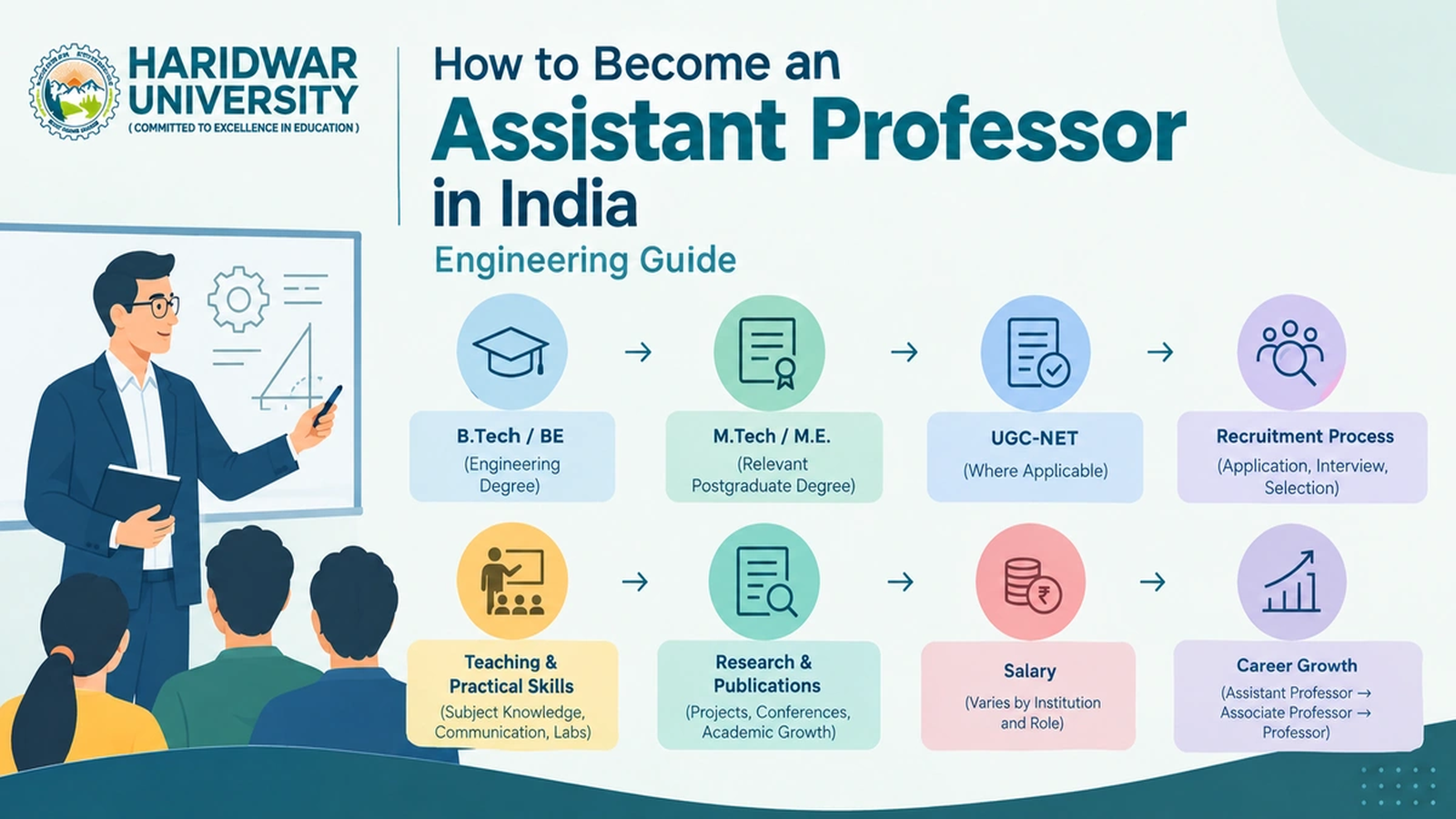
B.Tech / B.E. → Relevant Postgraduate Qualification (M.Tech / M.E.) → Statutory Eligibility → Faculty Recruitment → Assistant Professor → Doctoral Research → Academic Progression
3. M.Tech and M.E. Create a Stronger Route into Engineering Teaching
One of the questions students ask me most often is: "Can I become an Assistant Professor after completing M.Tech?"
In engineering disciplines, postgraduate credentials have historically formed a vital gateway into teaching roles. Judicial precedents interpreting AICTE's technical-education framework (Indian Kanoon Landmark Rulings) have affirmed B.E./B.Tech and M.E./M.Tech with First Class in the appropriate branch as the foundational baseline for technical Assistant Professor recruitment.
I advise aspiring engineering educators to follow this roadmap:
- Graduate with a strong academic record in B.Tech / B.E. in your core discipline.
- Crack GATE or institute entrance exams to secure admission into an M.Tech / M.E. specialisation.
- Master fundamental teaching and laboratory protocols during postgraduate teaching assistantships.
- Track official recruitment advertisements published by autonomous institutions and state universities.
- Enrol in a Ph.D. program if your long-term goal is research leadership, university professorship, or institute directorship.
4. UGC-NET Has a Specific Role in Faculty Eligibility
There is frequent confusion regarding the role of UGC-NET in technical education. Conducted by the National Testing Agency (NTA), UGC-NET certifies eligibility for Assistant Professorship and Junior Research Fellowship (NTA Examination Information). Candidates must hold a Master’s degree with at least 55% marks (50% for reserved categories).
However, engineering graduates must note an essential nuance: UGC-NET is primarily structured around humanities, commerce, sciences, and computer applications; core technical engineering branches fall under AICTE guidelines where M.Tech and GATE carry central weight. Furthermore, qualifying NET establishes eligibility where mandated, but does not guarantee an appointment. You must always review the specific eligibility rules stated in each recruitment notification.
5. The Recruitment Process Extends Beyond Qualifications
Meeting minimum eligibility gets your resume shortlisted. The selection process evaluates your real-world capability as an educator and researcher:
| Recruitment Stage | What the Selection Committee Assesses |
|---|---|
| Application Screening | Degree relevance, marks percentage, accredited institute background, statutory eligibility |
| Academic Shortlisting | Specialisation match, journal publications (SCI/Scopus), GATE score, research thesis quality |
| Technical Assessment | Written test or deep technical Q&A on engineering fundamentals and applied mechanics |
| Teaching Demonstration (Demo Class) | Clarity of blackboard/presentation delivery, student engagement, pedagogical structuring |
| Comprehensive Interview | Conceptual depth, poise under tough questioning, attitude towards mentoring and institutional duty |
| Research Presentation | Plan for sponsored research, patent filing ability, and postgraduate student guidance |
| Final Selection & Offer | Overall composite score under statutory selection committee guidelines |
6. Engineering Faculty Need More Than Academic Degrees
To build a distinguished teaching career, develop five foundational proficiencies:
- Subject Mastery Without Slides: You should be capable of explaining core derivations and design calculations on a whiteboard without leaning entirely on pre-written PowerPoint decks.
- Pedagogical Structuring: Exceptional teachers understand cognitive load—introducing fundamental intuition first, followed by mathematical formalisation and industrial context.
- Practical Lab & Prototyping Capability: Engineering is practical. Faculty experienced with CNC milling, microcontrollers, CAD modeling, and instrumentation immediately command greater classroom respect.
- Active Research Orientation: Publications in peer-reviewed journals, participation in national conferences, and collaborative R&D define academic longevity. At Haridwar University, our institutional Research Promotion Policy provides seed funding and financial incentives for faculty research publications and patent grants.
- Empathy and Mentorship: Guiding young engineers through academic frustration and career anxiety is a core professional responsibility.
7. Assistant Professor Salary Depends on the Institution and Role
Salary structures vary substantially across institutional classifications:
- Central & State Government Institutions: Follow the 7th Central Pay Commission (CPC) Pay Band (Academic Level 10, typically starting with basic pay of ₹57,700 plus DA, HRA, and allowances, bringing total gross emoluments between ₹85,000 to ₹1,10,000 per month). Relevant notifications are tracked on the UGC Pay Scale Public Notice.
- Private Engineering Colleges & State Private Universities: Offer competitive compensation based on applicant qualifications, M.Tech/Ph.D. pedigree, research track record, subject demand (e.g., AI/ML, Data Science, VLSI), and industry experience.
When evaluating an appointment, look beyond starting monthly compensation. Evaluate the teaching load, research funding, laboratory freedom, sponsorship for doctoral studies, and promotional pathways.
8. Academic Career Growth Requires Teaching and Research
Assistant Professor is an entry-level designation in higher education. With experience, research credentials, and doctoral qualifications, you can advance through a clear promotional hierarchy:
Assistant Professor (Senior / Selection Grade) → Associate Professor → Professor → Head of Department (HOD) → Dean / Principal → Vice-Chancellor
Senior promotions depend heavily on Academic Performance Indicators (API scores), research publication citations, doctoral scholars guided, and external funding secured. Staying connected with industrial applications is equally vital—as explored in my guide on B.Tech Mechanical Engineering with AI, modern engineering education bridges software analytics directly with mechanical hardware.
9. Haridwar University Connects Engineering Education With Practical Learning
At Haridwar University, this pedagogical balance is central to our engineering mission. The Roorkee College of Engineering brings together multidisciplinary faculties, advanced CNC and IoT labs, and active student project teams across Mechanical, Civil, Electrical, and Computer Engineering.
For students exploring both corporate and academic avenues after graduation, our comprehensive guide on career paths after B.Tech Mechanical Engineering examines how industry roles, government public-sector opportunities (PSUs), and higher education (M.Tech/Ph.D.) intersect.
10. Frequently Asked Questions (FAQs)
Is M.Tech eligible for Assistant Professor?
M.Tech can be an important qualification for engineering faculty positions, but eligibility depends on the applicable regulatory framework and the specific recruitment notification.
Can B.Tech graduates become Assistant Professors?
A B.Tech alone should not be assumed to qualify a candidate for every Assistant Professor position. Engineering faculty requirements vary by institution, discipline and applicable regulations.
Is UGC-NET mandatory for engineering faculty?
Not universally for every engineering faculty appointment. UGC-NET determines Assistant Professor eligibility in its covered framework, while individual recruitment is governed by the applicable institutional or government rules.
Can I become an Assistant Professor after M.Tech without a PhD?
This depends on the institution, discipline and recruitment rules applicable to the post. Candidates should check the exact eligibility criteria in the recruitment advertisement rather than relying on a blanket rule.
What skills should an engineering Assistant Professor have?
Strong subject knowledge, teaching ability, laboratory and project experience, communication, mentoring and research capability are all valuable.
Does an Assistant Professor need research experience?
Research expectations vary by institution and position. However, research capability becomes increasingly important for academics who want to progress into research-intensive and senior faculty roles.
Is an Assistant Professor career suitable for every engineer?
No. It suits engineers who genuinely enjoy teaching, mentoring, technical learning and research. If you prefer only industrial execution and commercial project work, an industry career may be a better fit.
11. Build the Academic Career Intentionally
Becoming an Assistant Professor in an engineering college is not a shortcut; it is a dedicated professional vocation. If you see yourself enjoying the process of breaking down complex engineering principles, mentoring inquisitive students, and conducting experimental research long after your own degree is completed, higher education offers a fulfilling career.
The qualification opens the door. Your competence, passion for engineering, and student impact determine the legacy you build.
Pursue Engineering Excellence at Haridwar University
Learn from experienced faculty and industry veterans at Roorkee College of Engineering. Build deep practical competence in state-of-the-art laboratories and prepare for distinguished careers in industry, higher research, and academia.