

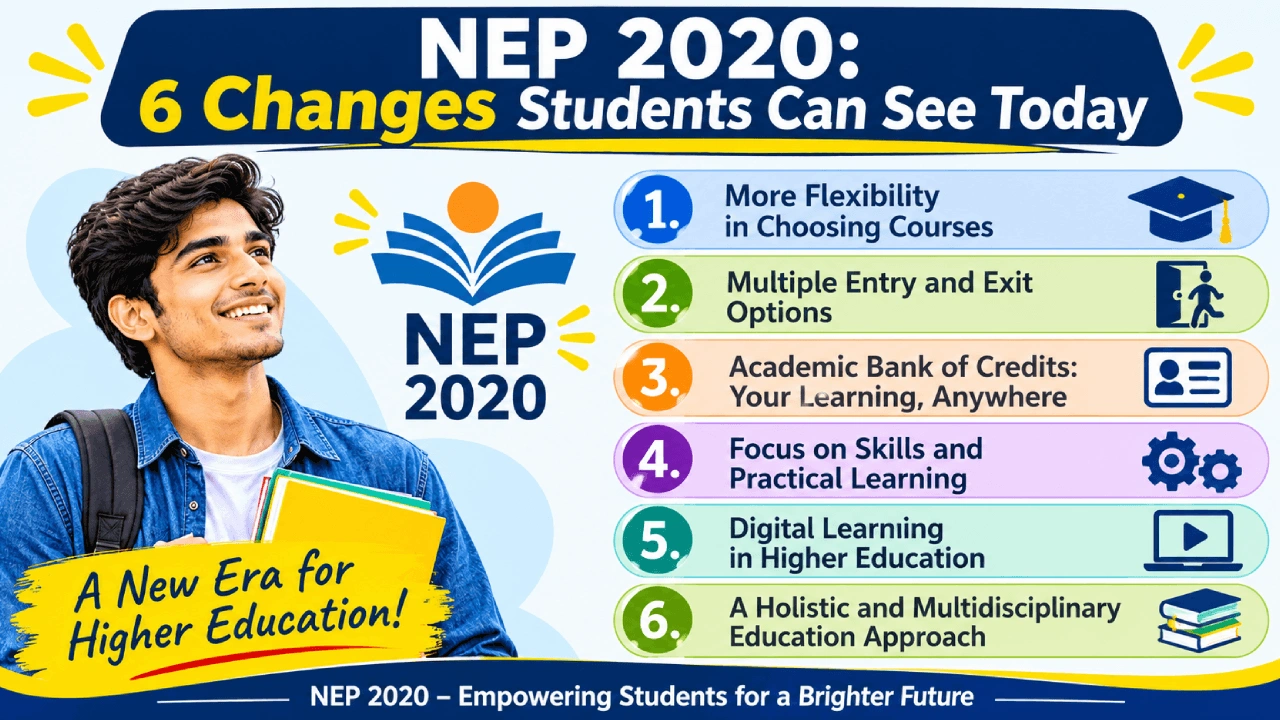
NEP 2020: 6 Changes Students Can See Today
Dr Aadesh K. Arya
Pro Vice-Chancellor, Haridwar University
When students and parents discuss the National Education Policy (NEP) 2020, one fundamental question deserves focused attention: What Has Actually Changed after NEP 2020 for Students? The policy introduced a profound structural transformation in Indian higher education—shifting the academic landscape away from rigid degree silos toward flexible learning paths, multidisciplinary choices, industry-linked skill development, and nationwide credit mobility. However, because higher education institutions implement these reforms progressively, understanding how these changes operate on the ground is essential for every prospective and continuing undergraduate.
For students entering university today, this transformation is directly visible in how degree programmes are designed, how academic credits are accumulated digitally through the Academic Bank of Credits (ABC), and how practical internships are integrated into the curriculum. As documented in the Ministry of Education's recent annual updates and University Grants Commission (UGC) regulations, Indian higher education is moving toward a student-centric learning model.
Overview: Traditional College Model vs. NEP 2020 Direction
| Focus Area | Traditional Approach | Direction Under NEP 2020 |
|---|---|---|
| Curriculum Structure | Rigid, pre-set subject combinations within a single discipline. | Flexible, multidisciplinary choices combining majors, minors, and electives. |
| Programme Duration | Strict 3-year or 4-year completion with "all-or-nothing" exit. | Multiple entry and exit pathways (Certificate, Diploma, Degree, Honours). |
| Academic Records | Institution-locked physical mark sheets and grade cards. | Portable digital credit accumulation via the Academic Bank of Credits (ABC). |
| Learning Pedagogy | Heavy emphasis on rote memorisation and passive classroom lectures. | Hands-on, experiential, project-based and skill-oriented coursework. |
| Online Education | Treated as secondary, supplementary, or unrecognised. | Formal recognition of up to 40% course credits via SWAYAM/NPTEL portals. |
| Career Preparation | Theory-heavy focus often disconnected from industry needs. | Mandatory internships, apprenticeships, and industry problem-solving. |
Table of Contents
- From a Fixed Degree Structure to More Flexible Learning
- Multiple Entry and Exit: More Options When Life Interrupts Education
- Academic Bank of Credits: Making Academic Records More Portable
- Learning Beyond One Subject: Skills, Internships and Practical Exposure
- Digital Learning and Student Participation in Higher Education
- What Students Should Check Before Choosing a University
- Frequently Asked Questions (FAQs)
1. From a Fixed Degree Structure to More Flexible Learning
One of the most consequential changes introduced by NEP 2020 is dismantling the artificial barriers between sciences, humanities, commerce, and vocational streams. In the traditional higher education paradigm, an undergraduate followed a rigid, locked syllabus. If you enrolled in Computer Science, studying business finance or design was rarely possible; if you enrolled in Commerce, studying programming or data science was completely off-limits.
NEP 2020 actively dismantles these walls through the UGC's Curriculum and Credit Framework for Undergraduate Programmes (CCFUP). Today, undergraduate education is structured around a Major discipline (comprising at least 50% of your total credits), while allowing the remaining credit envelope to be customised with multidisciplinary courses, minor specialisations, and vocational electives.
For example, a student pursuing a B.Tech in Computer Science can strategically add a minor in Finance or Entrepreneurship, while a management student can complete courses in Python programming, machine learning, and business analytics. This multidisciplinary design mirrors modern industry realities, where technology leaders need commercial acumen and business managers need quantitative data fluency. To understand how to select these course blocks strategically, read our guide on how to choose minor and elective subjects strategically.
What Does Flexible Learning Mean for You?
- Interdisciplinary Freedom: Freedom to choose courses aligned with your personal career vision rather than an arbitrary curriculum silo.
- Dual Competence: The opportunity to graduate with both deep technical mastery (Major) and applied commercial versatility (Minor).
- Continuous Curriculum Updates: Syllabi that evolve with emerging technologies and industry best practices.
At Haridwar University, Roorkee, students explore industry-aligned programmes across engineering, computing, management, commerce, agriculture, pharmacy, and allied health sciences designed within this holistic, multidisciplinary framework.
2. Multiple Entry and Exit: More Options When Life Interrupts Education
Historically, Indian higher education operated on an uncompromising principle: if a student completed two full years of a three-year or four-year programme and was forced to withdraw due to personal, financial, medical, or family obligations, they left campus with zero formal qualifications. The time, tuition fees, and academic effort invested were largely lost.
Under the NEP 2020 framework, degrees are partitioned into accredited milestones that recognise cumulative academic achievement at each stage:
| Completed Academic Stage | Awarded Qualification | Key Credit Conditions |
|---|---|---|
| 1st Year (2 Semesters) | Undergraduate Certificate | ~40 credits + 4 mandatory skill-enhancement credits. |
| 2nd Year (4 Semesters) | Undergraduate Diploma | ~80 credits + 4 mandatory skill-enhancement credits. |
| 3rd Year (6 Semesters) | Bachelor’s Degree | ~120 credits across core major and multidisciplinary areas. |
| 4th Year (8 Semesters) | Bachelor’s Degree (Honours / Research) | ~160 credits with dissertation/capstone research project. |
These exit credentials provide immense peace of mind. A student who pauses their degree to take up an immediate job or handle family obligations receives a certified, nationally recognised credential and retains the regulatory right to re-enter the higher education system within the prescribed timeframe to complete their degree. For comprehensive regulatory details, read our in-depth analysis on 4-year UG degree exit options and NEP guidelines.
3. Academic Bank of Credits: Making Academic Records More Portable
The Academic Bank of Credits (ABC), established under NEP 2020 and anchored on DigiLocker through the Ministry of Education’s Digital India framework, serves as a digital commercial bank for your academic achievements. Instead of relying on vulnerable paper transcripts that must be physically verified by college registrar offices, your credits are digitally deposited, authenticated, and accumulated against a unique 12-digit ABC ID.
Under UGC regulations, credits deposited in your ABC account have a validity shelf life of up to seven years. If you decide to transfer between universities, pursue higher education elsewhere, or redeem credits toward a degree, the receiving institution can evaluate and recognise your past learning transparently. For a complete guide on how this process works, explore our post on credit transfer and the Academic Bank of Credits.
Practical ABC Tip for Students: Ensure you generate your official ABC ID via abc.gov.in or the DigiLocker app before university registration, and confirm that your university's examination branch links your semester grade cards to your ABC account.
4. Learning Beyond One Subject: Skills, Internships and Practical Exposure
One of the most persistent criticisms of Indian university education was the divide between classroom theory and real-world workplace demands. Graduates frequently entered the job market with high theoretical test scores but limited applied problem-solving abilities.
NEP 2020 directly tackles this challenge by institutionalising practical, experiential, and work-integrated learning:
- Mandatory Internships and Apprenticeships: Under the latest UGC guidelines, internships are no longer optional side activities—they carry official credit weightage on your semester grade card. Students engage directly with corporate environments, production facilities, or research laboratories.
- Domain-Specific Skill Labs:
- Engineering & Computing: Applied software development, robotics, VLSI design, IoT laboratories, and cloud architecture deployments.
- Management & Commerce: Live market research projects, financial simulation modelling, and ERP software training.
- Agriculture & Allied Health Sciences: Experiential field-crop cultivation, hospital postings, clinical patient care rotations, and diagnostic pathology workflows.
- Value-Added Skill Certifications: Integrated certification modules in AI tools, cyber defence, communication, and business analytics embedded directly within undergraduate curricula.
At Haridwar University, experiential learning is a cornerstone of the academic model. Advanced laboratories, dedicated incubation centres, and active corporate tie-ups ensure students graduate with proven execution capabilities, not just textbook knowledge.
5. Digital Learning and Student Participation in Higher Education
Digital education under NEP 2020 has matured from emergency remote teaching into a powerful, accredited pillar of higher learning. Through government-backed national digital portals such as SWAYAM and NPTEL, students across India have direct access to courses developed and taught by premier faculty from IITs, IIMs, and central universities.
Crucially, UGC regulations allow students to earn up to 40% of their total degree credits through approved online platforms, provided their host university has adopted the UGC credit-transfer framework. This provides three major benefits:
- Access to Niche Subjects: Study cutting-edge subjects (such as quantum computing, bioinformatics, or international intellectual property law) that your physical college might not offer.
- Flexible Study Pacing: Balance intensive laboratory schedules by taking approved online courses during breaks or evening hours.
- Official Credit Integration: Verified proctored exam scores from SWAYAM/NPTEL transfer directly onto your university marks sheet. Read our detailed guide on adding SWAYAM and NPTEL credits to your degree for full procedural steps.
6. What Students Should Check Before Choosing a University
While NEP 2020 establishes a visionary national framework, the quality of your academic journey depends on how effectively your university translates these policies into reality. Before finalising your admission, evaluate every institution using this practical checklist:
1. UGC CCFUP Adoption & Elective Availability
Confirm whether the university has actively transitioned to the UGC Curriculum and Credit Framework. Ask specifically about the roster of open electives and minor tracks available to students in your branch.
2. ABC Integration and Digital Portability
Ensure the university actively deposits course credits to DigiLocker’s Academic Bank of Credits portal each semester so your academic records remain safe and portable.
3. Practical Infrastructure and Student Support
Look beyond campus brochures to inspect laboratories, computing facilities, and student guidance services. At Haridwar University, students have access to dedicated counselling and mentoring assistance and comprehensive student welfare services. To explore the daily student experience, read our guide to life at Haridwar University.
4. Transparent Fees and Scholarship Opportunities
Verify annual programme fee structures and institutional financial aid upfront. Review Haridwar University’s official Fees and Scholarships page to evaluate merit concessions and the ₹5,000 semesterly Academic Excellence Award.
7. Frequently Asked Questions (FAQs)
1. What is the main purpose of NEP 2020 for higher education students?
NEP 2020 transforms Indian higher education into a flexible, multidisciplinary, and student-centred system. It eliminates rigid academic boundaries, facilitates academic credit mobility through ABC, embeds practical internships, and expands access to accredited digital education.
2. Does NEP 2020 allow students to leave a degree after one year?
Yes. Under the UGC multiple entry and exit framework, students completing Year 1 (~40 credits plus 4 vocational/skill credits) are eligible for an Undergraduate Certificate, provided their university has implemented the exit option for that specific programme.
3. What is the Academic Bank of Credits (ABC)?
The Academic Bank of Credits is a national digital platform linked to DigiLocker that records, stores, and transfers academic credits earned by students. It empowers students with lifelong learning portability and seamless inter-institutional mobility.
4. Can students change universities under NEP 2020?
Yes, subject to institutional admission rules and syllabus equivalence checks. The ABC platform enables the transfer of earned credits, allowing the receiving university to recognise completed coursework without forcing the student to restart their degree from scratch.
5. Does NEP 2020 allow students to study different subjects together?
Yes. NEP 2020 actively encourages multidisciplinary subject combinations. An engineering student can take electives in management or design, while a humanities or commerce student can study artificial intelligence and data science.
6. Are internships compulsory for every undergraduate student?
Under UGC CCFUP guidelines, internships or practical apprenticeships carrying 2 to 4 credits are integrated into undergraduate curricula to ensure graduates possess verifiable, real-world industry exposure before graduation.
7. Can SWAYAM and NPTEL courses count towards a university degree?
Yes. Where an institution has formally adopted the UGC online credit transfer regulations, students can earn up to 40% of their total programme credits through approved SWAYAM and NPTEL courses with proctored examinations.
8. Has every university in India implemented all NEP 2020 provisions?
Implementation is progressive across Indian states and central bodies. Leading autonomous universities and progressive state institutions have adopted flexible degree frameworks, while others are rolling them out in planned phases. Always confirm the specific status of your chosen programme.
9. How can students identify a university following the NEP 2020 framework?
Review the university’s published curriculum documents, check whether they mandate an ABC ID during enrollment, verify their industry internship tie-ups, and review whether open electives and minors are actively offered across departments.
Shape Your Future with an NEP-Aligned University
Experience flexible, multidisciplinary learning with industry-linked internships and digital credit mobility at Haridwar University. Admissions are open for the 2026-27 academic session.