

Table of Contents
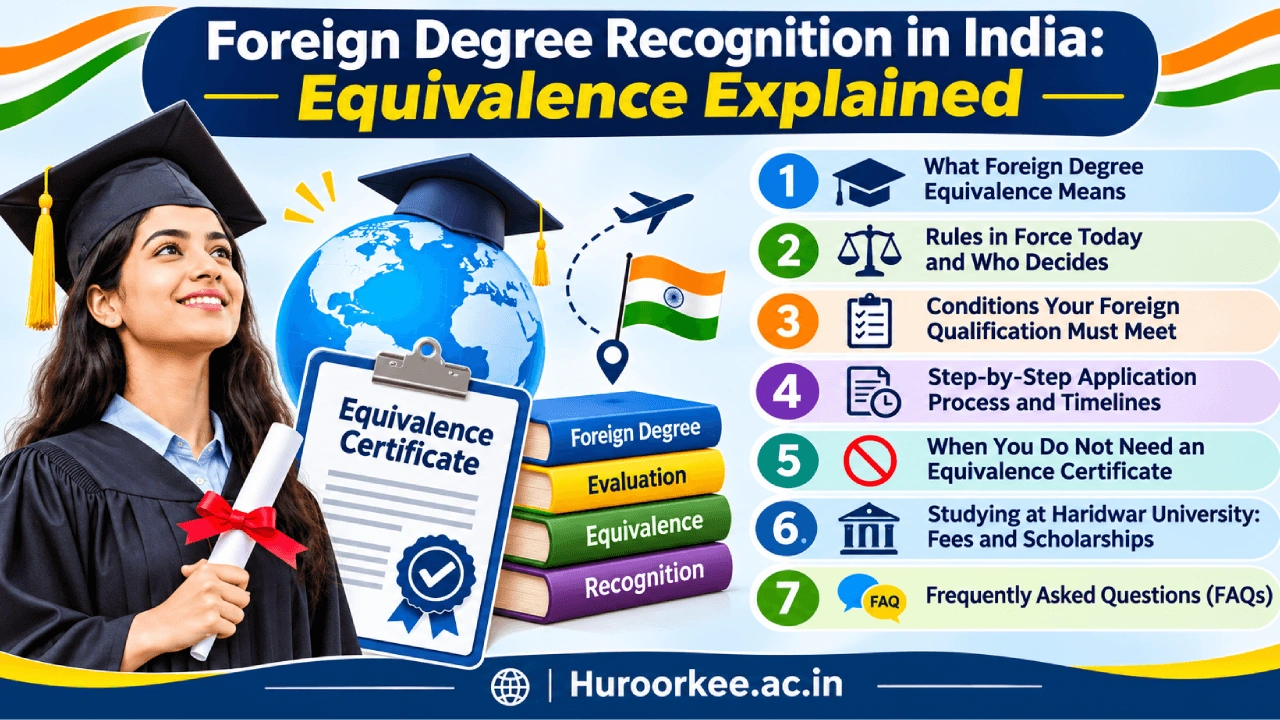
- 1. What Foreign Degree Equivalence Means
- 2. Rules in Force Today and Who Decides
- 3. Conditions Your Foreign Qualification Must Meet
- 4. Step-by-Step Application Process and Timelines
- 5. When You Do Not Need an Equivalence Certificate
- 6. Studying at Haridwar University: Fees and Scholarships
- 7. Frequently Asked Questions (FAQs)
A graduate returns to India with a degree from a foreign university and applies for a master’s programme, a doctoral seat, or a public sector appointment. The very first question at the verification desk is whether that foreign qualification is formally recognized in India.
Foreign Degree Recognition in India operates through a statutory procedure known as equivalence. Since April 2025, the University Grants Commission (UGC) processes all academic equivalence applications directly through a centralized digital portal. This guide details who requires an equivalence certificate, what the regulations mandate, processing timelines, and key planning steps if your next academic milestone is at Haridwar University.
1. What Foreign Degree Equivalence Means
Equivalence is an official statutory declaration certifying that an academic qualification earned from a foreign institution sits at parity in academic level with a corresponding qualification awarded by an Indian university.
Level Parity vs. Subject Suitability: The UGC equivalence certificate establishes level parity — meaning your foreign master’s degree is legally recognized as a postgraduate degree in India. However, whether your specific coursework covers the prerequisite syllabus required for a specific job post or university specialization remains the prerogative of the recruiting agency or admitting department.
Historically, equivalence certificates were issued by the Association of Indian Universities (AIU). Under the April 2025 statutory regulations, the University Grants Commission assumed direct authority for processing and issuing foreign equivalence certificates.
2. Rules in Force Today and Who Decides
The legal yardstick is the UGC (Recognition and Grant of Equivalence to Qualifications obtained from Foreign Educational Institutions) Regulations, 2025, gazetted on 4 April 2025. Applications are processed through a dedicated Standing Committee constituted by the UGC.
Regulated Professional Disciplines
A crucial limitation: qualifications in Medicine (MBBS/MD), Pharmacy (B.Pharm), Nursing, Law (LLB), and Architecture are explicitly excluded from UGC’s general equivalence framework. Practice and academic recognition in these fields remain under the jurisdiction of their respective statutory bodies: the National Medical Commission (NMC), Pharmacy Council of India (PCI), Indian Nursing Council (INC), Bar Council of India (BCI), and Council of Architecture (COA).
3. Conditions Your Foreign Qualification Must Meet
Regulation 3 sets out three baseline criteria:
- Host Country Recognition: The awarding institution must be duly recognized and accredited under the legal framework of its home country.
- Authentic Study Pathway: The student must have been admitted and evaluated according to the institution’s approved full-time or formal instructional norms.
- Entry Requirements Parity: The prerequisite entry qualifications must be broadly comparable to the corresponding entry requirements in India.
How the Standing Committee Evaluates Curricula
The committee assesses minimum duration, total credit points, distribution of core and elective modules, laboratory and practical hours, and mandatory dissertations or internships. If the foreign programme duration is shorter than the conventional Indian timeline (e.g., a 1-year UK master’s or 3-year European honours degree), the evaluation pivots to normalized credit volume. A variation of up to 10% in normalized credits may be accepted. A shorter duration alone does not trigger automatic rejection.
Once enrolled in an Indian institution, see how credits are banked and transferred in our guide on the Academic Bank of Credits and credit mobility.
Offshore Campuses and Foreign School Boards
Degrees earned at an offshore branch campus are recognized only if the campus holds statutory accreditation in both the host nation and the university’s home nation. For undergraduate entry, foreign secondary school certificates qualify when the student completes at least 12 years of formal schooling recognized for degree admission in that country, or through systems already recognized as equivalent to CBSE, ISC, or State Boards.
4. Step-by-Step Application Process and Timelines
The equivalence application is completely digital. Candidates must scan and upload:
- Original degree certificate or official provisional qualification.
- Official year-wise / semester-wise transcripts showing grading scales and credits.
- Documentary proof of institutional accreditation in the host country.
- Authenticated English translations if documents are in a foreign language.
Apostille vs. Equivalence: What Is the Difference?
An apostille authenticates the legal signature and official seal on a foreign document under the Hague Convention of 1961, confirming it is not a forged piece of paper. It does not evaluate syllabus depth, academic levels, or credit rigor. Equivalence, on the other hand, evaluates academic depth and level parity. For a detailed breakdown of document legalization, read our guide on degree attestation and apostille procedures.
Statutory Processing Timelines
5. When You Do Not Need an Equivalence Certificate
Under Regulation 5, you are exempt from applying for an individual equivalence certificate if your qualification was earned through:
- Inter-governmental bilateral educational agreements between India and the host country.
- Formal twinning, joint degree, or dual degree programmes conducted under UGC’s 2022 Regulations.
- Offshore campuses of foreign universities established in India under UGC’s 2023 regulations (or GIFT City regulations).
6. Studying at Haridwar University: Fees and Scholarships
Many returnees complete their foreign degree equivalence to pursue higher postgraduate specializations or doctoral research in India. Haridwar University, Roorkee, offers UGC-recognized and AICTE-approved campus programmes across Engineering, Management, Computing, Agriculture, and Health Sciences.
Detailed application procedures are published on the Haridwar University Admission Overview portal. Below are the published 2026-27 benchmark figures from HU’s official Fees & Scholarships directory:
First-Year Tuition Scholarships at HU
On-campus students maintaining 85%+ in semester exams with zero backlogs also receive the ₹5,000 Award of Academic Excellence. The on-campus Student Care Centre in each academic block ensures student query resolution within 24 hours. For welfare and financial paperwork assistance, visit the Student Welfare Service desk.
7. Frequently Asked Questions (FAQs)
1. What is an equivalence certificate?
It is an official certification from the UGC confirming that a foreign qualification matches a corresponding Indian qualification in academic level, making it valid for higher education, research, and employment in India.
2. Who issues foreign degree equivalence certificates in India now?
The University Grants Commission (UGC) issues equivalence certificates through its dedicated online portal under the regulations notified on 4 April 2025. Previously, AIU issued these certificates.
3. How long does the UGC take to decide an equivalence application?
UGC must communicate its formal decision within 15 working days from receiving the complete application. If additional documentation is required, candidates receive 15 working days to respond.
4. Which documents are required for foreign degree equivalence?
Original degree certificate, official transcripts showing credit hours and grading scales, proof of institutional accreditation in the host nation, and authenticated English translations if non-English.
5. Can foreign medical, law, or nursing degrees obtain UGC equivalence?
No. Medicine, Pharmacy, Nursing, Law, and Architecture fall strictly outside UGC equivalence regulations. Recognition in these disciplines is governed directly by individual statutory councils (NMC, PCI, INC, BCI, COA).
6. What if my foreign course duration was shorter than the Indian degree?
The UGC Standing Committee compares total credit volume and instructional depth rather than duration alone. A variation of up to 10% in normalized credits may be accepted.
7. What should I do if my equivalence application is rejected?
You can file an appeal for formal review within 30 working days from the decision notice, alongside the prescribed review fee. A dedicated Review Committee evaluates the appeal within 15 working days.
8. Do online or distance foreign degrees qualify for equivalence?
Degrees earned purely through unaccredited online portals or franchise centres are not eligible. Only formal, accredited instructional programmes conforming to UGC regulations are recognized.
9. Is an apostille the same as an equivalence certificate?
No. An apostille authenticates document seals and signatures under the Hague Convention. Equivalence evaluates academic content, credits, and curricular parity.
Advance Your Academic Career at Haridwar University
Whether you are completing foreign degree equivalence or planning an accredited undergraduate, postgraduate, or research degree in India, Haridwar University delivers UGC-recognized academic excellence, state-of-the-art laboratories, and premier placement support.