

Table of Contents
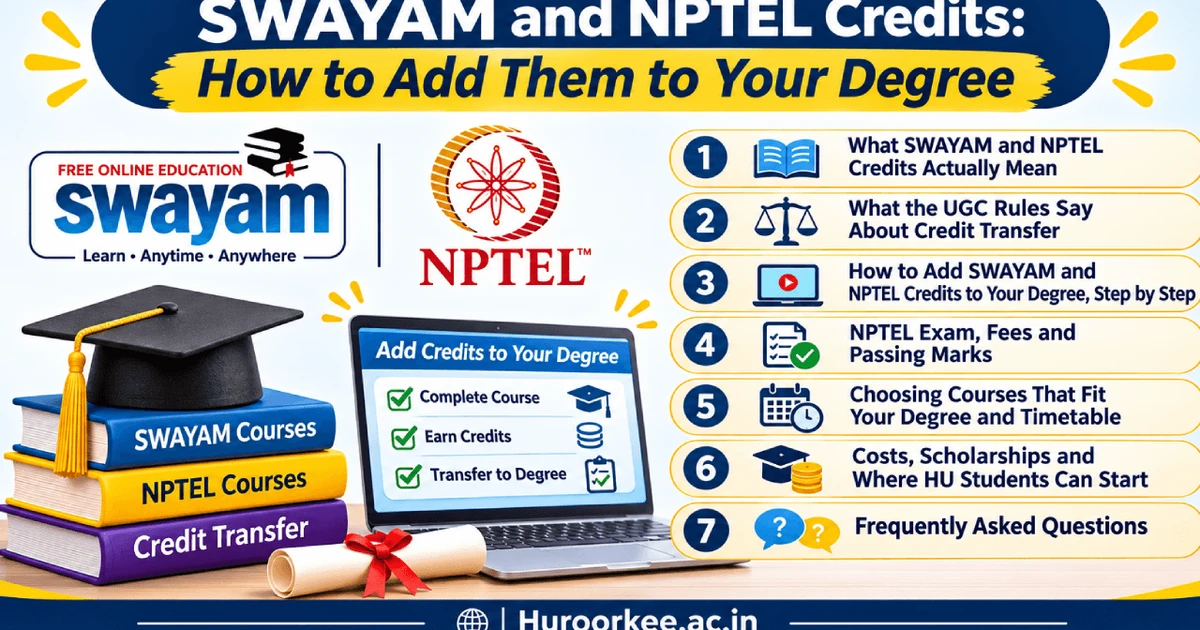
- 1. What SWAYAM and NPTEL Credits Actually Mean
- 2. What the UGC Rules Say About Credit Transfer
- 3. How to Add SWAYAM and NPTEL Credits to Your Degree, Step by Step
- 4. NPTEL Exam, Fees and Passing Marks
- 5. Choosing Courses That Fit Your Degree and Timetable
- 6. Costs, Scholarships and Where HU Students Can Start
- 7. Frequently Asked Questions (FAQs)
Finished an NPTEL course, downloaded the e-certificate, and now wondering whether it counts towards your university degree? It might — but not automatically. This guide explains How to Add SWAYAM and NPTEL Credits to Your Degree: what University Grants Commission (UGC) regulations permit, which institutional steps your university must take, what the NPTEL proctored examination costs, and how passing score weightages work for the 2026-27 academic cycle.
A Certificate and an Academic Credit Are Not the Same Thing: The e-certificate verifies that you completed the coursework and cleared the proctored test. The academic credit exists only when your parent university formally integrates that course into your official transcript and degree audit.
1. What SWAYAM and NPTEL Credits Actually Mean
SWAYAM (Study Webs of Active-Learning for Young Aspiring Minds) is India's national MOOC repository at swayam.gov.in. It bridges digital access for school, undergraduate, and postgraduate disciplines. Among its coordinators, NPTEL (National Programme on Technology Enhanced Learning) is the most widely adopted across engineering, computing, and applied science universities.
What a Credit Represents
An academic credit is a standardized unit measuring course workload, typically equating to 15 to 30 instructional and assignment hours per semester. Under UGC norms, the parent institution must accord equivalent credit weightage on its official grade sheets once a student passes the proctored MOOC assessment.
Who Decides What Counts
Your parent university decides which courses count. The UGC directives stipulate that each higher education institution must designate a SWAYAM Coordinator and maintain an officially approved roster of MOOC courses mapped to its curriculum. If you enrol in a course outside your university's approved list without prior clearance, you risk earning a standalone certificate without degree credits.
To understand how earned digital credits are banked across institutions, explore our detailed guide on credit transfer and the Academic Bank of Credits (ABC).
2. What the UGC Rules Say About Credit Transfer
The statutory cornerstone governing MOOC recognition is the UGC (Credit Framework for Online Learning Courses through SWAYAM) Regulations, 2021, officially notified in The Gazette of India on 24 March 2021.
The Statutory 40% Ceiling Rule
Under Regulation 3(1), an institution may allow its students to earn up to a maximum of 40% of the total courses offered in a particular programme in any given semester through SWAYAM online courses. For example, if your semester curriculum contains five 4-credit courses (20 credits total), you can fulfill up to two courses (8 credits) via approved SWAYAM/NPTEL portals.
Mandatory Non-Refusal Clause
UGC regulations state explicitly that no university shall refuse credit mobility for courses earned through MOOCs, provided the student complied with university adoption ordinances and took courses from the gazetted SWAYAM roster. SWAYAM publishes credit-transferable course lists bi-annually on 1 June (for the July cycle) and 1 November (for the January cycle).
3. How to Add SWAYAM and NPTEL Credits to Your Degree, Step by Step
Follow this strict four-step operational sequence to ensure your NPTEL credits are seamlessly endorsed:
- Step 1: Verify Institutional Ordinance Adoption: Confirm that your university has formally amended its academic ordinances to adopt the UGC 2021 Credit Framework. Consult your department head or examination controller for the approved course matching list.
- Step 2: Obtain Written Departmental Pre-Approval: Match the SWAYAM/NPTEL syllabus with your departmental elective or open elective requirements. Secure written approval (or formal email endorsement) from your Board of Studies (BOS) or departmental advisor before the semester registration cutoff.
- Step 3: Register Using Consistent Credentials: When enrolling on NPTEL/SWAYAM, register using the exact same primary email address linked to your university portal and exam registration. NPTEL calculates internal continuous evaluation exclusively through the registered email ID.
- Step 4: Clear the Proctored Exam and Submit Results: Clear both weekly assignments and the physical proctored test. Once your e-certificate is generated, submit an authenticated copy to your university's examination office. The institution transfers host marks or letter grades directly onto your semester grade sheet.
4. NPTEL Exam, Fees and Passing Marks
While accessing video modules and homework sets is entirely free, obtaining an authenticated e-certificate for credit transfer requires sitting for an invigilated proctored examination:
Passing Criteria Caution: Even if your combined score reaches 40%, failing to achieve the individual sub-minimums (10/25 in assignments or 30/75 in the proctored exam) results in no certificate being issued.
5. Choosing Courses That Fit Your Degree and Timetable
To make online credits work smoothly, apply these scheduling strategies:
- Focus on Open and Professional Electives: Elective subjects (such as Cloud Computing, Intellectual Property Law, or Artificial Intelligence Fundamentals) are far easier to map than core laboratory subjects.
- Harmonize Academic Calendars: University odd semesters typically run from August to December, while SWAYAM runs from July to October. Confirm with your department how final grades will align with your semester marksheet timelines.
Review Haridwar University’s UG & PG Programme Guidelines for standard semester credits. Students needing administrative guidance on credit submissions can consult the Student Care Centre in each academic block, or visit the Student Welfare Service desk.
6. Costs, Scholarships and Where HU Students Can Start
NPTEL exam fees (₹1,000 per paper) are paid directly to the testing agency and are independent of university campus tuition. Haridwar University maintains complete fiscal clarity: official fee schedules cover comprehensive tuition, library, examination, and uniform kit charges. Below are published 2026-27 benchmarks from the Fees & Scholarships directory:
Meritorious applicants can secure 10% to 80% first-year tuition waivers based on JEE ranks, Class 12 marks, or CUET percentiles. Furthermore, candidates maintaining 85%+ semester averages with zero backlogs receive the ₹5,000 Award of Academic Excellence. For detailed financial timelines, consult our Haridwar University fee structure 2026-27 guide.
7. Frequently Asked Questions (FAQs)
Is there a fixed process for how to add SWAYAM and NPTEL credits to your degree?
Yes. Your university must first adopt the UGC 2021 Credit Framework. You then secure departmental pre-approval for the course, register using your university-linked email, sit for the proctored test, and submit your completion certificate to the controller of examinations.
Does an NPTEL certificate automatically count as college credit?
No. An NPTEL e-certificate demonstrates individual subject competence. It converts to degree credits only when your parent university formally inputs the grades into your semester grade report.
How much does the NPTEL exam cost?
The standard proctored examination fee is ₹1,000 per course. A 50% waiver applies to SC/ST students and Persons with Disabilities (PwD) with greater than 40% disability.
What marks do I need to earn the certificate?
You need at least 10 out of 25 in your best assignment average, and at least 30 out of 75 in the in-person proctored exam. Missing either individual cutoff means no certificate will be awarded.
Can a university refuse credit transfer for approved courses?
Under UGC SWAYAM Regulations 2021, institutions that have adopted the framework cannot arbitrarily deny credit mobility for mapped and approved courses. Prior written departmental sanction remains essential.
When do SWAYAM semesters begin?
SWAYAM operates two annual cycles: January and July. Eligible credit-transfer rosters are officially released on 1 November and 1 June respectively.
Can I take more than 40% of my courses on SWAYAM?
No. UGC regulations cap SWAYAM online course credits at a strict ceiling of 40% of total courses in any single semester for regular on-campus degrees.
Accelerate Your Higher Education at Haridwar University
Combine advanced digital learning with full-scale campus immersion. Haridwar University offers accredited degrees across Engineering, Computing, Management, Agriculture, and Health Sciences — backed by modern laboratories, vibrant student clubs, and proactive placement pathways.