

Table of Contents
- 1. What the UGC Guidelines Say About Two Degrees
- 2. The Three Permitted Combinations Under UGC Rules
- 3. Eligibility and Admission Requirements for Two Degrees
- 4. Pursuing Degrees From Different Universities
- 5. Recognition and Validity for Government Jobs
- 6. Rules for Online, Distance and Professional Programmes
- 7. Managing Attendance, Examinations and Academic Workload
- 8. A Checklist Before Enrolling in Two Programmes
- 9. Frequently Asked Questions (FAQs)
- 10. Making an Informed Decision About Two Degrees
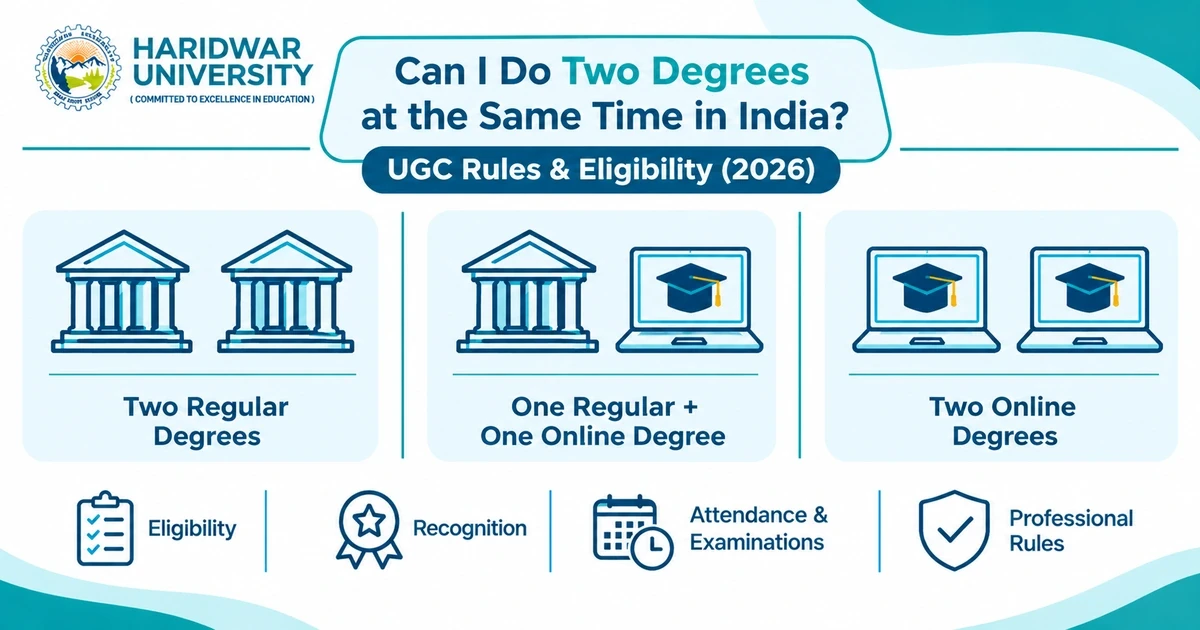
Can I do two degrees at the same time in India? Yes. Under official guidelines issued by the University Grants Commission (UGC), students are legally permitted to pursue two academic programmes simultaneously under specified conditions. These include two full-time physical programmes, a combination of regular and online or distance education, or two online and Open and Distance Learning (ODL) programmes.
However, statutory permission from UGC does not mean every combination is automatically feasible or admitted without checks. Institutional ordinances, professional council mandates, non-overlapping lecture timetables, and distinct examination schedules all dictate whether your dual enrollment remains valid. This guide provides an administrative perspective on the rules, eligibility benchmarks, and practical considerations governing dual degrees in India for 2026.
1. What the UGC Guidelines Say About Two Degrees
The University Grants Commission formally notified its Guidelines for Pursuing Two Academic Programmes Simultaneously on 13 April 2022. This landmark reform was introduced to align Indian higher education with the National Education Policy (NEP 2020), encouraging multidisciplinary learning and curricular flexibility.
The 2025 UGC Partial Modification
On 5 June 2025, UGC issued a formal partial modification clarifying retroactive recognition for certain dual degree combinations pursued prior to the April 2022 notification. The modification confirms that earlier simultaneous qualifications are recognized where they adhered to prevailing UGC First and Master Degree Regulations, university statutes, professional council norms, and Distance Education Bureau directives.
To better understand how dual qualifications integrate with multi-entry exits and degree progressions, explore our comprehensive guide on the 4-year undergraduate degree framework in India.
2. The Three Permitted Combinations Under UGC Rules
The UGC statutory framework categorizes permissible simultaneous academic journeys into three distinct pathways:
1. Two Regular, Full-Time Degrees
A student can attend two full-time physical programs provided class lecture hours do not clash (for example, morning batch for Programme A and evening/late afternoon shift for Programme B). However, fulfilling mandatory 75% physical attendance, competing continuous internal assessments, and avoiding clashing term-end examination dates make this combination exceptionally demanding.
2. One Regular Degree and One Online / Distance Degree
This represents the most pragmatic and popular route for undergraduate students. A student attending a full-time on-campus degree (such as B.Tech, BCA, or BBA) can concurrently enroll in a UGC-DEB entitled online or ODL bachelor's, diploma, or certificate in fields like Economics, Psychology, Foreign Languages, or Data Analytics without conflicting attendance schedules.
3. Two Online or Distance Degrees
The framework allows learners to take up to two remote degrees concurrently. Candidates must ensure each institution is independently approved by the UGC Distance Education Bureau for the relevant intake session.
3. Eligibility and Admission Requirements for Two Degrees
A vital administrative truth every applicant must understand: UGC permission makes simultaneous study legally permissible; it does not guarantee automatic admission into both programs.
Each academic programme maintains its independent admission prerequisites, entrance exam cutoffs (e.g., JEE Main, CUET, or CAT), minimum qualifying percentage criteria, and seat quotas. Furthermore, each university must formally adopt the UGC guidelines through its Academic Council and Executive Council statutes before enabling simultaneous enrolments.
For students seeking greater systemic flexibility across academic intervals, read our guide on how Multiple Entry and Multiple Exit through Academic Bank of Credits (ABC) facilitates credit banking, semester pauses, and degree re-entry.
4. Pursuing Degrees From Different Universities
Students frequently inquire whether the two degrees can be pursued from two entirely different universities. The UGC framework does not mandate that both qualifications originate from the same institution. A student can pursue Degree 1 at University A and Degree 2 at University B.
However, the practical and administrative logistics must function harmoniously across both institutions. Before remitting registration fees, you must confirm:
- Does University A's statute permit concurrent enrollment at an external institution?
- Will migration or transfer certificates (if collected by University A) create administrative hurdles during University B’s document verification?
- Are academic semester examination dates independent, or is there a risk of clashing final examinations?
Always obtain transparent written confirmation from both institutions before accepting simultaneous admission offers.
5. Recognition and Validity for Government Jobs
A major question asked by parents is whether simultaneous degrees will be recognized by government recruiters such as UPSC, SSC, State Public Service Commissions, and public sector undertakings (PSUs).
Crucial Verification Factors for Government Service:
- Institutional Recognition: Both awarding bodies must be established under Central/State Acts and recognized by the UGC.
- Mode Approval: Each course must hold explicit regulatory approval for its specific mode (regular, ODL, or online).
- Overlapping Timing Compliance: For two regular degrees, documentary evidence confirming non-clashing class schedules must be defensible.
- Recruitment Advertisement Mandates: Ultimately, the recruiting commission’s specific terms govern job eligibility. A qualification valid for higher education might not satisfy a gazetted post requiring uninterrupted single-degree specialization.
To review legal precedents, verification portals, and gazette recognitions, consult our exhaustive breakdown on is a private university degree valid for government jobs in India.
6. Rules for Online, Distance and Professional Programmes
The two-degree framework enforces strict boundaries regarding online education and professional qualifications:
Mandatory DEB-ID Verification for Distance Enrolment
If you select an ODL or online programme as your second qualification, you must verify that the course is listed on the official Distance Education Bureau directory (deb.ugc.ac.in) and generate your government-mandated DEB-ID. As detailed in our recent guide on why the DEB-ID is now mandatory for distance learning, admissions taken without this verified credential are legally invalid.
Statutory Professional Council Restrictions
UGC guidelines explicitly clarify that the dual-degree framework does not override statutory professional councils. Regulators like the Bar Council of India (BCI), Pharmacy Council of India (PCI), and Indian Nursing Council (INC) enforce autonomous rules regarding full-time student commitment. Certain disciplines also cannot be pursued online under any circumstances; see our detailed analysis on courses you cannot study fully online in India.
For students interested in advanced scholarly pathways alongside undergraduate studies, review the curriculum structure of an Honours with Research degree.
7. Managing Attendance, Examinations and Academic Workload
Being legally allowed to enrol in two degrees and possessing the mental stamina to complete both with distinction are two different matters. Before registering, evaluate these five operational bottlenecks:
- Mandatory Attendance Thresholds: Can you sustain the statutory 75% physical attendance required for your regular degree while attending lectures or submitting weekly assignments for the second?
- Exam Timetable Collisions: Universities set examination schedules independently. If Term-End Theory Papers for both programs land on the exact same date and session, you will be forced to skip one paper, resulting in backlogs.
- Laboratory and Clinical Rotations: Practical-intensive degrees (Engineering, Nursing, Pharmacy, Agriculture) involve non-negotiable physical lab work, internal vivas, and hospital attachments that cannot be shifted.
- Campus Transit Times: If pursuing two regular physical programs at separate campuses, commute times can make schedules unsustainable.
- Burnout & GPA Impact: Diluting your energy across two degrees may lower your overall CGPA, impairing campus recruitment and higher study prospects.
8. A Checklist Before Enrolling in Two Programmes
As Registrar, I strongly advise students to obtain definitive affirmative answers to this eight-point checklist before committing financial resources to a second degree:
- ✓ Have I verified entry eligibility criteria for both programmes?
- ✓ Are both institutions recognized by UGC and approved for their respective delivery modes?
- ✓ Does each university's current academic ordinance permit simultaneous external enrolment?
- ✓ For two regular degrees, are class timings completely non-overlapping?
- ✓ Have I verified examination windows, practical lab sessions, and attendance quotas?
- ✓ Do any professional council regulations (BCI, PCI, INC) restrict secondary study?
- ✓ Have I received formal written approval or No-Objection Certificates (NOC) where necessary?
- ✓ Can I comfortably manage the combined tuition fees, study workload, and project schedules?
9. Frequently Asked Questions (FAQs)
1. Can I pursue two bachelor's degrees at the same time in India?
Yes. The UGC guidelines permit a student to pursue two full-time physical bachelor's programmes provided class timings do not overlap. Students can also combine a regular degree with an online/ODL degree, or pursue two online/ODL degrees simultaneously.
2. Can I pursue two master's degrees simultaneously?
Yes. The UGC framework does not exclude postgraduate programmes. However, students must fulfill the admission eligibility, attendance quotas, and administrative rules of both admitting universities.
3. Can I pursue one regular degree and one distance degree?
Yes. Combining one full-time regular campus degree with one UGC-DEB recognized online or Open and Distance Learning programme is explicitly permitted and represents the most manageable dual-degree option.
4. Can I pursue two degrees from different universities?
Yes. The UGC framework does not require both degrees to be from the same institution. However, students must ensure the academic calendars, exams, and attendance policies of both institutions do not conflict.
5. Can I pursue three degrees at the same time?
No. The UGC guidelines specifically provide for pursuing up to two academic programmes simultaneously. They do not sanction enrolling in three or more degree qualifications at once.
6. Does the UGC dual-degree rule apply to PhD programmes?
No. The UGC guidelines explicitly state that they apply only to non-PhD programmes (undergraduate, postgraduate, diploma, and certificate courses). PhD candidates cannot pursue another degree simultaneously. To explore direct doctoral entry without a master's, review our guide to PhD eligibility after a 4-year undergraduate degree.
7. Will two simultaneous degrees be valid for government jobs?
Yes, provided the programmes satisfy UGC guidelines, both institutions are recognized, class timings do not clash (for regular degrees), and the candidate fulfills the specific eligibility criteria detailed in the recruitment notification.
10. Making an Informed Decision About Two Degrees
The provision to pursue two degrees simultaneously in India represents an empowering reform for motivated students aiming to build interdisciplinary mastery. Yet the decision must be rooted in realistic planning rather than the novelty of collecting dual degrees.
My recommendation is to evaluate your primary career goal, confirm formal institutional policies in writing, check professional council restrictions, and evaluate your study schedule with complete honesty. Ultimately, academic distinction and professional success stem from deep mastery and applicable knowledge — not merely the number of graduation scrolls on your wall.
Build a Recognized, Career-Ready Foundation at Haridwar University
Whether you are planning an interdisciplinary undergraduate pathway or seeking an accredited campus degree in Engineering, Computing, Management, Agriculture, or Allied Sciences, Haridwar University provides UGC-recognized excellence, cutting-edge laboratories, and premier placement support.