

Recognition of Prior Learning (RPL) in India: UGC Guidelines, Eligibility & Benefits
Mr. Sumit Chauhan
Registrar, Haridwar University
A person may spend years working in a profession, learning a trade, managing a business or completing specialised training without earning a formal academic qualification for that learning. Later, when they decide to return to university, an important question arises: can the knowledge and skills gained outside a classroom count towards a higher education qualification?
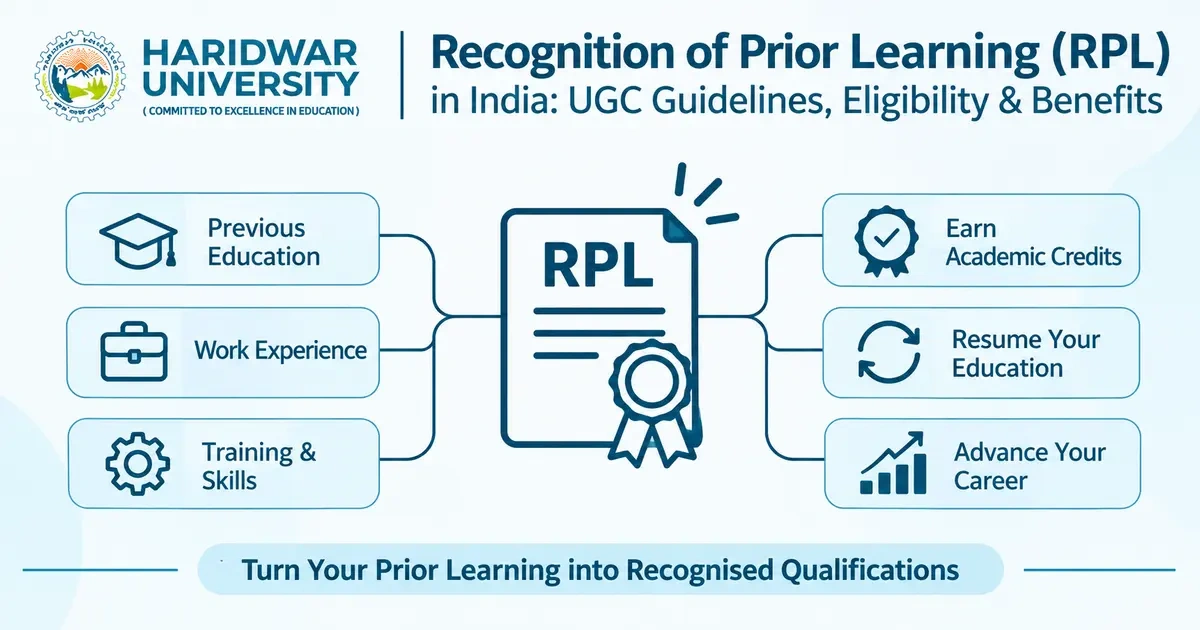
Recognition of Prior Learning (RPL) addresses this question. It provides a structured way to assess knowledge and competencies gained through formal education, workplace experience, vocational training and other learning activities. Where the evidence meets defined academic outcomes, the learning may be recognised and assigned credits under the applicable framework.
The University Grants Commission (UGC) published its Guidelines for Implementation of Recognition of Prior Learning in Higher Education on 25 March 2025. The framework connects RPL with the National Education Policy (NEP) 2020 and the National Credit Framework (NCrF). However, RPL is not an automatic conversion of work experience into a degree. Assessment, evidence and institutional rules remain central to the process.
Table of Contents
- What Is Recognition of Prior Learning (RPL)?
- UGC Guidelines for Recognition of Prior Learning in India
- Eligibility Criteria for Recognition of Prior Learning
- Types of Previous Learning That Can Be Recognised
- How the RPL Assessment Process Works
- RPL, the National Credit Framework and the Academic Bank of Credits
- Returning to University After a Long Study Break
- Benefits and Limitations of Recognition of Prior Learning
- Frequently Asked Questions (FAQs)
- A More Flexible Route Back to Education
What Is Recognition of Prior Learning (RPL)?
Recognition of Prior Learning is the process of evaluating knowledge, skills and competencies acquired before entering or returning to a formal academic programme. The learning may come from employment, professional training, apprenticeships, self-directed study, community activities or previously completed courses.
The important distinction is that RPL recognises what a person has learned, not simply how long they have worked.
For example, a person who has managed a small business for several years may have developed practical knowledge of accounting, customer relations, inventory and marketing. If they apply for recognition against relevant learning outcomes in a higher education programme, an assessment may examine whether their experience demonstrates the required competencies.
The UGC guidelines describe three cases in which RPL may be applicable:
- Credit earning, accumulation and transfer in formal education: Recognising previously completed modules or credit-bearing learning.
- Prior certificated learning: Recognising learning certified through non-degree qualifications, industry accreditations, or structured training diplomas.
- Prior experiential learning: Assessing non-certificated knowledge gained through practical workplace duties, entrepreneurial operations, or professional practice.
These describe the areas in which RPL can be applied. The separate classification of formal, non-formal and informal learning, explained below, describes the different ways in which that learning may have been acquired.
UGC Guidelines for Recognition of Prior Learning in India
The UGC's March 2025 guidelines provide a framework for higher education institutions to recognise learning gained through different routes. They are linked to the wider NEP 2020 objective of making education more flexible and connecting academic learning with vocational skills and work experience.
The guidelines focus on several important principles:
- Learning outcomes: Credits should reflect demonstrated knowledge and competencies, rather than being awarded only on the basis of time spent working or studying.
- Relevant evidence: Applicants must provide credible evidence that relates to the programme or qualification for which recognition is sought.
- Transparent assessment: Institutions should define their assessment methods, criteria, responsibilities and applicable credit limits.
- Institutional implementation: Higher education institutions develop their assessment policies in line with the national framework and applicable standards.
- Additional learning: Where gaps are identified, institutions may require bridge courses or upskilling before the learner progresses.
The guidelines do not establish one universal work-experience requirement for every course. They state that some institutions may specify a minimum number of years of relevant experience. Eligibility therefore depends on the institution, programme and learning outcomes being assessed.
Official Document Reference: For official gazette provisions and criteria, consult the UGC Guidelines for Implementation of Recognition of Prior Learning in Higher Education (March 2025).
Eligibility Criteria for Recognition of Prior Learning
There is no single eligibility formula that applies to every RPL application. The UGC guidelines identify several factors that institutions may consider when assessing an applicant:
| Eligibility Factor | What It Means |
|---|---|
| Relevant Prior Learning | Previous learning must relate directly to the intended programme or qualification curriculum. |
| Demonstrated Competence | Applicants must show the knowledge and skills required by the relevant learning outcomes. |
| Authentic Evidence | Certificates, work records, projects, portfolios and verifiable employment documentation must support the claim. |
| Depth of Knowledge | The applicant should demonstrate an adequate understanding of the subject, not just casual familiarity with it. |
| Language Proficiency | The applicant must be able to participate in assessments and communicate in the medium of instruction. |
| Assessment Readiness | The applicant may need to complete an interview, examination, portfolio review or practical demonstration. |
Common Misconception: A common misconception is that five, eight or ten years of employment automatically qualifies someone for academic credits. It does not. Experience provides useful evidence, but the applicant must demonstrate what they learned and how that learning matches specific academic syllabus requirements.
Types of Previous Learning That Can Be Recognised
The RPL framework considers learning from different settings. The distinction between these categories helps applicants understand what evidence they need to assemble. These learning types complement the three RPL application cases described earlier:
1. Formal Learning
This includes structured education from recognised institutions, such as university courses, diplomas, degrees and professional qualifications. In some cases, a learner may have completed individual courses or modules without completing the full qualification.
2. Non-Formal Learning
Non-formal learning is organised and intentional but takes place outside a conventional university programme. Examples include structured workplace training, corporate upskilling programmes, industry workshops and organised vocational courses.
3. Informal and Experiential Learning
This learning develops through practical activities and everyday experience. It may include managing business operations, working on technical projects, applying professional trade skills or learning through community-based activities.
The UGC guidelines also highlight illustrative examples, such as a nurse seeking to progress from a General Nursing and Midwifery (GNM) diploma towards a B.Sc. Nursing qualification, or an individual using non-formal learning to demonstrate competencies relevant to postgraduate study. These are illustrative examples under institutional frameworks, not universal automatic guarantees.
How the RPL Assessment Process Works
The UGC framework outlines a staged assessment model. While exact procedures, documents and testing formats vary across institutions, the journey follows five structured milestones:
-
Identify the Qualification and Learning Outcomes:
Start by identifying the target course or qualification. The applicant's previous learning must align with the institution's published curriculum outcomes. -
Prepare Supporting Evidence:
Assemble comprehensive documentation demonstrating the learning claimed, including:- Previous academic transcripts, certificates and diplomas.
- Employment records and detailed employer letters describing roles and duties.
- Apprenticeship, vocational or technical training certificates.
- Work samples, technical projects, code repositories, designs or practical assignments.
- Records of continuous professional development (CPD) or relevant industry achievements.
-
Submit the Application and Portfolio:
The applicant submits the official application alongside an evidence portfolio. A well-constructed portfolio explains what was learned, how it was learned and how it maps to specific course modules. -
Complete the Assessment:
Assessments evaluate evidence relevance, authenticity, sufficiency and currency. Methods may involve portfolio viva-voce, structured interviews, written examinations, laboratory demonstrations, or practical project evaluations. -
Receive the Assessment Outcome:
The institution's assessment body determines whether outcomes are met. Results may award partial course credits, recommend specific bridge/upskilling courses, or decline credit where evidence is insufficient.
The guidelines also provide for an appeal process if a candidate believes an assessment outcome contains an administrative or evaluative error. Applicants should review the institution's published procedures, timelines and fees prior to applying.
RPL, the National Credit Framework and the Academic Bank of Credits
While RPL, the National Credit Framework (NCrF) and the Academic Bank of Credits (ABC) work closely together, each serves a distinct role in the Indian education ecosystem:
- Recognition of Prior Learning (RPL): The qualitative and evaluative process through which previous learning and practical competencies are verified and mapped to academic curricula.
- National Credit Framework (NCrF): The overarching regulatory framework developed by UGC, AICTE, NCVET and ministry bodies that assigns credit values across academic, vocational and experiential learning.
- Academic Bank of Credits (ABC): The secure digital repository that stores, transfers and validates verified academic credits earned through recognised institutions.
Important Distinction: An applicant cannot simply upload an employment certificate to the ABC portal and expect university credits to appear. Learning must first be formally assessed and recognized by an eligible university. The institution then registers the recognized credits on the ABC portal.
For a detailed breakdown of credit accumulation, check HU's guide to Credit Transfer and the Academic Bank of Credits. You can also review the wider national policy via the National Credit Framework Report.
Returning to University After a Long Study Break
A long break from formal education does not mean you must restart from scratch. However, two scenarios must be handled separately:
Scenario A: Previously Completed University Courses
If you previously completed semesters or degrees at a recognised college, your transcripts may qualify under credit-transfer regulations. The receiving institution assesses syllabus equivalence, credit shelf-life and validity periods.
Scenario B: Skills Gained Through Employment
If your competencies were built through professional practice, entrepreneurship or corporate training, RPL provides the structured assessment route to evaluate those competencies against degree outcomes.
These two pathways are not interchangeable. A student who paused an academic degree cannot assume credits remain valid indefinitely without institutional review. Gather all marks sheets, syllabi, training records and employment evidence before consulting the admissions department.
Benefits and Limitations of Recognition of Prior Learning
The primary value of RPL lies in recognizing competencies that were previously invisible in the academic realm:
- A Viable Route Back to Higher Education: Allows adult learners and industry professionals to demonstrate expertise gained outside lecture halls.
- Recognition of Practical Competencies: Translates hands-on industry experience into recognized university learning credits.
- Flexible Academic Progression: Enables accelerated completion or subject exemptions under institutional guidelines.
- Reduced Redundancy: Eliminates the need to re-learn introductory or foundational material already mastered on the job.
- Support for Lifelong Learning: Bridges formal academia, vocational trades and modern corporate careers.
Realistic Limitations: RPL is a rigorous assessment, not an effortless shortcut to a degree. Compiling portfolios takes time and effort. Not every industry skill aligns with academic syllabi, and professional statutory bodies (such as PCI, BCI, or NMC) maintain strict on-campus requirements that cannot be bypassed through prior experience.
Frequently Asked Questions (FAQs)
1. What are the UGC guidelines for Recognition of Prior Learning?
The UGC published its higher education RPL guidelines on 25 March 2025. They explain how universities can assess formal, non-formal and informal learning and recognize relevant competencies under the National Credit Framework.
2. How many years of work experience are required for RPL?
There is no single universal requirement. The UGC framework permits universities to set specific minimum experience requirements depending on the programme, degree level and competency depth.
3. Can work experience be converted into university credits?
Yes, provided the experience demonstrates relevant course learning outcomes and passes formal university assessment. Mere employment duration or job tenure alone does not earn credits.
4. How can I apply for Recognition of Prior Learning?
Contact an institution with an active RPL admission mechanism. Request their portfolio guidelines, fee structure and assessment timelines, then compile your evidence portfolio for submission.
5. Is an RPL certificate equivalent to a university degree?
No. An RPL assessment awards recognized credits or modular certificates towards a qualification. It does not replace a full degree unless all programme credit requirements are fully satisfied.
6. Can I use RPL after leaving college for several years?
Yes. Prior academic studies and practical industry experience can be evaluated under combined RPL and credit-transfer rules, subject to university equivalence checks.
7. Does the Academic Bank of Credits automatically recognise work experience?
No. The ABC is an electronic storage ledger. Credits must first be evaluated, approved and submitted by a recognized awarding institution before appearing in your ABC account.
A More Flexible Route Back to Education
A break in formal education does not mean that learning has stopped. People continue to acquire knowledge through work, training, projects and practical responsibilities. The challenge is to demonstrate that learning in a way that meets recognised academic standards.
The UGC's RPL framework offers a structured approach to that challenge. Its success, however, depends on credible evidence, transparent assessment and clear institutional implementation. Anyone considering this route should begin by identifying the qualification they want to pursue, organising their previous learning records and confirming the recognition options available from the relevant institution.
For students and working professionals exploring further study, Haridwar University's comprehensive academic programme listings provide a clear overview of undergraduate and postgraduate pathways. In addition, research-focused learners can explore the official guide to research and innovation at Haridwar University to evaluate project facilities and doctoral opportunities.
The underlying principle is straightforward: previous learning deserves to be evaluated on its evidence and relevance. RPL provides a framework for doing that, while keeping academic standards firmly at the centre of recognition.
Ready to Advance Your Education at Haridwar University?
Explore NEP 2020-aligned degrees, multi-disciplinary programmes, and career-focused learning designed for today's dynamic industry demands. Applications are now open for the 2026-27 academic session.