

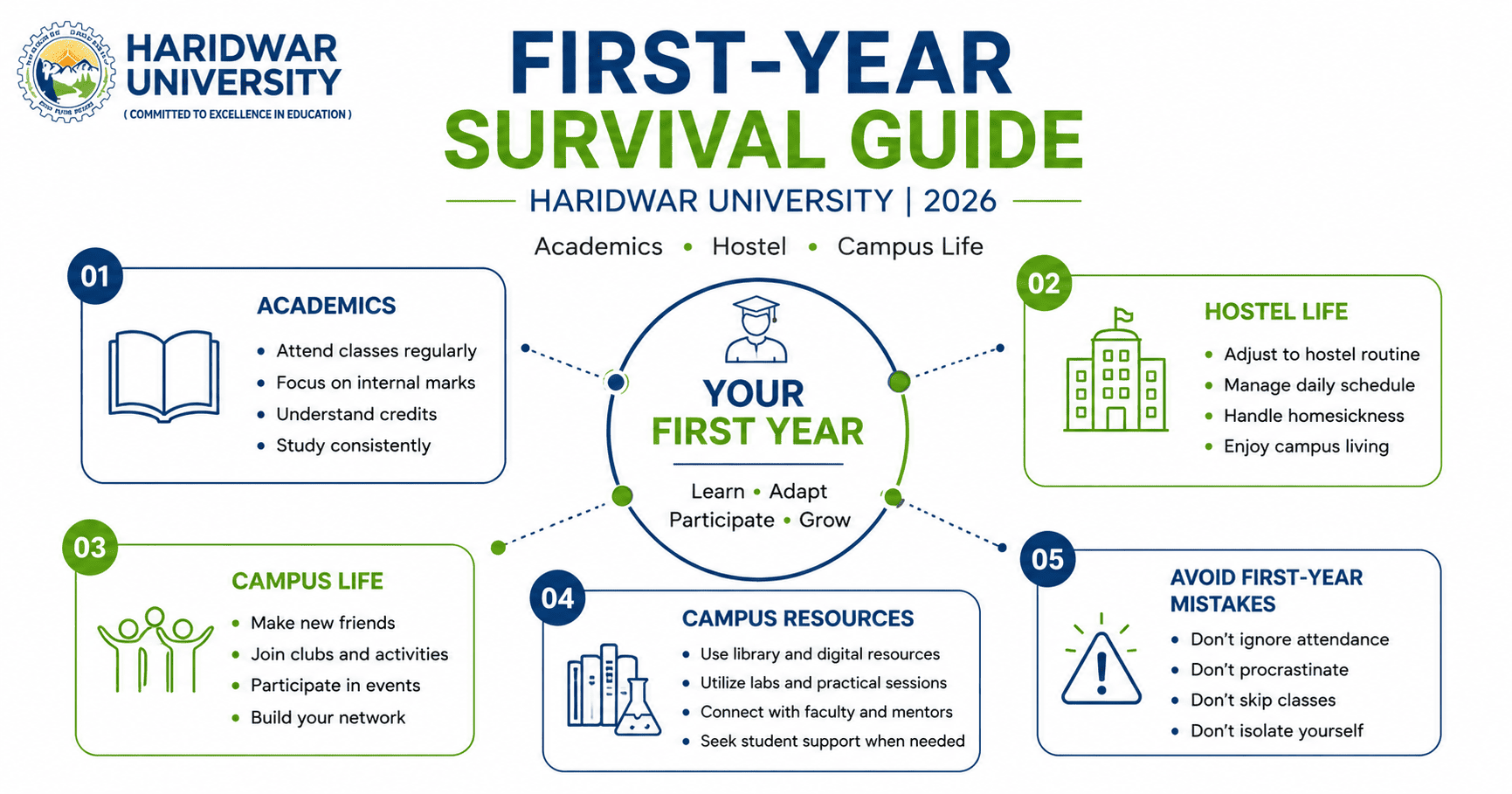
The first year teaches students how to use university. At Haridwar University, that means understanding attendance, assessment, academic resources, hostel life and support systems. My advice is practical: learn the rules early, keep your routine simple and use the facilities already available on campus. The biggest adjustment is not moving from school to university — it is learning to manage your own time, decisions and responsibilities.
Table of Contents
- First Week at Haridwar University: A Practical Checklist
- HU Attendance and Internal Assessment: What First-Year Students Need to Know
- From School to University: How to Manage the Academic Shift
- Haridwar University Hostel Life: What First-Year Students Should Know
- Making Friends at HU: Clubs, Sports and Campus Activities
- Managing Money in Your First Year
- HU Library, Labs and Student Support: Know Where to Go
- First-Year Mistakes to Avoid at Haridwar University
- Haridwar University First-Year Campus Resource Map
- Frequently Asked Questions (FAQs)
- Explore HU Resources for Your First Year
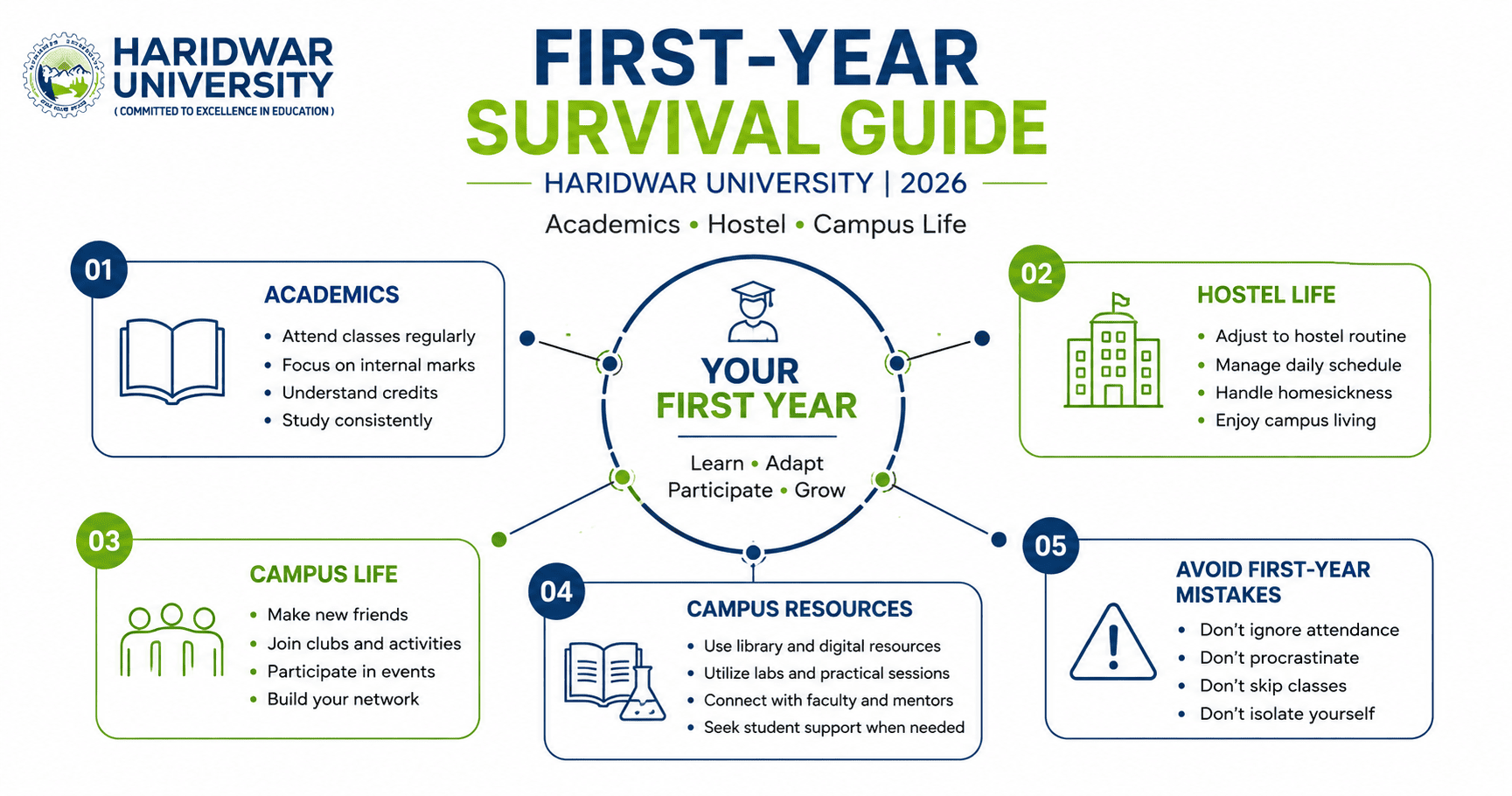
1. First Week at Haridwar University: A Practical Checklist
Starting university can feel overwhelming during the first few days. Having a clear checklist helps you settle into the campus smoothly:
| First-week Task | What to Do |
|---|---|
| Timetable | Save your current class and laboratory schedule. |
| Academic calendar | Note registration, classes, examinations and important deadlines. |
| Department | Save your department and faculty contact details. |
| Attendance | Understand how attendance is recorded for your programme. |
| Assessment | Ask your department about the applicable internal assessment pattern. |
| Campus | Locate classrooms, laboratories, library, hostel, medical and student-support facilities. |
| Documents | Keep admission, identity and academic documents safely organised. |
HU describes its teaching approach as experiential, practitioner-led and practical, with an emphasis on experimentation, critical thinking and collaboration.
2. HU Attendance and Internal Assessment: What First-Year Students Need to Know
HU's UG & PG Programme Guidelines state that students are normally expected to attend all teaching periods and that attendance requirements apply for appearing in end-semester examinations. The guidelines also state that each subject carries credits according to the approved scheme.
| Academic Point | HU Information |
|---|---|
| Teaching attendance | Students are expected to attend all periods; examination eligibility is subject to attendance requirements. |
| End-semester examination | Conducted according to syllabi approved by the Academic Council. |
| Credits | Each subject carries credits under the approved scheme. |
| Academic record | Students should track attendance, assessment work and examination requirements throughout the semester. |
Use the university guidelines and your department for applicable programme requirements.
3. From School to University: How to Manage the Academic Shift
The academic transition is less about studying for longer and more about becoming responsible for how and when you study. At university, students have greater freedom, but that also means fewer reminders and more responsibility for keeping track of classes, submissions and academic progress.
| School Habit | University Habit to Build |
|---|---|
| Waiting for reminders | Check notices, deadlines and your timetable yourself. Make a simple weekly schedule so important academic tasks do not depend on last-minute reminders. |
| Studying mainly before examinations | Study smaller portions every week. Regular revision makes it easier to handle assignments, internal assessments and end-semester examinations together. |
| Relying on classroom notes | Use books, journals, databases and practical resources. Library and laboratory work can help you understand concepts beyond what is covered during a classroom session. |
| Asking for help after repeated difficulty | Speak to faculty or mentors early. A difficult topic is usually easier to address before it affects later units, assessments or your overall academic performance. |
| Treating practical work as secondary | Connect laboratory work with theory and projects. Practical sessions are an opportunity to see how concepts discussed in class are applied to real problems. |
The aim in the first semester should not be to create a perfect routine immediately. It is to build a repeatable academic system: attend regularly, review your work each week, track deadlines and ask for help before a small gap becomes a larger one. HU says its academic model combines innovative teaching with practical-based learning and new technologies and equipment.
4. Haridwar University Hostel Life: What First-Year Students Should Know
Hostel adjustment is easier when students treat it as a routine change. HU's hostel page lists three residential facilities, but allocation differs by student group:
| Hostel | Published Information |
|---|---|
| KD Bhawan | Boys' hostel; 277 seats |
| ML Bhawan | Boys' hostel; 539 seats; meant for students from second year onwards |
| PL Bhawan | Girls' hostel; approximately 250 seats |
HU lists 24/7 security, CCTV surveillance, biometric entry, fire-safety equipment, wardens, Wi-Fi, furnished rooms, study rooms, mess services and indoor/outdoor recreation facilities. The hostel page also states that medical support and ambulance facilities are available around the clock.
5. Making Friends at HU: Clubs, Sports and Campus Activities
Friendships usually begin with repeated contact: classmates, laboratory groups, hostel neighbours and people you meet through activities. HU's campus-life material describes seminars, workshops, technical events, cultural programmes, sports, yoga and community engagement through NCC and NSS.
| If You Enjoy... | Start With... |
|---|---|
| Sports | Campus sports and competitions |
| Culture | Cultural programmes |
| Community service | NCC or NSS activities |
| Technical learning | Workshops, technical events and department activities |
| Quiet social interaction | Library discussion spaces and study groups |
6. Managing Money in Your First Year
Divide monthly money into daily needs, academic expenses, travel and personal spending, and keep a small emergency reserve. HU's fee and scholarship page publishes hostel fee information separately from tuition and scholarship provisions, so check current figures before budgeting.
7. HU Library, Labs and Student Support: Know Where to Go
| Need | HU Resource |
|---|---|
| Books and reference material | Central Library |
| Digital academic resources | Digital Library and subscribed databases |
| Practical learning | Department laboratories |
| Academic difficulty | Faculty mentors and department |
| Learning gaps | Remedial classes |
| Emotional support | Full-time psychological counsellor |
| Medical support | University infirmary and ambulance |
| Student grievance | Grievance Redressal Committee |
HU's Central Library has a collection exceeding 20,000 volumes and subscribes to resources including IEEE, JSTOR, Sage, EBSCO, SCC Online, Westlaw, DELNET, NDLI and Shodhganga. Five library cards are issued per student and renewed at the beginning of each semester.
The Counselling & Assistance service states that HU provides one-to-one and group counselling, faculty mentoring for academic and learning difficulties, remedial classes for students scoring below 40% in Mid-Term Examination, an infirmary and ambulance support.
8. First-Year Mistakes to Avoid at Haridwar University
| Mistake | Better Approach |
|---|---|
| Ignoring attendance until examinations | Check it regularly |
| Leaving internal work until the deadline | Track submissions weekly |
| Allowing one difficult subject to accumulate | Ask faculty or mentors for help early |
| Staying isolated in the hostel | Attend classes and one suitable activity |
| Ignoring library and laboratory resources | Use them from semester one |
| Relying only on informal student advice | Check official HU guidelines |
9. Haridwar University First-Year Campus Resource Map
| Resource | Why It Matters |
|---|---|
| Academic Overview | Teaching approach, practical learning and academic structure |
| UG & PG Guidelines | Academic and examination rules |
| Central Library | Books, journals, databases and study spaces |
| Hostel | Accommodation, facilities and hostel rules |
| Counselling & Assistance | Counselling, mentoring, remedial and medical support |
| Infrastructure | Cafeteria, hostel, connectivity, sports and campus facilities |
| Life at HU | Campus activities, sports, culture, NCC and NSS |
Explore Haridwar University Campus Resources
10. Frequently Asked Questions (FAQs)
1. What should I do during my first week at Haridwar University?
Save your timetable, identify your department and faculty contacts, understand attendance and assessment requirements, and locate the library, laboratories, hostel and student-support facilities.
2. How important is attendance for first-year students?
Attendance is important because HU's programme guidelines connect attendance requirements with eligibility to appear in end-semester examinations. Students should monitor attendance throughout the semester.
3. What academic resources can first-year students use at HU?
Students can use department laboratories, faculty support and the Central Library, which has more than 20,000 volumes and multiple subscribed academic databases.
4. Does Haridwar University provide hostel facilities?
Yes. HU lists KD Bhawan, ML Bhawan and PL Bhawan. Hostel allocation depends on student category and year; ML Bhawan is listed for students from second year onwards.
5. What can students do if they are homesick?
Maintain regular family contact while building a campus routine through classes, hostel life and suitable activities. Students can also approach HU's counselling service when personal support is needed.
6. How can first-year students make friends at HU?
Start with classmates, laboratory groups, hostel peers and activities such as sports, cultural programmes, technical events, NCC and NSS.
7. What support is available if a student struggles academically?
HU lists faculty mentoring and remedial classes, including remedial support for students scoring below 40% in Mid-Term Examination.
8. Where should students check if they are unsure about a university rule?
Check the relevant official HU guideline or programme page first, then contact the department or appropriate university office rather than relying on informal information.
11. Explore HU Resources for Your First Year
Attend consistently, understand your academic rules, use the library and laboratories, build a realistic hostel routine and participate in campus life. Those habits make the next academic year easier.
Ready for a Great First Year at Haridwar University?
Discover campus life, academic guidelines, hostel facilities, and student welfare services.