

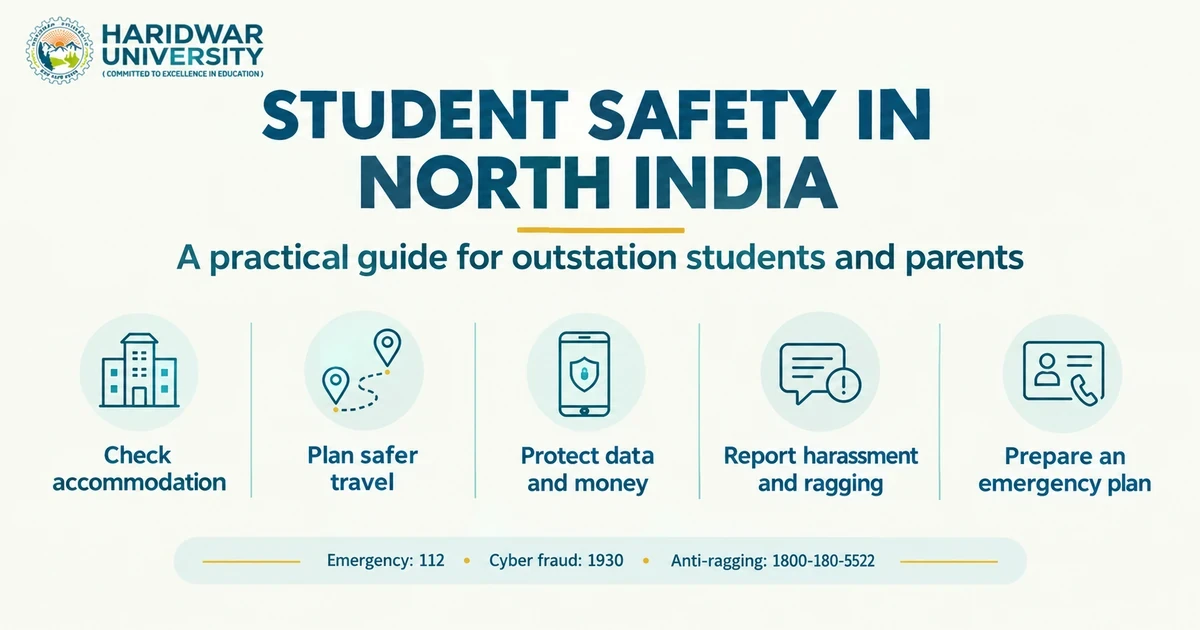
Moving to another state for higher education is a momentous milestone for an undergraduate student and their family. Alongside crucial questions regarding academic degree programs, multi-year tuition costs, and corporate placement records, parents naturally ask: Where will my child reside? How safe is their daily transit? Who supervises the residence late at night? And what formal protocols activate if an emergency arises?
In student welfare administration, safety discussions yield the greatest peace of mind when they shift from vague reassurances to concrete preparation. Student safety in North India is not a single abstract concept. It is built through well-managed accommodation, sensible daily travel habits, firm personal boundaries, financial and cyber vigilance, accessible emergency networks, and institutional responsiveness.
No checklist can eliminate every unpredictable event in life. However, rigorous preparation empowers students to recognize risks early, make confident choices, and utilize established safety frameworks throughout their university journey.
Table of Contents
- Understanding Student Safety Beyond the Campus
- Checking Accommodation Before Moving In
- Building Safer Daily Travel Habits
- Protecting Personal Information and Money
- Recognising Harassment, Ragging and Other Warning Signs
- Preparing an Emergency Plan with Family
- Student Safety at Haridwar University
- Frequently Asked Questions
- Helping Students Become Confident and Prepared
1. Understanding Student Safety Beyond the Campus
A university campus is only one element of a student's daily ecosystem. Outstation students also navigate public bus stands, local markets, nearby pharmacies, weekend cafes, and inter-city rail journeys during semester breaks.
When evaluating colleges across North India, families should examine safety across three distinct pillars:
- Physical Safety: Residential access controls, exterior street lighting, dependable campus transit, fire safety equipment, and emergency evacuation protocols.
- Personal & Social Safety: Mutual respect within student communities, strict zero-tolerance anti-harassment regulations, formal grievance redressing committees, and accessible female student support.
- Digital & Financial Security: Safeguarding identity cards, bank account credentials, UPI PINs, passwords, and private residential details.
These areas demand proactive institutional mechanisms. For example, installing CCTV cameras helps monitor public thoroughfares, but cameras alone cannot replace attentive residential wardens, well-lit corridors, or transparent reporting procedures when a student raises a concern.
2. Checking Accommodation Before Moving In
Whether selecting an on-campus university hostel, a private paying guest (PG) facility, or a shared flat, the commercial label matters far less than how the facility is managed day-to-day. Before transferring a deposit or signing a lease, students and parents should verify the following essential parameters:
| Safety Parameter | What to Personally Establish & Verify |
|---|---|
| Access & Entry Control | Who can enter the building, how resident identity is verified (biometric/ID cards), and how outside visitors and delivery personnel are screened. |
| Supervisory Personnel | Whether full-time residential wardens and trained security guards are physically present 24/7, particularly during late-night hours. |
| Locks & Common Areas | Whether individual room doors latch securely, window grills are robust, and all stairwells, corridors, and exterior access points are brightly lit. |
| Fire & Electrical Safety | Clear, unobstructed fire exits, functional fire extinguishers on every floor, smoke alarms, and safe electrical circuit breakers. |
| Emergency Medical Response | Proximity to the nearest reputable hospital, on-campus ambulance availability, stocked first-aid centers, and doctor-on-call arrangements. |
| Written Lease Terms | Explicit security deposit refund policies, electricity unit tariffs, meal inclusion schedules, maintenance responsibilities, and curfew rules. |
For a detailed analysis of cost, supervision, and living differences, read Haridwar University’s guide to choosing between a PG and a university hostel. If considering private accommodation, review our 15-point safe PG checklist before paying any advance rental money.
3. Building Safer Daily Travel Habits
When arriving in a new town, unfamiliar streets and transit routes can initially feel disorienting. Developing structured transit habits significantly enhances confidence during the first semester:
- Save Offline Maps & Landmarks: Pin your exact hostel or PG address, the university main gate, the nearest railway station, and the closest government hospital in your phone for offline GPS access.
- Use Verified Transit Routes: Rely on institutional buses or registered shared auto/e-rickshaw stands. When using app-based cabs, always verify the license plate and driver name before boarding.
- Avoid Real-Time Location Broadcasting: Do not broadcast live travel check-ins, train coach numbers, or solo travel status publicly on Instagram or social platforms.
- Establish a Healthy Communication Routine: Send a quick confirmation text when reaching a new destination. Parents should avoid calling every hour, which creates anxiety and may discourage students from communicating openly during real difficulties.
4. Protecting Personal Information and Money
Personal safety encompasses financial security. Outstation freshers are prime targets for cyber criminals posing as university admission officers, landlord representatives, scholarship coordinators, or part-time internship providers.
Golden Rules for Financial & Digital Protection:
- Never share bank account OTPs, UPI PINs, or debit card CVVs with anyone claiming to represent a college or hostel.
- Official fee transactions must be routed through verified institutional portals (such as Haridwar University Fees Portal), never to private individual UPI IDs.
- If cyber fraud occurs, immediately freeze the affected account and file a report on the official National Cyber Crime Reporting Portal or dial the national financial cyber fraud helpline at 1930.
5. Recognising Harassment, Ragging and Other Warning Signs
Undergraduate students occasionally hesitate to report uncomfortable encounters due to fear of social isolation, academic retaliation, or peer judgment. That silence allows minor misconduct to escalate into distressing situations.
Under Indian law and UGC regulations, ragging and campus harassment are severe, non-bailable criminal offenses. Physical intimidation, forced chores, verbal humiliation, forced senior subservience, or unconsented touch must never be accepted as "ordinary college tradition."
The University Grants Commission operates a 24/7 toll-free National Anti-Ragging Helpline at 1800-180-5522. Students can preserve digital communications, screenshots, or audio notes and approach institutional Proctorial Boards.
To understand institutional safeguards in detail, read HU’s official policies on anti-ragging committee procedures and our comprehensive overview of girls' safety and residential facilities at Haridwar University.
6. Preparing an Emergency Plan with Family
An emergency response plan is effective only if it is established before departure and accessible without an active internet connection. Every outstation family should prepare a one-page printed and laminated emergency card containing:
- The student’s exact campus building, hostel room number, and local police station jurisdiction.
- Direct phone numbers of the Chief Warden, Hostel Supervisor, and Head of Department.
- At least one trusted local contact or relative residing within the regional state.
- A clear agreed protocol if a mobile phone is lost, stolen, or damaged during transit.
- The national unified emergency response number: 112 (India’s Emergency Response Support System combining Police, Fire, and Ambulance).
7. Student Safety at Haridwar University
Haridwar University provides an enclosed, secure, and supportive residential campus ecosystem tailored for students hailing from across India and abroad. Key safety infrastructure includes:
- Access Management: Perimeter security walls, professional security guards at all campus portals, biometric residential hostel entry, and extensive CCTV surveillance covering corridors and open spaces.
- Full-Time Residential Wardens: Dedicated male and female residential wardens residing on premises, ensuring immediate supervision, nightly roll-calls, and structured student care.
- Health & Medical Facilities: On-campus health dispensary, 24/7 dedicated ambulance on standby, and tie-ups with leading multispecialty hospitals in Roorkee and Haridwar.
- Student Care Centres: Established within each academic block through our Student Welfare Services, offering an assured 24-hour response window for personal grievances, academic counseling, and mental health support.
Explore our official Haridwar University Hostel Portal to examine room categories and dining provisions, or consult our campus and hostel life guide and first-year survival guide for step-by-step onboarding advice.
8. Frequently Asked Questions
1. What key security features should parents verify before confirming admission?
Verify physical security infrastructure (perimeter guards, biometric entry, CCTV), residential warden availability around the clock, on-campus medical facilities, emergency transport, strict anti-ragging committees, and clear grievance reporting mechanisms.
2. Is an on-campus university hostel inherently safer than private PG rentals?
In the vast majority of cases, yes. On-campus university hostels feature institutional security protocols, screened visitor access, full-time wardens, no night-time street commuting, and immediate emergency medical support. Private PGs often lack institutional oversight and professional late-night supervision.
3. Which emergency telephone numbers must outstation students save?
Every student should save 112 (Unified National Emergency Helpline for Police, Fire, Ambulance), 1930 (National Cyber Financial Fraud Helpline), 1800-180-5522 (UGC Anti-Ragging Helpline), alongside direct contact numbers for their hostel warden and university security desk.
4. What immediate steps should a student take if faced with ragging?
Move to a safe public space immediately, preserve any text messages, call records, or witness details, and report the incident to the university Proctorial Board, Warden, or Student Welfare Officer. Students can also lodge confidential complaints directly with the UGC Anti-Ragging Portal.
5. How can parents remain reassured without micromanaging their child's day?
Agree upon a predictable daily or weekly check-in routine (e.g., an evening call after dinner), maintain copies of emergency contacts, and build an open family dialogue so the student feels comfortable discussing genuine challenges without fear of an overreaction.
6. How can new students protect themselves from rental and online fraud?
Never transfer advance booking fees or security deposits without personally inspecting the accommodation, checking formal lease documentation, and verifying the landlord's identity. Never share OTPs or banking credentials over the phone.
7. What should students do if they feel uncomfortable but are unsure if it warrants a formal complaint?
Students should speak to a designated Student Welfare Officer, residential warden, or faculty mentor immediately. Approaching supportive campus counselors early prevents minor stress from developing into significant personal distress.
9. Helping Students Become Confident and Prepared
Living away from home is an indispensable phase of personal development. Safety should empower that independence, not replace it with constant anxiety. Outstation students flourish when they know their environment, embrace personal responsibility, and recognize the exact institutional mechanisms available whenever they require assistance.
At Haridwar University, our commitment to student welfare ensures that every learner enjoys a secure, welcoming, and enriching educational journey.
Experience a Safe, Supportive, and World-Class Campus Community
Haridwar University provides 24/7 gated security, residential biometric access, round-the-clock wardens, modern on-campus health facilities, and dedicated student care support.