

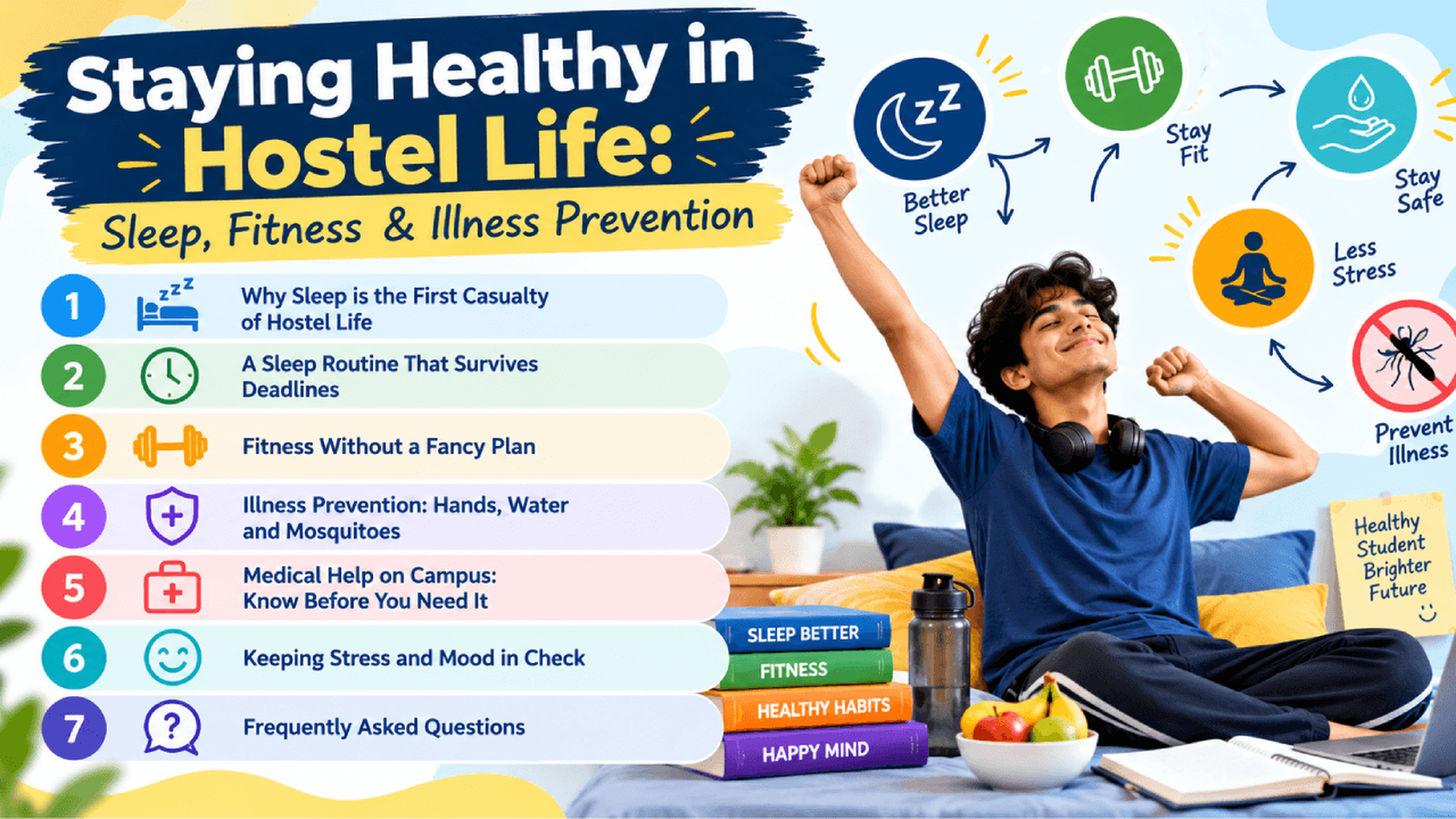
Hostel life hands students complete personal independence on day one and quietly presents the physical toll a few weeks later: midnight snack runs, missed morning walks, a persistent cough travelling down the shared corridor, and pre-exam cramming that obliterates sleep. Staying healthy in hostel life is not about drastic fitness overhauls or ascetic resolutions; it comes down to three repeatable anchors: protecting restorative sleep, integrating modest daily physical activity, and breaking the transmission cycle of common seasonal illnesses.
In this guide, we outline practical daily health strategies, explore the recreational and clinical amenities provided on the Haridwar University campus, and establish clear guidelines on when to seek medical intervention.
Table of Contents
- • 1. Why Sleep Is the First Casualty of Hostel Life
- • 2. A Sleep Routine That Survives Deadlines
- • 3. Fitness Without a Fancy Plan
- • 4. Illness Prevention: Hands, Water and Mosquitoes
- • 5. Medical Help on Campus: Know Before You Need It
- • 6. Keeping Stress and Mood in Check
- • 7. Frequently Asked Questions (FAQs)
- • 8. Empowered Residential Living at Haridwar University
1. Why Sleep Is the First Casualty of Hostel Life
The Biological Cost of Sleep Deprivation
Hostel residents rarely stay awake late out of malice; hours evaporate through unplanned social chats, video streaming, and last-minute assignment cramming. According to clinical guidance published by the Centers for Disease Control and Prevention (CDC), adults aged 18 to 60 require at least seven hours of sleep per night. Sleeping less than seven hours consistently elevates chronic risks of obesity, hypertension, weakened immunity, impaired cognitive processing, and acute emotional distress. Seven hours is not an aspirational upper limit; it represents the biological baseline.
Identifying Hostel Sleep Disruptors
Hostel environments present unique sleep obstacles: mismatched roommate timetables, corridor chatter, late-night high-caffeine consumption, and screens kept within arm's reach of the bed. Placing your smartphone on a desk across the room rather than under your pillow eliminates reflexive blue-light scrolling and preserves natural melatonin production.
2. A Sleep Routine That Survives Deadlines
Anchor the Wake-Up Time
While bedtimes fluctuate with academic workload, your wake-up time is substantially easier to stabilize. Pick a consistent rising time across weekdays and weekends within a 60-minute window. Immediate exposure to morning sunlight, a large glass of water, and light stretching calibrate your suprachiasmatic nucleus, synchronizing your biological circadian rhythm naturally.
Room Etiquette and Dedicated Study Spaces
Agree on mutual lights-out hours with roommates during the initial week of the semester. As detailed on the Haridwar University hostel facilities page, every residential block houses an independent, quiet study hall equipped with reference material and newspapers. Relocating late-night study sessions to the dedicated study room prevents friction and respects resting roommates. For institutional guidelines on conduct, read our overview of hostel rules and discipline policies.
3. Fitness Without a Fancy Plan
The 30 to 45-Minute Daily Movement Baseline
The Indian Council of Medical Research (ICMR) and National Institute of Nutrition (NIN) dietary and fitness guidelines recommend 30 to 45 minutes of moderate physical activity daily. Physical movement does not necessitate intense competitive training; walking briskly across academic complexes, opting for staircases over elevators, and engaging in evening badminton on hostel courts fulfill this physiological requirement.
On-Campus Gymnasium and Yoga Facilities
Haridwar University provides students with dedicated athletic infrastructure directly inside campus gates:
-
Air-Conditioned Gymnasium: As outlined on the university gymnasium portal, the fitness centre features separate zones for cardio exercise and heavy weight training, including Smith machines, multi-gym stations, cross trainers, and treadmills.
Designated Timings: Girls: 5:00 to 6:30 AM & 5:00 to 6:30 PM | Boys: 6:30 to 8:00 AM & 6:30 to 8:00 PM. (Mandatory sports shoes and university ID required). - Yoga and Mindfulness Center: The campus yoga and wellness centre conducts daily sessions from 6:00 to 7:30 AM and 5:30 to 7:00 PM, offering guided pranayama, flexibility training, and exam stress alleviation.
4. Illness Prevention: Hands, Water and Mosquitoes
Rigorous Hand Hygiene
Communal residential facilities can easily accelerate bacterial and viral transmission. Epidemiological data confirms that routine handwashing with soap for 20 seconds prevents 1 in 3 diarrhoeal illnesses and 1 in 5 respiratory infections like seasonal influenza. Haridwar University hostel rooms feature attached private washrooms, regular sanitation cycles, and complimentary in-house laundry service for up to 50 garments per month, keeping clean clothing and towels accessible.
Dengue and Vector-Borne Prevention
Guidelines from the National Centre for Vector Borne Diseases Control (NCVBDC) emphasize that Aedes mosquitoes bite predominantly during daylight hours and breed in clean, stagnant water containers. Inspect room air cooler trays and bathroom buckets to ensure no water sits idle, wear protective full-length apparel, and report external stagnant puddles to block wardens immediately.
Dining Standards and Hydration
Gastrointestinal infections generally originate from contaminated food and unfiltered water. Haridwar University's residential mess and dining halls operate under strict hygiene protocols and FSSAI standards. For a detailed review of daily menus, meal timings, and dietary balance, consult our hostel mess food and nutrition guide.
5. Medical Help on Campus: Know Before You Need It
Medical emergencies demand immediate, coordinated response. Haridwar University provides comprehensive medical infrastructure directly on campus:
Campus Medical & Emergency Framework
- On-Campus Infirmary: Staffed by four resident doctors (two male and two female medical officers) providing outpatient primary healthcare and first aid.
- 24/7 Ambulance Service: A dedicated, high-tech emergency ambulance equipped with critical-care transfer gear on standby 24 hours a day.
- Round-the-Clock Pharmacy: On-campus medicine dispensing for immediate prescription needs.
Never substitute medical attention with casual roommate self-medication. High fevers persisting over 24 hours, persistent vomiting, or respiratory difficulty warrant immediate evaluation at the infirmary. For complete details, review our guide to health, first-aid and counselling services at HU.
6. Keeping Stress and Mood in Check
Psychological stress invariably manifests physically through insomnia, muscle tension, and digestive upset. Haridwar University takes a holistic approach to student mental wellness:
- Professional Psychological Counselling: As described on the Counselling & Assistance portal, qualified resident counsellors conduct confidential individual and group sessions. Read more in our broader perspective on mental health on Indian campuses.
- Faculty Mentorship: Academic obstacles are resolved early via designated faculty advisors before they turn into chronic anxieties.
- Rapid Grievance Redressal: The Student Welfare Service maintains Student Care Centres across academic blocks with a guaranteed 24-hour turnaround on administrative inquiries.
- National Support: Students experiencing severe distress can reach Tele-MANAS toll-free at 14416 (or 1800-891-4416) for 24/7 free psychological assistance.
7. Frequently Asked Questions (FAQs)
1. How many hours of sleep do college students need?
Adults aged 18 to 60 require at least seven hours of sleep per night according to the CDC and sleep medicine societies. Maintaining a consistent wake-up time reinforces circadian stability.
2. How can I sleep better in a shared hostel room?
Establish mutual lights-out agreements with roommates during the first week, keep charging mobile phones away from the bed, use earplugs or eye masks when study schedules conflict, and relocate late-night study sessions to the designated hostel study room.
3. Does HU have a gym for hostel students?
Yes. Haridwar University houses a fully equipped, air-conditioned campus gymnasium for hostel students, featuring separate zones for cardio training and weightlifting with professional trainers.
4. What are the gym timings at HU?
Timings are separated by gender for comfort and safety: Female students train from 5:00 to 6:30 AM and 5:00 to 6:30 PM. Male students train from 6:30 to 8:00 AM and 6:30 to 8:00 PM. Students must carry their University ID card and wear appropriate athletic footwear.
5. Where can I get counselling at HU?
Haridwar University provides full-time on-campus psychological counselling offering individual and group sessions at the Counselling & Assistance Centre. For 24/7 telephonic assistance, students can also contact national helpline Tele-MANAS at 14416.
6. How can I avoid catching every cold that goes around?
Practice thorough handwashing with soap for at least 20 seconds before meals and after using restrooms, avoid sharing bath towels or personal water bottles, and maintain at least seven hours of nightly sleep. Proper hand hygiene prevents up to 1 in 5 respiratory infections.
7. How do I protect myself from dengue in the hostel?
Prevent standing water from accumulating in room buckets or cooler trays, wear full-length clothing during daytime hours, and apply mosquito repellent. Promptly report any external stagnant water to the hostel warden.
8. What medical facilities are available at HU?
Haridwar University operates an on-campus infirmary staffed by four qualified medical officers (two male and two female doctors), a 24/7 dedicated ambulance with emergency critical-care capabilities, and an on-campus pharmacy.
9. How much is the hostel fee at HU?
For the 2026–27 academic session, residential charges are ₹85,000 per year for a Normal Room, ₹95,000 for Semi-Deluxe, and ₹1,05,000 for Deluxe (AC), which covers boarding, hygienic dining meals, and regular laundry service of up to 50 garments per month.
Experience Safe, Supportive Campus Life at Haridwar University
Haridwar University provides modern hostel accommodation, 24/7 healthcare security, modern athletic facilities, and holistic student welfare support.