

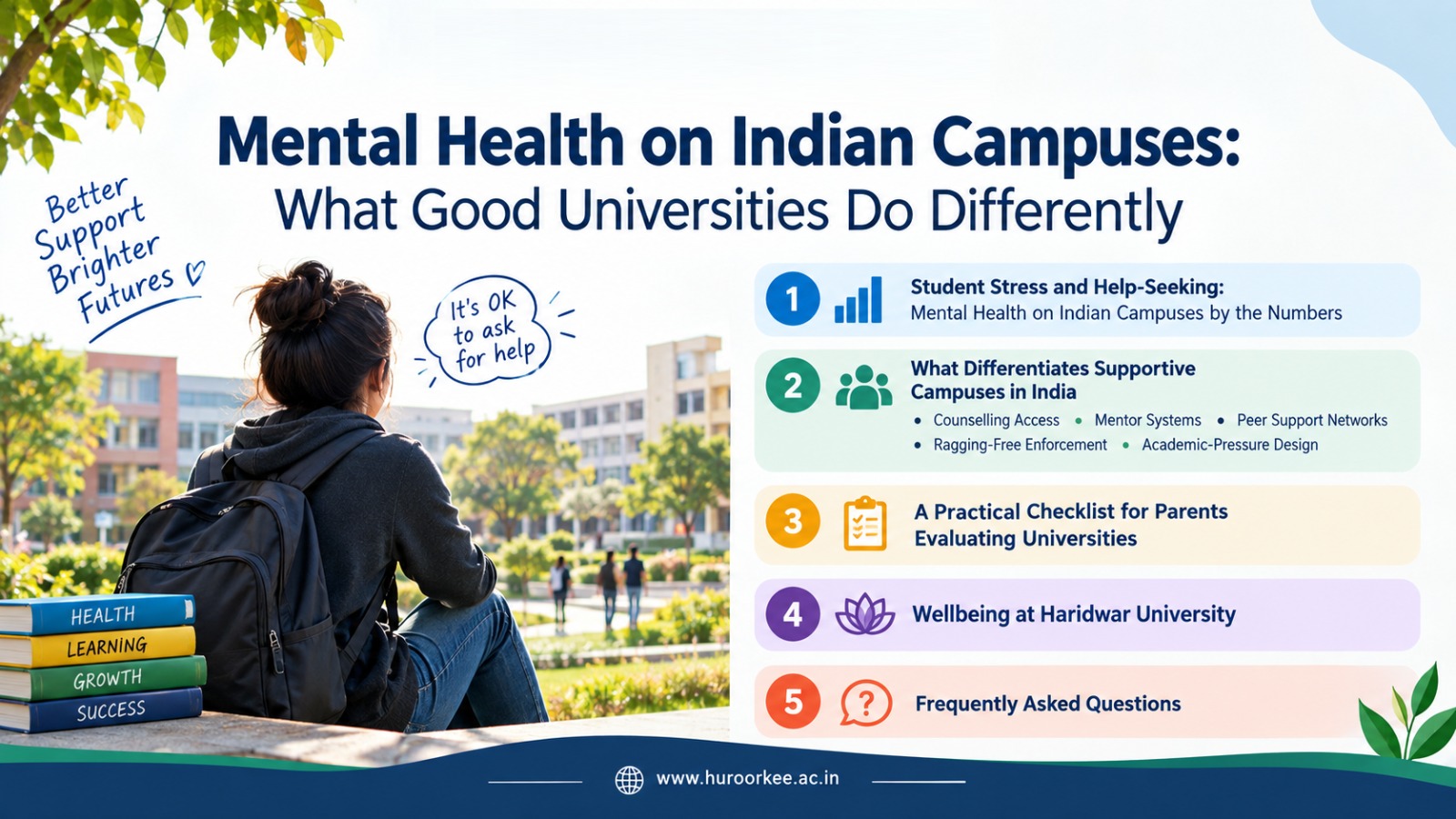
For a growing number of Indian families, mental health on Indian campuses is now as critical an admission consideration as placement figures, academic accreditations, or NAAC grades when selecting where a son or daughter will spend the next three to five formative years.
Intense academic pressure, competitive entrance benchmarks, relocation anxiety, and living away from home for the very first time all converge during undergraduate years. How an institution responds — through proactive counselling, transparent mentorship, zero-tolerance anti-ragging measures, and an empathetic culture that treats stress as a manageable reality rather than a personal failing — fundamentally determines whether a student thrives or struggles in isolation.
This analysis examines verified national mental health data in India, outlines what well-governed universities do differently, and provides parents with an actionable checklist to evaluate student wellbeing before finalizing an enrollment decision.

Table of Contents
- 1. Student Stress & Help-Seeking: Mental Health on Indian Campuses by the Numbers
- 2. What Differentiates Supportive Campuses in India (5 Structural Pillars)
- 3. A Practical Checklist for Parents Evaluating Universities
- 4. Wellbeing at Haridwar University: Infrastructure & Transparency
- 5. Frequently Asked Questions (FAQs)
- 6. Plan Your Campus Visit & Admissions
1. Student Stress & Help-Seeking: Mental Health on Indian Campuses by the Numbers
Official mortality and public health data in India presents an urgent imperative for systemic change:
13,892 Student Deaths
According to the National Crime Records Bureau (NCRB) Accidental Deaths and Suicides in India 2023 report, 13,892 students died by suicide in 2023 — the highest count in a decade, accounting for 8.1% of all suicides nationwide.
7.3% Adolescent Morbidity
The National Mental Health Survey conducted by NIMHANS reported that approximately 7.3% of youth aged 13–17 live with diagnosable mental health conditions, with a massive majority unable to access timely institutional support.
24x7 Tele-MANAS: 14416
The Ministry of Health & Family Welfare operates Tele-MANAS (toll-free 14416 / 1-800-891-4416), offering confidential psychological counseling in 20+ languages alongside the Ministry of Education's Manodarpan helpline.
Following the Supreme Court of India's directions in Sukdeb Saha v. State of Andhra Pradesh (2025) and subsequent draft guidelines from the University Grants Commission (UGC), student mental health support has transitioned from an optional welfare service into a statutory compliance mandate.
2. What Differentiates Supportive Campuses in India (5 Structural Pillars)
Simply pinning a counsellor’s name on a corridor noticeboard does not constitute a supportive environment. Genuinely caring institutions exhibit five core structural practices:
1. Stigma-Free, Accessible Counselling
Walk-in appointments without bureaucratic gatekeeping, absolute confidentiality of mental health records, and a healthy counsellor-to-student ratio (UGC draft norms recommend 1 qualified professional per 100–500 students depending on campus scale). Publishing counsellor credentials and hours openly normalizes seeking help.
2. Scheduled, Tracked Faculty Mentorship
Effective campuses employ structured mentor-mentee frameworks where faculty mentors meet assigned students at fixed weekly or fortnightly intervals. These check-ins catch homesickness, isolation, or academic slippage before they spiral into severe crises.
3. Vibrant Peer Support & Active Alumni Networks
Clubs, sports leagues, cultural societies, and an active Alumni Network cultivate institutional belonging. Seeing former graduates succeed in diverse industries offers immediate relief to final-year students battling placement anxiety.
4. Visible, Zero-Tolerance Anti-Ragging Enforcement
Ragging remains a documented trigger of severe psychological trauma. Robust institutions maintain active Anti-Ragging Committees, continuous monitoring squads, and prominent displays of the National Anti-Ragging Toll-Free Helpline (1800-180-5522). Learn about our institutional enforcement in our Anti-Ragging Measures at HU Guide.
5. Empathetic Academic-Pressure Design
Campuses that balance continuous internal evaluations, laboratory assessments, and structured assignments rather than staking entire semester grades on a single high-stakes terminal exam observe noticeably reduced student anxiety. Transparent semester credit loads published across Academic Programme Pages help students pace their study cycles.
3. A Practical Checklist for Parents Evaluating Universities
When visiting campuses during admission counseling, parents should verify wellbeing provisions as rigorously as laboratory equipment:
- Counselling Specifics: Ask if there is a qualified on-campus psychologist, their working hours, and average wait times.
- Anti-Ragging Infrastructure: Confirm the Anti-Ragging Committee composition and look for the visible 1800-180-5522 helpline across campus corridors.
- Mentorship Intervals: Inquire how many students are assigned to each faculty mentor and how often formal progress reviews take place.
- Hostel Safety & Wardens: Inspect hostel blocks personally. Verify warden accessibility, night check-in protocols, and emergency medical response times (see our Hostel Rules Guide and Hindi Parents' Hostel Guide).
- Financial Predictability: Review fee structures for hidden costs. Haridwar University publishes tuition, hostel, and scholarship criteria transparently on the Fees & Scholarships Page, eliminating unexpected financial strain.
- Early Warning Systems: Ask how the institution detects and intervenes when a student experiences sharp drops in class attendance.
- Career Preparation: Examine placement support on the Training & Placement Overview, since final-year placement uncertainty is a leading driver of psychological distress.
4. Wellbeing at Haridwar University: Infrastructure & Transparency
At Haridwar University, student wellbeing is intentionally integrated into campus architecture and daily life:
- Sprawling 20-Acre Campus: As detailed on our About Us Page, our self-contained campus in Roorkee features lush greenery, noise-free study enclaves, and round-the-clock CCTV security.
- Residential Hostels: Dedicated residential blocks (KD Bhawan, ML Bhawan for boys; PL Bhawan for girls) with resident wardens, clean dining facilities, and structured out-pass procedures. Read our Day in the Life at HU Guide for a detailed view.
- 50,000+ Volume Central Library: Offering quiet individual reading cubicles, private digital browsing stations, and air-conditioned reading halls for low-pressure study.
- Multi-Sport Complex: Outdoor athletics tracks, basketball courts, cricket grounds, and indoor gymnasium facilities provide essential physical outlets for releasing academic fatigue.
- Substantial Scholarships Reducing Cost Anxiety: Up to 80% merit scholarships on first-year tuition, a dedicated 25% scholarship for girl students, sports concessions, and support for children of Armed Forces personnel.
Counselling Transparency & Immediate Support Access:
Haridwar University maintains full institutional honesty: while our faculty mentorship, hostel warden check-ins, and student welfare protocols are active daily, the university is in the process of finalizing its dedicated mental health centre listing online. Students experiencing immediate emotional distress can confide in their assigned faculty mentor or hostel warden, visit the Student Welfare Office, or access the government’s 24×7 free helpline Tele-MANAS (Dial 14416) at any hour.
5. Frequently Asked Questions (FAQs)
1. How common are mental health struggles among Indian college students?
National epidemiological surveys estimate roughly 1 in 14 adolescents lives with a diagnosable mental health condition, and NCRB data recorded 13,892 student suicide deaths in 2023 alone — underlining why mental health on Indian campuses has become an urgent national policy priority.
2. What is Tele-MANAS, and is it free to use?
Tele-MANAS is a government-run, 24x7 tele-counselling service (14416 / 1-800-891-4416) established by the Ministry of Health & Family Welfare. It is completely free of cost to any caller across India, offering confidential support in over 20 regional languages.
3. Has the UGC made mental health support mandatory for universities?
Yes. Following Supreme Court directives, the UGC's draft mental health guidelines mandate higher education institutions to institute dedicated Mental Health and Well-being Centres, establish monitoring committees, and provide 24x7 crisis counselling access.
4. What should I ask a university about counselling before admission?
Ask about the counsellor’s clinical qualifications, appointment booking procedures, confidentiality policies, and average wait times. A transparent, functioning service will answer specifically rather than pointing vaguely to a general prospectus.
5. Why is ragging still relevant to student mental health?
Ragging is a severe driver of acute anxiety, depressive trauma, and academic dropout. Strict UGC compliance mandates that universities enforce zero tolerance, maintain active Anti-Ragging Committees, and prominently display the national helpline (1800-180-5522).
6. Does academic-pressure design actually reduce stress?
Institutions that distribute grading across continuous internal assessments, practical laboratories, and assignments — rather than a single high-stakes end-term exam — consistently record lower levels of chronic stress among students.
7. Does Haridwar University have anti-ragging and hostel safety measures?
Yes. Haridwar University operates an active Anti-Ragging Committee aligned with UGC regulations. Hostels feature 24/7 CCTV surveillance, biometric access, and resident wardens. Students can access support via their faculty mentor, warden, or by calling Tele-MANAS (14416).
8. Are scholarships at Haridwar University linked to easing financial stress?
Yes. Clear, published scholarships of up to 80% on first-year tuition, along with concessions for female candidates, armed forces dependents, and sports quota qualifiers, eliminate financial ambiguity for families.
9. How can I apply to or visit Haridwar University?
Families can schedule an in-person campus tour via our Contact Us Page or submit an online application via our Apply Now Portal.
6. Plan Your Campus Visit & Admissions
Visiting the campus in person is the best way to evaluate student life, interact with our faculty mentors, inspect residential hostels, and experience the supportive community at Haridwar University.
Experience a Nurturing Campus at Haridwar University
Admissions are open for the 2026 academic session across engineering, computing, pharmacy, business, and allied sciences with comprehensive scholarship options.