

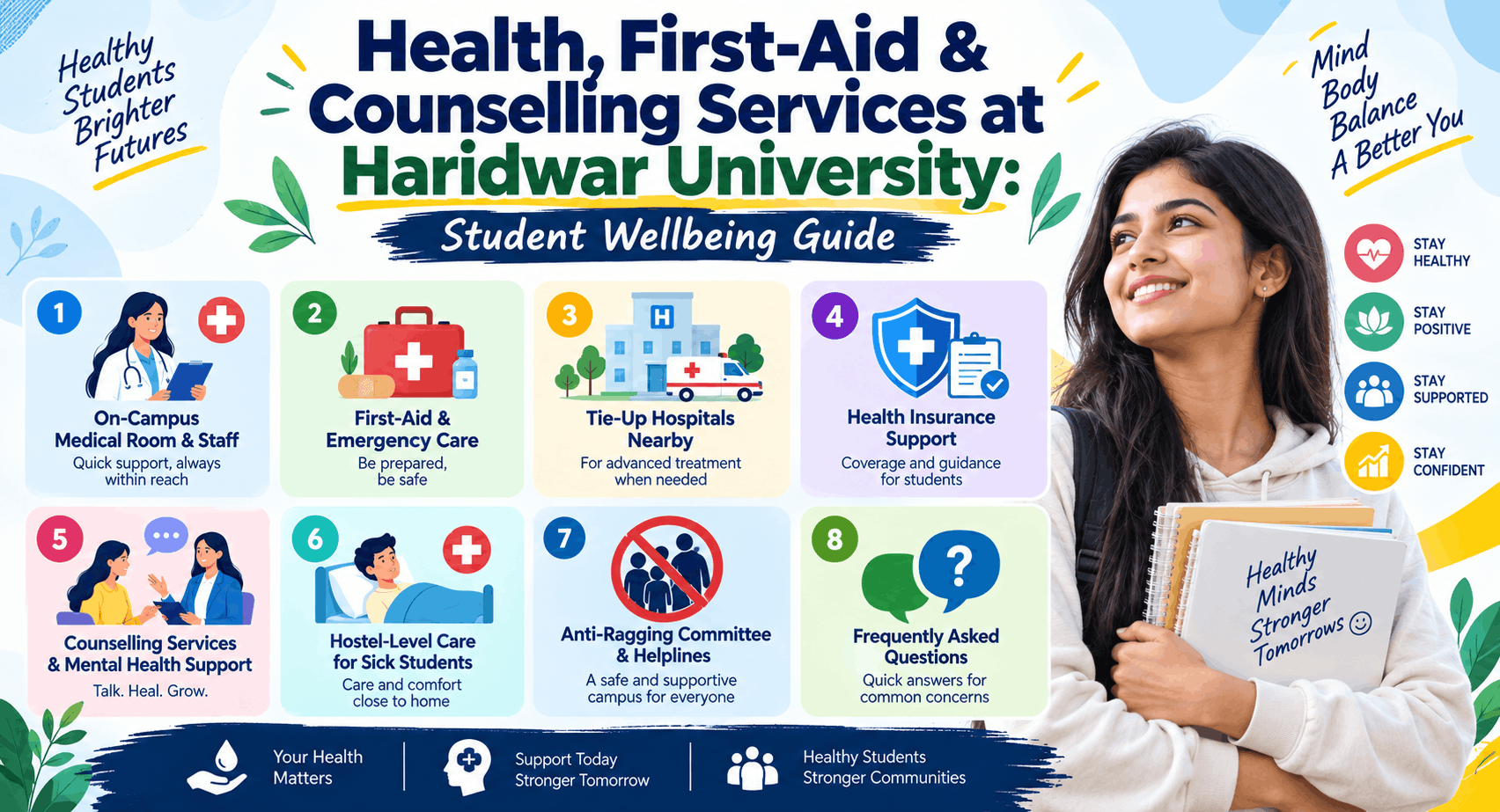
Sending a child away to university is, for most families, a trust decision before it's an academic one — and health, first-aid and emotional support are usually the first worries a parent doesn't say out loud. This guide sets out what Haridwar University medical facilities, counselling access and hostel-level care actually look like, sourced directly from HU's own published pages together with named government sources — the UGC's anti-ragging framework and the national Tele-MANAS helpline — rather than treating either as the sole authority.
Where HU hasn't published a detail (a tie-up hospital list, a formal parent-notification protocol, a student insurance scheme), this guide says so plainly instead of filling the gap with an unverified claim, and points you to a single office that can answer all of those open questions at once (see Section 8).
Table of Contents
- 1. On-Campus Medical Room & Staff
- 2. Tie-Up Hospitals Nearby & Emergency Protocol
- 3. Health Insurance for Students, If Any
- 4. Counselling Access & Confidentiality
- 5. Anti-Ragging Committee & Helplines
- 6. Hostel-Level Care for Sick Students
- 7. Parent Communication Policy
- 8. One Point of Contact for Open Questions
- 9. Frequently Asked Questions (FAQs)
- 10. Student Welfare & Admissions Next Steps
1. On-Campus Medical Room & Staff
HU's own hostel page and infrastructure page both carry the same statement, word for word:
“The medical facilities like ambulance, pharmacy are also available inside the HU around the clock. Our dedicated medical staff ensures that all students receive prompt medical attention whenever needed.”
In practical terms, this confirms three key infrastructure pillars:
24x7 Campus Ambulance
Stationed on campus ready for rapid emergency transit whenever immediate hospital referral is required.
On-Campus Pharmacy
Provides essential first-aid supplies, fever and pain medications, and basic healthcare consumables around the clock.
Dedicated Medical Staff
Round-the-clock healthcare personnel ensuring students receive prompt triage, first aid, and recovery care.
That round-the-clock framing matters for a residential campus — a student who falls ill at night or over a weekend isn't left waiting for a weekday clinic to reopen.
Parent Advisory: What HU's public pages don't spell out is the exact size of the medical team, specific doctor qualifications, or the precise location of the medical room on campus. Families who need that level of detail for a specific medical condition, such as a standing prescription or a known allergy, should confirm it directly with the admissions or hostel office before enrolment rather than assume campus staff already have that information on file.
2. Tie-Up Hospitals Nearby & Emergency Protocol
Based on what HU has published, the campus is designed to be the first point of response for a medical situation: the on-campus ambulance and dedicated medical staff handle first aid and immediate care, with the on-campus pharmacy covering routine medication needs.
For anything beyond that — a condition requiring hospital-level diagnosis, surgery, or overnight admission — the practical expectation is referral outward to multi-speciality hospitals in Roorkee or nearby Haridwar, both a short drive from the Roorkee-Haridwar Canal Road campus.
Transparency on Hospital Referral Lists
To be transparent: HU has not published a named list of tie-up or empanelled hospitals specifically for student medical emergencies on its official site as of this writing. This is a different question from the hospital placements HU's B.Sc Nursing programme arranges for clinical training, which serve an academic purpose rather than a student-emergency one, so this guide does not conflate the two. Parents who want a confirmed hospital-referral chain in writing should request it directly from the Registrar's office (see Section 8).
3. Health Insurance for Students, If Any
No dedicated student health-insurance or mediclaim scheme appears on HU's official site as of this writing. What is published, verified against the live Fees & Scholarships page, are programme-wise tuition figures — not a separate insurance line item.
Admissions Tip: If a health-insurance cover matters to your enrolment decision, confirm directly with admissions rather than assuming one exists or doesn't; this guide won't guess either way.
4. Counselling Access & Confidentiality
HU lists psychological counselling among its student support services, alongside pre-placement training, expert lectures and value-added courses, as part of the university's own description of what it offers students beyond academics.
Separately, the Training & Placement Cell runs its own career-counselling and employability-assessment process — a distinct service focused on placement readiness, not personal or emotional wellbeing, and this guide keeps the two apart rather than blending them into one claim.
On-Campus Psychological Support
Campus-based counselling has the advantage of familiarity with university life, faculty context, and in-person follow-up support through the Counselling Assistance desk.
National Tele-MANAS (MoHFW)
India's 24x7 tele-mental-health programme (toll-free 14416 or 1800-891-4416), offering free, strictly confidential tele-counselling in multiple languages.
HU's public pages do not spell out a formal confidentiality protocol for its psychological counselling service — who a student can approach, how a session is recorded, or what stays private. Rather than assume an answer, this guide flags that gap honestly and points to Tele-MANAS, India's national tele-mental-health support programme, reachable by phone anytime a student wants to talk to someone outside the campus system, for anything from ordinary homesickness and stress to more serious concerns.
Balanced Approach: Neither option should be read as a substitute for the other. Campus-based counselling offers immediate local context, while Tele-MANAS provides guaranteed external confidentiality and 24x7 availability. Using both, depending on the situation, is the recommended path.
Note on ICC Helplines: HU's anti-ragging helpline is named below (Section 5); this guide could not confirm whether HU separately publishes an Internal Complaints Committee (ICC) or equivalent harassment/safety helpline. If one exists, it belongs alongside the anti-ragging number for parity of coverage — worth confirming directly with the Registrar's office.
5. Anti-Ragging Committee & Helplines
Like every UGC-recognised institution, Haridwar University is required to maintain an Anti-Ragging Committee and Anti-Ragging Squad under the UGC Regulations on curbing the menace of ragging in higher educational institutions, and HU's own material states the campus is strictly monitored for ragging.
HU's site does not publish a named roster of current committee members, so this guide does not invent one — families wanting that detail should ask the Registrar's office directly (see Section 8).
Official Verified Anti-Ragging Helplines
National 24x7 Toll-Free Helpline: 1800-180-5522 (listed on HU's footer, matching the National UGC Anti-Ragging Helpline).
National Online Complaint Portal: antiragging.in (reaches central monitoring authorities immediately).
A separate campus mobile number is also listed on some HU pages. This guide does not republish it, because it could not be independently confirmed as a currently monitored, genuine line at the time of writing — reproducing an unverified number risked sending a worried parent or student to a dead end. The verified national number above is the reliable option until that campus number is confirmed.
6. Hostel-Level Care for Sick Students
For a resident student who falls sick, the first point of contact is the hostel's own warden structure rather than a separate medical office. HU's hostel blocks each have a residential Faculty Warden and Assistant Warden, supported by attendants, all reporting to a university-wide Chief Warden — a structure confirmed on HU's own hostel and infrastructure pages.
Hostel Care & Medical Escalation Path:
In practice, this means a sick student doesn't have to independently locate the on-campus medical facility while unwell; the warden on duty is meant to be the first call, who can then coordinate onward care.
7. Parent Communication Policy
HU's public pages do not lay out a formal, written protocol for how or when parents are contacted during a student's medical situation — this guide won't invent one where none is published. What is confirmed is the practical structure that would carry that communication: the hostel warden system described above, with escalation up to the Chief Warden and, for anything requiring university-level attention, the Registrar's office.
Recommended Action for Families: Given that gap, the most reliable step for a family is to ask directly, before admission, exactly who calls whom and how quickly in a medical situation — and to save the relevant hostel warden's contact number rather than relying on an assumed default policy.
8. One Point of Contact for Open Questions
This guide has been deliberately honest about five specific items HU has not yet published in writing:
Rather than leave each as a separate dead end, the single fastest way to get an answer on any or all of them is the same office: the Registrar's Office, which oversees the hostel warden structure and the Students' Grievance Redressal Committee & Student Welfare Service. Contact the Registrar's Office directly, ideally before enrolment, and ask about all five items in one conversation.
9. Frequently Asked Questions (FAQs)
Is a doctor or medical staff available on campus at all times?
HU states that its ambulance, pharmacy and dedicated medical staff are available inside the campus around the clock, not just during office hours. Exact staffing numbers and doctor qualifications aren't published, so confirm those specifics with admissions if needed.
What happens if my child needs hospital care beyond first aid?
Campus care handles first aid and immediate response; anything requiring hospital-level treatment is referred outward to hospitals in Roorkee or Haridwar. HU hasn't published a named tie-up hospital list for student emergencies, so ask the Registrar's office for the current referral arrangement.
Does HU provide health insurance for students?
No dedicated student health-insurance scheme is listed on HU's official site as of this writing. Only programme tuition fees appear on the live Fees & Scholarships page — confirm insurance separately with admissions if it matters to your decision.
Is campus counselling confidential?
HU lists psychological counselling among its student support services but doesn't publish a formal confidentiality protocol. For a service with a clearly stated confidential, government-run structure, Tele-MANAS (toll-free 14416) is available by phone at any time.
What should I do if I suspect ragging?
Call HU's 24x7 toll-free number, 1800-180-5522, which matches the national UGC Anti-Ragging Helpline, or register a complaint through the antiragging.in complaint portal. HU is required to maintain an Anti-Ragging Committee under UGC regulations.
Will the university inform me if my child is unwell?
HU hasn't published a formal parent-notification protocol, so this guide doesn't assume one. Ask the admissions or hostel office directly, before enrolment, exactly who would contact you and how quickly in a medical situation.
Prioritising Student Health & Wellbeing at Haridwar University
Explore Haridwar University's student welfare infrastructure, counselling support, and transparent grievance redressal systems.