

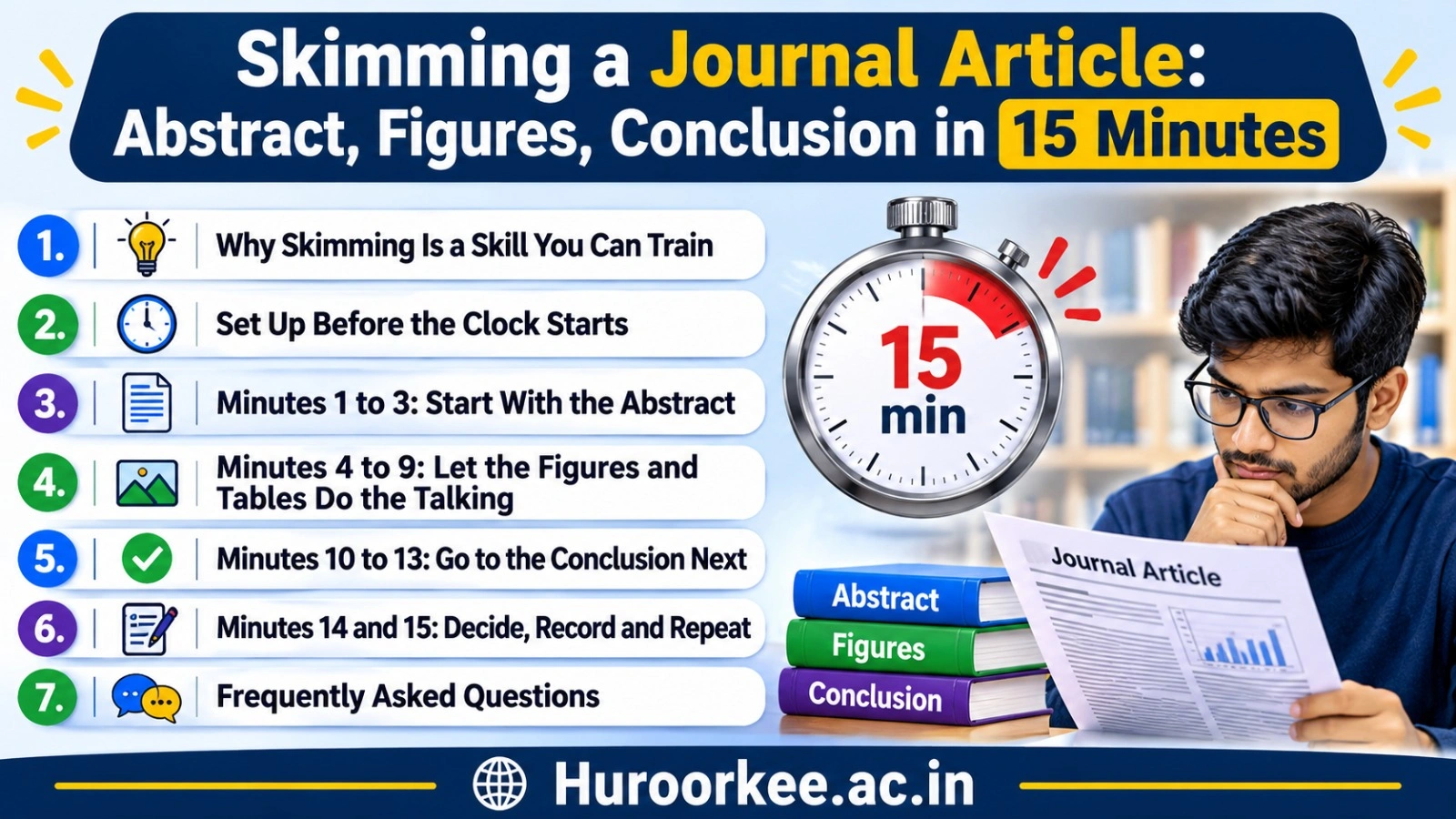
Skimming a Journal Article: Abstract, Figures, Conclusion in 15 Minutes
Dr. V.K. Saini
Director, Haridwar University
Most students don't have a reading problem. They have a sorting problem. You open a PDF at nine in the evening, scroll for forty minutes and still can't say whether the paper helps your project. This guide to Skimming a Journal Article: Abstract, Figures, Conclusion in 15 Minutes gives you a fixed order, a running clock and a decision at the end.
Skimming isn't a replacement for careful reading. It's the step that tells you which papers deserve it. The table below outlines the complete fifteen-minute roadmap, followed by detailed strategies for each stage.
| Timeline | What You Read | What You Look For | What You Write Down |
|---|---|---|---|
| Minutes 1 to 3 | Title, keywords, abstract | The research question, the method, the headline result | Four one-line concise answers |
| Minutes 4 to 9 | Figures, tables, captions | Whether the empirical data back up the headline claims | Brief notes on key figures and controls |
| Minutes 10 to 13 | Conclusion and limitations | What the authors say it all means; caveats and boundaries | Gaps between abstract claims and conclusion |
| Minutes 14 to 15 | Your own synthesis notes | Is this paper genuinely worth a full deep read? | A definitive tag: Read Fully, Keep for Background, or Drop |
Table of Contents
- 1. Why Skimming Is a Skill You Can Train
- 2. Set Up Before the Clock Starts
- 3. Minutes 1 to 3: Start With the Abstract
- 4. Minutes 4 to 9: Let the Figures and Tables Do the Talking
- 5. Minutes 10 to 13: Go to the Conclusion Next
- 6. Minutes 14 and 15: Decide, Record and Repeat
- 7. Frequently Asked Questions (FAQs)
1. Why Skimming Is a Skill You Can Train
Skimming gets a bad name, as if it were laziness with a better label. It isn't. A literature search throws up far more titles than anyone can read cover to cover, so every serious researcher sorts, and the successful ones save careful reading for the papers that shape their core arguments.
Skimming, scanning and reading are different jobs
Reading means following an argument step by step from premise to conclusion. Scanning means hunting for one specific piece of data, such as a dataset name, author or parameter. Skimming sits purposefully between the two: you build a mental map of what the paper claims and verify whether the supporting empirical evidence looks solid.
What skimming can't do
It cannot confirm that a complex mathematical derivation was completely sound, and it cannot replace a full read when you plan to cite a specific technical claim in your own paper. Skimming decides where your attention goes. It does not replace the attention.
2. Set Up Before the Clock Starts
The clock starts only when the PDF is open, so settle two vital things first: access, and whether the article is genuinely worth your time.
Get legitimate access
Haridwar University's Central Library portal lists extensive institutional subscriptions to JSTOR, IEEE Xplore, Sage and EBSCO BSE, institutional membership in DELNET, the National Digital Library of India (NDLI), and Shodhganga, alongside an active Reference Service where any registered student can consult the Reference Librarian.
Nationally, researchers can also leverage the Government of India's One Nation One Subscription (ONOS) scheme executed by INFLIBNET, which covers major academic journals across 30 publishers through campus IP and remote INFED credentials. For Indian doctoral research, INFLIBNET's Shodhganga provides an open-access repository of digital theses.
Decide if the paper deserves 15 minutes
Glance at the title, publication venue, impact factor and publication year. Is it an empirical study or a review? If you cannot clearly connect its abstract to your specific project needs, spend two minutes and move on. A fast "no" is an excellent outcome that saves hours of unproductive browsing.
3. Minutes 1 to 3: Start With the Abstract
Start with the title and author keywords, then read the abstract slowly and deliberately. It is the one section you will read word for word, because it represents the authors' own synthesized compression of their study.
Four answers to extract:
- The question: What exact engineering or scientific problem was investigated?
- The method: What experimental setup, algorithm, dataset or methodology was used?
- The finding: What specific quantitative result or breakthrough was achieved?
- The meaning: Why do the authors argue this contribution matters?
Write each answer as a single line in your notes. A gap you cannot fill is valuable information: it indicates the abstract is vague or the paper may be overstating its scope.
For example, imagine a computer science student researching automated leaf disease detection. If the abstract notes that the deep learning model achieved its highest accuracy on tomato leaves in controlled laboratory lighting, that single clause alerts the researcher that the claim may not hold across open-field environments or different crops.
When abstracts carry structured headings—as documented by the US National Library of Medicine for MEDLINE—jump directly to the Results and Conclusions sections first. The abstract hands you the claim, so everything you read after it has a distinct job: to test that claim against data.
4. Minutes 4 to 9: Let the Figures and Tables Do the Talking
Figures are where an author's claim meets reality, which is why they receive the largest allocation: six full minutes. Do not read the dense explanatory paragraphs surrounding them yet. Look at the visual data first.
- Read the captions before the pictures: A well-crafted caption functions like a micro-abstract: it states what is plotted, under what operational conditions, and what trends to observe. Running through all captions in sequence often reveals the complete storyline before reading a single paragraph.
- Check axes, units and comparisons: For every significant graph, verify three items: What is plotted on each axis, and in what units? What is being compared with what? Is there an established baseline, a control group, or visible error bars indicating statistical significance?
- Match every figure to a claim: Revisit your four-line summary from the abstract and locate the corresponding figure or table for each claim. If the abstract claims a 25% efficiency improvement but no figure demonstrates this under controlled conditions, place a question mark beside that claim.
5. Minutes 10 to 13: Go to the Conclusion Next
You read the conclusion after the figures on purpose. Having examined the empirical evidence first, you are prepared to critically evaluate the authors' claims rather than passively adopting their interpretations.
Compare it with the abstract
Do the abstract and conclusion tell the same story? Frequently, the conclusion is more cautious and nuanced than the abstract, which reflects good scientific practice. Alternatively, if the conclusion claims broader applications than the data proved, note the discrepancy in a single line.
Hunt for limitations
Scan for qualifying keywords: however, limited to, assumes ideal conditions, and future work. Authors frequently disclose constraints in this section, preventing you from misapplying their results. A brief glance at the subheadings in the methodology section will quickly complete your mental model of the experimental setup.
6. Minutes 14 and 15: Decide, Record and Repeat
The final two minutes turn your fifteen-minute investment into an actionable decision. Assign every paper one of three clear categories:
The article directly addresses your primary research question, provides a reusable methodology, or contradicts key assumptions you need to test.
The paper offers useful contextual definitions, literature review citations or secondary metrics for your introduction chapter.
The methodology does not apply, the results are too preliminary, or the scope diverges from your study objectives.
Write your tag directly beside the citation in your literature matrix so you never repeat the exercise later.
A note format that fits on one line
Keep your notes brief: citation, your four-line summary, the single most important figure number, the primary limitation, and the decision tag. If you are reading physical books, remember that under HU library regulations, underlining or highlighting library property carries a penalty of ₹1,000, so record annotations in a digital document or personal research notebook.
Build the habit without burning out
Commit to skimming one paper per day for a week with an honest timer. If intense research workloads start to impact your focus, the Student Care Centre in each academic block offers dedicated welfare assistance with a stated 24-hour response time.
Once a paper qualifies for a full read, our companion guide on how to write a research paper as an undergraduate demonstrates how to synthesize your findings into publishable drafts. Furthermore, as noted on the official fees and scholarships page, HU awards an Academic Excellence incentive of ₹5,000 to students achieving 85% or above across semester examinations in their first attempt.
Skimming a journal article in 15 minutes will not make you an instant authority on the paper, but it will tell you quickly, objectively, and reliably whether the paper deserves your time.
7. Frequently Asked Questions (FAQs)
1. Can I really skim a journal article in 15 minutes?
Yes, provided your goal is triage and decision-making rather than exhaustive comprehension. A 15-minute skim identifies the central claim, the experimental evidence, and key limitations, allowing you to determine whether a full read is warranted.
2. Should I read the abstract or the conclusion first?
Abstract first, then figures, then the conclusion. The abstract establishes the core hypothesis, the figures reveal the actual data, and the conclusion shows whether the authors' interpretations remain grounded in their results.
3. Is skimming enough to cite a paper in my project?
No. Skimming decides whether to read a paper. Citing an article based solely on a skim is how misinterpreted findings and incorrect citations enter academic work. Always read relevant sections thoroughly before citing.
4. What if the abstract has no section labels?
Hunt for the same four foundational elements yourself: problem statement, methodology, primary finding, and overall implication. Highlight them directly in your PDF reader.
5. How do I skim a paper full of dense equations?
Treat complex mathematical proofs as a black box on the first pass. Read surrounding text to understand what physical relationship the equation models, and look at the plots to see how variables interact.
6. How can I get past a paywall legitimately?
Check your university library's institutional subscriptions, explore national initiatives like One Nation One Subscription (ONOS), search open-access repositories such as NDLI and Shodhganga, or consult your campus Reference Librarian.
7. Does this method work for literature review articles?
Yes. Because reviews synthesize dozens of studies rather than presenting one experiment, spend the visual analysis minutes examining taxonomy diagrams, classification frameworks, and comparative summary tables.
8. Can I skim a master's or doctoral thesis the same way?
The principle is identical, though you will need 25 to 30 minutes due to the greater length. Read the preliminary abstract, examine the primary summary charts, and jump directly to the concluding summary chapter.
9. When should I stop skimming and read a paper in full?
Stop skimming the moment a paper directly answers your research question, introduces an experimental protocol you intend to replicate, or provides rigorous data that challenges your working hypothesis.
Accelerate Your Academic Research at Haridwar University
Access world-class digital libraries, international journal subscriptions, faculty research mentorship, student welfare support, and merit scholarships up to 80%. Admissions open for the 2027-28 academic year.