

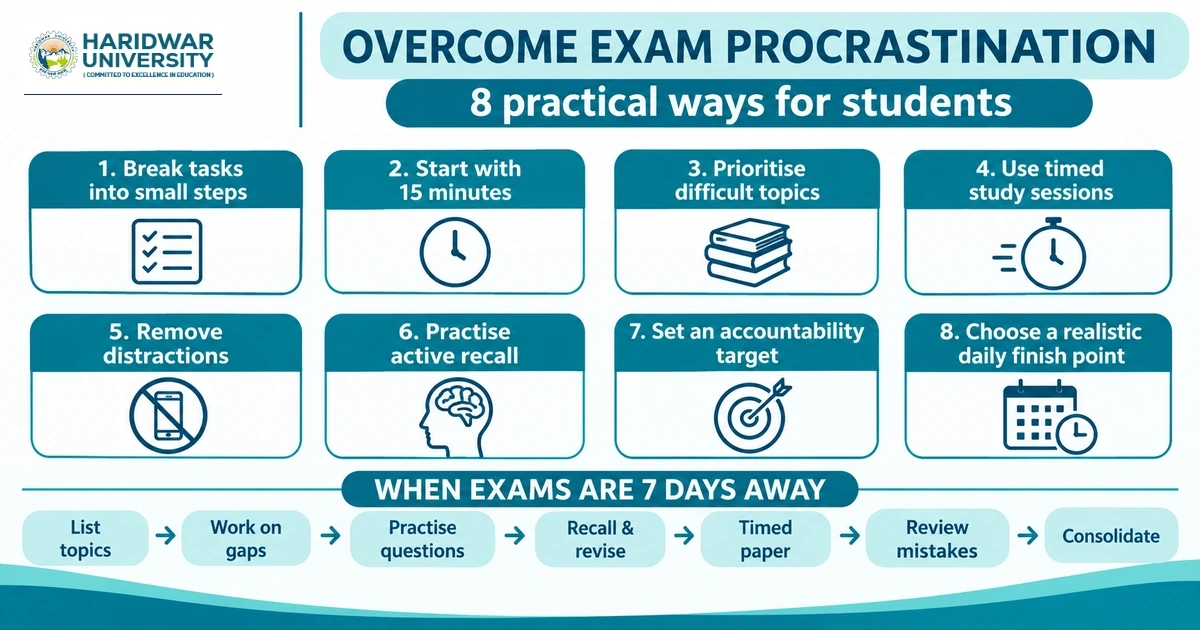
How Do I Overcome Procrastination Before Exams? 8 Practical Ways for Students
Mrs. Nisha Dhiman
Student Welfare Officer, Haridwar University
Examinations are approaching, the syllabus is unfinished, and yet opening a textbook feels like the hardest task of the day. A student may spend an hour arranging notes, checking messages or planning a timetable, only to postpone the actual revision until tomorrow. Then tomorrow becomes another day of delay.
How do I overcome procrastination before exams? I would begin by recognising that postponing study is not always a matter of laziness. A difficult chapter, fear of getting an answer wrong, an unclear study plan or the pressure of completing too much can all make starting uncomfortable. The solution is not simply to demand more discipline. It is to make the next academic task clear, manageable and possible to begin.
Research by psychologist Piers Steel, published in Psychological Bulletin in 2007, reviewed 691 correlations related to procrastination and identified factors such as task aversiveness, delay, self-efficacy and impulsiveness among its stronger predictors. This gives us a useful starting point: understand what is causing the delay, then change the way the work is approached.
Table of Contents
- 1. Why Students Procrastinate Before Exams
- 2. How Procrastination Affects Exam Preparation
- 3. 8 Practical Ways to Overcome Procrastination
- 4. A Seven-Day Plan for Exams That Are Near
- 5. How to Stay Focused During Study Sessions
- 6. What to Do After Wasting a Study Day
- 7. Building Habits That Prevent Exam Procrastination
- 8. Frequently Asked Questions (FAQs)
- 9. A More Manageable Way to Begin
1. Why Students Procrastinate Before Exams
Students often postpone revision for reasons that are more specific than a lack of motivation. Identifying the reason matters because different problems need different responses:
- Fear of failure: A student avoids a difficult subject because attempting it may reveal how much they have not understood.
- Perfectionism: Revision gets delayed until the student has the perfect notes, timetable or study environment.
- An overwhelming syllabus: Looking at several subjects and unfinished units at once makes it difficult to decide where to begin.
- Unclear tasks: Writing "study chemistry" in a timetable does not explain what needs to be completed.
- Distractions: Notifications, social media and unrelated activities provide an easier alternative to demanding academic work.
There is also an emotional side to procrastination. In a 2013 paper, Fuschia Sirois and Timothy Pychyl discussed how postponing an unpleasant task can provide short-term mood relief, even when it creates difficulties for the future. A student may feel temporary relief after avoiding a challenging chapter, but the chapter remains unfinished.
The useful question is not simply, "Why am I so lazy?" It is, "What makes this particular task difficult to start?"
2. How Procrastination Affects Exam Preparation
The immediate cost of procrastination is lost study time. The larger problem is that it reduces the time available for understanding, practice and revision.
Consider a student who postpones a numerical topic for several days. When the examination approaches, the student may have enough time to read the formulas but not enough to understand their application, solve different question types and correct mistakes.
The same pattern affects theory subjects. Reading a chapter once is not necessarily the same as being able to explain its arguments or recall important points without looking at the book.
Last-minute preparation can also encourage students to sacrifice sleep or skip planned breaks. These choices may make a study schedule appear more intensive, but they do not automatically make learning more effective.
3. 8 Practical Ways to Overcome Procrastination
1. Break the Syllabus into Small, Specific Tasks
Replace broad targets with tasks that have a clear finish point. Instead of writing "prepare engineering mathematics", write:
- Revise five integration formulas.
- Solve two questions using substitution.
- Check the solutions and mark mistakes.
- Revisit the questions that were difficult.
This approach makes the first action easier to identify. It also gives students a way to measure progress beyond the number of hours spent at a desk.
2. Start with a Short Study Session
When a task feels difficult, commit to beginning it for a short, defined period. Set a timer for 15 minutes and work on one topic without switching activities.
The purpose is to overcome the initial resistance, not to claim that 15 minutes is sufficient for every subject. Once started, a student can decide whether to continue for another session. A short beginning is often more useful than waiting for an ideal two-hour study window that never arrives.
3. Prioritise Topics Instead of Treating Every Chapter Equally
When examinations are close, students need a realistic order of work. Prepare a simple topic list and classify each item:
| Topic Category | What It Means | Immediate Next Action |
|---|---|---|
| Understood | You can explain the concept or solve standard problems independently | Schedule a quick active-recall revision session |
| Needs Practice | You understand the theory but make computational or reasoning mistakes | Solve diverse question types and review errors |
| Not Understood | You cannot explain the topic or solve basic problems yet | Study the core concept and consult a faculty mentor |
Use the syllabus, course guidance and previous examination papers where available to understand the assessment requirements. Do not assume that a topic will appear in an examination simply because it appeared frequently in the past.
4. Use a Timed Study Method
The Pomodoro technique is one option: study for 25 minutes, take a five-minute break, and repeat the cycle. After four sessions, take a longer break if needed. Students can adjust the timings according to the subject and their concentration: a difficult numerical problem may need a longer uninterrupted session, while a short revision task may need less time. The important rule is to decide what will be completed during the session before starting the timer.
5. Remove Distractions Before They Interrupt You
Do not rely entirely on willpower when a distraction is within reach:
- Put your phone in another room or switch off non-essential notifications.
- Keep only the books and materials needed for the current task.
- Choose a study location where interruptions are manageable.
- Avoid keeping multiple unrelated browser tabs open on your laptop.
- Inform friends or family when you are completing a focused study session.
6. Study Actively Instead of Only Rereading
Passive rereading can make material look familiar without showing whether it can be recalled or applied. After studying a topic, close the book and try to explain the concept in your own words. Reproduce a diagram, write a formula from memory or solve a question without looking at the worked example.
A major review by John Dunlosky and colleagues (2013) gave practice testing and distributed practice high utility assessments. These approaches are useful because they involve retrieving information and revisiting it over time, rather than relying only on repeated reading. Students can explore HU's guide to evidence-based study methods for better memory and focus, as well as HU's semester examination preparation guide for revision planning and practice papers.
7. Use Accountability to Maintain Consistency
Some students work more consistently when another person knows what they intend to complete. Share a specific target with a classmate, friend or study partner. For example, agree to complete one topic and discuss five questions afterwards. A short progress check can help identify whether the work was completed or needs another session.
8. Set a Realistic Daily Finish Point
A timetable should include a manageable amount of work, not an idealised version of what a student hopes to achieve. Choose three important academic tasks for the day. Complete the most demanding one when concentration is relatively good, and leave time for practice and review. At the end of the day, check what was completed and move unfinished tasks into the next plan.
4. A Seven-Day Plan for Exams That Are Near
If revision has already fallen behind, the first step is to stop planning as though the entire syllabus can be completed overnight. A seven-day framework can help students organise the remaining time, but it must be adapted to the actual syllabus, examination timetable and level of preparation:
| Timeline | Main Academic Priority |
|---|---|
| Day 1 | List subjects and remaining topics; identify and triage the most urgent learning gaps |
| Day 2 | Work on difficult or foundational topics requiring conceptual clarity |
| Day 3 | Continue priority topics and solve related numerical and analytical questions |
| Day 4 | Revise completed topics using active recall, self-quizzing, and practice testing |
| Day 5 | Attempt relevant previous-year question papers or timed question sets |
| Day 6 | Review mistakes, resolve pending doubts with peers/faculty, and consolidate weaker areas |
| Day 7 | Consolidate key formulas and summary sheets, follow the examination timetable, and ensure adequate rest |
This is a planning example, not a guarantee of complete syllabus coverage. If a subject needs more time, adjust the sequence. Students should also check the official HU academic calendar for published academic and examination dates rather than relying on informal rumours.
5. How to Stay Focused During Study Sessions
Concentration is easier to manage when a student knows what the session is meant to achieve. Before beginning, write down one task and keep the relevant material ready. A useful session might look like this:
- Spend a few minutes recalling what was covered previously.
- Work on one defined topic without multitasking.
- Attempt a question or explain the concept without looking.
- Check the result and record mistakes.
- Take a planned break before the next task.
If attention repeatedly shifts, note the distracting thought or task on a separate piece of paper and return to the current work. It can be dealt with after the session concludes. Students who are adjusting to university routines can also consult HU's first-year guide to academics and university life for building a consistent daily schedule.
6. What to Do After Wasting a Study Day
One unproductive day does not mean the entire preparation plan has failed. The mistake is often trying to recover the lost time by creating an even more demanding timetable. Instead:
- Identify which tasks remain unfinished.
- Remove low-priority activities from the immediate plan.
- Choose one important task to restart with.
- Divide the remaining work across the time available.
- Protect reasonable sleep and recovery breaks.
I would encourage students not to spend the next morning regretting the previous evening. Review the plan, make the necessary adjustment and return to the next task. Consistency is built by restarting, not by expecting every single day to unfold perfectly.
7. Building Habits That Prevent Exam Procrastination
Exam preparation becomes less stressful when it is not postponed until the examination timetable is announced. A few repeatable habits can reduce the amount of work that accumulates:
- Review lecture material regularly instead of leaving entire units untouched.
- Record assignment and examination deadlines in one centralised place.
- Ask questions immediately when a concept first becomes difficult.
- Keep notes organised by subject, unit and topic.
- Practise recalling information and solving questions throughout the semester.
- Review the next day's academic tasks before ending the current study day.
Organised notes make regular revision far easier. Students who want a practical approach to recording important lecture points, reviewing them after class and arranging material for examinations can read HU's guide on how to take lecture notes you can actually use later.
If procrastination is repeatedly linked to chronic anxiety, low mood or emotional distress, students should not feel they have to manage it alone. They can reach out to the university's counselling and assistance centre for dedicated guidance and confidential support.
8. Frequently Asked Questions (FAQs)
1. How do I overcome procrastination as a student?
Identify what is causing the delay, break the work into specific tasks and begin with a manageable study session. Use a realistic timetable, reduce distractions and review your progress regularly.
2. Why do students procrastinate so much before exams?
Common reasons include fear of failure, perfectionism, unclear tasks, an overwhelming syllabus and digital distractions. Postponing study often provides short-term emotional relief from task-related stress.
3. How can I focus on studying when I have no motivation?
Do not wait for motivation to strike. Choose one small task, set a short 15-minute timer, remove phone distractions and start working. Taking action generates momentum and motivation follows.
4. Is the Pomodoro technique useful for exam preparation?
It is highly useful for structuring study time into focused 25-minute intervals separated by five-minute breaks. Adjust interval lengths to suit demanding mathematical derivations or long programming exercises.
5. How can I stop procrastinating when exams are only a week away?
List all remaining topics, triage the most urgent learning gaps, prioritise realistic high-yield subjects, and protect dedicated time for solving previous question papers rather than panicking.
6. Should I study late at night to make up for lost time?
Sacrificing sleep impairs memory consolidation, cognitive processing speed, and exam recall. Plan realistic daytime and evening windows, and safeguard at least 7 hours of restorative sleep.
7. What should I do if I keep missing my study targets?
Review whether your goals are too ambitious, vague or lack clear stopping points. Break tasks into smaller units, reset your schedule without self-blame, and ask a teacher or classmate for help.
9. A More Manageable Way to Begin
Overcoming procrastination before exams does not require a perfect timetable or an entire day of uninterrupted study. It requires recognising why a task is being delayed and making the next step easier to take.
Prepare a short list of unfinished topics today. Select one that deserves immediate attention, decide what you will complete, set a timer and begin. If the plan needs to change tomorrow, adjust it. What matters is replacing repeated postponement with steady, purposeful academic work.
Achieve Your Academic Potential at Haridwar University
Benefit from professional student welfare counselling, dedicated study halls, faculty mentorship, career coaching, and merit scholarships up to 80%. Admissions open for the 2027-28 academic session.