

Study Schedule for College Students: How to Build a Routine Around a Busy Timetable
Mrs. Nisha Dhiman
Student Welfare Officer, Haridwar University
A full college day can leave very little time for independent study. Lectures may run back-to-back, practical sessions can take longer than expected, assignments arrive together, and commuting adds another fixed commitment. By the time a student returns to their room or home, a timetable copied from the internet may already be impossible to follow.
I believe a useful study schedule for college students must begin with the commitments they cannot move. It should make room for academic work without treating meals, travel, rest and personal responsibilities as wasted time. The aim is not to fill every hour. It is to identify realistic study windows and use them consistently.
Research supports the value of planning, although it does not offer a universal timetable. A 2026 meta-analysis covering 31 studies and 13,506 participants found a moderate positive association between time management and college students' learning outcomes. The researchers also reported substantial variation between studies, so the result should not be read as a guarantee that a particular schedule will automatically improve marks.
Table of Contents
- 1. Why a Full College Timetable Makes Study Planning Difficult
- 2. How to Build a Study Schedule for College Students
- 3. Sample Study Schedules for Different College Timetables
- 4. How to Use Free Periods and Gaps Between Classes
- 5. Balancing Lectures, Assignments and Independent Study
- 6. Keeping Your Routine Flexible When College Plans Change
- 7. Common Mistakes That Make Study Routines Fail
- 8. Reviewing and Improving Your Weekly Study Schedule
- 9. Frequently Asked Questions (FAQs)
- 10. A Routine That Can Adapt With You
1. Why a Full College Timetable Makes Study Planning Difficult
University study is not limited to classroom hours. A student may have lectures in the morning, a practical session after lunch, an assignment submission approaching and a group project that requires coordination outside class. These activities compete for time, but they do not all require the same kind of attention.
There are four common planning difficulties:
- Fixed academic commitments: Lectures, practicals, tutorials and scheduled assessments cannot always be moved.
- Unpredictable workloads: A laboratory report or group assignment may take longer than expected.
- Travel and personal responsibilities: Commuting, meals, family commitments and errands reduce the time available for independent study.
- Uneven energy levels: A student may be alert in the morning but tired after a long day of classes.
This is why I advise students not to begin by deciding how many hours they should study. Begin by finding out how much time is genuinely available.
2. How to Build a Study Schedule for College Students
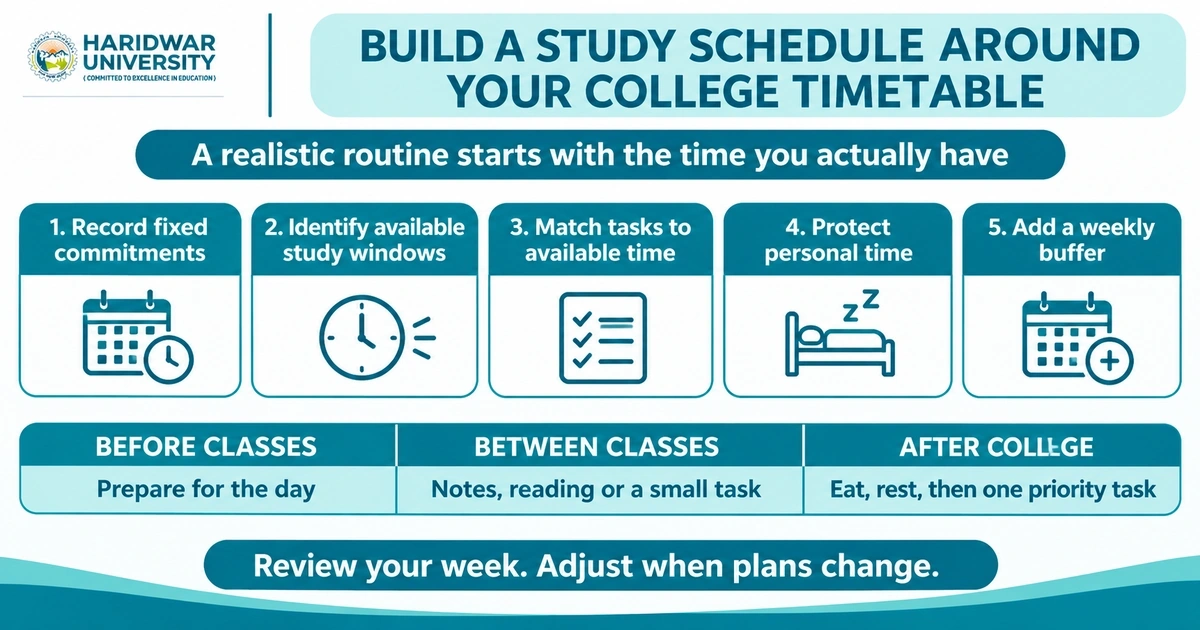
A practical study schedule for college students can be built in five steps. A notebook, calendar or simple spreadsheet is enough; the system matters less than whether it reflects the student's actual week.
- Record all fixed commitments: Start with the official class timetable. Add practical sessions, tutorials, travel, meals, regular responsibilities and any recurring activities. Include the time needed to move between locations.
- Identify your available study windows: Look for periods that are genuinely free. These may include a short period before classes, a gap between lectures, or time after returning from college. Do not count a 15-minute gap across campus as a full study session if travelling to the next class takes most of it.
- Match tasks to the time available: Not every task needs a long session. Use shorter windows for organising lecture notes, checking assignment instructions, reading a few pages or preparing questions. Keep longer periods for substantial assignments, problem-solving and project work.
- Protect personal time: Include meals, sleep, exercise, family responsibilities and rest. A schedule that removes recovery time may look productive on paper but is difficult to maintain across a semester.
- Add a buffer: Leave some unallocated time during the week. Practical sessions may overrun, faculty may announce additional work, and unexpected responsibilities can interrupt a planned session. A buffer prevents one disruption from overturning the entire schedule.
My advice is simple: plan the week you are likely to have, not the perfect week you wish you had.
3. Sample Study Schedules for Different College Timetables
There is no single daily routine that suits every university student. The following examples are illustrative planning models, not official Haridwar University class timings. Students should adjust them to their own lectures, practicals and travel arrangements.
| College Day Type | A Workable Planning Approach |
|---|---|
| Full day of classes | Use a short morning window to prepare for the day. Reserve a suitable gap for a small academic task. After returning, take time to eat and rest before completing one priority task. |
| Classes with long gaps | Use one substantial gap for library work, assignment progress or reading. Keep a separate break for lunch and avoid filling every free period with academic work. |
| Shorter college day | Complete classes and travel first, then use a longer afternoon window for assignments or independent study. Keep the evening lighter if the day has already been demanding. |
A weekly plan should also account for differences between weekdays and weekends. For example, a student with practical sessions on three weekdays may reserve a longer block on Saturday for project work. Sunday can include a short review of pending tasks and preparation for the next week, while leaving time for rest.
Students adjusting to university life may also find HU's first-year guide to academics, hostel life and campus responsibilities useful when organising their new routine.
4. How to Use Free Periods and Gaps Between Classes
A free period is useful only when the task fits the time available. Students sometimes lose these windows because they have not decided what to do before the gap begins.
I recommend keeping a small list of tasks that can be completed in 15, 30 or 45 minutes:
Check the next lecture's reading, organise notes or list questions for a faculty member.
Review a lecture topic, read a short section or make progress on a small assignment component.
Work on a problem set, prepare a practical record or complete a defined part of a project.
Longer gaps may be suitable for library work or assignments that require concentration. Very short gaps should not be treated as compulsory study time. Students need time to reach the next classroom, eat and speak with classmates or faculty. The important distinction is between using available time and trying to make every minute productive.
5. Balancing Lectures, Assignments and Independent Study
A study schedule for college students should distinguish between three kinds of academic work:
- Lecture-related work: Keep a manageable window to organise material from recent classes and identify topics that need clarification. This helps prevent several weeks of unfinished classwork from accumulating.
- Assignments and practical work: Record each submission date and divide larger tasks into smaller stages. For example, a project may require topic selection, research, drafting, practical work and final submission. Giving each stage a place in the weekly plan is more realistic than writing only the final deadline.
- Independent study: Reserve regular periods for subjects that need attention beyond classroom teaching. The amount of time required will vary with the course, subject difficulty and assessment calendar.
Students should also check their programme requirements and semester dates rather than relying on assumptions. HU's UG and PG programme guidelines explain the semester structure, while the academic calendar provides session-specific academic dates.
For students who want to improve what they do during an independent study session, HU's guide to evidence-based study methods for better memory and focus covers learning techniques separately.
6. Keeping Your Routine Flexible When College Plans Change
A timetable should guide decisions, not create anxiety when something changes. Practical sessions may overrun, a class may be rescheduled, or a group assignment may require an additional meeting.
Use a simple 5-step adjustment rule:
- Identify the task that was interrupted.
- Check its deadline and academic importance.
- Move it to the next suitable available window.
- Reduce or postpone a lower-priority task if necessary.
- Continue with the rest of the plan.
If a study session is missed, avoid doubling the next day's workload automatically. That often creates another unrealistic schedule. Use the weekly buffer or redistribute the task across two manageable sessions.
Students should also check official university notices and examination updates when dates change. HU's examination schedule page is a useful reference for published examination dates and related information.
7. Common Mistakes That Make Study Routines Fail
Some routines fail not because students lack discipline, but because the plan was unrealistic from the beginning:
Their commute, class timings, responsibilities and energy levels may be completely different.
A schedule without breaks or spare time cannot absorb ordinary academic or personal disruptions.
A class ending at 4 pm does not mean a student is ready to begin studying at 4 pm.
Large tasks need smaller, scheduled stages distributed evenly across the week.
Rest, physical well-being and social interaction are essential components of a sustainable university routine.
8. Reviewing and Improving Your Weekly Study Schedule
Set aside 10 to 15 minutes at the end of each week to review the plan. This is not an exercise in judging how productive you were. It is a way to identify what needs changing.
Ask yourself:
- Which planned study windows did I actually use?
- Which assignments or subjects need more time next week?
- Did I underestimate travel, practical work or recovery time?
- Were some study periods too short for the tasks assigned to them?
- Is there a deadline or university activity that needs to be added?
Make one or two practical changes for the next week rather than rebuilding the entire timetable. Over time, this review will show which periods are most reliable and which commitments regularly affect your plans.
9. Frequently Asked Questions (FAQs)
1. How many hours should college students study every day?
There is no fixed number that applies to every student. It depends on the course, class workload, practical requirements, current understanding and assessment deadlines. Begin with the time genuinely available outside college commitments and adjust according to the work that needs to be completed.
2. What is the best study schedule for college students?
The best schedule is one built around actual lecture timings, practicals, travel, assignments and personal responsibilities. It should include realistic study windows, breaks and some unallocated time for unexpected work.
3. Should I study before or after college?
Choose the period that fits your energy and daily commitments. Morning study may suit students who have time before classes, while others may prefer a session after returning and resting. Consistency is more useful than following someone else's preferred timing.
4. How can I manage assignments alongside regular lectures?
Write down each deadline and divide larger assignments into smaller tasks. Schedule these tasks across the week instead of waiting until the submission date is close. Use shorter gaps for planning or small components and longer periods for work that requires concentration.
5. How should I use free periods between classes?
Match the task to the length of the gap. Short periods can be used to organise notes or prepare for the next lecture. Longer gaps may allow library work or assignment progress. Keep enough time for meals, travel and rest.
6. What should I do if I cannot follow my study timetable?
Identify why the plan failed. You may have underestimated travel time, assigned too many tasks or overlooked a practical session. Move the unfinished work to a realistic window and revise the following day's priorities rather than trying to recover every missed hour at once.
7. Should college students make a daily or weekly study timetable?
Use both. A weekly schedule helps distribute assignments and subjects across the week, while a daily plan identifies the tasks to complete around that day's classes. Review the weekly plan when lecture timings or academic priorities change.
10. A Routine That Can Adapt With You
A study schedule for college students should make university life easier to organise, not turn every day into a test of discipline. Start with fixed commitments, identify the time that remains and assign work according to its urgency and the time it requires.
As the semester progresses, lectures, practicals and deadlines will change. Your routine should change with them. I encourage students to focus on a schedule they can follow consistently, review honestly and adjust without guilt. A realistic plan, repeated week after week, is far more useful than an ambitious timetable abandoned after a few days.
Thrive Academically and Personally at Haridwar University
Benefit from student welfare mentorship, state-of-the-art campus learning resources, career counselling, and merit scholarships up to 80%. Admissions open for the 2027-28 academic year.