

Active Recall Method for Engineering Students: A Spaced Repetition Study Plan
Dr. Himanshu Verma
Associate Professor & HOD, Computer Science & Engineering, Haridwar University
Engineering students rarely struggle because they have too little material to study. The difficulty is remembering a concept several weeks after a lecture, recalling the right formula during an examination, or applying a method to a problem that looks different from the example in the textbook. Reading notes repeatedly can create familiarity, but familiarity is not the same as being able to reproduce or apply what you have learnt.
I recommend combining the active recall method with spaced repetition. The first asks you to retrieve information without looking at your notes; the second gives you a planned way to revisit that information over time. Used together, they make revision deliberate and highly effective across engineering subjects involving complex formulas, derivations, algorithms, schematics, and multi-step calculations.
Table of Contents
- 1. The Active Recall Method for Engineering Students
- 2. How Spaced Repetition Strengthens Technical Learning
- 3. Combining Active Recall and Spaced Repetition
- 4. Practical Examples Across Engineering Subjects
- 5. A 30-Day Spaced Repetition Study Plan
- 6. Common Mistakes to Avoid
- 7. Tools That Can Support Your Revision
- 8. Frequently Asked Questions (FAQs)
- 9. Building a More Consistent Engineering Study Routine
1. The Active Recall Method for Engineering Students
Active recall is the practice of retrieving information from memory rather than looking at the answer while studying. After learning a topic, close the textbook or lecture notes and try to explain the concept, reproduce the formula, draw the diagram or solve a question independently.
For example, after studying Kirchhoff's circuit laws, do not simply read the worked example again. Take a blank sheet of paper, write the two laws in your own words, draw a circuit and identify how you would apply nodal or mesh analysis. Then compare your attempt with the correct explanation.
The same method works for computer science. After learning a sorting algorithm, write its logic or pseudocode without referring to the lecture slides. Trace it using a new unsorted array and observe where your logic halts. A critical distinction for engineers is that active recall tests what you can retrieve, while problem-solving tests whether you can use it. Technical proficiency requires both.
This approach aligns with cognitive science. In their comprehensive review, Dunlosky and colleagues (2013) evaluated practice testing and distributed practice as high-utility learning techniques across diverse learner groups, curricula, and testing conditions, while passive rereading consistently showed low utility.
2. How Spaced Repetition Strengthens Technical Learning
Spaced repetition means revisiting material at expanding intervals instead of attempting to master everything in one exhaustive session. A topic studied today is retrieved again after a gap, then revisited later. Each session gives you another opportunity to identify what remains accessible and what needs reinforcement.
This is especially vital during an engineering semester. A mathematical technique introduced in August (such as Laplace transforms or eigenvalues) is required again in October for control systems and vibration analysis. If revision happens only during pre-exam cramming, foundational concepts become difficult to recall under pressure.
The spacing intervals should remain flexible. A student who struggles to recall an algorithm should review it sooner, while a concept that can be explained and derived effortlessly can be pushed to a longer interval. A 2022 review by Carpenter, Pan, and Butler in Nature Reviews Psychology highlights how spacing and retrieval practice work synergistically to build robust, long-term schema consolidation.
3. Combining Active Recall and Spaced Repetition
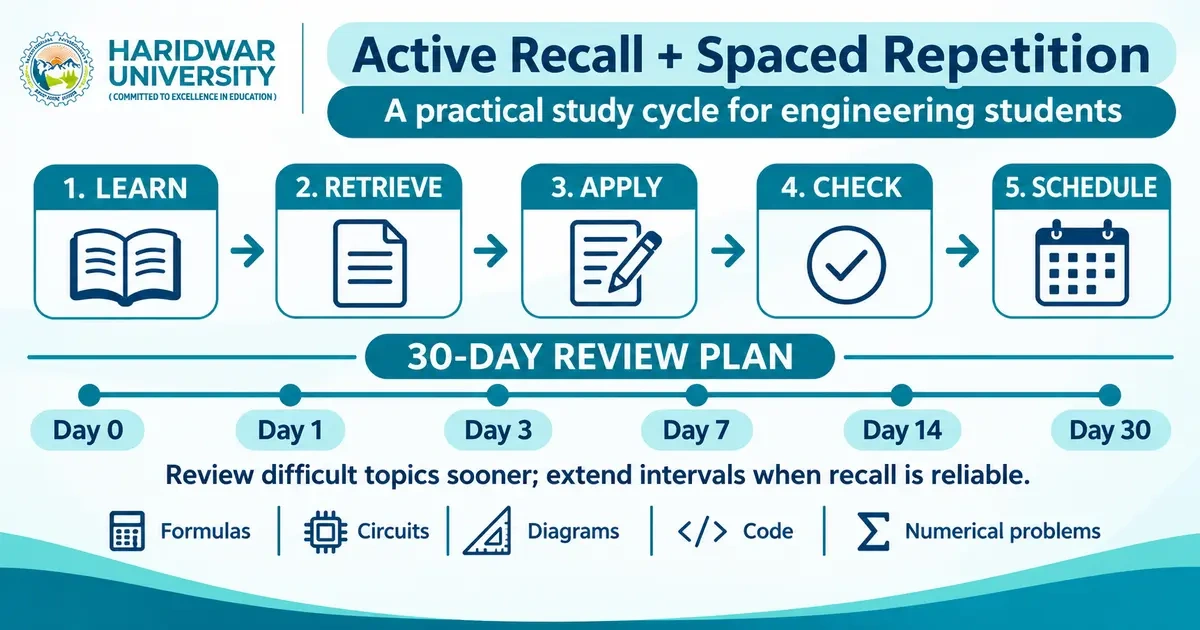
Treat these two techniques as complementary steps within one continuous study loop:
Understand the concept through lectures, core engineering textbooks, simulations, or laboratory practica.
Close your notes and write out the governing equations, assumptions, circuit paths, or code logic from pure memory.
Solve an unseen numerical problem, write a fresh code implementation, or construct an alternate proof without checking solutions.
Audit your derivation against reference material, noting mathematical signs, boundary constraints, and edge-case errors.
Log the topic into your review tracker (Day 1, Day 3, Day 7) based on your retrieval fluency.
4. Practical Examples Across Engineering Subjects
Active recall must adapt to the specific cognitive demands of different engineering disciplines:
| Subject Area | Active Recall Exercise | Spaced Review Task |
|---|---|---|
| Engineering Mathematics | Re-derive a formula from first principles and state its boundary conditions | Solve an unseen differential equation or matrix transformation using the method |
| Electrical Engineering | Draw a circuit schematic and explain voltage drops and current laws without notes | Reconstruct the circuit with altered resistor/capacitor loads and calculate the response |
| Mechanical Engineering | Sketch a thermodynamic cycle (Rankine, Carnot) and label all state transformations | Redraw the p-v and T-s diagrams and calculate thermal efficiency with new parameters |
| Civil Engineering | Reproduce a structural shear force and bending moment calculation sequence from memory | Repeat the beam analysis using a different support configuration and point-load arrangement |
| Computer Science | Write the pseudocode for a search tree traversal or Dijkstra’s algorithm on paper | Trace the algorithm on a new graph edge-case and code the solution in an IDE without notes |
For computer science students, memorising the textbook definition of a binary search tree is just a superficial start. A genuine retrieval exercise requires drawing the tree through consecutive insertions, explaining node rebalancing, and tracing edge cases when duplicate keys appear. Students can connect these exercises directly with core curricula across Haridwar University’s computing programmes.
5. A 30-Day Spaced Repetition Study Plan
A structured schedule ensures revision has a guaranteed spot in your weekly calendar rather than being crowded out by new assignments. Below is an adaptable 30-day interval blueprint for technical topics:
| Timeline | Revision Activity | Learning Objective |
|---|---|---|
| Day 0 | Learn topic; execute first blank-sheet recall exercise | Establish conceptual baseline |
| Day 1 | Reproduce key governing formulas, schematics, or algorithm steps | Catch early memory decay |
| Day 3 | Solve 2 to 3 unseen application questions without checking worked solutions | Test formula application in novel contexts |
| Day 7 | Attempt a timed closed-book past exam question under test conditions | Expose remaining conceptual blind spots |
| Day 14 | Interleave this topic with problems from earlier units | Train cognitive discrimination between methods |
| Day 30 | Complete a comprehensive cumulative exam problem | Verify permanent long-term retention |
I also strongly recommend maintaining a 3-column error log:
- Column 1: Problem description and core topic.
- Column 2: Exact nature of the mistake (calculation slip, incorrect boundary assumption, forgotten formula).
- Column 3: Corrected step and re-test date.
Students can integrate this review cadence with our university-wide semester exam preparation guide to ensure syllabus coverage across all subjects.
6. Common Mistakes to Avoid
Keep prompts concise. Long paragraphs on flashcards trigger recognition instead of effortful retrieval.
Memorising symbols without understanding boundary conditions causes catastrophic errors when exam questions introduce altered constraints.
Peeking at solutions after 30 seconds of struggle destroys the retrieval effect. Sit with the difficulty before checking hints.
Adapt review spacing dynamically: review difficult topics in 24 hours, while extending fluent material out by two weeks.
Spending hours customising digital flashcard decks or note-taking apps cannot replace writing code or deriving equations on paper.
7. Tools That Can Support Your Revision
You can implement active recall and spaced repetition effectively with simple tools:
- Physical Notebook & Blank Paper: The most dependable medium for deriving equations, sketching circuit schematics, and drawing free-body diagrams.
- Digital Spreadsheets: Maintain a 4-column tracker (Topic | Date Studied | Next Review Date | Fluency Rating 1-5) to schedule reviews without software friction.
- Anki: An open-source spaced repetition platform using algorithmic scheduling, ideal for conceptual questions, API signatures, and core definitions.
For fresh undergraduates adjusting to college-level academic rigor, our comprehensive first-year engineering guide provides essential advice on balancing lecture attendance, laboratory coursework, and self-study schedules.
8. Frequently Asked Questions (FAQs)
1. What is the active recall method in studying?
The active recall method involves retrieving information from memory without looking at reference notes or textbooks. Students use self-quizzing, blank-page derivations, formula reconstruction, and unseen practice problems to test what they genuinely comprehend.
2. Is active recall useful for engineering students?
Yes. It is essential for mastering mathematical proofs, thermodynamic cycles, circuit laws, data structures, and structural calculations. Active retrieval must always be paired with independent problem solving.
3. How does spaced repetition work?
Spaced repetition involves reviewing material at expanding intervals over time (e.g., Day 0, 1, 3, 7, 14, 30). Retrieving information just as it begins to fade forces the brain to reinforce memory traces, preventing pre-exam cramming.
4. What is a practical spaced repetition schedule?
A reliable baseline schedule is Day 0 (learn & retrieve), Day 1 (reproduce equations), Day 3 (solve questions), Day 7 (timed quiz), Day 14 (interleaved problem set), and Day 30 (cumulative assessment). Adjust the intervals dynamically based on personal fluency.
5. Can I use active recall without flashcards?
Absolutely. Writing derivations on a blank sheet, tracing code line-by-line, sketching engineering mechanisms, and solving textbook problems without consulting solutions are all highly effective forms of active recall.
6. Which is better: active recall or spaced repetition?
They are two halves of the same cognitive engine. Active recall governs how you engage with information (effortful retrieval), while spaced repetition governs when you review it. Combining them yields maximum learning efficiency.
7. How much time should I spend on active recall each day?
Start with 30 to 45 minutes of dedicated daily recall testing per subject, followed by focused numerical problem solving. Measure progress by verifiable problem accuracy rather than clock hours.
9. Building a More Consistent Engineering Study Routine
Engineering mastery is not built through passive memorisation. It demands continuous synthesis: bridging mathematical theories, drawing system schematics, diagnosing error logs, and implementing working technical solutions.
My advice to every student is straightforward: when you complete a lecture topic, close the book, retrieve what you can on paper, solve a fresh problem, and audit your mistakes. Spacing this practice across the semester exposes conceptual gaps early while there is ample time to consult professors and laboratory instructors. That proactive discipline is the foundation of enduring engineering achievement.
Excel in Engineering & Computer Science at Haridwar University
Study with expert faculty mentors, state-of-the-art computing clusters, industry-aligned engineering labs, and merit scholarships up to 80%. Admissions open for the 2027-28 academic session.