

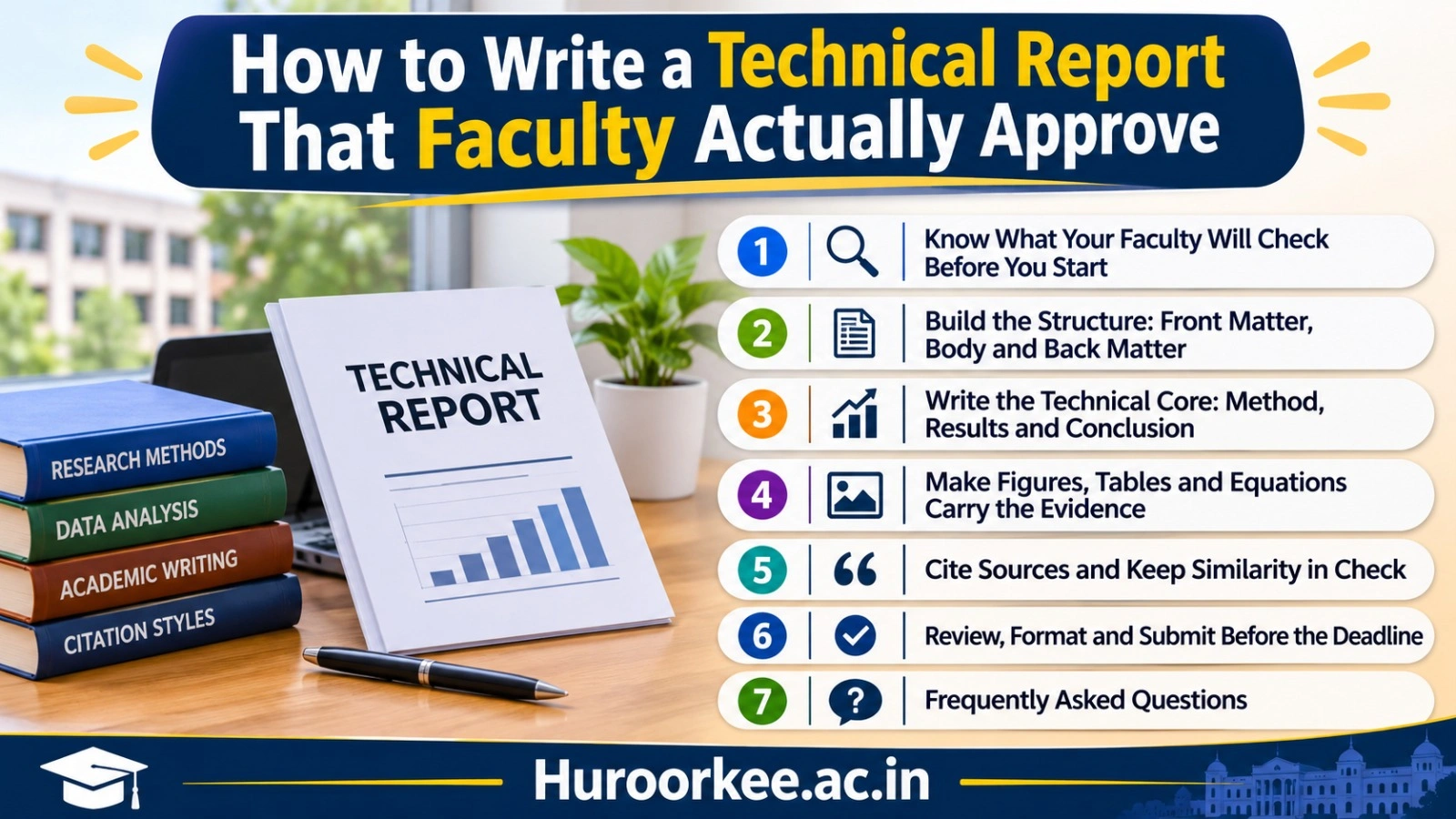
How to Write a Technical Report That Faculty Actually Approve
Dr. V.K. Saini
Director, Haridwar University
Picture a student who hands in forty pages of careful work and gets it back with one line from the supervisor: restructure and resubmit. The experiments were fine. The report wasn't. If you're working out how to write a technical report that faculty actually approve, the fix is rarely fancier vocabulary. It's making the reader's job easy. A supervisor wants to find your problem, method, numbers and conclusion without hunting, and wants to trust every claim you make.
The table below shows what gets checked, and the sections after it explain how to get each part right.
| Report Part | What Faculty Look For | What Triggers Pushback |
|---|---|---|
| Abstract | Problem, method, main result and conclusion in one single paragraph | Vague promises instead of concrete findings |
| Introduction | A clear objective and why the problem matters in engineering practice | Objective missing, ambiguous, or shifted later |
| Method | Enough technical detail for an independent researcher to repeat the work | Steps, tools, software versions, or assumptions left out |
| Results | Clean data presented objectively before it is interpreted | Results mixed prematurely with personal opinion |
| Conclusion | A direct, numbered answer to the stated introductory objectives | Brand new, unsupported material appearing here |
| References | One consistent style (IEEE, APA, MLA), every source fully traceable | Uncited ideas, incomplete citations, missing entries |
Table of Contents
- 1. Know What Your Faculty Will Check Before You Start
- 2. Build the Structure: Front Matter, Body and Back Matter
- 3. Write the Technical Core: Method, Results and Conclusion
- 4. Make Figures, Tables and Equations Carry the Evidence
- 5. Cite Sources and Keep Similarity in Check
- 6. Review, Format and Submit Before the Deadline
- 7. Frequently Asked Questions (FAQs)
1. Know What Your Faculty Will Check Before You Start
Get the format in writing
Ask your supervisor or department for the template, the length limit and the marking rubric before you write a single line. A format mismatch is one of the easiest ways to lose a reviewer's goodwill, and one of the cheapest to avoid. If nothing exists in writing, email your assumptions to your faculty guide and keep the reply.
Write for a busy expert
Your reader knows the subject but hasn't lived inside your project for months. Define each term the first time it appears, state the problem in plain words, and skip background information that any final-year student already knows. Test every paragraph with one question: would the reader miss it if it vanished?
2. Build the Structure: Front Matter, Body and Back Matter
Technical reports get read to find things, not enjoyed cover to cover. A 2024 lecture on the elements of technical report writing, hosted on IIT Guwahati's portal, splits the layout into three clear parts so readers always know where to look:
- Front matter: Title page, abstract, contents list, and lists of figures and tables. Write the abstract last, when you actually know what you found.
- Body: Introduction, method, results, discussion and conclusion, in that exact order. Use numbered headings so a reviewer can write "see 3.2" in the margin.
- Back matter: References and appendices. Raw data, long mathematical derivations and code listings live here, which keeps the main narrative clean and readable.
3. Write the Technical Core: Method, Results and Conclusion
The method section has one primary job: another student or researcher should be able to repeat your work from it. List equipment or software with versions, the experimental or algorithmic steps in order, and every assumption you made.
Results come next, and they must remain results. Show the data, say what it shows in a clear sentence, and save the "why" for the discussion section. Then close the loop: the conclusion answers the objective from your introduction, point by point, with nothing new introduced. If a reader can set your first page beside your last and see the question and the answer matching directly, you have accomplished the hardest part.
Own your limitations
Faculty trust a report far more when it admits what it couldn't do. If a sensor drifted, a sample size was small, or a simulation assumed ideal conditions, say so in the discussion and explain how it affects your result. Hiding a weakness rarely works; reviewers usually spot it, and then they start doubting the parts that were sound.
Keep the language plain
Prefer active verbs, short sentences and one consistent term per idea. Use SI units consistently and define each symbol at first use. If technical prose is your weak spot, NPTEL lists a comprehensive course called Technical Communication for Engineers, taught by Prof. Arun K. Saraf of IIT Roorkee.
4. Make Figures, Tables and Equations Carry the Evidence
A good figure saves a page of explanation. A careless one invites a page of critical questions.
- Captions and callouts: Number every figure and table, caption it descriptively, and mention it in the text before it appears. Label axes with physical quantities and units. Follow your department's convention on caption placement, and never paste a low-resolution screenshot of a table you could rebuild.
- Equations and data: Number the equations you refer to later and explain each variable beside them. Keep decimal places consistent across columns, and verify that numbers in prose match numbers in tables. Mismatches are the quickest way to erode a reviewer's confidence.
- Credit and legibility: Draw your own figures where possible, and credit the original source under any figure or dataset you adapt. Keep text inside figures readable at print size, and ensure charts remain distinguishable even if printed in greyscale.
5. Cite Sources and Keep Similarity in Check
Reviewers check the reference list early, and they notice gaps immediately. Cite every idea, figure, dataset and formula that isn't yours, in the single style your department specifies. Refer to HU's guide to citing sources in APA, IEEE and MLA to see the formats side by side.
On similarity, the UGC 2018 Academic Integrity Regulations set four distinct similarity tiers:
| Plagiarism Tier | Similarity Range | Regulatory Implication |
|---|---|---|
| Level 0 (Minor) | Up to 10% | No penalty imposed; accepted under fair academic use |
| Level 1 | Above 10% to 40% | Student asked to submit a revised manuscript within specified time |
| Level 2 | Above 40% to 60% | Debarred from submitting revised script for one year |
| Level 3 | Above 60% | Registration cancelled or disciplinary penalties enforced |
Properly attributed quotations, references, the contents page, preface and acknowledgements, and generic terms, laws, standard mathematical symbols and equations are excluded from the similarity check. Note that UGC regulations define a "script" primarily targeting masters dissertations and doctoral theses; for undergraduate project reports, departmental regulations apply. Confirm current guidelines on the UGC portal before final submission.
6. Review, Format and Submit Before the Deadline
Run a three-pass review
Read once for logic, once for numbers and units, and once for formatting. Compare the abstract with the conclusion; they should agree seamlessly. Share a draft with your supervisor early enough to act on the comments, and keep a short change log so revisions are easy to track. If possible, hand the draft to a peer from another engineering discipline. If they can follow your argument without confusion, your faculty committee will too.
Where this applies at HU
Haridwar University's Roorkee College of Engineering offers B.Tech. Hons. in ECE, CE, EEE and ME, each integrated with cutting-edge AI specialisations. On the official fees and scholarships page, tuition scholarships go up to 80% for a JEE rank up to 1,00,000, or above 90% in qualifying marks or CUET percentile.
If an administrative requirement or formatting guideline blocks your submission, the Student Care Centre provides active support in each academic block with dedicated welfare services. That is the practical foundation of how to write a technical report that faculty actually approve: clear structure, honest empirical evidence, rigorous citations, and enough preparation time to address feedback.
7. Frequently Asked Questions (FAQs)
1. What makes a technical report that faculty actually approve?
A clear objective, a repeatable method, honest results and a conclusion that answers the objective, all in your department's format with every source cited. Get those right and most review comments disappear.
2. How long should a technical report be?
There's no universal length. Your department's guidelines or rubric set the limit, so ask for it in writing. Cover the objective fully, then cut anything that doesn't serve it.
3. Should I write the abstract first or last?
Last. An abstract summarises findings, and you only know them once the results and conclusion are settled. Draft a working title early if it helps you stay focused.
4. How is a technical report different from a research paper?
A report documents work for a specific reader such as a supervisor, with full method detail and appendices. A paper argues one focused point to a wider scholarly audience, within journal space limits.
5. Which citation style should I use?
Use whichever your department names. IEEE, APA and MLA are all common, and the real rule is consistency: one style, applied the same way from the first citation to the last.
6. How much similarity is acceptable?
UGC's 2018 regulations treat similarity up to 10% as minor, with no penalty, and exclude attributed quotes and your reference list from the count. For project reports, follow your department's policy and confirm current rules with UGC.
7. Can I use AI tools to help write my report?
Check your department's policy first, because rules on AI assistance differ between institutions. Either way, you stay responsible for accuracy, and every claim still needs a real source you've actually read.
8. What belongs in an appendix?
Material a reviewer might want to verify but doesn't need in the main flow: raw data, long derivations, code listings and survey forms. Refer to each appendix from the main text.
9. Where can I get help with submission formalities at HU?
The Student Care Centre in each academic block handles administration and student-service problems and lists a 24-hour response time. For questions about the writing itself, start with your supervisor.
Build Your Engineering Career at Haridwar University
Study engineering with industry-grade laboratories, rigorous project mentorship, modern computing infrastructure, and merit scholarships up to 80%. Admissions open for the 2027-28 session.