

How to Take Lecture Notes You’ll Actually Use Later: A Student’s Guide
Mrs. Nisha Dhiman
Student Welfare Officer, Haridwar University
Students often leave a lecture with several pages of notes but still struggle to explain the topic a week later. Some have copied almost every sentence from the presentation. Others have written so quickly that the abbreviations and unfinished points make little sense when they return to them.
The problem is not always how much a student writes. It is whether those notes will be useful after the lecture has ended.
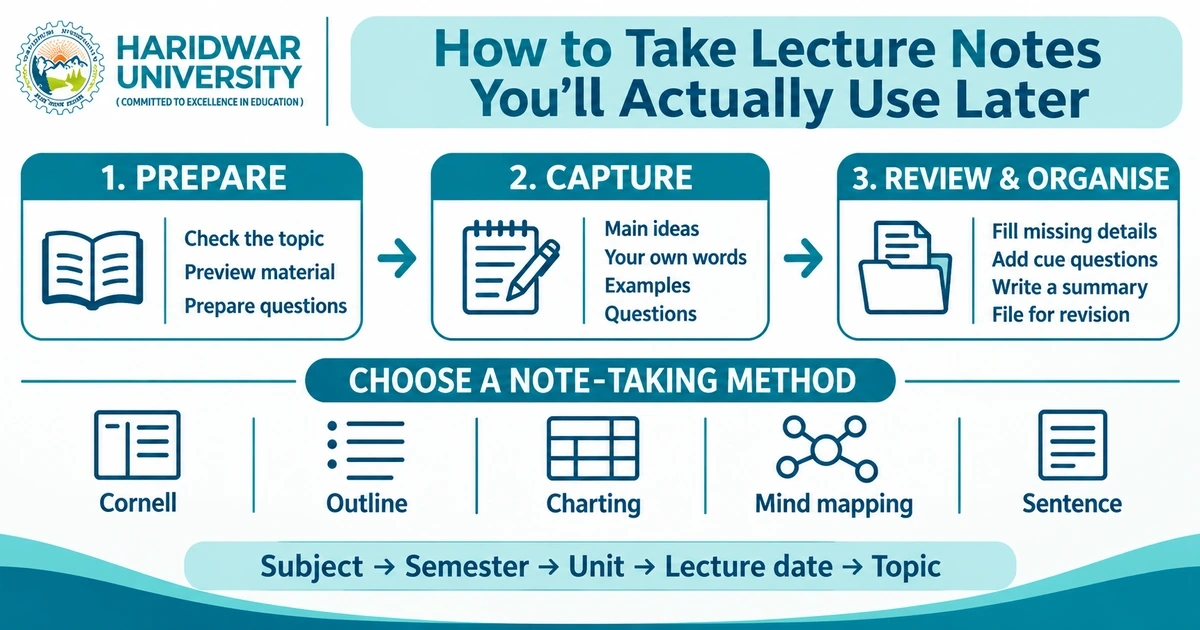
I encourage students to approach note-taking as a three-stage process: capture the important information, make sense of it afterwards, and organise it for future revision. A good set of lecture notes should help you understand a topic without having to reconstruct the entire class from memory.
Table of Contents
- 1. Why Useful Lecture Notes Matter
- 2. Preparing Before the Lecture
- 3. Taking Better Notes During Class
- 4. Choosing the Right Note-Taking Method
- 5. Turning Rough Notes into Revision Material
- 6. Organising Lecture Notes for Future Use
- 7. Handwritten Notes vs Digital Notes
- 8. Common Note-Taking Mistakes to Avoid
- 9. Frequently Asked Questions (FAQs)
- 10. Building a Note-Taking Routine That Lasts
1. Why Useful Lecture Notes Matter
Lecture notes serve two purposes. First, they help you follow and process information while a subject is being taught. Second, they provide a record that you can return to when completing assignments, preparing for tests or revising for semester examinations.
These purposes are easily confused. A student may produce ten pages of detailed notes without identifying the central argument, the connection between two concepts or the question that needs further explanation.
Research on learning and note-taking supports a more selective approach. The Harvard Initiative for Learning and Teaching's review, Notes on Note-Taking: Review of Research and Insights for Students and Instructors, discusses the limitations of verbatim transcription and the value of reviewing, summarising and testing yourself on lecture material.
My advice is simple: do not measure the quality of your notes by the number of pages. Measure it by how easily you can understand and use them later.
2. Preparing Before the Lecture
Useful notes begin before the lecturer enters the classroom. A little preparation makes it easier to recognise familiar ideas and identify what is new.
I recommend three practical steps:
- Check the topic: Look at the timetable, syllabus or lecture outline so you know which subject and unit will be covered.
- Preview the material: Spend a few minutes reviewing the relevant textbook headings, previous notes or available lecture slides. You do not need to study the entire chapter beforehand.
- Prepare your questions: Write down one or two things you want clarified. These questions give your listening a clear purpose.
For example, before a lecture on database normalisation, a computer science student could review the meaning of tables, keys and functional dependencies. During the lecture, it will then be easier to distinguish a new explanation from information already understood.
Students adjusting to university-level academic routines can also refer to HU's first-year guide to managing academics and university life.
3. Taking Better Notes During Class
The lecturer's words are not all equally important. Your task is to identify the main idea, supporting explanation, examples and points that need clarification.
I suggest following this structured approach:
- Record the main ideas first: Write the topic heading and the central point being explained. Add supporting details beneath it rather than recording every sentence.
- Listen for emphasis: Pay attention when a lecturer repeats a concept, compares two ideas, works through an example or explains why a particular result matters. These moments often provide useful context for later study.
- Write in your own words: Paraphrase explanations wherever possible. If a technical definition must be recorded accurately, preserve its meaning and terminology rather than changing it unnecessarily.
- Capture examples and questions: A formula without an example may be difficult to interpret later. Record a worked example, application or question that helps explain the concept.
- Leave space for missing details: If the lecture moves quickly, mark the gap and continue listening. You can clarify it after class rather than losing the next explanation while trying to catch up.
Consider a lecture on Ohm's law. Instead of copying a paragraph about the relationship between voltage, current and resistance, record the equation (\(V = IR\)), define each symbol, note the relevant units and include the lecturer's numerical example. Add a question if you are unsure how the relationship changes when resistance is altered.
That is a far more useful record than a page of copied sentences.
4. Choosing the Right Note-Taking Method
There is no single format that works equally well for every subject. The best note-taking method depends on the structure of the lecture and the kind of information being taught.
| Method | How it works | Best suited to |
|---|---|---|
| Cornell method | Separates notes, cue questions and a summary | Lectures that need regular revision |
| Outline method | Arranges main ideas, subtopics and supporting details hierarchically | Structured lectures and theory |
| Charting method | Places information into columns for comparison | Comparisons, classifications and data |
| Mind mapping | Connects a central topic with related ideas through branches | Conceptual subjects and interconnected topics |
| Sentence method | Records individual points in sequence | Fast-moving lectures with changing topics |
The Cornell method is particularly useful when you want revision built into your notes. Divide the page into a large notes section, a narrower cue column and a summary area at the bottom. Record the lecture in the main section. After class, add questions in the cue column and write a short summary. When revising, cover the main notes and try to answer the questions using only the cues. The University of Toronto's Cornell method guide explains how to use this format before, during and after lectures.
The outline method is a practical alternative for lectures with a clear sequence. Put the main topic first, indent subtopics beneath it and add examples or explanations under each subtopic. For a lecture comparing operating systems, for example, the main heading could be followed by process management, memory management, file systems and security. Supporting details can sit under each heading.
The charting method is useful when the lecturer compares several categories. A student studying different types of computer networks could create columns for network type, coverage, application and limitation. This makes differences easier to locate during revision.
Rather than forcing every lecture into one format, choose the structure that makes the information easiest to understand.
5. Turning Rough Notes into Revision Material
The work should not end when the lecture finishes. Notes taken quickly during class may contain incomplete sentences, unexplained abbreviations and unanswered questions. Returning to them while the lecture is still fresh makes these gaps easier to address.
I recommend a short post-lecture review:
- Read through the notes: Check whether each heading and explanation makes sense.
- Fill in missing details: Consult the textbook, slides or a reliable reference where necessary.
- Add questions: Turn important headings into questions that you can answer later.
- Write a summary: Reduce the lecture to a few sentences in your own words.
- Mark unresolved doubts: Ask the lecturer, discuss the point with a classmate or consult the relevant course material.
Princeton University's guide to active listening and taking great notes recommends reviewing notes within 24 hours and adding context, questions and summaries.
Once your notes are clear, use them actively. Close the notebook and explain the topic without looking. Reproduce a diagram, solve a related question or recall the important steps in a process. This connects note-taking with active recall rather than leaving revision as passive rereading.
Students preparing for assessments can also use HU's semester examination preparation guide for broader guidance on syllabus planning, practice papers and revision.
6. Organising Lecture Notes for Future Use
Even well-written notes lose their value if you cannot find them when needed. A consistent filing system saves time during assignments and examination preparation.
Subject → Semester → Unit → Lecture Date → Topic
Example: Computer Science → Semester 2 → Unit 3 → 21 November → Database Normalisation
Apply the same structure to paper notebooks, folders and digital files. Include the lecture date and a clear topic heading on every set of notes.
I also recommend maintaining a separate list of:
- Topics that need further explanation.
- Questions to ask during the next class.
- Important formulas, diagrams or definitions.
- Connections between the current lecture and earlier units.
Do not spend excessive time decorating or rewriting notes. Organisation should make information easier to retrieve, not become another task that takes time away from learning.
7. Handwritten Notes vs Digital Notes
Both formats can work. The choice should depend on the subject, classroom requirements and the student's ability to remain focused.
| Handwritten Notes | Digital Notes |
|---|---|
| Useful for diagrams, equations and quick sketches | Convenient for searching and editing |
| Encourage selective recording when students avoid transcription | Easy to organise across subjects and semesters |
| Can be reviewed without a device or screen fatigue | Can be backed up and accessed across multiple devices |
| May be difficult to search or reorganise rapidly | Can encourage distraction or excessive verbatim copying |
A 2014 study by Mueller and Oppenheimer, The Pen Is Mightier Than the Keyboard, examined differences between laptop and longhand note-taking. It is useful background, but it should not be treated as proof that handwriting is always better for every student or every lecture.
My recommendation is to choose the format that helps you listen, process and organise information. A student using a laptop should still paraphrase, structure and review notes rather than type every word. A student using a notebook should make sure the pages are dated, readable and organised.
For students in computing and other technical disciplines, the Haridwar University programmes and courses page provides an overview of the academic areas in which different note-taking approaches may be useful.
8. Common Note-Taking Mistakes to Avoid
Some habits make notes look complete while reducing their usefulness:
Transcribing slides or lectures leaves little room for selecting and processing important ideas.
Pages without topic labels become difficult to navigate during revision.
Short forms save time only when you can understand them weeks later.
Highlighting should draw attention to selected information, not replace understanding.
Unclear points become harder to resolve when you leave them untouched for weeks.
Neatness has limited value if it consumes time without improving understanding.
Use a consistent filing system so that important material is easy to retrieve.
The objective is not to produce perfect-looking pages. It is to create a reliable learning resource.
9. Frequently Asked Questions (FAQs)
1. What is the best way to take lecture notes?
Listen for the main ideas, write explanations in your own words, include useful examples and organise information under clear headings. Review and summarise the notes after class so they remain useful for future study.
2. Which note-taking method is best for college students?
The Cornell method is useful for lectures that require regular revision. The outline method works well for structured topics, while charting and mind mapping can help with comparisons and connected concepts. Choose according to the subject.
3. Should I write everything the lecturer says?
No. Focus on key ideas, definitions, explanations, examples and important questions. Record exact wording where technical accuracy matters, but avoid turning the lecture into a word-for-word transcript.
4. Is it better to take notes by hand or on a laptop?
Neither format is automatically best for every student. Handwriting can be convenient for diagrams and equations, while digital notes offer search and editing features. What matters is whether you actively process and review the information.
5. How soon should I revise my lecture notes?
Review them as soon as reasonably possible, preferably on the same day or within 24 hours. Use that review to correct incomplete points, add questions and write a short summary.
6. How can I make lecture notes useful for examinations?
Organise notes by subject and unit, turn headings into questions, practise recalling key concepts and solve relevant problems. Combine your notes with the syllabus and previous-year question papers where appropriate.
7. How should I organise digital lecture notes?
Create folders by subject and semester, then use unit names, lecture dates and descriptive file titles. Keep related slides and reference material together, and maintain backups of important files.
10. Building a Note-Taking Routine That Lasts
Good lecture notes are built through consistent habits, not complicated stationery or elaborate applications. Prepare briefly before class, listen for the ideas that matter, record them in a structure you understand and return to the notes afterwards.
I would encourage every student to ask one question before closing a notebook or digital file: Could I understand this page if I opened it three weeks from now?
If the answer is yes, the notes are doing their job. They are no longer just a record of a lecture; they have become a resource that supports understanding, independent study and examination preparation.
Empower Your Academic Journey at Haridwar University
At Haridwar University, students receive dedicated mentorship, welfare services, state-of-the-art libraries, and career guidance designed to turn classroom learning into lifelong professional success. Admissions open for the 2027-28 academic year.