

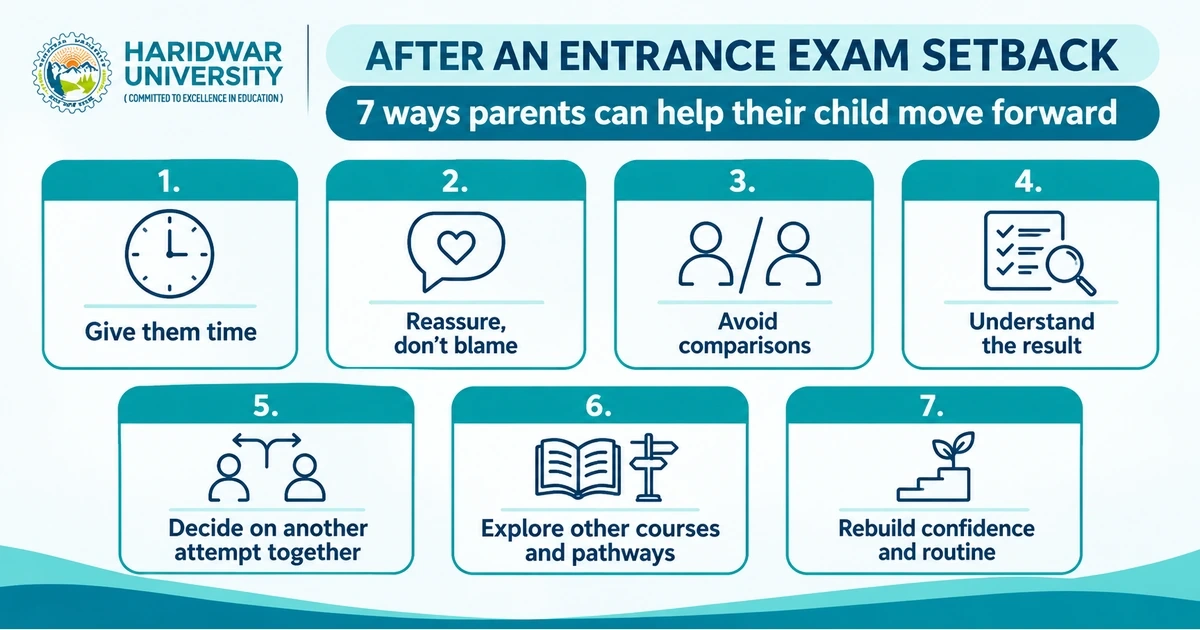
When Your Child Doesn't Clear an Entrance Exam: 7 Ways Parents Can Help Them Move Forward
Mrs. Nisha Dhiman
Student Welfare Officer, Haridwar University
An entrance examination result can change the atmosphere at home in a matter of minutes. A child who spent months preparing for NEET, JEE, CUET or another competitive examination may suddenly feel that all that effort has led nowhere. Parents, meanwhile, may be worried about the next academic year, coaching expenses, admission deadlines and what their child should do next.
In my view, this is the moment when a parent's response matters most. A student who has not cleared an entrance exam needs more than advice to work harder. They need time to process the result, reassurance that their worth is not defined by a score, and practical support when they are ready to consider the next step.
Supporting a child after an entrance exam setback is not about pretending the result does not matter. It is about helping them respond to it without losing confidence in themselves.
Table of Contents
- 1. Give Your Child Time to Process the Result
- 2. Choose Words That Reassure Rather Than Blame
- 3. Avoid Comparisons and Unnecessary Pressure
- 4. Understand What Went Wrong Before Planning Again
- 5. Decide Together Whether Another Attempt Makes Sense
- 6. Explore Other Courses and Admission Pathways
- 7. Help Your Child Rebuild Confidence and Routine
- 8. Frequently Asked Questions (FAQs)
- 9. Help Your Child See More Than One Way Forward
1. Give Your Child Time to Process the Result
The first conversation after an unsuccessful result should not become an interrogation. Questions such as "How many marks did you get?", "Where did you lose marks?" or "What will you do now?" may be important later, but asking all of them immediately can make a disappointed student feel cornered.
Give your child room to react. Some students want to talk; others need a little quiet. Neither response should automatically be interpreted as indifference or irresponsibility.
I recommend beginning with a simple question: "Would you like to talk about the result now, or would you prefer some time?"
Listen without interrupting. Avoid immediately explaining why the result happened or reminding the child how much the family spent on preparation. The purpose of this first conversation is not to solve the admission problem. It is to make sure the student does not feel alone while facing it.
2. Choose Words That Reassure Rather Than Blame
Parents often want to encourage their children, but the words they choose can unintentionally increase pressure. Telling a student to "forget it" may dismiss a disappointment that feels very real to them. Saying "You should have studied harder" assumes the reason for the result before understanding it.
A more constructive response acknowledges the setback while keeping the conversation open.
| Avoid saying | Try saying instead |
|---|---|
| Why didn't you study harder? | What do you think made the examination difficult? |
| Your friends have cleared it. | Let's focus on understanding your result, not comparing it with others. |
| We spent so much on your coaching. | We can discuss the next step together when you're ready. |
| You must take another attempt. | Let's consider whether another attempt is right for you. |
| You have wasted a year. | The time you spent preparing has given us something to learn from. |
The difference is not simply politeness. Supportive language allows a student to discuss mistakes honestly without feeling that every answer will lead to criticism.
3. Avoid Comparisons and Unnecessary Pressure
Entrance examination results are often discussed among relatives, neighbours, classmates and family friends. That can make a disappointing result feel even more public.
Avoid comparing your child with a cousin who secured a high rank, a school friend who received an admission offer or an older sibling who followed a different academic path. Students do not have identical interests, preparation conditions, learning needs or circumstances.
I would also discourage parents from repeatedly discussing the result with relatives without the child's consent. A student should not have to explain an unsuccessful attempt to every visitor or family member.
Instead, agree on what the family needs to know and give the child some privacy. Keep everyday conversations going. Meals, household routines, hobbies and time with friends can help restore a sense of normality.
A child should feel that family support does not depend on an examination result.
4. Understand What Went Wrong Before Planning Again
Once the initial disappointment has settled, help your child examine the result calmly. Do not assume that a low score automatically means a lack of effort.
Several factors may have affected performance:
- Preparation gaps: Some topics may not have received enough attention or practice.
- Conceptual difficulties: The student may have memorised material without being able to apply it to unfamiliar questions.
- Time management: They may have struggled to complete the paper within the allotted time.
- Examination anxiety: Stress may have affected concentration or decision-making.
- Course expectations: The student may have been preparing for an examination without being fully certain about the course it leads to.
Where official scorecards, answer keys or response records are available, review them using the examination authority's published process. The National Testing Agency's official examination results page explains the stages after an examination, including answer-key challenges, results and counselling. Remember that the examination authority and the body responsible for seat allocation may be different.
The objective is to identify what can be improved, not to assign blame. If the student is willing, a teacher, subject mentor or qualified academic counsellor can help interpret the performance more objectively.
5. Decide Together Whether Another Attempt Makes Sense
Repeating an entrance examination can be a reasonable decision, but it should not be an automatic response to an unsuccessful result.
Before discussing another attempt, consider:
- Does the student still want the course associated with the examination?
- Are they willing to prepare again?
- Can they identify specific areas that need improvement?
- Is there sufficient time for preparation before the next examination?
- Can the family manage the financial and practical demands of another preparation cycle?
- Are there other suitable admission opportunities available now?
A second attempt should have a reasoned plan behind it. Repeating the same preparation routine without understanding the previous difficulties may produce the same frustrations.
I also advise parents not to make the decision entirely on the basis of their own expectations. A student who no longer wants a particular career should be allowed to discuss that honestly. The next step should reflect the student's interests and realistic academic options, not simply the family's original plan.
6. Explore Other Courses and Admission Pathways
Not clearing one entrance examination does not automatically close every route to higher education. However, alternatives must be checked carefully. Admission requirements differ by course, institution, academic session and examination.
Parents and students can explore:
- Other entrance examinations: Check whether another relevant examination or counselling round is still open.
- Merit-based admission: Some institutions offer admission based on qualifying examination marks, subject to their published eligibility requirements.
- Related programmes: A student interested in technology, for example, may consider different computing or engineering-related programmes after comparing their curriculum and eligibility.
- Different academic interests: The result may be an opportunity to reconsider whether the original course is genuinely the right choice.
Do not assume that admission without one examination is automatically available for every course. Verify the current eligibility criteria, admission procedure, fees and recognition of the institution before applying.
Families can begin by reviewing the Haridwar University academic programmes directory to understand the range of programmes listed across its academic units. For broader academic planning, our guide to preparing for multiple competitive examinations without burning out may also help students think about managing future preparation more sustainably.
The important point is to compare alternatives on their own merits. A different course should be a considered choice, not a hurried substitute selected simply because the first option did not work out.
7. Help Your Child Rebuild Confidence and Routine
After a disappointing result, some students lose interest in activities they previously enjoyed. Others spend long periods checking other candidates' scores or repeatedly discussing what might have happened.
Parents can help by encouraging a manageable routine rather than imposing another demanding timetable immediately.
Start with a few practical steps:
- Restore regular sleep and meal timings.
- Encourage physical activity, hobbies and time away from result discussions.
- Set small, achievable academic or personal goals.
- Reduce repeated checking of comparison posts and unofficial result discussions.
- Make time for conversations that are not about examinations or admission.
Pay attention to changes that persist or interfere with everyday life. If your child remains withdrawn, experiences ongoing distress, has significant sleep or appetite changes, or expresses hopelessness, consider speaking with a qualified mental-health professional. If there are concerns about immediate safety or self-harm, seek urgent professional help rather than waiting for the situation to improve.
In India, the government's Tele-MANAS service provides free, confidential, round-the-clock mental-health support through 14416 or 1800-891-4416. The service is described by the Directorate General of Health Services under the National Tele Mental Health Programme. Seeking help is a responsible step, not a failure of parenting.
8. Frequently Asked Questions (FAQs)
1. What should parents say when their child does not clear an entrance exam?
Start by acknowledging the disappointment. Tell your child that you are available to listen and that the result does not change your support for them. Avoid immediate criticism, comparisons or demands for a new study plan.
2. How can parents motivate a child after exam failure?
Help the child identify manageable next steps rather than demanding instant motivation. Listen to their concerns, recognise the effort they made and involve them in deciding what to do next.
3. Should a student repeat an entrance examination after an unsuccessful attempt?
It depends on the student's interest, eligibility, readiness, preparation gaps, available time and family circumstances. Another attempt should be based on a realistic plan, not pressure or fear of choosing an alternative.
4. What should a student do after not clearing NEET or JEE?
First, check the official result, scorecard and applicable counselling information. Then review eligibility for other relevant opportunities, consider whether another attempt is suitable and explore related programmes. The correct options differ between examinations.
5. Can a student get admission without clearing an entrance examination?
Some programmes and institutions offer merit-based or other admission routes, while others require specific entrance examinations. Students must check the current admission notification and eligibility conditions for the exact programme and institution.
6. How long should parents wait before discussing another attempt?
There is no fixed waiting period. Allow enough time for the student to process the result, then ask whether they feel ready to discuss their options. The conversation should be guided by their emotional state and upcoming admission deadlines.
7. When should parents seek professional help after an exam setback?
Consider professional support when distress persists, affects sleep or daily functioning, leads to prolonged withdrawal or includes expressions of hopelessness. Any concern about self-harm or immediate safety requires urgent professional attention.
9. Help Your Child See More Than One Way Forward
An unsuccessful entrance examination can be painful for a student and worrying for the family. But the result is one piece of academic information, not a complete assessment of a young person's ability, interests or future.
As parents, we may not be able to remove the disappointment. We can, however, decide how we respond to it. Listen before advising, understand the result before planning another attempt, and explore alternatives without making the child feel that they have fallen short of the family's expectations.
I would encourage every parent to keep one principle in mind: the aim is not simply to help a child recover from one examination result. It is to help them make their next decision with confidence, clarity and the knowledge that their family stands beside them.
Explore Supportive Academic Pathways at Haridwar University
Discover merit-based admission routes, diverse undergraduate degree programmes, scholarship opportunities, and dedicated student welfare support at Haridwar University.