

Before Paying a University Admission Fee: How Parents Can Verify Its Claims
Mr. Sumit Chauhan
Registrar, Haridwar University
A university admission decision can involve several years of fees, accommodation costs and a considerable commitment from a family. Yet parents are often expected to make the first payment after a counselling conversation, a campus visit or a few exchanges with an admissions representative. The information may sound convincing, but how much of it can be independently verified?
I believe parents should make one distinction before transferring money: a university's statement is a claim; a document or official record is evidence. Both matter, but they are not interchangeable.
On 17 November 2026, the University Grants Commission (UGC) issued a Public Advisory on verifying the authenticity and legal status of higher education institutions before admission. Issued pursuant to a Supreme Court order dated 9 October 2026, the advisory asks students, parents and guardians to verify an institution before seeking admission or entering into any academic or financial arrangement. It identifies four areas for verification: (1) legal establishment or recognition; (2) authority to offer programmes and award qualifications; (3) statutory and regulatory approvals; and (4) permissibility of the programme, mode of study and location of delivery. The UGC also cautions against relying solely on advertisements, websites, brochures, social media posts or institutional claims.
This makes the question particularly important: how can parents verify university claims before paying the admission fee?
Table of Contents
- 1. Start With the Claim, Not the Brochure
- 2. Verify the Institution and the Exact Programme
- 3. Check Placement, Internship and Faculty Claims
- 4. Verify Fees, Scholarships and Refund Conditions
- 5. Check Facilities, Industry Partnerships and Student Support
- 6. Confirm the Offer Letter and Payment Process
- 7. Recognise Warning Signs Before Making a Payment
- 8. Frequently Asked Questions (FAQs)
- 9. Make the Decision With Evidence
Start With the Claim, Not the Brochure
A brochure is useful for understanding what a university presents about itself. It is not, by itself, proof that every statement is accurate or applicable to the programme a student intends to join.
I recommend that parents first record the specific claims made during admission counselling. These might include a placement percentage, a scholarship, a particular laboratory facility, an industry partnership or a fee concession.
For each claim, note three things:
- What was promised? Record the exact statement rather than relying on memory.
- Who made the claim? Note whether it appeared in an official brochure, on the university website, in an email or in a conversation with a counsellor.
- What evidence supports it? Ask for the relevant report, policy, certificate, official webpage or written confirmation.
Keep screenshots of online advertisements and relevant messages, and save brochures and emails. If a counsellor says a scholarship is guaranteed, for example, ask for the written conditions that establish the amount, eligibility and duration.
The principle is straightforward: do not try to verify a vague impression. Verify the exact promise.
Verify the Institution and the Exact Programme
The first substantive check is whether the institution is legally established and authorised to award the qualification being advertised.
The UGC's November 2026 advisory identifies four areas parents should verify: legal establishment or recognition, authority to offer the particular programme and award the qualification, applicable statutory approvals, and permission for the programme's mode and location of delivery.
Parents can begin with the University Grants Commission's official website, which provides information about recognised higher education institutions. They should also consult the relevant professional regulator where a programme requires specific approval.
For example, pharmacy and nursing programmes have their respective professional regulatory requirements. An institution's general recognition should not be treated as automatic proof that every course, campus or delivery mode has all the necessary permissions.
Check the following details together:
- Exact legal name of the institution.
- Name and level of the programme.
- Campus or location where the programme will be delivered.
- Academic session for which admission is being offered.
- Relevant regulatory approval, wherever applicable.
Parents considering online or distance education need an additional check. The UGC's Distance Education Bureau publishes institution- and programme-related information for these modes. Verify the exact programme and admission session rather than assuming that permission in an earlier session remains valid.
For a more detailed explanation, read our guide on how to verify an online degree programme before paying.
Check Placement, Internship and Faculty Claims
Placement figures are among the claims that deserve careful examination. A headline such as "90% placement" tells a parent very little unless the university explains how that percentage was calculated.
Ask for the placement report for the relevant programme and graduating batch. Check:
- Total number of students who graduated.
- Number of students who were eligible for placement.
- Number who received offers and number who actually joined.
- Companies recruiting for the specific programme.
- Whether the figures represent one campus, one department or the entire institution.
- Whether the published salary is the highest, average or median package.
These distinctions matter. A highest package represents an individual outcome, not what most graduates can expect. Similarly, a university-wide placement figure may not describe the prospects of a particular course.
Internship claims need the same scrutiny. Ask whether students receive internships as part of the curriculum, whether opportunities are facilitated by the university, and whether the institution can provide examples from recent batches.
Faculty claims should also be programme-specific. Request the department's current faculty details, including qualifications and relevant teaching or professional experience. A photograph of a visiting industry expert does not establish that the person teaches the programme regularly.
Parents can use HU's placement reports and placement information as an example of the kind of information to examine, while applying the same questions to every university under consideration.
Verify Fees, Scholarships and Refund Conditions
A verbal fee quotation is not a complete financial commitment. Before paying, request an itemised fee schedule covering the full duration of the programme.
Check tuition, admission and enrolment charges, examination fees, laboratory or other compulsory charges, hostel and transport costs where applicable, and any deposits. Ask whether fees can change in later academic years and which charges are refundable.
Scholarship promises deserve particular attention. A statement such as "up to 50% scholarship" does not mean every applicant will receive that amount.
Ask for written confirmation of:
- Scholarship percentage or fixed amount.
- Eligibility criteria and required documents.
- Whether the concession applies to tuition alone or other charges too.
- Whether it applies to the first year or continues throughout the programme.
- Renewal conditions, minimum marks and other exclusions.
- Whether two scholarships can be combined.
Compare the written offer with the university's published fee and scholarship information. HU, for example, publishes its programme-wise fee structure and scholarship conditions. The important practice is to compare the same programme, academic session and eligibility category rather than relying on an approximate figure quoted over the phone.
Also read the institution's cancellation and refund policy before paying. Ask what happens if a student withdraws, does not meet an admission condition or decides not to join. Retain the version of the policy applicable when the payment is made.
Check Facilities, Industry Partnerships and Student Support
A photograph of a laboratory or a list of industry partners does not establish how frequently students use those facilities or what an association delivers.
During a campus visit, ask to see the facilities relevant to the chosen course. A prospective engineering student should examine the laboratories and equipment used for practical learning. A pharmacy applicant should ask about programme-specific laboratories and practical arrangements.
Parents should also check whether the facilities shown are available to the admitted batch, rather than reserved for demonstrations or special events.
For industry partnerships, ask for examples of recent student-facing activity. Has the association led to internships, live projects, technical sessions or placements? When did the last activity take place?
The same approach applies to student support. Request details of academic mentoring, grievance redressal, anti-ragging arrangements, medical assistance and hostel supervision. If accommodation is part of the decision, inspect the actual facilities and ask for written details of charges and services.
Parents can review the HU academic programme directory to understand how programme information is presented, and use the parent's checklist for evaluating a private university for broader campus and institutional checks.
Confirm the Offer Letter and Payment Process
Before making a payment, compare the admission offer with the information supplied during counselling.
The offer letter should identify the institution, student, programme, academic session and applicable admission conditions. Check whether the fee amount, scholarship and payment deadline match the written information already provided.
If anything differs, ask the admissions office to clarify the discrepancy in writing before proceeding. Parents should not assume that a verbal assurance will automatically override a written admission document.
Payment safeguards are equally important:
- Use payment channels officially identified by the university.
- Confirm the account or payment recipient through the institution's official contact details.
- Avoid transferring money to an individual's personal bank account or UPI ID on the strength of a verbal instruction.
- Check the amount and purpose before authorising a transaction.
- Obtain and preserve an official receipt.
If an intermediary or admission agent is involved, independently confirm the arrangement with the university. The institution should be able to confirm whether the representative is authorised to handle the admission or collect fees.
Recognise Warning Signs Before Making a Payment
A single unanswered question does not automatically establish misconduct. However, repeated reluctance to provide basic documentation should make parents pause.
I would treat the following situations as reasons to delay payment until the facts are clear:
- A counsellor promises a scholarship but refuses to provide its written conditions.
- Placement figures are advertised without a programme-wise report or explanation of the calculation.
- The fee quoted over the phone differs from the published fee schedule.
- A university pressures a family to transfer money immediately to secure a seat without giving time to examine the offer.
- The payment recipient cannot be independently confirmed as an official university channel.
- The institution avoids sharing relevant recognition or programme approval details.
- A promised facility or industry partnership cannot be demonstrated or explained.
Parents who face misleading representations or unresolved payment concerns should first preserve the evidence and submit a written complaint to the university's appropriate grievance authority. If the matter remains unresolved, the National Consumer Helpline provides complaint-registration channels, including the toll-free number 1915.
Frequently Asked Questions (FAQs)
1. How can parents check whether a university is genuine?
Start by checking its legal establishment and recognition through the UGC's official records. Then verify whether the institution is authorised to offer the exact programme and whether additional regulatory approvals apply.
2. Is a university brochure sufficient proof of its claims?
No. A brochure communicates institutional information but does not independently establish that every claim is accurate. Request supporting documents, official records or written confirmation.
3. How can parents verify placement claims?
Ask for programme-wise placement information for a specific graduating batch. Check the number of graduates, eligible students, students placed, recruiters and whether salary figures represent the highest, average or median package.
4. What should parents check in a scholarship offer?
Confirm the amount, eligibility criteria, duration, renewal conditions, applicable fee components and exclusions in writing. Do not treat an advertised maximum scholarship as an individual entitlement.
5. Should parents pay a seat-booking amount before receiving an offer letter?
They should first obtain sufficient written information to identify the institution, programme, payment purpose, applicable conditions and refund terms. If essential details are missing, seek clarification before transferring money.
6. How can parents check whether an admission offer letter is genuine?
Confirm its details directly with the university through contact information published on its official website. Check the student's name, programme, academic session, admission conditions and payment instructions.
7. What should parents do if a university refuses to provide evidence?
Pause the payment, keep records of the claim and request clarification through an official email or written communication. If the institution still cannot substantiate a material promise, consider other options before committing financially.
Make the Decision With Evidence
Choosing a university is not simply a matter of comparing brochures, campus photographs or the confidence of an admissions representative. It is a decision that deserves documentary scrutiny.
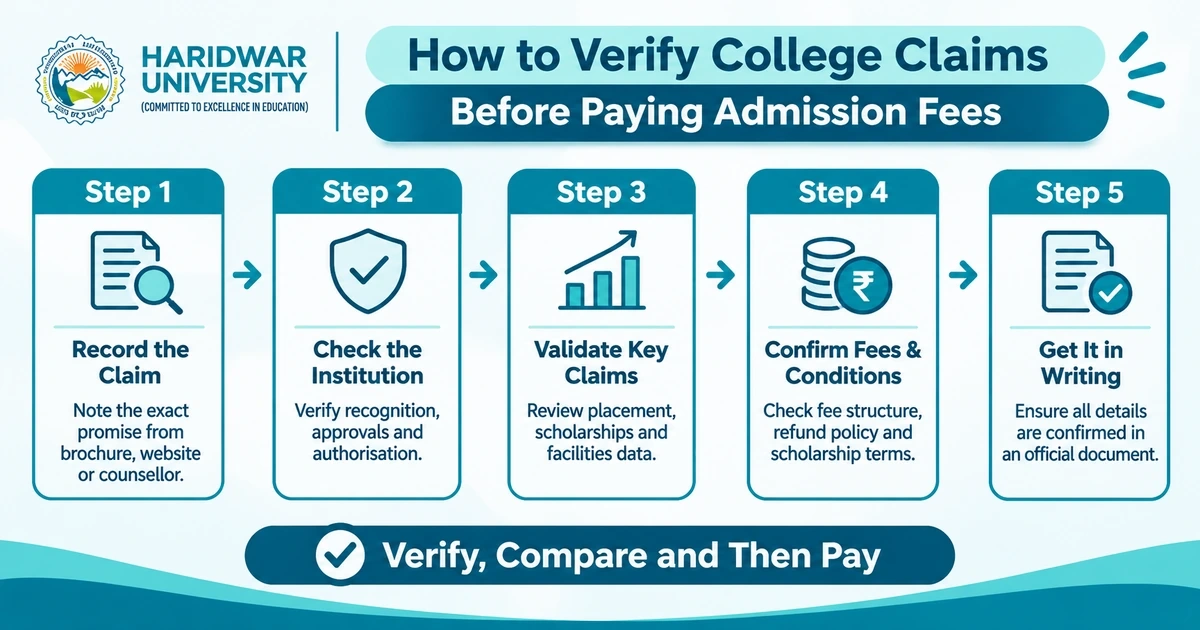
My advice to parents is to keep the process simple: record the claim, request its supporting evidence, verify the information independently and retain written confirmation before paying. Recognition, placement figures, scholarships, fees and facilities each require different forms of proof; one attractive brochure cannot establish all of them.
A university should be able to explain what it offers and show parents where the relevant information can be checked. Families should give themselves enough time to do that work. An admission decision becomes more dependable when the evidence is clear before the payment is made, not after.
Verify Everything Before You Enrol at Haridwar University
Review our published fee schedules, scholarship terms, UGC recognition, placement reports, and degree programmes directly on our official portal before making any admission commitment.