

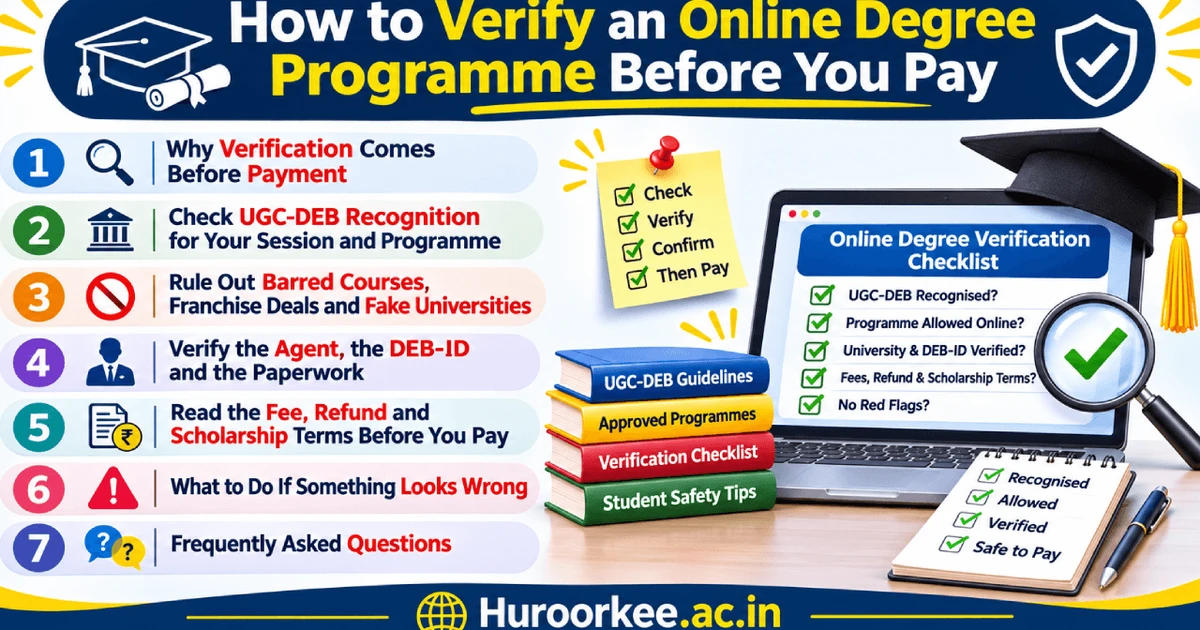
Table of Contents
- 1. Why Verification Comes Before Payment
- 2. Check UGC-DEB Recognition for Your Session and Programme
- 3. Rule Out Barred Courses, Franchise Deals and Fake Universities
- 4. Verify the Agent, the DEB-ID and the Paperwork
- 5. Read the Fee, Refund and Scholarship Terms Before You Pay
- 6. What to Do If Something Looks Wrong
- 7. Frequently Asked Questions (FAQs)
How to verify an online degree programme before you pay a single rupee? Start with the statutory regulator, not a promotional brochure. Paying first and checking later is the costliest order to do things in — and unfortunately, it is the sequence many third-party admission agents actively encourage.
This guide provides five verifiable checks you can complete in an afternoon, all constructed directly upon official University Grants Commission (UGC) public directories. It reflects the regulatory framework in force for the 2026-27 academic cycle.
1. Why Verification Comes Before Payment
A degree is only as legally defensible as the statutory permission behind it. Under Regulation 22 of the UGC (Open and Distance Learning Programmes and Online Programmes) Regulations, 2020, degrees awarded through distance or online mode by recognized institutions are treated as equivalent to conventional on-campus degrees.
Critical Regulatory Reality: Institutional recognition is neither blanket nor permanent. UGC explicitly warns that a university holding approval in one academic cycle does not automatically hold entitlement for the next session. If you enroll in a session where the university was not entitled, your degree will not be recognized for higher education or government jobs.
Which Regulations Apply Today
The benchmark legal framework remains the UGC (Open and Distance Learning Programmes and Online Programmes) Regulations, 2020 (amended on 1 July 2021, 18 July 2022, and 2 May 2024). To see how apex bodies interact across disciplines, review our comprehensive explainer on UGC, AICTE, PCI, and NAAC approvals for parents.
2. Check UGC-DEB Recognition for Your Session and Programme
This single check settles 90% of verification issues. The UGC Distance Education Bureau publishes public, searchable, session-wise directories of approved institutions on deb.ugc.ac.in. You must cross-match three data points simultaneously:
- The exact university name (beware of similarly named entities).
- The exact programme title (e.g., BBA or BCA; an entitlement for B.Com does not authorize BCA).
- The specific academic intake session (January-February or July-August / October).
"Recognised" vs. "Entitled" Universities
Institutions fall into two regulatory classes under UGC online norms:
- Entitled Institutions: High-tier universities with a NAAC score of 3.26+ or top-100 NIRF university rankings in at least two of the prior three cycles. These HEIs are entitled to offer up to 13 online programmes (3 UG, 10 PG) without prior course-by-course UGC inspection, though they must notify the Commission.
- Recognised Institutions: Universities holding NAAC 3.01+ that undergo individual programme evaluation and specific sanction from UGC before admitting students.
Either way, your degree course must appear explicitly in the published DEB registry. For a transparent view of statutory accreditations and state government charters, visit Haridwar University’s Recognitions and Approvals page.
3. Rule Out Barred Courses, Franchise Deals and Fake Universities
Courses That Cannot Be Taken Online
UGC regulations explicitly bar 18+ practical, lab-intensive, and clinical domains from online delivery. Any institution claiming to offer an "online B.Tech", "online B.Pharm", "distance MBBS", or "online B.Sc Nursing" is violating federal regulations.
Furthermore, effective from the July-August 2025 academic session, the UGC prohibited all allied and healthcare programmes covered under the NCAHP Act, 2021 (including Psychology as a healthcare specialization). M.Phil and Ph.D. degrees are strictly barred through distance/online modes across all streams.
Commercial Franchise Arrangements
UGC regulations strictly prohibit universities from outsourcing admissions, curriculum delivery, or examinations to private coaching centres, study circles, or ed-tech franchisees. If an admission brochure showcases a private coaching brand, confirm whether the university itself directly issues the admission letter and handles examinations. For structured due diligence, consult our parents' checklist for evaluating a university.
UGC Fake University Register
The UGC maintains an official public blacklist of unaccredited institutions that self-style as universities. In its February 2026 update, 32 bogus institutions were officially named. Always check the exact spelling against the UGC Fake University List. Remember: absence from the fake list does not equal online approval; you must still verify DEB entitlement.
4. Verify the Agent, the DEB-ID and the Paperwork
Verifying the regulatory registry is only half the battle; you must also verify the operational paperwork:
Essential Paperwork Safeguards:
- Generate Your DEB-ID Independently: The UGC makes holding a DEB-ID mandatory before enrolling in ODL or online courses. Generate it yourself using your DigiLocker ABC ID. Never allow an agent to generate it on your behalf. Read our full tutorial on why the DEB-ID is now mandatory for distance and online students.
- Official Banking Channels: Remit all application and course fees exclusively to bank accounts titled in the university's legal name. Never transfer fees to personal UPI handles or third-party agencies.
- Written Programme Confirmation: Insist on formal admission letters explicitly stating the programme name, session, and UGC entitlement order reference.
5. Read the Fee, Refund and Scholarship Terms Before You Pay
Never accept vague fee schedules. Legitimate universities publish multi-year fee structures, transparent breakdown of tuition versus examination fees, and written refund guidelines complying with UGC directives. For an overview of statutory deduction slabs and cancellation timelines, read our guide on the UGC fee refund policy.
What a Transparent Higher Education Fee Schedule Looks Like
Note: Haridwar University provides full-time, regular on-campus education and does not operate an ODL or online wing. The figures below represent published 2026-27 benchmarks from HU's official Fees & Scholarships directory, illustrating the standard of clarity you should demand from any educational provider:
6. What to Do If Something Looks Wrong
If you spot anomalies during verification, take immediate corrective action:
- Stop Further Payments Immediately: Do not release installment payments or registration balances based on verbal assurances.
- Preserve Digital Evidence: Screenshot the DEB portal list for your session, save email communications, prospectus pages, and bank transfer receipts.
- Seek Written Explanation: Demand an official clarification on the university's letterhead citing the UGC approval notification number.
- File a National Consumer Grievance: If a refund is unlawfully withheld, lodge a formal dispute via the National Consumer Helpline (NCH) at 1915 or register your grievance at consumerhelpline.gov.in. Educational fee disputes fall squarely within its consumer protection ambit.
If distance or online routes fail your credibility check, opting for a regular, fully accredited on-campus degree offers security, mentorship, and industry-grade laboratory infrastructure. Discover how our campus community supports student success on Haridwar University’s Student Welfare Service page.
7. Frequently Asked Questions (FAQs)
How to verify an online degree programme before paying fees?
Open deb.ugc.ac.in and verify that your university, exact course title, and specific intake session appear on the recognised or entitled list. Ensure the programme is not in a prohibited domain and verify that the institution is absent from UGC's fake university directory.
What is the difference between recognised and entitled universities?
Entitled universities meet higher quality thresholds (NAAC ≥ 3.26 or top-100 NIRF ranking) and may launch up to 13 online courses without prior UGC approval. Recognised universities hold NAAC 3.01+ and must seek programme-by-programme UGC inspection.
Is an online degree equal to a regular degree in India?
Yes. Under Regulation 22 of the UGC 2020 Regulations, degrees awarded by UGC-recognised institutions conforming to degree nomenclature specifications are legally equivalent to conventional campus degrees for higher education and employment.
Can I study B.Tech, B.Pharm, or nursing online?
No. UGC explicitly prohibits engineering, pharmacy, nursing, medicine, and allied healthcare courses from being delivered online or through distance education. Any such offering is invalid.
Does last year's recognition cover this year's admissions?
No. Recognition is granted on a session-specific basis. Approval in a prior year does not guarantee entitlement for the current academic session. Always verify your exact intake cycle.
What happens if a university loses recognition after I enrol?
Under Regulation 23(2), an admission taken when the programme was recognized remains valid until completion of the minimum course duration, provided the university complied with norms. Always retain date-stamped admission letters and fee receipts.
Does Haridwar University offer online degrees?
Haridwar University provides comprehensive, full-time regular campus programmes and does not operate an ODL or online wing. Complete campus courses and fee schedules are published on its official portal.
How do I check whether a university is fake?
Search its exact name on the UGC Fake University directory (carrying 32 bogus entities as of February 2026). Then verify that it holds genuine UGC recognition on the DEB portal.
Where can I complain about a refused refund or misleading offer?
Submit a formal written grievance to the university's Registrar first. If unresolved, register an education services complaint on the National Consumer Helpline at 1915 or online at consumerhelpline.gov.in.
Choose Transparent, Accredited Education at Haridwar University
Avoid the risks of questionable distance programmes. Step into Haridwar University’s UGC-recognized, AICTE-approved campus degrees in Engineering, Computing, Management, Agriculture, and Health Sciences — equipped with industry mentors, advanced labs, and premier placement pathways.