

Table of Contents
- 1. What Biannual University Admissions Mean in India
- 2. What the Latest UGC Rules Say About January Admissions
- 3. How the January and July Admission Cycles Work
- 4. Who Can Apply for January University Admissions
- 5. Do All Universities and Courses Offer January Intake?
- 6. January Admissions for Regular, Online and Distance Programmes
- 7. When to Apply and How to Check Admission Deadlines
- 8. What Students Should Check Before Applying
- 9. Frequently Asked Questions (FAQs)
- 10. Making the Second Admission Cycle Work for You
A student who misses the conventional July admission cycle often assumes that the next opportunity will only arrive twelve months later. That is no longer necessarily the case. Under the University Grants Commission’s (UGC) progressive biannual admission framework, eligible higher education institutions can now admit students across two distinct annual cycles: July/August and January/February.
While this second cycle creates a valuable entry point for thousands of aspirants, it does not mean every university or discipline automatically opens its doors in January. An institution must possess requisite academic infrastructure, adequate faculty-student ratios, and statutory council sanction. As Head of Admissions, I believe students should understand both dimensions: the flexibility it offers and the preconditions that govern its availability in 2026.
1. What Biannual University Admissions Mean in India
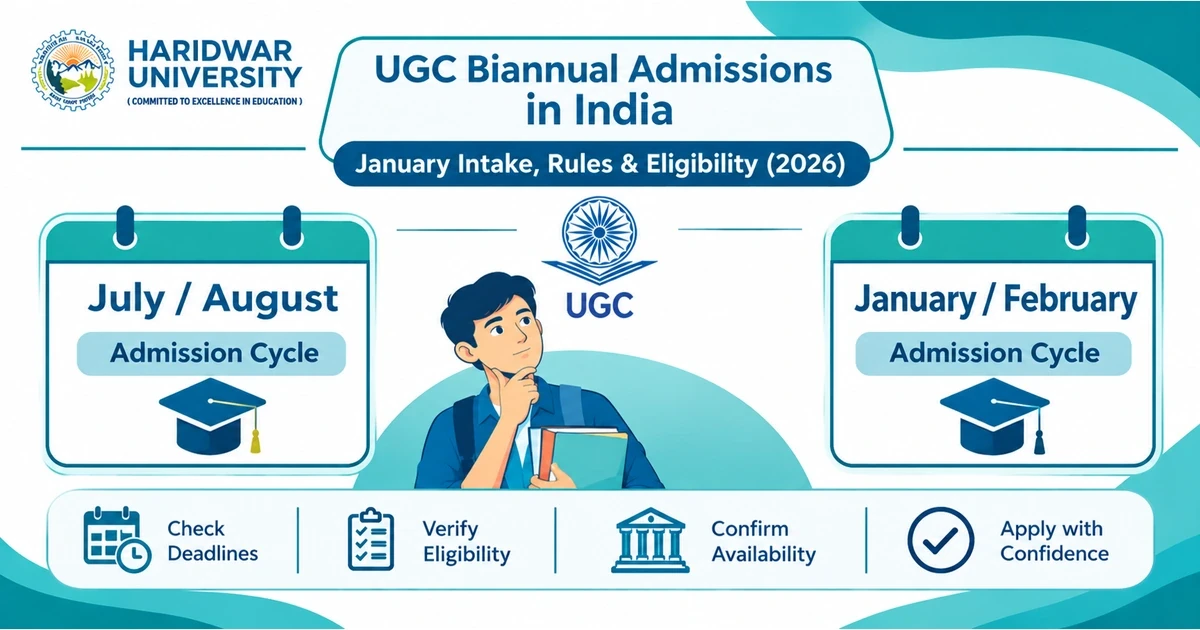
Biannual university admissions mean that a Higher Education Institution (HEI) can legally admit new cohorts twice within a single calendar year, transitioning away from the traditional single-window intake:
- July/August Cycle: The traditional primary academic intake aligned with Indian school board and national entrance results (CUET, JEE, NEET).
- January/February Cycle: An additional winter admission window for institutions ready with faculty, lab resources, and classroom space.
The UGC approved this policy shift in 2024 to bring Indian academia in harmony with global universities (such as in North America and Europe) and to prevent students from losing an entire gap year due to delayed board results, personal emergencies, or competitive exam preparation.
2. What the Latest UGC Rules Say About January Admissions
The regulatory foundation for twice-a-year enrollment is codified under the UGC (Minimum Standards of Instruction for the Grant of Undergraduate Degree and Postgraduate Degree) Regulations, 2025. Regulation 4.0 explicitly authorizes HEIs that are operationally prepared to admit students in both cycles.
Mandatory Statutory Conditions for HEIs:
- Prior Statutory Capacity Determination: The institution must determine its total intake capacity through its Academic Council and Executive Council, ensuring that faculty recruitment and physical infrastructure keep pace.
- Uncompromised Quality & Mentorship: Teaching standards, laboratory access, and evaluation benchmarks in the winter cycle must be identical to the summer cycle.
- Statutory Council Concurrence: For professional programmes regulated by apex councils (such as AICTE, PCI, BCI, or INC), specific council guidelines and sanctioned seat limits continue to apply.
The distinction is crucial: UGC permission is enabling, not mandatory. It gives universities the legal right to offer January admissions if they have the capacity; it does not force every college to open every course twice a year.
3. How the January and July Admission Cycles Work
While both admission windows lead to the exact same recognized degree, the operational calendars operate on alternating semester tracks:
4. Who Can Apply for January University Admissions
The January intake is particularly advantageous for specific student profiles:
- Students with Delayed Examination Results: Candidates whose re-evaluation, supplementary board exams, or qualifying degree declarations missed the August cutoff.
- Competitive Exam Aspirants: Students who dedicated the autumn semester to JEE, NEET, CUET, or CAT and wish to start university without waiting for the next autumn.
- Lateral Entry Candidates: Diploma holders seeking entry into engineering or computer applications who completed paperwork after summer counselling windows closed.
- Mid-Year Career Switchers: Working professionals seeking postgraduate management or computing credentials.
Remember: an additional cycle does not dilute qualification standards. Applicants must still meet prescribed minimum percentage thresholds in Class 12 or graduation.
5. Do All Universities and Courses Offer January Intake?
No. This is one of the most vital realities applicants must grasp.
A university may choose to run the winter cycle only for specific non-lab courses or postgraduate streams while keeping high-infrastructure disciplines (such as B.Tech, Nursing, or Pharmacy) restricted to a single summer intake. Practical-intensive courses require clinical rotations, semester-long crop cycles in agricultural farms, or structured workshop progressions that cannot always be duplicated in a parallel January track.
Haridwar University publishes its complete directory of academic programmes and transparent UG/PG programme guidelines. Haridwar University operates an academic calendar where the odd semester begins in August and the even semester begins in January. Note that an even semester start for existing students is distinct from a fresh admission intake. Always check current admissions notifications directly before applying.
6. January Admissions for Regular, Online and Distance Programmes
The operational mode plays a decisive role in how January intakes function:
Regular Campus Admissions
For regular physical degrees, universities must ensure separate lecture timetables, parallel lab schedules, and dedicated faculty cohorts so that January-admitted students receive the exact same 15-week instructional semester as the July cohort.
Online and Distance Learning (ODL) Programmes
Many Open and Distance Learning providers have historically operated calendar-year (January-December) sessions. However, under current UGC-DEB regulations, any online or ODL admission requires:
- Institutional entitlement explicitly valid for that session on deb.ugc.ac.in.
- Mandatory generation of a student DEB-ID prior to paying fees, as outlined in our guide on why the DEB-ID is now mandatory.
- Absolute compliance with UGC prohibited course lists; see courses you cannot study fully online in India.
7. When to Apply and How to Check Admission Deadlines
There is no single centralized national deadline for January admissions. Each university issues its autonomous notification based on internal seat availability and statutory approvals.
Recommended Planning Timeline for Winter Intakes:
- October – November: Monitor official university admission portals for winter cycle notifications.
- November – December: Prepare academic transcripts, migration certificates, and entrance scorecards.
- Late December – January: Complete online application forms, counseling, and document verification.
- Late January – Early February: Orientation, fee payment, and commencement of semester classes.
For a comprehensive walk-through of application milestones, explore our detailed guide on the Haridwar University admission process.
8. What Students Should Check Before Applying
Before committing registration fees for a January admission intake, review this pre-admission checklist:
- ✓ Has the university formally notified the January intake on its official website?
- ✓ Is your preferred degree course and specialization explicitly included?
- ✓ Do you meet all published qualifying marks and subject prerequisites?
- ✓ Are fee installment dates and class commencement schedules published in writing?
- ✓ Does the programme hold active recognition from the relevant statutory council?
- ✓ Has the admissions office clarified seat confirmation timelines?
If you missed the primary admission window, do not assume a January cycle is your only path. Depending on the academic calendar, universities occasionally offer managed late entry within regulatory cutoffs. Read our guide on late admission options at Haridwar University to evaluate timely possibilities.
9. Frequently Asked Questions (FAQs)
1. Can I take admission in an Indian university in January?
Yes. Under UGC's biannual admissions framework, prepared universities can conduct an additional admission cycle in January/February alongside the traditional July/August intake.
2. Is the January intake compulsory for all universities?
No. Biannual admissions are completely optional. Each university decides whether to offer the winter cycle based on its faculty strength, lab infrastructure, and statutory approvals.
3. Are January and July admissions equally valid?
Yes. Degrees earned through either intake cycle are legally identical in validity, academic standing, and recognition for government employment and higher studies.
4. Can I apply for January admission if I missed the July intake?
Yes, provided your targeted university participates in the January cycle, offers your specific programme, and you fulfill its published eligibility criteria.
5. Are all undergraduate and postgraduate courses available in January?
No. Many universities restrict January admissions to non-lab or postgraduate courses, keeping clinical and intensive laboratory degrees strictly in the summer intake.
6. Do online and distance universities also offer January admissions?
Many do, but availability depends strictly on UGC-DEB session entitlement and active DEB-ID registration on the central portal.
7. Where can I check official January admission dates?
Check the university's official website, designated admission portal, or contact the university admissions office directly. Avoid relying on third-party aggregators.
10. Making the Second Admission Cycle Work for You
Biannual admissions represent a welcome modernization of Indian higher education. The opportunity to commence studies in January prevents unnecessary gap years and accommodates diverse academic journeys.
My recommendation is simple: start with clarity on your degree aspirations, verify whether your chosen programme participates in the second cycle, and confirm all statutory accreditations before paying fees. When backed by due diligence, the biannual framework can propel your higher education forward without missing a beat.
Plan Your Academic Future at Haridwar University
Whether you are preparing for regular admissions or seeking expert counseling on degree paths in Engineering, Computing, Management, Agriculture, or Allied Sciences, Haridwar University offers state-of-the-art campus facilities, attractive scholarships, and robust placement mentorship.