

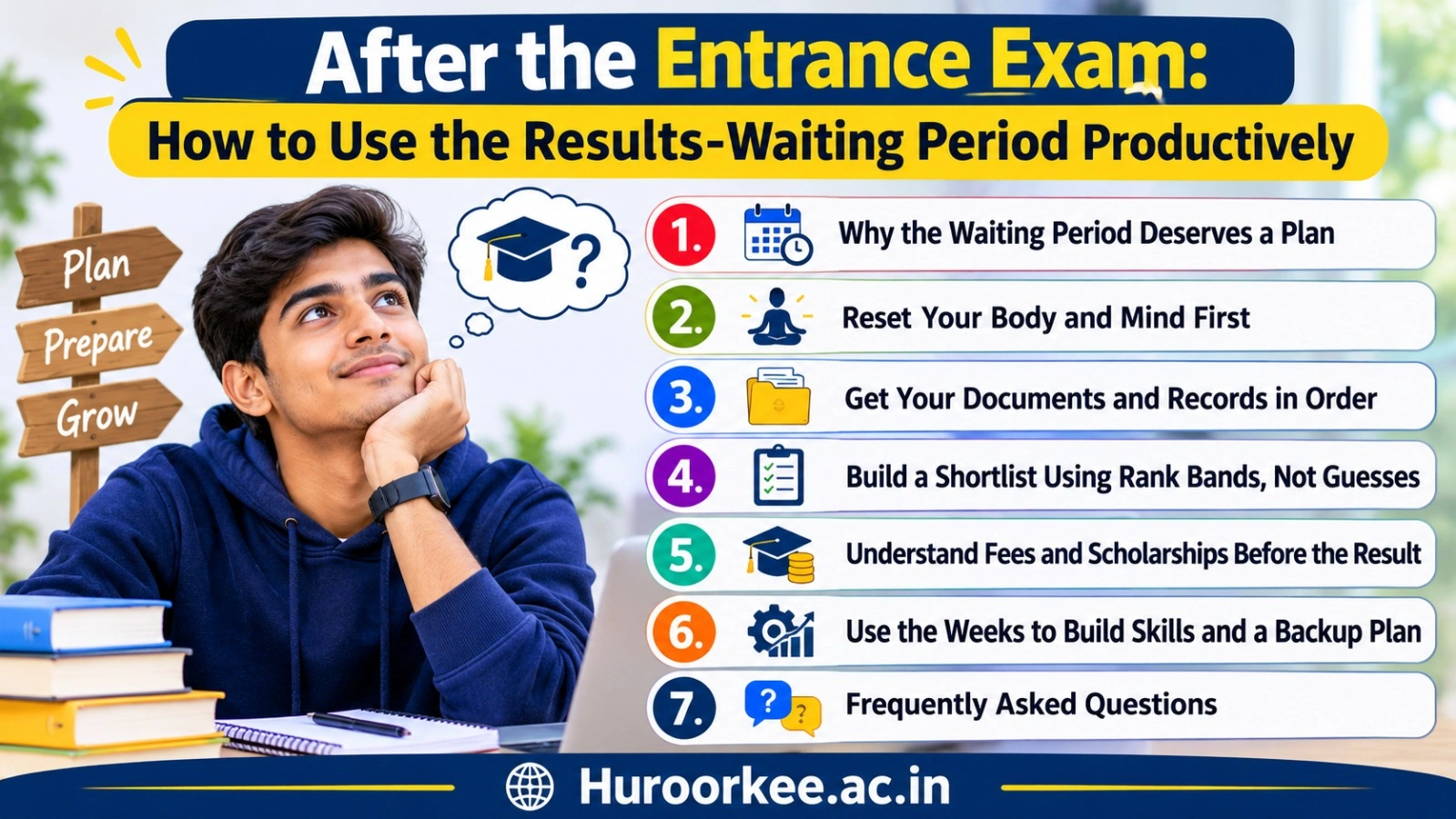
After the Entrance Exam: How to Use the Results-Waiting Period Productively
Dr. V.K. Saini
Director, Haridwar University
The paper is over, the hall ticket is back in the drawer, and the hardest stretch has just started: waiting. Some students refresh the result page every hour. Others stop doing anything at all. Neither habit helps. This guide shows how to use the results-waiting period productively, with small steps you can begin today and finish before your score arrives. Exam dates keep shifting, so treat every date you hear as provisional. The National Testing Agency itself calls the dates in its exam calendar tentative, and its official website is where you should confirm them.
Your waiting period is an opportunity to get ahead. Rather than letting uncertainty fuel anxiety, dividing your focus across physical recovery, document gathering, institution shortlisting, financial planning, and targeted micro-skilling turns wasted weeks into a decisive advantage.
Table of Contents
- 1. Why the Waiting Period Deserves a Plan
- 2. Reset Your Body and Mind First
- 3. Get Your Documents and Records in Order
- 4. Build a Shortlist Using Rank Bands, Not Guesses
- 5. Understand Fees and Scholarships Before the Result
- 6. Use the Weeks to Build Skills and a Backup Plan
- 7. Frequently Asked Questions (FAQs)
1. Why the Waiting Period Deserves a Plan
Your examination score is already decided. What you do over the next few weeks is not. That gap is the primary reason to plan this transitional period deliberately instead of drifting aimlessly through it.
What the Wait Is Not
It is not an unconditional holiday, and it is certainly not a punishment. Students who treat it as pure indulgence often panic on result day because none of their application paperwork is ready. Conversely, students who treat it as overtime exam preparation burn out completely before counselling rounds even begin.
What You Can Control
You cannot change the evaluator's marks, but you have full control over your sleep schedule, your paperwork, your college shortlist, your budget, and one new self-directed skill. If you have never structured your own unstructured time, explore Haridwar University’s guide on how to make a study timetable for an adaptable weekly template.
2. Reset Your Body and Mind First
Exhausted students make compromised choices. The coming admission season demands clear-headed decisions regarding academic branches, hosteller life, and financial allocations. Start by restoring balance:
- Fix Your Sleep and Movement: Re-establish a consistent circadian rhythm. Go to bed and wake up at set times. Incorporate 30 to 45 minutes of daily physical activity—walking, cycling, or team sports—to metabolize lingering stress hormones.
- Limit Result Speculation: Endless answer-key debates in WhatsApp and Telegram groups feel productive, but they only fuel panic. Designate one single 15-minute slot per day to check official examination notices, and close the portals immediately afterwards. If post-exam stress feels overwhelming, read our expert insights on handling exam anxiety and burnout.
- Know When to Ask for Support: If persistent worry disrupts your sleep or eating habits, reach out to family, mentors, or professional counsellors. The Ministry of Health's Tele-MANAS mental health helpline provides free, confidential, round-the-clock counselling across India on toll-free number 14416.
3. Get Your Documents and Records in Order
If you want a single task with an immediate, stress-relieving return on investment, organize your admission documentation. Counselling verification counters process hundreds of applicants daily; a missing migration certificate or mismatched affidavit can cost days of administrative delays.
| Document Category | Required Records & Certificates |
|---|---|
| High School (Class 10) | Original Marksheet, Passing Certificate, and School Character Certificate (serves as age proof). |
| Intermediate (Class 12) | Original Marksheet, Passing Certificate, School Leaving/Transfer Certificate (TC), and Migration Certificate. |
| Entrance Scorecards | Official NTA/State scorecards (JEE Main, CUET, NEET, etc.) once declared, plus Admit Card copies. |
| Gap Year Affidavit | Notarized affidavit on non-judicial stamp paper stating the reason for any study gap after 12th. Read our guide to taking a gap year after 12th. |
| Identity & Address Proof | Aadhaar Card, Passport, or Voter ID with matching parent names and date of birth. |
| Attested Photocopies | At least two sets of self-attested photocopies of every academic and identity record. |
| Photographs | Ten passport-size photographs of the student, plus two photographs of the mother and two of the father. |
Organize physical originals into a dedicated accordion binder, keep photocopies in a separate file, and scan high-resolution PDF copies into DigiLocker and cloud storage. Consult the official admission requirements and eligibility criteria for course-specific mandatory prerequisites. Furthermore, keep in mind that seat confirmation generally requires an initial registration deposit (₹25,000 at Haridwar University via cash, DD, NEFT, or RTGS) so plan this contingency with your family in advance.
4. Build a Shortlist Using Rank Bands, Not Guesses
Working with an estimated raw score is helpful; anchoring your entire future to an exact single rank number is dangerous. Because answer keys undergo expert challenges and normalisation curves shift percentiles, prudent students plan using structured rank tiers.
- Create Three Institutional Tiers: Group prospective programmes under three clear buckets: Strong Chance (realistic safety options based on historical cutoffs), Fair Chance (solid matches for your expected score), and Reach (aspirational choices if percentiles tilt in your favor). Maintain at least two verified institutions in each category.
- Verify Eligibility Criteria First: Never finalize a course without scrutinizing the institution's primary eligibility rules. To understand how score percentiles convert to institutional allocations, consult our analysis on how entrance exam scores map to university admission.
- Compare on Real Infrastructure: Set up a straightforward comparison sheet evaluating accredited approvals (NAAC/UGC/AICTE), campus placement records, specialized laboratory infrastructure, hostel facilities, and total fee outlay side by side.
5. Understand Fees and Scholarships Before the Result
Evaluating financial obligations prior to result day avoids rushed, stressful compromises when admission deadlines loom. Transparent universities publish comprehensive course-wise fee structures and scholarship slabs directly on their portals.
For instance, Haridwar University details its complete fee schedules on its fees and scholarships page. Indicative annual tuition figures include ₹62,000 for B.Tech. Hons. CSE, ₹30,000 for BCA, and ₹20,000 for B.Com with AI. Listed charges incorporate tuition, enrolment, admission, examination, and uniform fees, with transport and hostel billed transparently as separate options.
Merit Scholarship Slabs (First-Year Tuition)
| JEE Rank Bracket | Class 12 (PCM/PCB or Agg.) | CUET Percentile | Tuition Waiver |
|---|---|---|---|
| 1 – 1,00,000 | Above 90% | Above 90% | 80% Scholarship |
| 1,00,001 – 2,00,000 | Above 80% up to 90% | Above 80% up to 90% | 50% Scholarship |
| 2,00,001 – 3,00,000 | Above 70% up to 80% | Above 70% up to 80% | 20% Scholarship |
| 3,00,001 – 6,00,000 | Above 60% up to 70% | Above 60% up to 70% | 10% Scholarship |
Additional institutional support includes a dedicated 25% first-year tuition scholarship for girl students, sports achievement waivers ranging from 10% to 50% across school, district, state, and national tournaments, and a ₹5,000 academic merit cash award for students scoring 85%+ in their semester exams on first attempt. Hostel accommodations range from ₹85,000 (standard non-AC) to ₹95,000 (semi-deluxe) and ₹1,05,000 (deluxe AC), all covering lodging, three meals daily, and laundry services. For a wider evaluation of institutional aid, read our guide on how merit scholarships work in Indian private universities.
6. Use the Weeks to Build Skills and a Backup Plan
Spending 45 minutes a day during the waiting window mastering a tangible tool gives you an immediate head start once collegiate lectures commence:
- Select One Practical Skill: If heading into computing or engineering, complete an introductory Python or GitHub module. For commerce or management, master spreadsheet formulas (VLOOKUP, Pivot Tables). For pharmacy or agriculture, review organic reaction mechanisms or plant physiology fundamentals. Build one tangible mini-project you can reference.
- Secure a Legitimate Backup: Never place your entire academic future on a single entrance session. Explore institutions with flexible multi-criteria admission processes. At Haridwar University, the student welfare service operates dedicated Student Care Centres in each block with 24-hour turnaround commitments, and provides on-campus assistance with education loan financing covering tuition, boarding, books, and laptops.
- Plan for Result Day Itself: Agree on next steps with your parents for each score band, keep your registered mobile SIM and email active, and download official scorecards immediately upon release to avoid portal traffic bottlenecks.
7. Frequently Asked Questions (FAQs)
1. How long does the entrance results waiting period usually last?
Result timelines vary by exam. While some national exams declare scores within two to three weeks, others take up to a month. NTA marks dates as tentative in its calendar, so always rely exclusively on official circulars rather than social media speculation.
2. Should I keep studying during the results wait?
If you have registered for Session 2, state CETs, or alternate entrance exams, yes—maintain a structured revision rhythm. If you have finished all tests, switch to light reading, paperwork preparation, shortlisting, and practical digital skills.
3. Can I rely on my score estimate calculated from the unofficial answer key?
Treat your answer-key calculations as an indicative range rather than a fixed rank. Official answer keys are frequently challenged, dropped questions alter raw scores, and multi-shift normalisation formulas shift final percentiles.
4. Which documents are required for admission at Haridwar University?
Class 10 and 12 original marksheets and certificates, Transfer/Migration Certificate, Character Certificate, Scorecard copy, Gap year affidavit (if applicable), Aadhaar address proof, two self-attested photocopy sets, and 10 passport photos of the applicant along with parent photographs.
5. What is the seat confirmation deposit amount at Haridwar University?
The standard initial seat confirmation deposit is ₹25,000, payable via Cash, Cheque, Demand Draft, NEFT, or RTGS. Always confirm the updated account details on the university's official portal before transferring funds.
6. Does Haridwar University provide merit scholarships on ranks or 12th marks?
Yes. Haridwar University offers transparent first-year tuition waivers of 80%, 50%, 20%, and 10% based on JEE Main ranks, Class 12 aggregate percentages, or CUET percentiles. Only one institutional scholarship can be availed per student.
7. Is there a dedicated scholarship for girl students?
Yes. Haridwar University offers a dedicated 25% first-year tuition fee scholarship for female candidates to encourage and support women in higher education.
8. How can I manage anxiety during the results wait?
Maintain a predictable daily sleep and exercise routine, curb continuous group chat discussions, and speak openly with mentors. For persistent distress, reach out to the National Tele-MANAS mental health helpline at toll-free 14416.
9. How do I initiate an enquiry or application at Haridwar University?
You can initiate an application online via the official portal at huroorkee.ac.in/apply-now, contact the admissions team directly at +91-9801012345, or visit the Roorkee campus in person.
Ready to Advance Your Education at Haridwar University?
Turn your entrance results into an actionable career plan. Explore NEP-aligned degree programmes across Engineering, Computing, Pharmacy, Agriculture, and Management with transparent merit scholarships and dedicated career support. Applications are open for the 2027-28 session.