

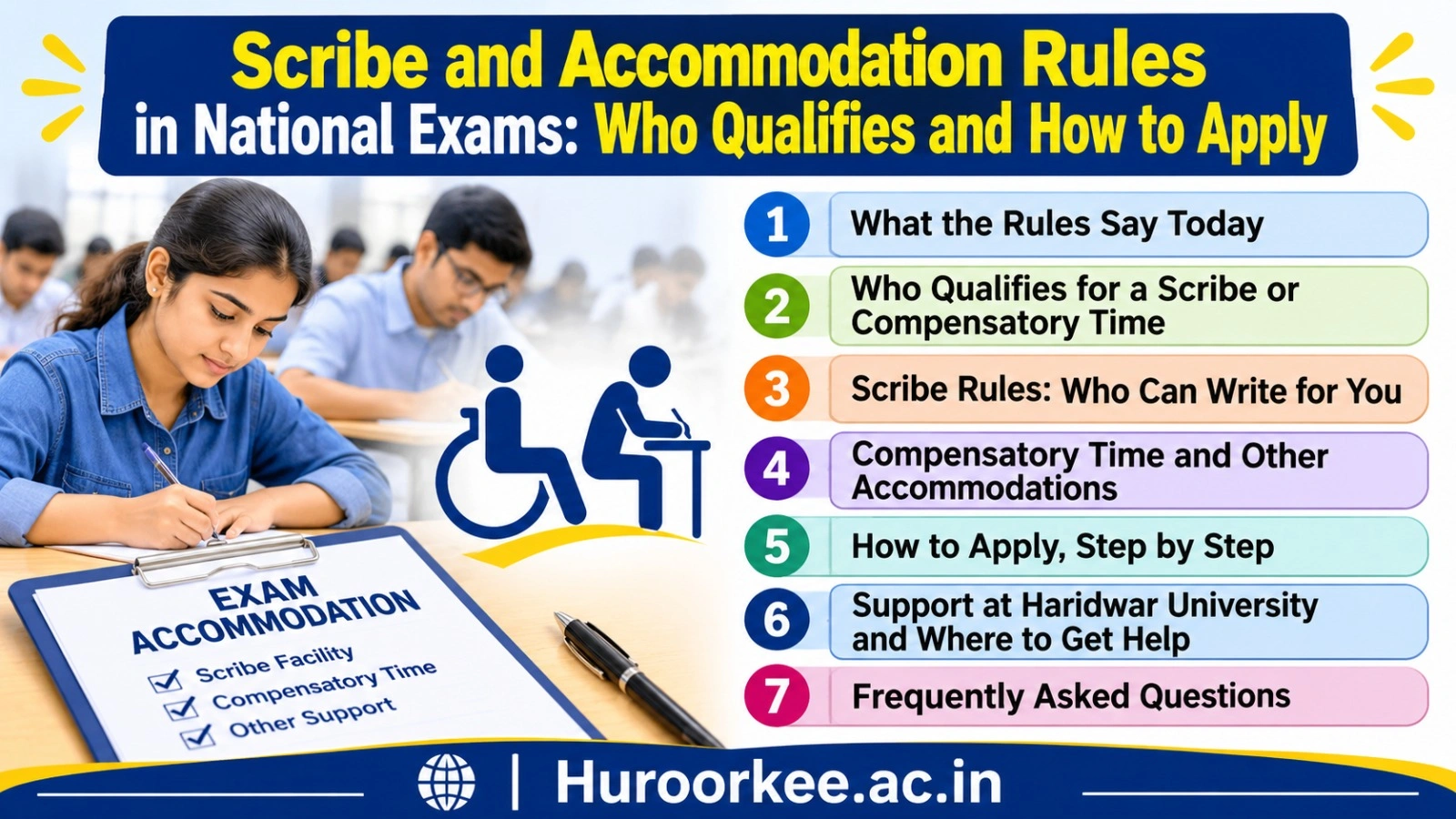
Scribe and Accommodation Rules in National Exams: Who Qualifies and How to Apply
Mr. Jitendra Chaudhary
Admissions Manager, Haridwar University
Plenty of candidates with disabilities arrive at national entrance examination centres under the assumption that a scribe, specialized seating, and compensatory extra time will automatically be arranged for them. In reality, students are frequently turned away or forced to write unassisted because their formal accommodation request was never submitted in the prescribed format during online registration.
The Scribe and Accommodation Rules in National Exams are formulated at the apex level by the Government of India through the Department of Empowerment of Persons with Disabilities (DEPwD). However, each testing authority—including the National Testing Agency (NTA)—converts these national directives into its own strict certification formats, online annexures, and rigid application deadlines. Using the official JEE Main 2027 Information Bulletin as our primary operational benchmark, this guide clarifies who qualifies, which medical documents are legally recognized, and how to apply step-by-step.
One critical deadline demands immediate attention: under official NTA guidelines, disability claims cannot be added or modified once the online registration and correction windows close. All dates are provisional, so always verify latest circulars on official examination portals before submitting your paperwork.
Scribe and Compensatory Time at a Glance
| Disability Category | Mandatory Documentation | Scribe Facility | Compensatory Time |
|---|---|---|---|
| Blindness, Locomotor (Both Arms Affected), or Cerebral Palsy (≥ 40%) | Valid Disability Certificate or Unique Disability ID (UDID) Card. | Granted automatically upon request. | 20 minutes per hour of examination. |
| Other Benchmark Disabilities (≥ 40%) with Writing Limitations | UDID card plus Chief Medical Officer (CMO) Certificate confirming physical limitation to write (Annexure I). | Granted based on medical certificate recommendation. | 20 minutes per hour of examination. |
| Disabilities < 40% with Severe Writing Difficulty | Government Medical Board Certificate (valid up to 6 months) confirming writing limitation (Annexure II). | Granted upon verification by medical board. | 20 minutes per hour once scribe is approved. |
Source: DEPwD Office Memorandums dated 29 August 2018 and 10 August 2022, as integrated into JEE Main 2027 Information Bulletin (Paras 4.2 & 4.3).
Table of Contents
- What the Rules Say Today
- Who Qualifies for a Scribe or Compensatory Time
- Scribe Rules: Who Can Write for You
- Compensatory Time and Other Accommodations
- How to Apply, Step by Step
- Support at Haridwar University and Where to Get Help
- Frequently Asked Questions (FAQs)
- Securing Your Examination Rights Proactively
1. What the Rules Say Today
National entrance examination accommodations are governed by two landmark central memorandums issued by the Department of Empowerment of Persons with Disabilities (DEPwD), Ministry of Social Justice and Empowerment:
- The 29 August 2018 Memorandum: Establishes universal examination accommodations for candidates with benchmark disabilities (40% or more disability).
- The 10 August 2022 Memorandum: Followed the landmark Supreme Court ruling in Vikash Kumar v. UPSC (2021), extending scribe and compensatory time rights to candidates with less than 40% disability who face documented physical difficulty in writing.
Status of the 2025 Revised Guidelines
While DEPwD issued revised comprehensive guidelines on 1 August 2025, those guidelines are not currently in operational effect. The department has officially kept the 2025 guidelines in abeyance through notifications listed on the DEPwD Official Documents Portal. Consequently, all national examinations conducted across India continue to operate under the tried-and-tested 2018 and 2022 frameworks.
2. Who Qualifies for a Scribe or Compensatory Time
1. Benchmark Disabilities (≥ 40%)
Under Section 2(r) of the Rights of Persons with Disabilities (RPwD) Act, 2016, a person with benchmark disability holds not less than 40% of a certified disability. Candidates with blindness, locomotor disability affecting both arms, or cerebral palsy are entitled to a scribe and compensatory time as a matter of right. Candidates with other benchmark disabilities (such as dysgraphia, severe muscular dystrophy, or amputations) qualify upon submitting a certificate from a Chief Medical Officer (CMO), Civil Surgeon, or Medical Superintendent confirming writing limitations.
2. Candidates Below 40% Disability with Writing Difficulty
Having a disability quantified below 40% is no longer a disqualifying factor. Under Section 2(s) of the RPwD Act, candidates suffering from chronic neurological conditions, joint trauma, or temporary orthopedic injuries that hinder handwriting or computer mouse operation can receive a scribe and extra time. This requires an evaluation by a designated government medical board, which issues a certificate valid for up to six months.
Verification Rigour: NTA cross-verifies Unique Disability ID (UDID) numbers directly on the central Swavlamban database. The bulletin warns that claiming a scribe or extra time through falsified medical certificates leads to immediate cancellation of results and permanent debarment from national entrances.
3. Scribe Rules: Who Can Write for You
A scribe's role is strictly limited to reading out examination questions verbatim and entering responses on the computer console or OMR sheet exactly as directed by the candidate. A scribe is legally prohibited from explaining question meanings, clarifying nuances, or suggesting answers.
Candidate's Own Scribe vs Testing Agency Scribe
- Candidate's Own Scribe: The 2018 and 2022 memorandums allow candidates to bring their own scribe upon submitting a formal undertaking (Annexure III in JEE Main). The scribe's educational qualification must be one step below the candidate's qualification. If the scribe is found to possess equal or higher qualifications, the candidate forfeits their admission.
- Testing Agency Provided Scribe: If you request a scribe from NTA, the agency assigns a qualified assistant meeting matriculate standards who does not exceed the examination's minimum eligibility criteria.
Candidates can consult the DEPwD Revised Guidelines Documentation for comprehensive technical details on assistant eligibility.
4. Compensatory Time and Other Accommodations
The statutory baseline for compensatory time is not less than 20 minutes per hour of examination for candidates permitted a scribe:
- Standard 3-Hour Paper (JEE Main B.Tech): Entitled to 60 minutes extra, extending the total examination duration to 4 hours.
- 3.5-Hour Combined Papers (B.Arch & B.Planning): Entitled to 70 minutes extra, extending the total time to 4 hours and 40 minutes.
- Automatic Compensatory Time: In JEE Main, all benchmark-disability candidates eligible for a scribe receive compensatory time automatically, even if they choose to write independently without a scribe. Candidates below 40% receive extra time once certified and granted a scribe.
Assistive Devices and Physical Infrastructure
Beyond extra time, candidates may bring certified assistive aids—such as hearing aids, magnifying glasses, low-vision optical devices, and prosthetic limbs. Testing agencies are mandated to ensure barrier-free, ground-floor computer labs with ramps and accessible restroom facilities.
5. How to Apply, Step by Step
Follow this precise sequence during online registration to ensure your accommodation request is recognized:
-
Prepare Scanned Certificates in Advance:
Ensure your UDID card or competent authority disability certificate is scanned as a clean PDF between 50 KB and 300 KB. If applicable, prepare your CMO writing limitation certificate (Annexure I for ≥40%; Annexure II for <40%) and your own-scribe undertaking (Annexure III). -
Declare Disability Status During Online Application:
In the registration form, select "Yes" under the PwD/PwBD column, specify your exact impairment category, and indicate whether you require a scribe and whether you will bring your own or request one from NTA. -
Verify Data in the Correction Window:
Review your submitted application during the designated correction window. Disability claims cannot be introduced after the correction window closes. -
Prepare for Exam Morning:
Carry your printed admit card, physical UDID card/medical certificate, and scribe identification documents. To ensure a smooth entry experience, review our comprehensive NTA Exam Day Checklist.
6. Support at Haridwar University and Where to Get Help
Specialized accommodations do not end with entrance exams. Once enrolled in higher education, students with disabilities must receive continuous academic support across semester assessments and lab evaluations.
Inclusive Examination Framework at Haridwar University
Under Haridwar University's published Exam Rules and Regulations, enrolled students with certified disabilities are entitled to:
- Compensatory Time: Extra time of up to 30 minutes per hour for end-semester theoretical papers.
- Scribe Facilities: Qualified institutional scribes for visually impaired students and candidates with motor impairments.
- Specialized Seating: Barrier-free ground-floor examination seating with accessible desktop setups.
- Alternative Question Formats: Large-print question papers and customized assessment options on request.
Student Welfare and Merit Scholarships
At Haridwar University, our on-campus Student Care Centres located across academic blocks provide dedicated support for students with special needs, with guaranteed 24-hour query response through our Student Welfare Services.
Additionally, Haridwar University's transparent Fee Structure and Scholarships Schedule awards generous first-year tuition waivers based on competitive performance: 80% waiver for JEE ranks 1 to 1,00,000; 50% for ranks up to 2,00,000; 20% for ranks up to 3,00,000; and 10% for ranks up to 6,00,000.
7. Frequently Asked Questions (FAQs)
1. Can a candidate with less than 40% disability get a scribe in national exams?
Yes. Following the 2022 central memorandum, candidates with less than 40% disability who face certified physical difficulty in writing can receive a scribe and compensatory time by submitting a certificate from a government medical board.
2. Is compensatory time granted automatically?
In JEE Main, all candidates with benchmark disabilities eligible for a scribe receive compensatory time automatically, regardless of whether they choose to use a scribe. Candidates below 40% receive it once their writing limitation certificate is verified and approved.
3. Exactly how much extra time is awarded for JEE Main Paper 1?
Under the 20 minutes per hour rule, eligible candidates receive 60 minutes of compensatory time for the 3-hour Paper 1, giving them a total examination duration of 4 hours.
4. Can I bring my own scribe to the examination centre?
Yes, government guidelines permit bringing your own scribe upon submitting a formal undertaking. However, you must carefully consult your specific examination bulletin, as testing agencies outline exact declaration formats.
5. What academic qualifications must a scribe possess?
An own scribe's qualification must be one step below the candidate's qualification. A scribe provided by the examination authority must be at least a matriculate but must not exceed the exam's minimum qualifying standard.
6. Can the scribe explain questions or assist in solving problems?
Absolutely not. The scribe is strictly limited to reading questions and recording candidate responses. Any attempt to explain or suggest answers is treated as malpractice.
7. What happens if someone uses a scribe without a genuine disability?
The testing authority will cancel the candidate's results, bar them from counselling, and report the matter under unfair means provisions, which can lead to permanent debarment.
8. Can I add a PwD or scribe request after the correction window closes?
No. Testing bulletins strictly prohibit adding disability or scribe requests once the correction window has shut. Requests made on exam day at the centre cannot be entertained.
9. Do these accommodations apply to university semester exams?
Yes. Under the central guidelines, recognized universities and colleges must provide scribes, compensatory time, and accessible infrastructure for internal and semester examinations.
Securing Your Examination Rights Proactively
National examination accommodation rules exist to level the playing field and ensure every candidate can demonstrate their true academic potential. However, securing these statutory rights requires proactive preparation: obtaining government medical certificates early, verifying your UDID number, declaring your requirements accurately during online registration, and preserving hard copies of all documentation.
For students preparing for university admissions, Haridwar University provides an accessible, empowering academic environment across engineering, computer science, pharmacy, commerce, and healthcare. Explore our comprehensive academic programmes, review our transparent eligibility criteria, and connect with our dedicated admissions advisors to begin your higher education journey with confidence.
Ready to Advance Your Education at Haridwar University?
Explore NEP-aligned, industry-driven programmes in Engineering, Computer Applications, Pharmacy, Management, and Health Sciences with dedicated accessibility support and generous merit scholarships. Applications are open for the 2027-28 academic session.