

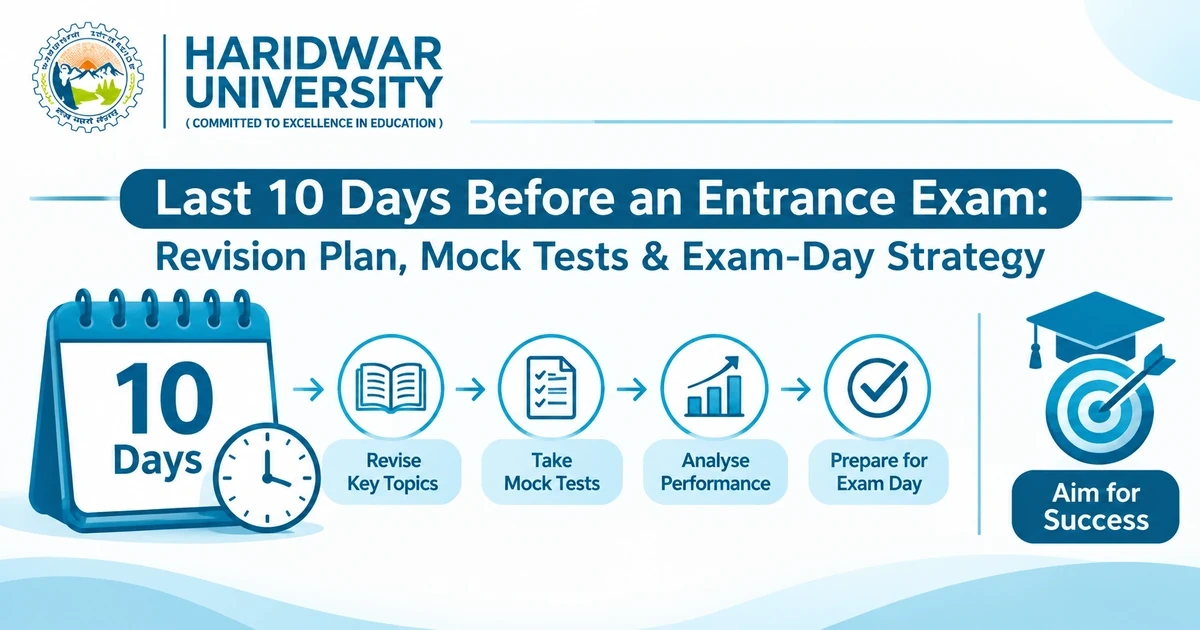
Last 10 Days Before an Entrance Exam: Revision Plan, Mock Tests & Exam-Day Strategy
Mr. Prajwal Chaudhary
Head, Training & Placement, Haridwar University
The last 10 days before an entrance exam can feel considerably more daunting than the preceding months of steady preparation. Students frequently respond to rising pressure by dramatically inflating study hours, taking exhausting back-to-back mock tests, or opening brand-new chapters they have barely touched. Yet this final countdown is precisely when an erratic, unfocused shift in routine can undermine months of disciplined foundation building.
The golden rule for the final stretch is straightforward: use the last 10 days to consolidate what you already know, eliminate recurring test-taking errors, and condition yourself to perform calmly under strict examination constraints. This is not the time to rebuild your syllabus from scratch or gamble on unfamiliar textbooks.
A high-impact revision strategy must adapt to your individual mastery, the exact format of the test, and your daily stamina. The battle-tested framework detailed below offers a structured 10-day roadmap suitable for aspirants preparing for JEE Main, CUET, CMAT, NIFT, and other major national entrance examinations.
Table of Contents
- Why the Last 10 Days Need a Different Preparation Strategy
- Start With a Quick Syllabus and Mock-Test Audit
- The 10-Day Entrance Exam Revision Plan
- How to Prioritise Strong, Weak and Unfinished Topics
- How to Use Mock Tests and Previous-Year Papers Effectively
- What to Avoid in the Final 10 Days
- Adjust Your Strategy to the Type of Entrance Exam
- Prepare for Exam Day: Documents, Centre and Routine
- Frequently Asked Questions (FAQs)
- Make the Final 10 Days Count
1. Why the Last 10 Days Need a Different Preparation Strategy
Your overarching preparation objective shifts fundamentally as the exam draws near. In earlier months, learning was exploratory: absorbing new principles, deriving formulas, completing extensive question banks, and broadening conceptual breadth. In the final 10 days, your focal priority must pivot towards recall speed, procedural accuracy, sensible question selection, and time discipline.
The logic is practical: attempting to grasp complex unfamiliar chapters in the final week swallows immense mental bandwidth without granting enough practice to ensure retention under exam stress. Conversely, reinforcing concepts you already understand and diagnosing why you drop marks on solvable questions yields an immediate, tangible score dividend.
Divide your final countdown across three vital pillars:
- Retention: Maintain effortless mental access to essential formulas, shortcuts, definitions, reactions, and calculation techniques.
- Accuracy: Systematically identify root causes of negative marking (calculation slips, misread questions, rushed assumptions) and eliminate them.
- Readiness: Condition your mind to operate within the exact physical duration and question pattern of the actual test shift.
A candidate sitting for an engineering or medical entrance requires intense concept retention and numerical calculation checks, whereas someone appearing for an aptitude-heavy examination like CMAT or CUET general tests must prioritise question pacing and elimination strategies.
2. Start With a Quick Syllabus and Mock-Test Audit
Before designing your 10-day revision schedule, invest 2 to 3 hours conducting an objective self-audit. Do not evaluate yourself on gut feeling or emotional confidence; rely strictly on factual data from your latest mock attempts and official syllabus checklists.
| Audit Area | What to Verify & Document |
|---|---|
| Completed Topics | Can you solve moderate-level problems accurately without referring to notes, solution keys, or formula sheets? |
| Weak Topics | Are mistakes stemming from conceptual confusion, computational errors, or misinterpretation of questions? |
| Unfinished Topics | Can any remaining short, high-yield topic be realistically mastered in 2–3 hours without panic? |
| Mock Performance Data | Which sections consistently consume excessive time, trigger negative marks, or leave you fatigued? |
| Official Exam Requirements | Have you verified the latest official syllabus, section weightages, negative marking schemes, and admit card notices? |
Always verify syllabus topics directly against official authority portals. For example, JEE Main aspirants must refer to the official JEE Main syllabus, while CUET PG aspirants can check the NTA CUET PG syllabus portal.
Your audit output should be an actionable 1-page action list of specific topics and micro-tasks, not a bloated, unrealistic timetable that takes all day to create.
3. The 10-Day Entrance Exam Revision Plan
The schedule outlined below provides a balanced operational blueprint. Adjust study blocks, subject rotations, and practice sets according to your specific exam format and personal stamina:
| Timeline | Core Objective | Recommended Daily Actions |
|---|---|---|
| Days 10–9 | Audit & Prioritise | Run syllabus audit, analyse the latest full mock, group topics into Secure/Improve/Unfinished, and establish your targeted error list. |
| Days 8–7 | Consolidate Core Topics | Revise high-scoring chapters, concise notes, formula handbooks, chemical reactions, and standard question types to lock in high accuracy. |
| Days 6–5 | Timed Practice & Analysis | Attempt a full-length mock during your exact examination shift hours. Dedicate at least 3 hours post-test to dissect every incorrect and unattempted question. |
| Days 4–3 | Weakness Rectification | Focus intensely on recurring calculation errors, tricky sub-topics, and speed bottlenecks. Practise targeted sectional drills to stabilise question pacing. |
| Day 2 | Final Operational Simulation | Rehearse your examination game plan: section order, time allocation per question, skipping thresholds, and reviewing CBT keyboard shortcuts/instructions. |
| Day 1 | Light Review & Mental Reset | Briefly glance through formula sheets and personal cheat sheets. Organise admit cards, original ID, and stationery. Stop studying by early evening and sleep early. |
| Exam Day | Calm Execution | Follow reporting times strictly, clear biometric frisking smoothly, stick to your time-allocation strategy, and remain composed through difficult question clusters. |
Common Pitfall to Avoid: Treating every single day as a full-length mock day is counterproductive. Sitting for a 3-hour mock without comprehensive diagnostic analysis burns energy without fixing underlying knowledge or strategic defects. A mock test is only beneficial when the insights gleaned from it reshape what you practice next.
4. How to Prioritise Strong, Weak and Unfinished Topics
In the final 10 days, equal topic distribution is inefficient. Categorise your syllabus chapters into three distinct operational tiers:
| Topic Group | Current Status | Action in Final 10 Days |
|---|---|---|
| Tier 1: Secure | You have strong conceptual clarity and routinely achieve 85%+ accuracy in question sets. | Review formulas and summary notes briefly; do not over-practice what you have already mastered. |
| Tier 2: Improve | You understand theoretical foundations but drop marks due to calculation slips, confusion, or slow speed. | Primary focus: Solve 20–30 varied questions per topic and analyze exact failure points to convert them into secure marks. |
| Tier 3: Unfinished | Chapters you never started or find fundamentally bewildering. | Unless a topic is brief, direct, and heavily weighted, leave it aside to protect your confidence and revision schedule. |
Recognising the vital difference between Improve and Unfinished is the hallmark of smart test takers. A chapter you partially grasp can be polished into a reliable score source with 4–5 hours of targeted drilling. In contrast, diving into an unfamiliar, dense multi-layered topic risks wasting half a day in confusion while draining self-belief.
5. How to Use Mock Tests and Previous-Year Papers Effectively
Mock tests serve as psychological simulations, but the numerical score is merely an indicator. The greatest developmental value lies in post-exam diagnostic review. After finishing a test, systematically classify every missed mark into one of five categories:
| Diagnostic Error Type | Targeted Corrective Action |
|---|---|
| Conceptual Deficit | Re-open your primary theory notes, study the missing condition, and solve 3–5 illustrative textbook problems. |
| Calculation Slips | Inspect where arithmetic, units, or signs failed. Write out intermediate steps legibly on rough sheets. |
| Question Misreading | Underline critical qualifiers like "NOT correct", "increasing order", or "in SI units" before attempting options. |
| Time Bottlenecks | Enforce a strict 90-second threshold: if no clear solving path emerges, bookmark the question and proceed immediately. |
| Blind Guessing | Re-evaluate your risk tolerance. With negative marking, random guesses invariably cause rank deflation. |
Previous-Year Questions (PYQs) from the last 3–5 years are indispensable for recognizing examiner phrasing, standard question structures, and depth expectations. However, remember that historical papers do not guarantee repeated questions; use them to refine pattern recognition and test endurance, not as static prediction tools.
6. What to Avoid in the Final 10 Days
High effort without strategic discipline often backfires. Steer clear of these six common last-minute preparation traps:
- Opening Brand-New Reference Books: Stick exclusively to the concise notes, class summaries, and reference books you have studied throughout the year. New authors introduce unfamiliar notations that create needless anxiety.
- Overdosing on Unanalysed Mocks: Attempting multiple full tests daily without dissecting errors only induces burnout and solidifies flawed habits.
- Fixating on Other Students' Scores: Comparing percentile mock results on student forums or social apps distorts focus. Different test series have differing difficulty calibrations; measure progress solely against your own previous tests.
- All-Night Cramming Sessions: Pulling all-nighters right before an exam severely impairs prefrontal cortex cognitive function, memory retrieval, and calculation precision.
- Endless Social Media Speculation: Discussions predicting "probable cut-offs", paper leaks, or paper toughness are unproductive distractions.
- Neglecting Physical & Mental Well-Being: Maintain regular meal timings, hydrate properly, and ensure at least 7 to 8 hours of restful sleep every night.
Multi-Exam Coordination: If you are juggling simultaneous entrance tests alongside university or board exams, consult our detailed guide on how to prepare for multiple competitive exams without burnout for strategies on managing overlapping syllabi.
7. Adjust Your Strategy to the Type of Entrance Exam
Different competitive tests demand distinct psychological and technical calibrations. Tailor your 10-day focus to match the nature of your test:
| Entrance Examination | Key Revision Priorities | Suggested Resources & Guides |
|---|---|---|
| JEE Main (Engineering) | Formula retention, speed-solving single-correct questions, strategic choice in numerical-response sections, and quick elimination in multi-step physics/maths questions. | JEE Main Preparation Guide |
| CUET UG / PG | NCERT textbook line-by-line review for domain subjects, language comprehension drills, and timed practice for General Test logical reasoning and numerical ability. | CUET UG Strategy Guide |
| CMAT / MBA Entrances | Speed drills in quantitative techniques and data interpretation, logical sequencing practice, grammar error spotting, and revision of national business/GK capsules. | National Exam Calendar |
| NIFT / Design Entrances | Creative Ability Test (CAT) perspective sketching drills, product visualization, line drawings, visual proportion balancing, and General Ability Test (GAT) speed reading. | NIFT Aspirants Guide |
8. Prepare for Exam Day: Documents, Centre and Routine
Academic preparation is only half the battle; flawless logistical execution on exam morning is equally essential. Do not leave practical formalities to the morning of your exam. Complete this operational checklist 24 to 48 hours prior:
- Admit Card & Undertaking: Print clear, colour hard copies of your admit card on A4 sheets. Complete any mandatory self-declaration sections and affix your passport-size photo as instructed.
- Original Government Photo ID: Ensure you carry the exact physical ID card (Aadhaar Card, Passport, Voter ID, PAN Card, or Driving Licence) uploaded during registration. Digital scans or paper photocopies are strictly prohibited.
- Additional Photographs: Keep 2–3 passport-size photographs matching your application profile for the examination hall attendance sheet.
- Physical Venue Verification: Re-check the centre's exact postal address, landmark, and reporting time. Avoid relying purely on approximate GPS pins; plan your route allowing for peak-hour transit delays.
- Dress Code Compliance: Wear simple, comfortable clothes without metallic buttons or oversized pockets. Opt for flat slippers or sandals to speed through metal detectors.
- Stationery & Water: Carry only transparent ballpoint pens and a clear, label-free water bottle where permitted by official guidelines.
For complete details on prohibited items, biometric turnstiles, and entry protocols, read our comprehensive NTA Exam Day Checklist.
9. Frequently Asked Questions (FAQs)
1. Are 10 days really enough to prepare for a major entrance exam?
Ten days cannot substitute for months of foundational learning from scratch, but they are more than sufficient to consolidate completed coursework, enhance test-taking speed, streamline problem selection, and eliminate negative marks. For prepared students, a focused final 10 days can boost overall percentiles noticeably.
2. How many hours should I study each day in the last 10 days?
There is no universal magic number. Most successful candidates find that 7 to 9 hours of highly focused study—divided into 2 to 3 structured blocks with adequate rest—proves far more effective than 14 hours of exhausted, distracted reading. Track completed tasks and accuracy rather than mere clock hours.
3. Should I attempt a full mock test every single day before the exam?
No. Attempting a mock every day without time for error analysis creates mental exhaustion. In the last 10 days, 2 or at most 3 well-analysed full-length mocks are optimal. Use intervening days to correct specific conceptual gaps and calculation weaknesses.
4. Should I study brand-new chapters during the final week?
Generally, no. Starting large, difficult chapters creates anxiety and robs time from revising high-yield topics. Only attempt a new topic if it is short, direct, heavily weighted, and easily mastered within 2 to 3 hours.
5. Are previous-year question papers (PYQs) sufficient for last-minute prep?
PYQs are invaluable for understanding question formats, difficulty levels, and phrasing. However, they must be combined with formula revision and mock simulations. PYQs test historical patterns, while entrance exams constantly present novel question variations.
6. What should I revise exactly one day before the entrance exam?
On the final day, keep work exceptionally light. Review formula sheets, reaction charts, or personal cheat sheets. Verify your admit card, ID card, and travel arrangements. Avoid heavy problem-solving or taking new tests, and disconnect from studies by early evening.
7. What if my mock test scores drop drastically right before the exam?
Do not panic or alter your preparation framework. A sudden score dip is frequently due to test difficulty, fatigue, or experimenting with pacing. Diagnose whether the decline was caused by careless calculations or time mismanagement, and refocus calmly on fundamental strengths.
10. Make the Final 10 Days Count
The final 10 days before an entrance examination are not a desperate sprint to cover every single line in a textbook. They are an opportunity to make your existing knowledge reliable, accurate, and readily deployable under pressure. By reinforcing known concepts, diagnosing recurring mistakes, pacing your efforts systematically, and getting enough rest, you give yourself the best possible chance to convert your preparation into a standout performance.
Remember: do not evaluate the final stretch by how much new information you can force into your mind; measure it by how confidently, calmly, and accurately you can execute what you have already mastered.
For aspirants exploring university admissions and high-growth professional careers after their competitive examinations, Haridwar University provides world-class undergraduate and postgraduate programmes in Engineering, Computer Science, AI & ML, Pharmacy, Business Management, and Allied Health Sciences. Explore our complete directory of academic programmes, check out programme eligibility criteria, and review comprehensive scholarships and fees to plan your academic future with certainty.
Ready to Advance Your Education at Haridwar University?
Explore cutting-edge, industry-aligned degree programmes designed for high-impact careers in Engineering, Computing, Pharmacy, and Management. Applications are open for the 2027 academic session.