

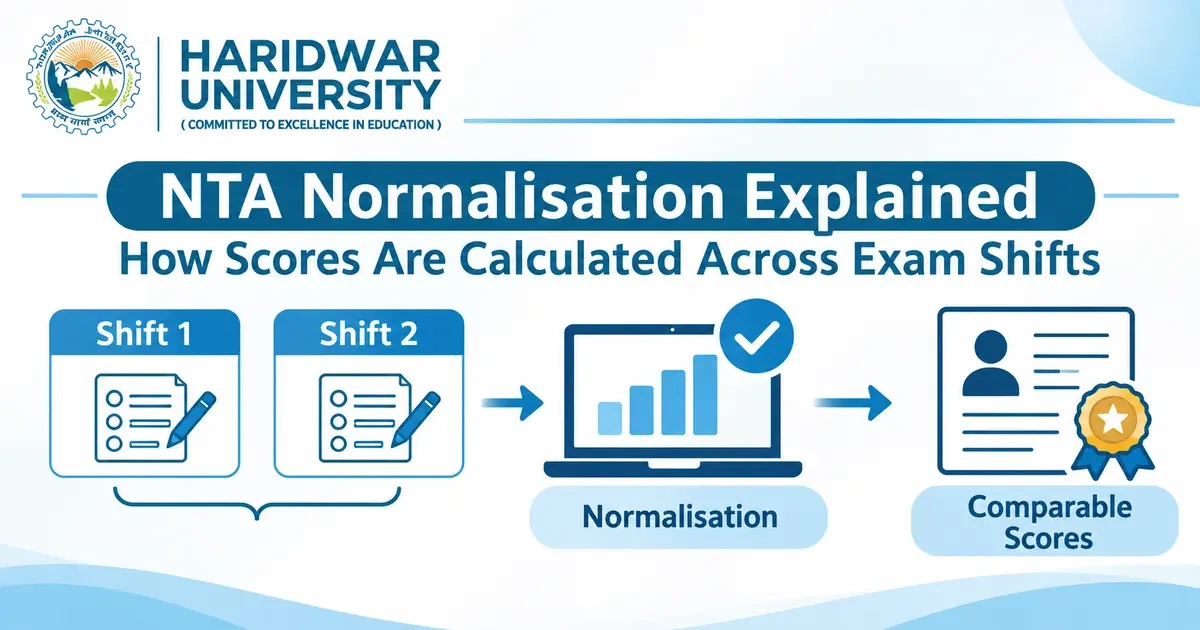
NTA Normalisation Explained: How Scores Are Calculated Across Exam Shifts
Dr. Ekta Jain
Associate Professor & HOD, Applied Science, Haridwar University
A candidate scores 160 marks in one examination shift, while another candidate scores the exact same marks in a different shift. Should both receive identical percentiles? Not necessarily. When a major national entrance examination is administered across multiple dates and shifts, candidates inevitably face different question papers. Even with rigorous paper-setting standards, difficulty levels cannot be mathematically identical across sessions. This is where the NTA normalisation process becomes essential.
Normalisation ensures that candidates are neither advantaged by an easier session nor penalised by an unusually difficult one. However, it is also one of the most widely misunderstood aspects of competitive exams in India. Aspirants routinely confuse raw marks, percentage, percentile scores, and normalised marks, or assume that appearing in a tough shift automatically inflates their final score.
The clearest way to demystify normalisation is to examine the mathematical mechanics behind it. Importantly, the shift-wise percentile method implemented in JEE Main is not identical to the equi-percentile methodology prescribed for CUET UG. Understanding how each method functions in its respective examination context is key to correctly interpreting your scorecard.
Table of Contents
- What Is NTA Normalisation and Why Is It Needed?
- Raw Marks, Percentage, Percentile and Normalised Score Explained
- How NTA Normalisation Works Across Multiple Shifts
- The NTA Normalisation Formula Explained With an Example
- How JEE Main and CUET Normalisation Methods Differ
- Why Your Score May Increase or Decrease After Normalisation
- Why Raw Marks Cannot Be Converted Into an Exact NTA Percentile
- Common Misconceptions About NTA Normalisation
- Frequently Asked Questions (FAQs)
- Understanding Your NTA Score Before Your Next Step
1. What Is NTA Normalisation and Why Is It Needed?
The National Testing Agency (NTA) conducts large-scale entrance examinations—such as JEE Main, CUET, and UGC-NET—serving hundreds of thousands of aspirants across multiple dates, cities, and shifts. Because it is logistically unfeasible to administer a single paper to over a million candidates simultaneously, different cohorts attempt distinct sets of questions.
Although expert examination committees formulate question papers using balanced syllabus blueprints, subtle differences in difficulty inevitably arise. A student writing a demanding paper might achieve fewer raw marks than an equally competent peer writing a simpler paper. Evaluating both candidates purely on their raw marks would be unfair.
The NTA normalisation process resolves this comparability challenge. Rather than comparing absolute raw scores across different sessions, it benchmarks each candidate's performance relative to the cohort that appeared in that specific shift.
Hypothetical Illustration: Suppose Candidate A scores 150 marks in Shift 1 (a tough session where the topper scored 180), while Candidate B scores 150 marks in Shift 2 (an easier session where the topper scored 260). Although their raw marks are identical, Candidate A sits much closer to the top of their shift. Normalisation mathematically reflects this relative merit.
Normalisation is not an arbitrary moderation or subjective bonus. It is a strictly auditable, peer-reviewed statistical procedure defined in the examination's official information bulletin.
2. Raw Marks, Percentage, Percentile and Normalised Score Explained
Much of candidate confusion originates from treating statistical metrics as interchangeable. Below is the precise definition of each metric:
| Metric Term | Exact Regulatory Meaning |
|---|---|
| Raw Marks | The actual numerical marks calculated strictly from the official answer key (+4 for correct, -1 for incorrect in JEE/CUET). |
| Percentage | The proportion of marks obtained out of the absolute maximum possible marks (e.g., 150 out of 300 equals 50.0%). |
| Percentile Score | The relative rank indicating the percentage of candidates in that specific shift who scored equal to or lower than that candidate. |
| Normalised Score | The final composite score calculated using the examination's prescribed statistical model (such as shift percentiles in JEE Main or equi-percentile interpolation in CUET). |
Crucially, an NTA Percentile of 90 does not mean you scored 90% marks. It means that your score was equal to or superior to roughly 90% of all students who took the test in your shift.
3. How NTA Normalisation Works Across Multiple Shifts
While specific algorithms differ by test, the foundational concept remains uniform: compare students by relative standing rather than absolute marks.
For JEE Main, normalisation proceeds as follows:
- Shift-Wise Percentile Computation: NTA calculates each candidate's percentile based on how many students in their shift scored equal to or less than them.
- Subject-Wise Percentiles: Individual percentile scores are calculated separately for Mathematics, Physics, and Chemistry, in addition to the overall total percentile.
- Independent Percentile Aggregation: The total percentile is not an arithmetic average of the three subject percentiles. It is calculated independently from total raw marks.
- Seven Decimal Precision: NTA calculates all percentile scores up to 7 decimal places (e.g., 99.1234567) to eliminate ties, bunching, and arbitrary rank sharing.
For official procedural documentation, refer to the official JEE Main normalisation procedure published by the National Testing Agency.
4. The NTA Normalisation Formula Explained With an Example
For JEE Main and general NTA multi-session papers, the official percentile formula is defined as:
Percentile Score = (100 × Number of candidates in the shift scoring equal to or below the candidate) ÷ (Total candidates who appeared in that shift)
Step-by-Step Numerical Example
Suppose 10,000 candidates appear in Shift 1. A candidate scores 165 raw marks, and exactly 9,000 candidates in that shift score 165 or fewer marks.
- Candidates with equal or lower marks: 9,000
- Total shift candidates: 10,000
- Calculation: (9,000 ÷ 10,000) × 100 = 90.0000000 Percentile
Now consider Shift 2, where 12,000 candidates appeared. Because the paper was comparatively easier, 9,600 candidates managed to score 165 or fewer marks, meaning 2,400 students scored higher than 165. For a student in Shift 2 with the same 165 raw marks, their percentile calculation becomes:
- Calculation: (9,600 ÷ 12,000) × 100 = 80.0000000 Percentile
Thus, identical raw marks (165) produced a 90 percentile in the tougher session and an 80 percentile in the easier session. This example illustrates why rank depends entirely on cohort performance rather than raw marks alone.
5. How JEE Main and CUET Normalisation Methods Differ
A frequent error among candidates is assuming that CUET UG uses the exact same percentile formula as JEE Main. While JEE Main relies purely on shift percentiles, CUET UG employs a distinct equi-percentile method for subjects conducted across multiple shifts.
The Three Stages of CUET UG Equi-Percentile Normalisation
- Shift-Wise Percentile Calculation: Raw scores are first converted into percentiles separately for each session and subject.
- Percentile Matching & Linear Interpolation: Percentile distributions from all shifts are mapped alongside each other. Where exact raw marks are absent for a specific percentile in a shift, NTA applies linear interpolation to calculate equivalent marks.
- Normalised Score Calculation: The corresponding raw marks across all shifts for that percentile tier are averaged together to yield the candidate's final normalised score.
For example, in the official worked example from the CUET UG Information Bulletin (Appendix VI), at the 100 percentile mark across four shifts, raw topper scores were 200, 194, 188, and 200. The mathematical average of these marks equals 195.5, which becomes the final normalised score for all 100-percentile candidates.
6. Why Your Score May Increase or Decrease After Normalisation
Depending on the examination methodology and cohort performance, your normalised score can be higher, lower, or equal to your raw marks. Neither an increase nor a decrease is guaranteed.
- In CUET UG: Candidates who took an unusually difficult paper may see their normalised score adjust upward relative to their raw score, while candidates in an easy shift may see their normalised marks adjust downward toward the cross-shift average.
- In JEE Main: Your result is reported strictly as a percentile score (from 0 to 100), not as revised marks out of 300. Thus, JEE Main scores do not represent a direct addition or subtraction of marks.
Preparation Focus: Rather than worrying about session difficulty or speculation on student forums, channel your energy into revision, mock analysis, and timing. Review our detailed guide on the Last 10 Days Before an Entrance Exam and our focused JEE Main January Attempt Study Plan to maximise your raw score in any shift.
7. Why Raw Marks Cannot Be Converted Into an Exact NTA Percentile
Aspirants frequently search online for static tables claiming: "150 Marks = 98 Percentile" or "70 Marks = 85 Percentile". No universal, permanent marks-to-percentile conversion table exists.
Your percentile is governed strictly by the actual scores achieved by the cohort in your specific room and session. If 150 marks places you in the top 1% of a very demanding shift, you secure a 99.0 percentile. If that same 150 marks places you in the top 8% of an easy session, you secure a 92.0 percentile.
Candidates can review the official NTA JEE Main shift-wise percentile analysis to see how score distributions vary across dates. To keep your daily preparation structured, use our guide on how to make a study timetable for competitive exams.
8. Common Misconceptions About NTA Normalisation
Steer clear of these six persistent exam myths:
Myth 1: A difficult shift automatically guarantees a higher percentile
A difficult shift only yields a higher percentile if your performance relative to your session peers is superior. If your score collapses alongside everyone else's, your percentile remains unchanged.
Myth 2: Percentile and percentage are identical concepts
Percentage measures your absolute marks against total possible marks; percentile measures your relative standing against all test-takers in your session.
Myth 3: Normalisation always adds bonus marks
Normalisation balances scores across cohorts; in equi-percentile models, scores in easier shifts can adjust downward toward the mean.
Myth 4: The same raw marks always yield the same percentile
Because candidate score distributions fluctuate between sessions, identical raw marks frequently yield different percentiles across shifts.
Myth 5: One formula applies to every NTA exam
Each examination specifies its own statistical methodology in its information bulletin (e.g., JEE Main percentile scaling vs CUET equi-percentile averaging).
Myth 6: Online percentile predictor tools are accurate
Online calculators rely on small, self-reported sample sizes. Only NTA possesses the complete census of all candidate scores necessary to run official normalisation.
Before exam morning, ensure you have reviewed all administrative protocols by reading our NTA Exam Day Checklist 2027 covering documents, dress codes, and biometric rules.
9. Frequently Asked Questions (FAQs)
1. Will my marks increase after NTA normalisation?
Not necessarily. In examinations using equi-percentile normalisation (like CUET), marks may adjust upward or downward depending on your shift's difficulty relative to other sessions. In JEE Main, your result is converted directly into a percentile score rather than modified raw marks.
2. How does NTA calculate percentile in JEE Main?
NTA divides the number of candidates in your shift who scored equal to or lower than your score by the total number of candidates who appeared in that shift, and multiplies the result by 100. Scores are calculated up to 7 decimal places.
3. Does a 90 percentile score mean I answered 90% of the questions correctly?
No. A 90 percentile indicates that your total score was equal to or higher than approximately 90% of all candidates who sat for the examination in your particular shift.
4. Can two candidates with identical raw marks receive different percentiles?
Yes. If they tested in different shifts, the number of candidates scoring below them will differ depending on the score distribution of their respective cohorts.
5. Is the normalisation methodology identical for JEE Main and CUET?
No. JEE Main uses shift percentiles directly as normalised scores, whereas CUET UG uses an equi-percentile method involving multi-shift percentile matching, linear interpolation, and average score calculations.
6. Can I calculate my exact normalised score before NTA declares results?
No. Accurate calculation requires the complete score dataset of every single candidate in your shift and across all sessions, which is available exclusively to the NTA.
7. Does appearing in a tougher shift always benefit candidates?
No. While the benchmark for a high percentile is lower in a tough shift, you must still outperform your peers within that session. Subjective difficulty alone does not guarantee a higher percentile.
10. Understanding Your NTA Score Before Your Next Step
An NTA score is an objective statistical measure designed to ensure multi-session fairness across competitive entrance tests. Understanding the distinction between raw marks, percentiles, and normalised scores empowers you to evaluate your performance realistically and avoid last-minute panic caused by online speculation.
For students balancing multiple competitive tests, our guide on how to prepare for multiple competitive exams provides practical scheduling and revision strategies.
As you plan your higher education journey after entrance examinations, Haridwar University provides career-defining undergraduate and postgraduate programmes in Computer Science & Engineering, AI & Machine Learning, Data Science, Pharmacy, Business Administration, and Allied Health Sciences. Explore our comprehensive academic programmes, review our transparent eligibility criteria, and explore our merit-based scholarships and fees to build your future on a solid foundation.
Ready to Advance Your Education at Haridwar University?
Explore cutting-edge, industry-aligned degree programmes designed for high-impact careers in Engineering, Computing, Pharmacy, and Management. Applications are open for the 2027 academic session.