

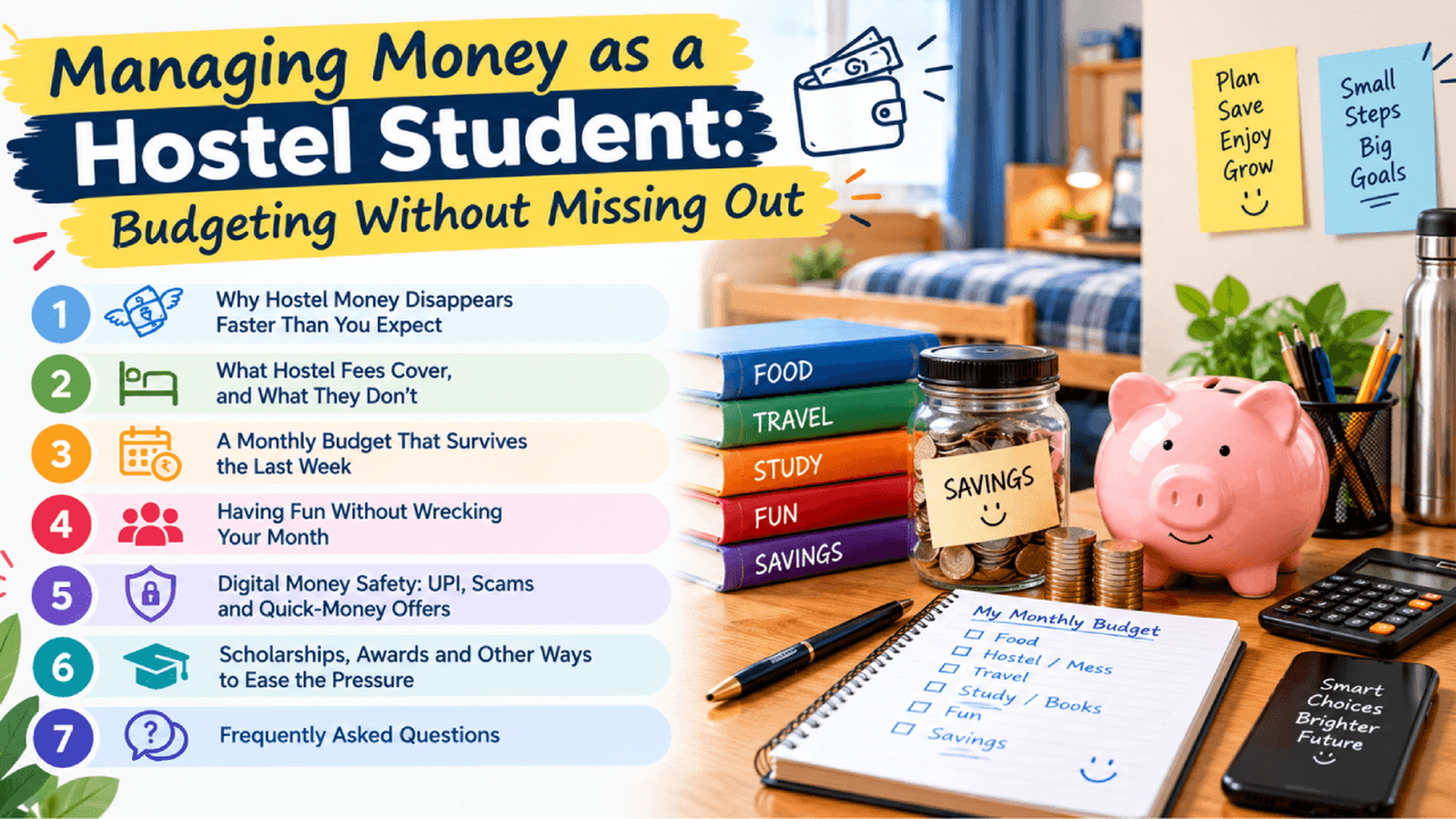
Managing money as a hostel student sounds like an abstract, dull skill until the 18th of the month arrives, when your wallet goes suspiciously quiet and your bank balance prompts a mild panic. Nobody warns you how fast small, unmonitored expenses add up: the spontaneous late-night chai, the group delivery order, the "just this once" auto ride to town, or the impulse online shopping spree. At Haridwar University, the residential hostel fee bundles the major recurring necessities—lodging, meals, and laundry. What is left still requires a conscious financial plan, and that plan is entirely yours to steer.
This guide is about budgeting effectively without becoming the isolated friend who skips every campus outing. You will discover exactly what the university hostel fee covers, how to construct a monthly four-bucket budget that comfortably survives the final week, how to maintain a vibrant social life on a modest allowance, and where predatory digital financial traps hide.
Table of Contents
- • 1. Why Hostel Money Disappears Faster Than You Expect
- • 2. What HU’s Hostel Fee Covers, and What It Doesn’t
- • 3. A Monthly Budget That Survives the Last Week
- • 4. Having Fun Without Wrecking Your Month
- • 5. Digital Money Safety: UPI, Scams and Quick-Money Offers
- • 6. Scholarships, Awards and Other Ways to Ease the Pressure
- • 7. Frequently Asked Questions (FAQs)
1. Why Hostel Money Disappears Faster Than You Expect
For the vast majority of students, moving into a university hostel is their first encounter with total financial autonomy. At home, family members quietly absorb auxiliary expenses: toothpaste refills, laundry detergent, grocery extras, mobile recharges, and medical supplies. In a hostel, every single commodity requires an active micro-transaction, and none of them feels particularly consequential at the moment of payment. By week three, however, the cumulative drain leaves students bewildered as to where their allowance evaporated.
Financial psychologists emphasize that this is rarely a failure of personal willpower; it is fundamentally an issue of financial visibility. Frictionless digital payments via UPI make spending invisible. Before creating rigid budgets, spend your initial two weeks writing down every single transaction, no matter how tiny. The basic financial literacy curriculum established by the Reserve Bank of India (RBI), accessible through the National Centre for Financial Education (NCFE), recommends maintaining a simple "Financial Diary" for this exact diagnostic purpose. A dedicated notes app on your phone works just as effectively.
At Haridwar University’s lush Roorkee campus (learn more about our history on the HU About Us page), the residential system handles accommodation, three wholesome daily meals, and laundry. That foundation removes the biggest unknowns from your ledger, leaving you to manage only discretionary day-to-day outlays.
2. What HU’s Hostel Fee Covers, and What It Doesn’t
Effective financial planning starts with clarity around fixed university costs. According to the official fees and scholarships page, Haridwar University provides three tiered accommodation tiers, with published rates inclusive of room lodging, mess dining, and professional laundry facilities:
Haridwar University Residential Hostel Fee Schedule (2026-27)
All published hostel rates bundle lodging, three daily mess meals, and laundry services. Fee verified October 2026.
| Hostel Room Option | Included Services | Annual Fee (₹) |
|---|---|---|
| Normal Room | Comfortable sharing room, 3-time mess meals, laundry up to 50 garments/month | ₹85,000 / year |
| Semi Deluxe Room | Upgraded furnishings, 3-time mess meals, laundry up to 50 garments/month | ₹95,000 / year |
| Deluxe Room (AC) | Air-conditioned room, 3-time mess meals, laundry up to 50 garments/month | ₹1,05,000 / year |
- Each resident can submit up to 50 garments per month for commercial washing and pressing.
- Non-vegetarian meals are offered as an optional dining upgrade at ₹20,000 per academic year.
- Prepaid electric sub-meters are fitted in each hostel room; personal appliance power is topped up separately.
- Previous monthly electricity/service balances cannot be carried over; do not treat unspent balances as rollover savings.
Notice the financial trade-offs: the ₹20,000 difference between a Normal Room and an AC Deluxe Room equals exactly the cost of the annual non-veg meal plan. Evaluating these choices before move-in ensures your family’s budget matches your daily lifestyle priorities. Furthermore, remember that personal toiletries, mobile data plans, course stationery, and external social outings fall entirely under your personal monthly budget. For advice on healthy eating without overspending, consult our guide on hostel food and student nutrition on a budget.
3. A Monthly Budget That Survives the Last Week
In its official Financial Awareness Messages (FAME) publication, the Reserve Bank of India defines a budget simply: an intentional roadmap comparing expected income and future expenses. A student budget must be straightforward enough to fit on a single index card or phone screenshot.
Structure your monthly allowance into four realistic operational buckets:
Bucket 1: Fixed Obligations (Non-Negotiable)
Prepaid electricity meter top-ups, monthly mobile data recharges, routine local commute fares, and recurring subscription fees.
Bucket 2: Living Essentials (Predictable)
Personal grooming, bath products, basic stationery, notebook replacements, photocopying course notes, and emergency first-aid supplies.
Bucket 3: Discretionary Socializing (Fun & Outings)
Weekend cafe visits, late-night canteen snacks, movies, and celebratory group meals with friends.
Bucket 4: Emergency Cushion (Buffer)
An untouched reserve for unforeseen emergencies: a broken laptop charger, urgent medical prescriptions, or emergency travel.
The Golden Rule: Pay Yourself First, Then Partition Weekly
RBI guidelines emphasize the classic wealth-building equation: Savings = Income - Expenditure. Rather than saving whatever random scraps remain at the end of thirty days, transfer your emergency buffer into a separate savings account the exact moment your allowance arrives.
Next, divide your Discretionary Socializing bucket into four weekly portions. A month is psychologically too distant to manage intuitively; a single week is immediate and manageable. If your weekly fun quota runs out by Thursday evening, your social life merely pauses for two days rather than leaving you destitute for the entire second half of the month. Conduct a five-minute review every Sunday evening to recalibrate.
4. Having Fun Without Wrecking Your Month
College budgeting fails whenever it turns into a dreary life of chronic deprivation. You enrolled at university to gain knowledge, build lifelong relationships, and experience campus life—not merely to sit in a room counting coins. The secret is not eliminating leisure, but giving it a clear allocation and spending it completely guilt-free.
Adopt these practical social spending habits:
- Plan major outings in advance: Pick one or two memorable weekend outings per month rather than saying yes to everyday casual splurges.
- Split shared restaurant bills on the spot: Never say "I’ll settle up later." Delayed micro-debts breed awkward tension and lead to unaccounted financial leakages.
- Leverage world-class on-campus amenities: Before paying for expensive off-campus gyms or entertainment, utilize university facilities. Haridwar University hosts a modern sports complex featuring indoor arenas, a swimming pool, gymnasium, and recreational courts.
- Master the comfortable "Not this weekend, guys": Saying no to an unaffordable outing takes ten seconds of minor awkwardness, which is far better than three weeks of intense financial stress.
If financial strains begin causing sleep disruption or academic anxiety, never suffer in silence. Haridwar University provides dedicated guidance through our student welfare services, where mentors help students navigate personal challenges with empathy. For settling into hostel routines smoothly, read our companion piece on surviving your first month in a hostel.
Curious About Campus Hostels & Living Spaces?
Explore accommodation amenities, dining options, security, and recreational facilities at Haridwar University.
5. Digital Money Safety: UPI, Scams and Quick-Money Offers
Nearly all student financial transactions occur digitally through smartphone apps. Consequently, your phone is both your most convenient financial tool and your most vulnerable threat vector.
The Reserve Bank of India’s digital payment security directives outline mandatory precautions for student users:
- Verify recipient name and amount: Always check the verified merchant or individual name on the UPI payment screen before pressing confirm.
- Remember that receiving money NEVER requires entering your PIN: Scammers frequently send fraudulent UPI "Collect" requests claiming you are receiving a scholarship, refund, or cashback. Entering your UPI PIN always debits money from your account.
- Official bodies never solicit credentials: Neither the RBI, banks, nor university officials will ever ask for your UPI PIN, banking password, or debit card CVV over phone calls, SMS, or emails.
- Three-day zero-liability rule: Under RBI mandates, if an unauthorized transaction occurs through no fault or compromise of your own, reporting it to your bank within three working days ensures zero financial liability. If you voluntarily share your OTP or PIN, you bear the loss until you officially notify the bank.
If you fall victim to financial cyber fraud, act immediately: call the National Cyber Crime Helpline at 1930 and register an immediate incident report on the National Cyber Crime Reporting Portal. Notify your bank manager simultaneously to freeze compromised payment channels.
Be profoundly sceptical of get-rich-quick offers circulating on campus or messaging apps. Work-from-home tasks that demand an upfront registration fee, unverified instant loan apps offering easy student cash, or investment pools promising "guaranteed 30% monthly returns" are fraudulent schemes. The RBI provides the RBI Sachet portal where citizens can verify registered financial entities and lodge complaints against illegal deposit schemes. Formal grievances against regulated banks can also be submitted to the RBI Ombudsman portal.
6. Scholarships, Awards and Other Ways to Ease the Pressure
Managing money effectively also means proactively claiming institutional fee waivers and merit rewards that can ease your family’s financial load. Haridwar University awards substantial tuition scholarships across several criteria:
- Academic Merit Scholarships: Tiered concessions of 10%, 20%, 50%, and up to 80% on first-year tuition based on qualifying Class 12 marks, JEE Main scores, or CUET percentiles.
- Girls’ Education Concession: A dedicated 25% tuition fee waiver for female candidates in their first year.
- Sports & Extracurricular Quota: Concessions ranging from 10% to 50% awarded based on state, national, and international athletic representation.
Keep in mind the critical policy rule: each student can claim exactly one institutional scholarship. Additionally, scholarships apply strictly to tuition fees rather than hostel accommodation, so your living expense calculations remain unchanged.
Another rewarding incentive is the Award of Academic Excellence: Haridwar University pays a cash prize of ₹5,000 to any student achieving 85% or higher in any semester, provided all examinations in that session were cleared on the first attempt.
Students should also explore national and state funding through the National Scholarship Portal (NSP). Under central guidelines, eligible students can receive one merit-based scholarship alongside targeted welfare or post-matric grants. If you are preparing for college admission, consult the comprehensive HU admission overview to understand documentation criteria, fee schedules, and available funding.
Managing money as a hostel student is not an exercise in deprivation. It is about understanding your fixed parameters, creating a realistic weekly spending ceiling, shielding your digital bank accounts, and leveraging institutional merit awards. Put these habits in place early, and the middle of the month will never cause you stress again.
7. Frequently Asked Questions (FAQs)
How much should a hostel student budget each month?
There is no single number that fits everyone. Start with fixed costs like electricity, transport, toiletries and your phone recharge, then divide what is left across the weeks. Managing money as a hostel student works best when you track two weeks of real spending first to establish your baseline.
What does the HU hostel fee include?
HU's fees page specifies that the hostel fee bundles lodging, three daily mess meals, and laundry services (up to 50 clothes per month). Non-veg meals are an optional extra at ₹20,000 per year.
How much is the hostel fee at Haridwar University?
The official fee structure lists ₹85,000 for a Normal Room, ₹95,000 for a Semi Deluxe Room, and ₹1,05,000 for a Deluxe Room (AC) per year, covering accommodation, mess, and laundry.
Is electricity covered by the hostel fee?
Prepaid electricity meters are installed in every hostel room at HU, so room power is topped up separately by students based on individual appliance usage. Plan to budget for monthly electricity top-ups.
Can I carry unused hostel money into the next month?
HU's hostel notes state that the previous month's balance cannot be carried forward to the next month on certain institutional amenities. Always verify specific account carry-over terms with the hostel warden office.
Do scholarships reduce the hostel fee?
No. The scholarships listed on HU's fees page apply exclusively to academic tuition fees, and most cover the first year. Hostel charges are billed separately, and each student is eligible to claim one institutional scholarship.
What is the Academic Excellence Award at HU?
Students who secure 85% or more in any semester receive an Academic Excellence Award of ₹5,000, provided they have cleared all subjects of that semester on their first attempt.
How do I stay safe from UPI and online money fraud?
Double-check the recipient name and amount before confirming, never share your UPI PIN or bank OTP with anyone, and be wary of unexpected collect requests. If defrauded, report immediately to the 1930 helpline and notify your bank within three working days.
Are instant loan apps or guaranteed return schemes safe for students?
RBI advises borrowing strictly from regulated financial institutions and avoiding loan apps promoted through unsolicited SMS or social media ads. Unregulated schemes and fraudulent investment offers can be reported on RBI's Sachet portal.
Experience Enriching, Well-Supported Campus Life at Haridwar University
Haridwar University offers secure residential hostels, merit scholarships, state-of-the-art sports facilities, dedicated student welfare support, and accredited professional degree programmes.