

MBA vs MCA at Haridwar University: Which Post-Graduation Path Should You Choose (2026)
Lt. Sumit Chauhan
Registrar, Haridwar University
Table of Contents
Business Degree or Tech Degree — Which Suits You?
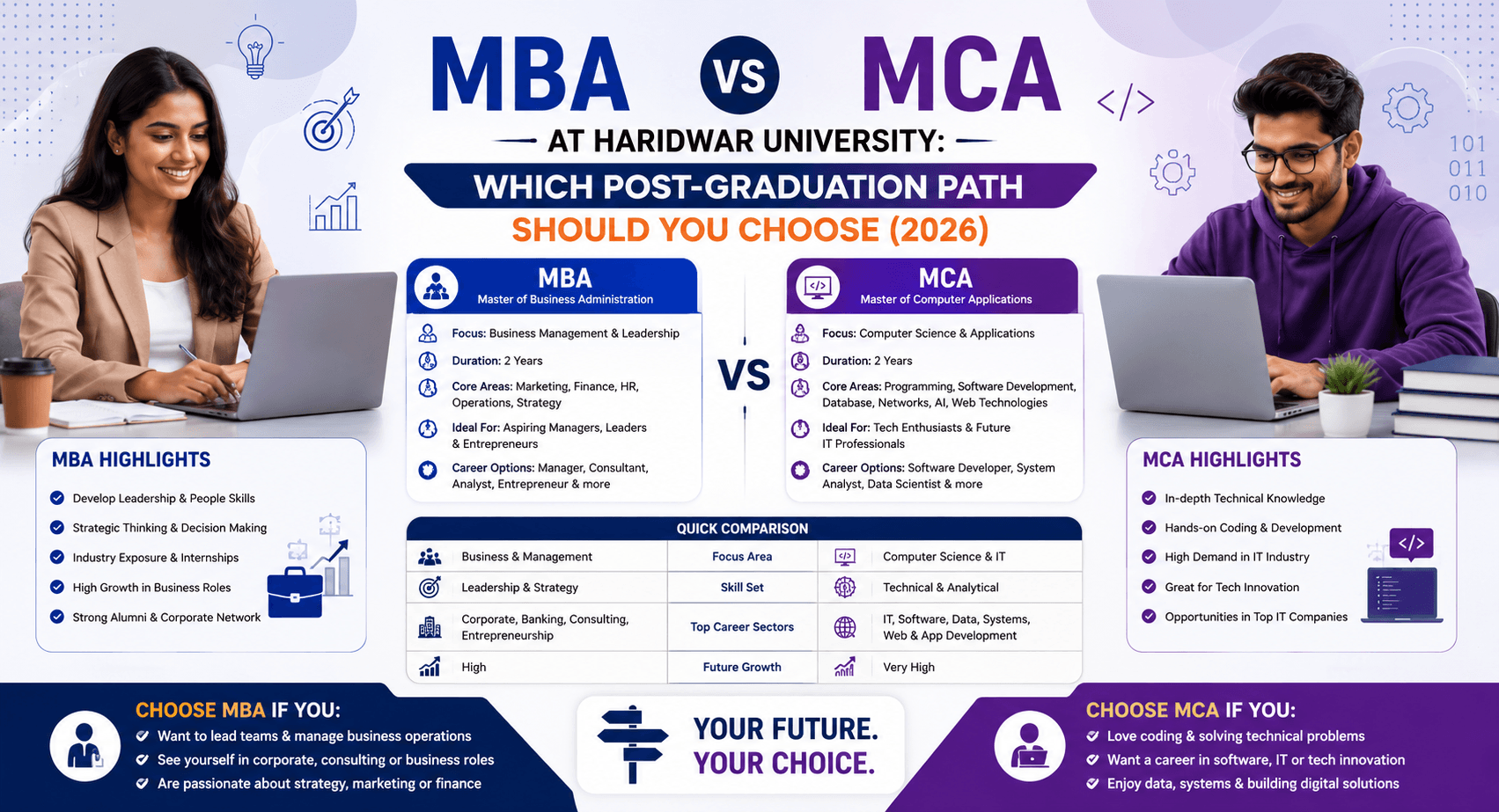
Every admission season I hear the same question from parents and students sitting across my desk: MBA or MCA at Haridwar University? Strip away the brochures and the placement-day photographs, and it comes down to one thing — do you want to manage people, or do you want to manage systems?
An MBA sharpens leadership, negotiation, and business judgement, the skills that eventually move you into consulting, operations, or growth roles. An MCA takes the opposite route: programming depth, systems thinking, and the kind of data fluency that opens doors in software and cloud careers.
Both programmes run out of our Roorkee campus, both come with the same placement support and industry-linked faculty, and I won't pretend one is objectively "better" than the other. The right pick depends on your academic background, whether you'd rather work with numbers and people or with code and infrastructure, and — put plainly — what kind of Monday morning you want to be having ten years from now.
Most students treat this as a purely academic choice. It isn't. It's a career-positioning decision. A management graduate ends up working across departments, clients, and stakeholders. A technology graduate works closer to the product itself — the infrastructure, the data, the systems underneath it all. Get the call wrong early, and you can spend two years building a skillset that doesn't line up with the work you actually want.
It's also not a one-way door. I've seen MCA graduates go on to do an executive MBA to move into product management, and MBA graduates with a technical undergraduate degree pivot into IT strategy later on. What matters right now is picking the programme that builds on where you already stand, so your first two years out of college add momentum rather than fight your natural strengths.
Curriculum Comparison
What you study in semester one quietly decides which jobs you can even apply for by semester four — and that's really where this comparison starts to take shape.
The MBA runs across four semesters and covers the standard management core — financial accounting, marketing management, organisational behaviour, business analytics, and HR — with electives in Global Business, Retail Management, and Pharma Management for students who want to specialise further. Case studies, live projects, and a mandatory internship run through every semester, so classroom theory keeps getting tested against real business situations instead of staying on paper.
MCA is built differently altogether: computer science fundamentals and applied software engineering — data structures and algorithms, database management, cloud computing, full-stack development, and, increasingly, AI and machine-learning modules. Where the MBA classroom runs on discussion and case debate, the MCA classroom runs on labs, code reviews, and a capstone project students actually have to ship by the end of the course.
Both curricula sit within the broader framework set by the University Grants Commission (UGC), and the technical electives inside the MCA programme follow guidelines published by the All India Council for Technical Education (AICTE).
Faculty on both sides mix full-time academics with visiting industry practitioners, so classroom content doesn't drift far from what recruiters are actually hiring for. MBA students layer business simulations and guest lectures on top of their internship; MCA students build a running portfolio of coding projects and finish with a semester-long capstone tied to a real organisational problem. The intent is deliberate — get students closer to the workplace before they've even graduated.
Career Roles Opened by Each
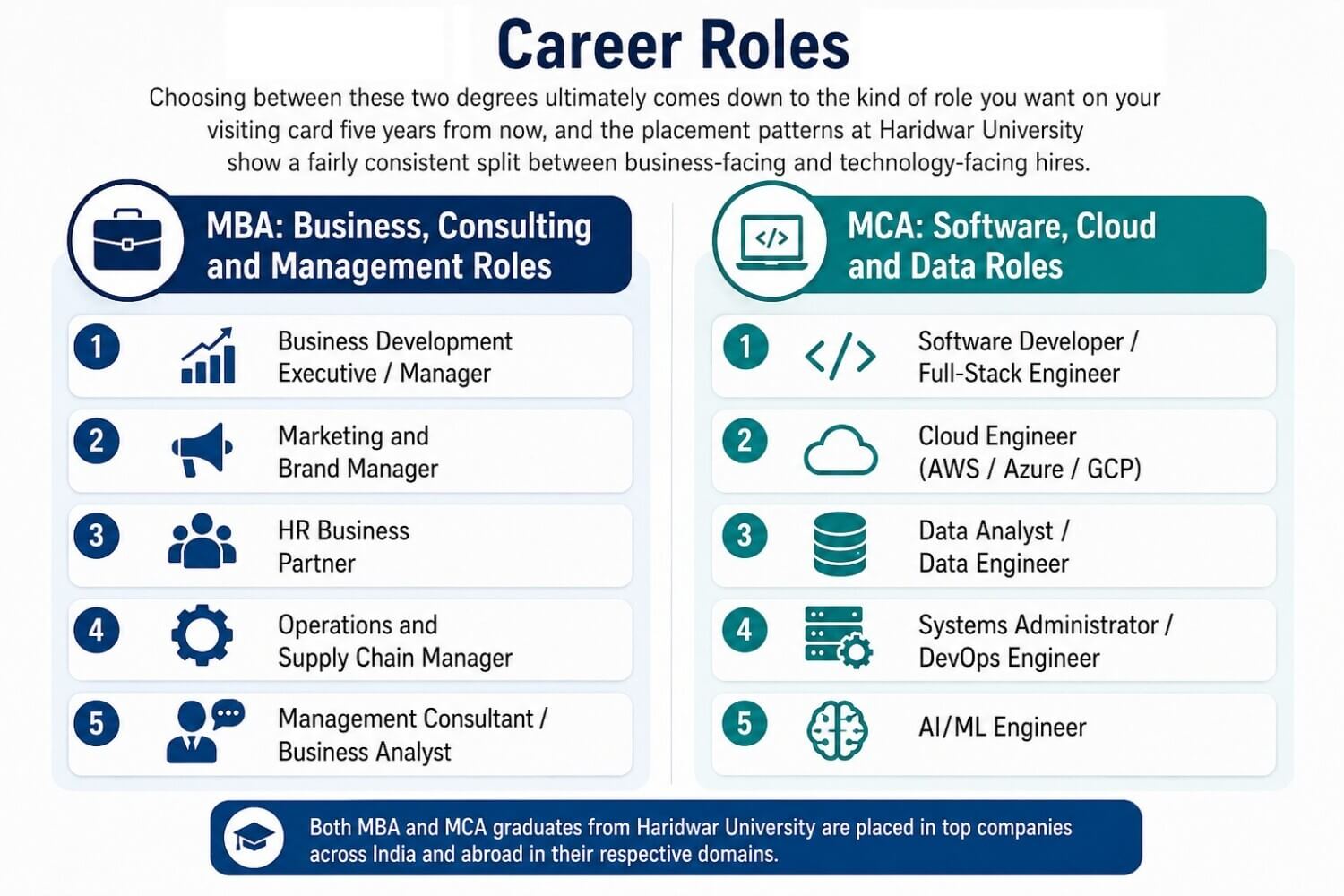
Choosing between these two degrees ultimately comes down to what you want printed on your visiting card five years from now, and placement patterns at Haridwar University show a fairly consistent split between business-facing and technology-facing hires.
Career paths after MBA and MCA at Haridwar University
MBA: Business, Consulting and Management Roles
- Business Development Executive / Manager: Finding new clients, building partnerships, and pushing revenue growth. This role suits MBA graduates who genuinely enjoy pitching and closing deals rather than just tolerating it. Entry-level BD executives in India typically start around ₹3–6 LPA, Business Development Managers average roughly ₹6–9 LPA, and senior professionals at larger firms cross ₹15–20 LPA (Glassdoor; AmbitionBox, 2026).
- Marketing and Brand Manager: Owns a product's positioning, campaigns, and customer engagement, working closely with sales and design teams. Marketing Managers in India average around ₹12.2 LPA (AmbitionBox, 2026), Senior Marketing Managers (5+ years) command ₹20–35 LPA, and Head of Marketing / CMO-level roles at large FMCG firms go well past ₹50 LPA.
- HR Business Partner: Aligns hiring, performance management, and workforce planning with the business's larger goals — the bridge between leadership and the people doing the work. HR Business Partners in India earn an average of roughly ₹10.6–11.7 LPA, with a typical range of ₹7–18 LPA depending on company size, city, and tenure (Glassdoor; Payscale).
- Operations and Supply Chain Manager: Runs the day-to-day machinery of a business — logistics, vendor coordination, process efficiency — across manufacturing, retail, or services. Payscale data puts the average salary for this role in India at around ₹12.4 LPA, with a spread of roughly ₹6–20 LPA depending on industry and seniority.
- Management Consultant / Business Analyst: Digs into business problems, gathers requirements, and recommends data-backed fixes. Business Analysts in India earn between roughly ₹3–17 LPA with an average close to ₹9.8 LPA (AmbitionBox, 2026), while consulting-track roles at bigger firms often start higher, in the ₹8–14 LPA band for mid-level professionals.
MCA: Software, Cloud and Data Roles
- Software Developer / Full-Stack Engineer: Designs, builds, and maintains applications across the front end and back end. Freshers joining IT services firms such as TCS, Infosys, or Wipro typically start around ₹3.5–7 LPA; developers at product-based companies with a strong portfolio can reach ₹8–18 LPA; senior engineers at top product firms cross ₹20 LPA plus equity (Recrew.ai 2026 Software Engineer Salary Guide).
- Cloud Engineer (AWS / Azure / GCP): Designs, deploys, and manages infrastructure on AWS, Azure, or Google Cloud — demand keeps climbing as more businesses shift to the cloud. Average cloud computing salaries in India range from roughly ₹7.6–8.4 LPA for freshers to mid-level professionals (AmbitionBox), with entry-level roles starting near ₹3.5–6 LPA and cloud-architecture or cloud-security specialists earning well over ₹10–12 LPA.
- Data Analyst / Data Engineer: Cleans, structures, and interprets data so organisations can make decisions from it — building the pipelines and dashboards behind the scenes. Salaries in India range from about ₹3.1–19.9 LPA with an average close to ₹9.8 LPA (AmbitionBox); analytics-heavy employers such as Accenture, IBM, and Deloitte tend to pay toward the higher end.
- Systems Administrator / DevOps Engineer: Keeps servers, networks, and automated deployment pipelines (CI/CD) running without breaking. DevOps Engineers in India earn roughly ₹6–21 LPA depending on experience, with average pay in the ₹12–17 LPA band for engineers with 5+ years' experience and hands-on CI/CD skills such as Jenkins, Docker, and GitLab (AmbitionBox; Edureka, 2026).
- AI/ML Engineer: Builds and deploys machine-learning models and AI-driven products — a fast-growing specialisation for MCA graduates who pick up AI and data-science electives. 2026 industry guides report AI Engineer salaries in India ranging from around ₹6 LPA for freshers to ₹30 LPA or more for experienced engineers at product companies and global capability centres, with mid-level professionals (3–6 years) typically earning ₹15–22 LPA (Taggd.in 2026 AI Engineer Salary Report).
A quick caveat on all of the above: these are indicative industry averages pulled from salary-tracking platforms — AmbitionBox, Glassdoor, Payscale, and Recrew.ai — describing the broader Indian job market, not a guaranteed outcome at any specific university. What you actually earn depends on the recruiter, the city, your specialisation, and how you perform in the interview room.
Salary Trajectories
This is probably the most-searched part of the MBA vs MCA at Haridwar University comparison, and for good reason — placement numbers published on the university's official placements page are a far more reliable reference point than whatever a random aggregator site claims.
Haridwar University reports up to 95% placement assistance across its postgraduate programmes (placements overview). For the 2025 graduating batch, the highest domestic package touched ₹60 LPA, with an average package of around ₹6.5 LPA — confirm the exact figures for the current intake with the placement cell, since these numbers are updated every cycle. MBA graduates typically start in management-trainee or business-analyst roles, with pay that climbs quickly once they move into people-management positions. MCA graduates often start a notch higher on the technical ladder in software or cloud roles, with steady jumps as they specialise in areas like cloud architecture or data engineering.
Recruiters visiting the campus have included TCS, Airtel, ITC, Tech Mahindra, IBM, IDBI, Kotak, and NPCI — a healthy mix of technology, BFSI, and FMCG hiring that benefits both streams.
Looking out five to seven years, the pattern holds: MBA graduates who move into people-leadership see compensation accelerate once they take on team or P&L ownership, while MCA graduates who specialise early in cloud, data, or AI/ML see similarly strong jumps as their technical seniority builds. Neither path has a hard ceiling — both simply reward depth and consistency in whichever direction you commit to early.
Eligibility
Admission requirements are where the MBA-versus-MCA question resolves itself fairly quickly — both programmes are genuinely open to a wide base of graduates, not a narrow academic pipeline.
Both Accept BCA / B.Sc-IT / B.Tech Backgrounds
Saying "both accept BCA, B.Sc-IT, and B.Tech" hides a fair amount of nuance that matters once you're actually filling out the application form.
BCA (Bachelor of Computer Applications) graduates are, arguably, the best-prepared candidates for either path. Three years of programming fundamentals, database basics, and web development give them a head start in the MCA classroom, where subjects like data structures, DBMS, and full-stack development pick up almost exactly where a BCA syllabus leaves off — which is why bridge modules are rarely needed for this group (MCA programme page). A BCA background works just as well for the MBA: business schools don't expect incoming students to already know finance or marketing, so a BCA graduate with decent aggregate marks and a good HUAET or CAT/MAT/XAT/CMAT/CUET-PG score is just as eligible for the MBA as a BBA or B.Com graduate.
B.Sc (IT) or B.Sc (Computer Science) graduates sit in a similar position for the MCA — their coursework typically covers programming languages, basic networking, and database concepts, mapping closely onto the first-year MCA syllabus. Where B.Sc-IT graduates sometimes need a short bridge course is in advanced data structures or object-oriented design, if their undergraduate programme was lighter on hands-on coding; Haridwar University offers these bridge modules specifically to close that gap in the first semester. For the MBA, a B.Sc-IT background is treated the same as any other science stream — eligible on minimum aggregate marks, no additional coursework required.
B.Tech graduates from any branch are eligible for both programmes without conditions, though Computer Science, IT, and Electronics streams transition most smoothly. For MCA, a B.Tech (CSE/IT) graduate typically needs no bridge courses at all, since core subjects like algorithms, operating systems, and databases already overlap heavily with the MCA syllabus. B.Tech graduates from non-computing branches (Mechanical, Civil, Electrical, and so on) can still apply for MCA, though they should expect a slightly steeper first semester and may be advised to take optional refresher sessions in programming logic. For the MBA, a B.Tech degree of any branch is fully eligible, and technical graduates often do well in the analytics and operations electives given their quantitative background.
Across all three backgrounds, the admission mechanics stay the same: a minimum aggregate of 45–50% at the qualifying degree, followed by either a personal interview or a merit-based shortlisting process. Selection happens through the university's own entrance test (HUAET) or through recognised national-level scores — CAT, MAT, XAT, CMAT, or CUET-PG — so candidates from any of these streams have more than one route into either programme.
Before you apply, it's also worth checking Haridwar University's standing on the National Institutional Ranking Framework (NIRF) alongside these eligibility details, to see where the university sits against other private institutions offering the same two programmes.
Fees at HU
Fee structure is one more piece worth getting right before you apply. It gets revised every admission cycle, so the current, authoritative numbers always live on the official fee structure page and the admissions portal — treat anything you read elsewhere as a rough estimate at best.
Both the MBA and MCA run as two-year postgraduate programmes at Haridwar University, and both qualify for merit-based scholarships of up to 50% for high-achieving students (fees & scholarships). Hostel, transport, and examination fees sit outside tuition and are charged separately, with instalment-based payment options available on both sides. Confirm the latest fee slabs directly with the admissions office before you budget anything — scholarship eligibility and instalment schedules are revised annually.
Fee and scholarship norms for private universities more broadly also sit within policy set by the Ministry of Education, Government of India (Education.gov.in), worth a skim for general context on how higher-education funding works in India.
Decision Framework
Still undecided? Running the choice through three practical filters usually helps more than trying to weigh the whole thing at once.
- Personality: Enjoy persuading people, leading teams, working through ambiguity? The MBA classroom will feel natural. Prefer solving well-defined logical problems and building things end-to-end? MCA is the better fit.
- Prior Background: A commerce or humanities graduate with people-facing internship experience usually leans toward the MBA. A BCA, B.Sc (CS/IT), or B.Tech graduate already comfortable with code usually leans toward the MCA.
- Career Goals: If your five-year target involves managing a team, a brand, or a P&L, go MBA. If it involves architecting systems, building products, or working with data at scale, go MCA.
Run all three filters together — don't pick the one that flatters you most in isolation. A technically inclined candidate who genuinely prefers people-facing work might still be better served by the MBA. A commerce graduate with real curiosity about coding might thrive in MCA with the right bridge preparation. The goal is honest self-assessment, not a forced fit.
Real HU Alumni Examples From Both Paths
Nothing settles this comparison quite like seeing where real graduates ended up. Alumni outcomes published on the university's about us page and placement records reflect exactly this split in career direction.
MBA alumni from Haridwar University have gone on to join banking, retail, and FMCG recruiters as management trainees, moving into brand and operations roles within a few years of graduating — placement drives regularly bring in recruiters such as Kotak, IDBI, and ITC for these business-facing positions. MCA alumni, on the other hand, have been placed into software development and technical support roles with recruiters such as TCS, Tech Mahindra, and IBM, with several moving into cloud and data-focused roles within their first couple of years on the job. Both cohorts credit the same placement cell and the same industry-linked curriculum, even though their day-to-day work looks completely different.
HUAET
No guide to this decision is complete without covering the entrance exam itself. The Haridwar University Admission Entrance Test (HUAET) is the university's own gateway exam for candidates who haven't already appeared for CAT, MAT, XAT, CMAT, or CUET-PG — full details sit on the official HUAET information page.
It's typically a one-hour test with around 50 questions covering quantitative aptitude, reasoning, and general awareness, and it applies to both the MBA and MCA admission tracks. If you already hold a valid CAT, MAT, XAT, CMAT, or CUET-PG score, you can use that directly for shortlisting instead of sitting for HUAET, so applicants have flexibility no matter which postgraduate path they're leaning toward.
As a recognised private university, Haridwar University is also listed on the Rajbhawan Uttarakhand list of private universities (GovernorUK.gov.in), which candidates can check to verify the university's official status before applying.
Make Your Decision
Whichever way you're leaning on the MBA vs MCA at Haridwar University question, the smartest next move is to look at the current syllabus, faculty, and fee details directly on the official programme pages before you lock in your application for the 2026 intake.
Frequently Asked Questions
1. Which is better, MBA or MCA, at Haridwar University?
Neither is universally better — it depends on your background and where you want to end up. Commerce and business-minded graduates tend to get more out of the MBA; candidates with a programming background usually see more value in the MCA.
2. Can a B.Tech graduate apply for both MBA and MCA?
Yes. B.Tech graduates from any branch are eligible for both programmes, since their quantitative and analytical training suits either management studies or advanced computing.
3. What is the average placement package for MBA and MCA at HU?
For the 2025 graduating batch, the average package across postgraduate programmes at Haridwar University sat around ₹6.5 LPA, with the highest domestic offers touching ₹60 LPA depending on recruiter and specialisation. Check the placements page for the latest cycle's figures.
4. Do both MBA and MCA require the HUAET exam?
Only if you haven't already appeared for an accepted national-level exam such as CAT, MAT, XAT, CMAT, or CUET-PG. Both the MBA and MCA tracks accept HUAET as a qualifying test.
5. Is MCA only for candidates with a computer science background?
Not at all. BCA, B.Sc (IT/CS), and B.Tech graduates make up the bulk of MCA applicants, but candidates from related science backgrounds can apply too, with bridge modules available to help them catch up on core programming concepts.
6. Which recruiters visit Haridwar University for MBA and MCA placements?
Recruiters across both streams have included TCS, Airtel, ITC, Tech Mahindra, IBM, IDBI, Kotak, and NPCI — a mix of technology, banking, and FMCG hiring for both business and technical graduates.
7. Are scholarships available for both MBA and MCA at HU?
Yes — merit-based scholarships of up to 50% are available for eligible students in both programmes, subject to the criteria published on the university's official fee and scholarship pages.
8. How long are the MBA and MCA programmes at Haridwar University?
Both run as two-year, full-time postgraduate programmes across four semesters, combining classroom learning with internships, live projects, and placement preparation.
9. Can I switch careers from a technical role to management after an MBA, or vice versa?
Yes, and it happens more often than you'd think. Many MCA graduates later do an MBA to move into technology-management or product-management roles, while some MBA graduates with a technical first degree move into IT-business analyst positions. Both transitions are common and well-supported by the skills built during either postgraduate programme.