

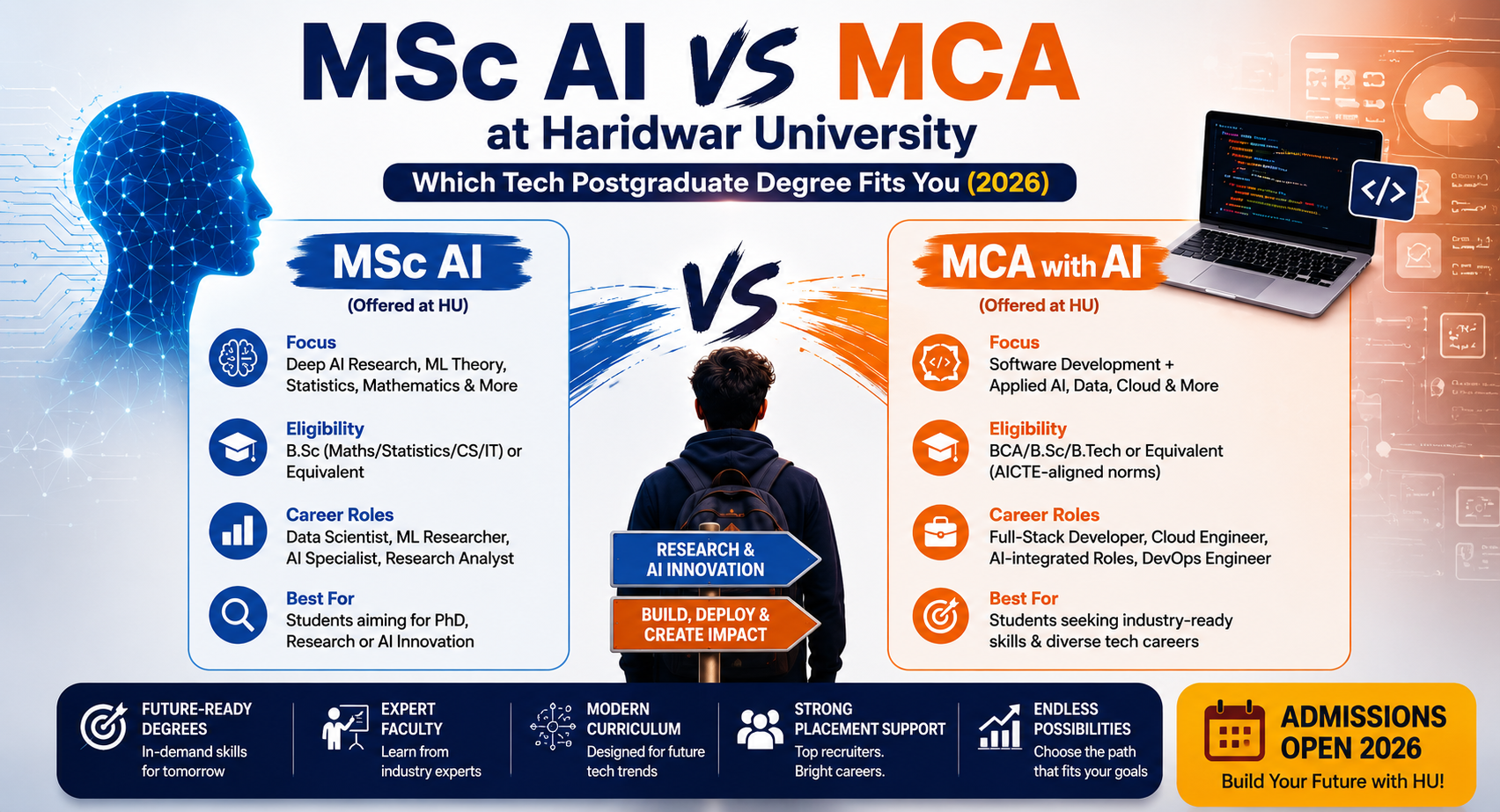
MSc AI vs MCA at Haridwar University: Which Tech Postgraduate Degree Fits You (2026)
Dr. Rohit Kumar
HOD, Computer Applications, Haridwar University
Table of Contents
- 1. The Quick Answer: What HU Actually Offers
- 2. MSc AI vs MCA in India: The Bigger Picture
- 3. Comparison: Curriculum, Eligibility, Careers & More
- 4. 2026 Salary Data
- 5. PhD & Research Suitability
- 6. Industry Demand in 2026
- 7. Fees & Duration at HU (2026-27)
- 8. Decision Framework by Background and Goal
- 9. Frequently Asked Questions
- 10. Final Word and Next Steps
1. The Quick Answer: What HU Actually Offers
Searching MSc AI vs MCA Haridwar University before the 2026 cycle? Here's the straight answer first: HU doesn't run a standalone MSc in Artificial Intelligence program — it never has. What you'll actually find, tucked under the Roorkee College of Smart Computing and Roorkee College of Engineering, is a cluster of AI-integrated postgraduate options: MCA with AI, M.Tech in Computer Science (M.Tech CS), M.Tech CSE, plus specialised M.Tech tracks in ECE, Civil, Mechanical and Electrical Engineering.
Every one of them folds AI in somewhere. So skip the search for two separately named degrees — the real 2026 choice at HU comes down to MCA with AI versus M.Tech CS/CSE. This guide walks through both and shows how they stack up against the wider national MSc AI vs MCA picture, so you're deciding with your eyes open rather than chasing a degree title HU simply doesn't offer.
2. MSc AI vs MCA in India: The Bigger Picture
Before we zoom in on HU, it's worth stepping back. What do these two degree types actually mean across Indian universities generally? A lot of applicants search for MSc AI vs MCA Haridwar University simply assuming both sit side by side everywhere — they usually don't.
An MSc in Artificial Intelligence, where a university does offer one, tends to be a research-leaning science degree at heart. Expect it to dig into mathematical foundations — probability, optimisation, deep learning theory, statistical learning — and to be aimed squarely at students chasing research roles, PhD progression, or specialist AI/ML positions. It usually wants a stronger mathematics or core-science background walking in the door.
An MCA (Master of Computer Applications) sits at the other end. It's applications-focused, regulated under AICTE/UGC norms, and built to hand you broad, employable software skills — programming, databases, software engineering, systems design, and, increasingly, applied AI and data tools layered on top. Nationally, per common AICTE-aligned norms, eligibility usually means a recognised bachelor's degree (BCA, B.Sc, B.Tech or equivalent) with Mathematics at 10+2 or graduation level, plus a minimum aggregate score — though exact cut-offs shift from one institution to the next.
Bottom Line: MSc AI stays narrower and more research-oriented; MCA runs broader and more industry-ready, especially once a college like HU layers structured AI modules on top. That's exactly the gap HU's MCA with AI program was built to close — for students who want applied AI skills without signing up for a purely research-track science degree.
3. Comparison: Curriculum, Eligibility, Careers & More
Since MSc AI vs MCA is the comparison most students actually type into Google, here's a table lining up the general MSc AI degree type (as it's commonly structured across Indian institutions) against HU's actual MCA with AI program — so you can see exactly where the trade-offs sit.
General MSc AI vs MCA with AI at HU
| Factor | MSc AI (typical, general degree) | MCA with AI at HU |
|---|---|---|
| Availability at HU | Not currently offered at HU | Offered at Roorkee College of Smart Computing |
| Curriculum focus | Research/AI-depth: ML theory, deep learning, statistics | Broad software engineering + applied AI modules |
| Typical eligibility | Bachelor's with strong Maths/Science background | Bachelor's (BCA/B.Sc/B.Tech) per AICTE-aligned norms |
| Career roles opened | Data Scientist, ML research roles | Full-Stack, Cloud, AI-integrated software roles |
| PhD/research suitability | Strong fit for PhD progression in AI/ML | Possible with added research exposure |
| Industry demand (2026) | High but narrower, specialised hiring | Broad-based demand across IT services & product firms |
MCA with AI vs M.Tech CS/CSE at HU
| Factor | MCA with AI | M.Tech CS / CSE |
|---|---|---|
| Best suited for | Non-B.Tech graduates (BCA, B.Sc) entering tech | B.Tech/B.E. graduates deepening core CS expertise |
| Curriculum emphasis | Application development, AI tools, software engg | Advanced algorithms, systems, specialised CS research |
| Career direction | Full-stack, cloud, software/AI application roles | Core software engineering, systems, research-adjacent |
4. 2026 Salary Data
Salary figures swing a fair bit by city, company type and specialisation, so treat what follows as an indicative benchmark, not a promise. Glassdoor's India salary data puts the average AI/ML Engineer salary in India at roughly ₹9 lakh per annum — entry-level pay starts lower, and senior Generative AI/LLM specialists pull in considerably more. For comparison, Glassdoor's Full-Stack Developer salary data for India puts the average closer to ₹7.3 lakh per annum, with a typical band somewhere between ₹4.8 lakh and ₹12 lakh depending on experience and location.
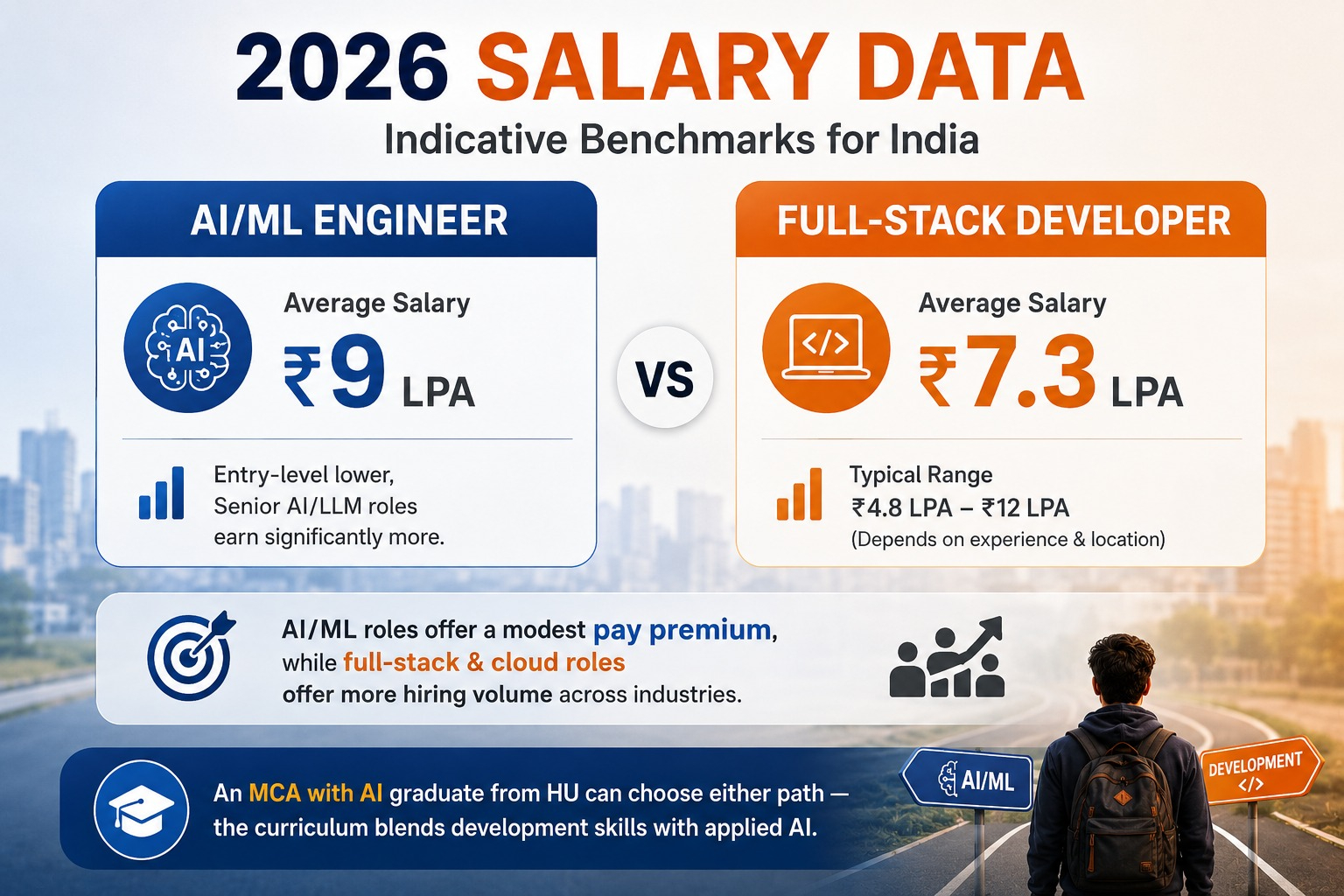
Average India Salary Comparison, 2026 (Glassdoor data)
So what does that actually mean for you? AI/ML-specialist roles currently carry a modest pay premium over generalist full-stack work, but full-stack and cloud roles open up far more hiring volume across IT services, product companies and startups. An MCA with AI graduate from HU isn't locked into either lane — the curriculum blends application development with applied AI exposure, so you can head toward whichever track makes sense once you see how the job market shapes up.
5. PhD & Research Suitability
Chasing a PhD in AI or Machine Learning down the line? A research-heavy MSc AI, wherever it's offered, usually gives you a more direct runway, thanks to its heavier mathematical and theoretical grounding. That said, M.Tech CS/CSE programs — including the ones at HU's Roorkee College of Smart Computing — also build toward research eligibility, particularly if you take on a serious dissertation or project component. HU runs Ph.D. programs in Computer Science and Computer Science & Engineering too, so students finishing MCA with AI or M.Tech CS/CSE here who want to keep going into doctoral research don't have to switch institutions to do it.
6. Industry Demand in 2026
Hiring data through 2026 keeps showing strong momentum for AI-adjacent roles — though the picture isn't quite as simple as it sounds. NASSCOM has projected that AI-related job demand in India will cross 1 million by 2026, even as only around 16% of IT professionals are currently AI-skilled — a gap that's kept senior AI talent scarce even as the broader pool of software engineers keeps growing to meet general IT demand.
Practically, that means candidates who pair core software engineering fundamentals — the MCA/M.Tech strength — with applied AI skills are sitting in a good spot for 2026 hiring cycles. Most companies are folding AI into existing product and engineering roles rather than hiring pure research scientists at scale. Which is precisely the space HU's MCA with AI curriculum was designed for, and it's reflected in HU's own placement outcomes.
7. Fees & Duration at HU (2026-27)
Every figure below comes straight from HU's official Fees & Scholarships page for the 2026-27 academic year, and covers tuition, enrollment, admission, examination and uniform charges. Hostel and transport get billed separately.
| Program | Duration | 1st Year Total | 2nd Year |
|---|---|---|---|
| MCA with AI | 2 years | ₹92,000 | ₹75,000 |
| M.Tech. CS | 2 years | ₹78,000 | ₹70,000 |
| M.Tech. CSE | 2 years | ₹78,000 | ₹70,000 |
HU also runs merit-based fee concessions worth knowing about: students with strong Class 12 or graduation percentages, UK domicile holders, girl students and sports-quota candidates can claim tuition-fee scholarships anywhere from 10% to 50% in the first year, per the same official fees page. Nationally, MCA runs as a shorter-duration postgraduate program under UGC oversight, with AICTE norms shaping the technical-education framework it sits in — HU's 2-year MCA with AI structure lines up with that. (For HU's own current approvals, it's worth double-checking the university's official recognitions page directly, since these statuses do get revised from time to time.)
8. Decision Framework by Background and Goal
Line up your undergraduate background against your career goal, and this decision gets a lot easier.
If you're a BCA graduate
MCA with AI at HU is the obvious next step here — it builds directly on what you already learned in BCA, deepens your software engineering skills, and layers on applied AI without asking for an engineering background you don't have.
If you're a B.Sc graduate
MCA with AI is generally your more accessible route into tech postgraduate study, as long as you clear the Mathematics eligibility bar. It's built to bring non-engineering graduates up to speed on programming and systems, not to assume you already know them.
If you're a B.Tech graduate
M.Tech CS/CSE — or a specialised M.Tech track under Roorkee College of Engineering — usually makes more sense for you. It builds on engineering fundamentals you've already covered and pushes further into specialised, research-adjacent territory instead of repeating ground you've been over.
If your goal is fast industry entry
MCA with AI is your shorter, application-heavy route, designed to get you job-ready in full-stack, cloud, and AI-integrated software roles without extra detours.
If your goal is research or a future PhD
M.Tech CS/CSE, followed by HU's Ph.D. in Computer Science, gives you the more direct academic pathway.
Note: Since HU doesn't currently run a standalone MSc AI program, students who are dead-set on that exact degree title should check directly with HU's admissions team. But for most 2026 applicants aiming at AI-adjacent careers, MCA with AI or M.Tech CS/CSE at HU cover the same practical ground anyway.
9. Frequently Asked Questions
1. Does Haridwar University offer an MSc in Artificial Intelligence?
No, it doesn't. As of the 2026 admission cycle, HU has no standalone MSc AI program on its list. The closest AI-focused postgraduate options are MCA with AI and M.Tech CS/CSE, both housed under the Roorkee College of Smart Computing.
2. Is MCA with AI a good alternative to MSc AI?
For most students aiming at industry roles rather than pure research — yes. MCA with AI pairs core software engineering training with applied AI modules, which makes graduates employable across a much wider range of tech roles than a narrowly research-focused MSc AI degree would.
3. What is the eligibility for MCA with AI at HU?
MCA programs nationally, per AICTE-aligned norms, generally ask for a recognised bachelor's degree with Mathematics at 10+2 or graduation level, along with a minimum aggregate percentage. Exact HU-specific cut-offs are best confirmed on the official MCA with AI program page.
4. Can a B.Tech graduate apply for MCA with AI, or is M.Tech better suited?
B.Tech graduates are usually better served by M.Tech CS/CSE or a specialised M.Tech track, since it builds directly on the engineering fundamentals you've already covered in your undergraduate degree rather than starting over.
5. What is the duration and fee for MCA with AI at HU?
MCA with AI at HU runs 2 years, with a first-year total fee of ₹92,000 and a second-year fee of ₹75,000, per HU's official 2026-27 fee structure.
6. Which pays more in 2026: AI/ML roles or full-stack/software roles?
Industry salary data shows AI/ML Engineer roles carrying a modest average premium over full-stack roles in India — though full-stack and cloud roles offer noticeably higher hiring volume across company types.
7. Is MCA with AI suitable for a future PhD?
It can be, particularly if you take on solid project or dissertation work. That said, M.Tech CS/CSE paired with HU's Ph.D. in Computer Science generally offers a more direct academic research pathway.
8. Are scholarships available for MCA with AI at HU?
Yes. HU runs merit, domicile, girl-student and sports-quota scholarships on first-year tuition fees, ranging from 10% to 50%, listed on the official fees and scholarships page.
9. How do I apply for MCA with AI or M.Tech CS/CSE at HU for 2026?
You can apply through HU's official admissions portal, where you'll be able to check current eligibility, submit documents, and track your application status for the 2026 intake.
10. Final Word and Next Steps
Here's the real takeaway: for most 2026 applicants, the question was never actually MSc AI vs MCA — it's whether MCA with AI or M.Tech CS/CSE at HU fits your background and goal better. Either way, HU's AI-integrated tech postgraduate programs are built to get you job-ready for what 2026's hiring market actually looks like.