

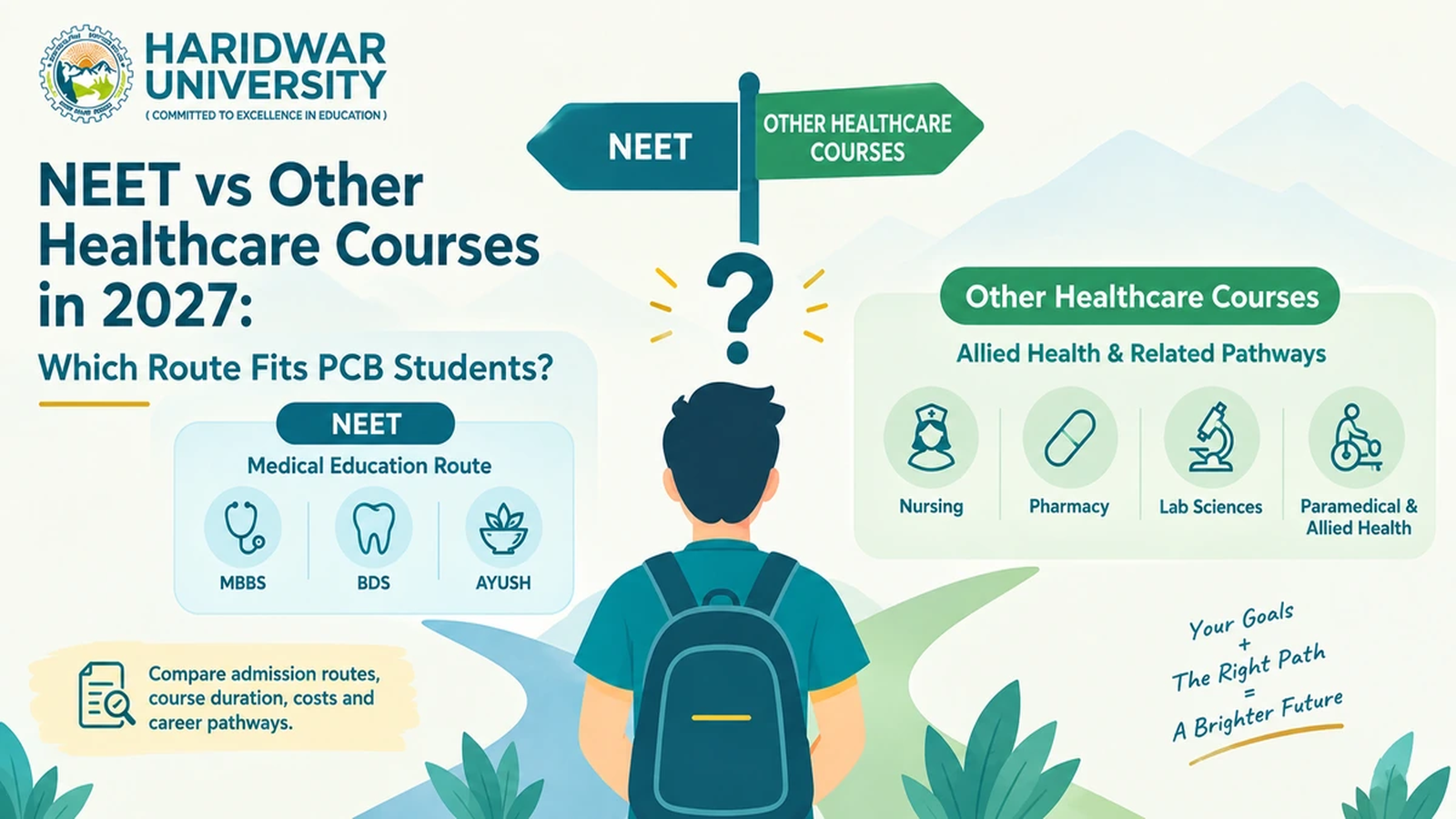
NEET vs Other Healthcare Courses in 2027: Which Route Fits PCB Students?
Mr. Vishal Baliyan
Assistant Professor, Allied Sciences, Haridwar University
Choosing a healthcare career after Class 12 Biology is not simply a binary choice of clearing NEET or desperately searching for an easy course that bypasses it. The far more meaningful question is: Which specific professional clinical or diagnostic role do you want to master, what admission framework does it require, and do its academic rigour and hospital work environment fit your natural strengths?
Students and parents frequently compare health degrees based on unverified salary rumors or social prestige before understanding the actual daily duties involved. MBBS prepares students specifically for medical practice as registered physicians, while nursing, pharmacy, and allied health professions fulfill distinct, indispensable pillars across the modern healthcare ecosystem. These are complementary, specialized disciplines—not interchangeable backups.
For students planning admission in 2027, the evaluation of NEET vs other healthcare courses must start with clear career objectives, statutory admission rules, practical clinical training requirements, and the distinct professional responsibilities governing each healthcare qualification.
Table of Contents
- 1. Understanding the Difference Between NEET and Healthcare Courses
- 2. Comparing Admission Routes for 2027
- 3. Matching Healthcare Careers with the Work Involved
- 4. Evaluating Course Duration, Costs and Career Progression
- 5. Choosing the Route That Fits Your Strengths
- 6. Preparing a Practical Admission Plan for 2027
- 7. Frequently Asked Questions (FAQs)
- 8. Make Your Decision Around the Profession You Want
1. Understanding the Difference Between NEET and Healthcare Courses
NEET-UG is an entrance examination, not a degree or a career in itself. It is used for admission to undergraduate medical education and is also applicable to specified AYUSH programmes under the relevant national legislation. The National Testing Agency publishes the examination's official notices, information bulletin and eligibility requirements on the official NEET-UG website.
For a PCB student, the distinction matters because qualifying for an examination and qualifying for a particular course are separate steps. Admission may also depend on rank, counselling, seat availability, category rules and the requirements of the institution.
Other healthcare degrees prepare students for distinct, highly specialized professional responsibilities:
- MBBS: Comprehensive medical education leading to legal registration as a medical doctor.
- BDS: Dental surgery education focusing on oral health, dental procedures, and reconstructive surgery.
- B.Sc. Nursing: Clinical healthcare education focused on acute bedside patient care, medical administration, patient recovery, and emergency response.
- B.Pharm & D.Pharm: Science of pharmacology, drug chemistry, industrial formulation, therapeutics, quality testing, and clinical drug distribution.
- Allied Health Sciences: Critical diagnostic and therapeutic degrees supporting modern medicine—including Medical Laboratory Technology (BMLT), Medical Imaging Technology (BMIT), and Physiotherapy (BPT).
The correct comparison is therefore never “NEET versus an easier backup.” It is evaluating one respected medical profession against another, each defined by its own statutory standards, academic commitment, and healthcare mission.
2. Comparing Admission Routes for 2027
Students should not assume that every healthcare career mandates NEET, nor should they assume that non-NEET courses offer unverified direct walk-in seats. Admission criteria differ significantly based on statutory council guidelines, university autonomy, and state regulatory bodies:
The NTA's NEET-UG introduction and examination information explains the examination's role in undergraduate medical admissions. Students should consult the current information bulletin and relevant counselling authority rather than relying on older course lists.
There is another distinction worth remembering: without NEET does not necessarily mean without an entrance examination. A university or state may use its own selection process, merit criteria or another applicable test. Before paying an application fee, check the rules for the exact course and institution.
3. Matching Healthcare Careers with the Work Involved
Degree titles can sometimes obscure what daily life on the job actually entails. Examine the routine tasks, clinical environments, and intellectual demands before finalizing your application:
These are broad role descriptions, not guarantees of eligibility for every job. Professional scope, licensing or registration requirements depend on the qualification and applicable rules.
Students interested in pharmacy can explore Haridwar University's Roorkee College of Allied Health Sciences, which lists B.Pharm, D.Pharm and related programmes alongside nursing offerings.
For a broader explanation of available pathways, HU's guide to healthcare careers without NEET discusses professional routes and the importance of checking eligibility and recognition. Use it as a companion to this comparison, not as a substitute for current admission notices.
4. Evaluating Course Duration, Costs and Career Progression
Advertised academic duration tells only part of the story. You must account for mandatory clinical internships, licensing examinations, postgraduate specializations, and the total cost of completing your degree:
Costs require the same scrutiny as duration. Compare the full published fee schedule rather than only the first-year tuition. Include examination charges, accommodation, transport, equipment, internship-related expenses where applicable and the potential cost of further study.
For a concrete institutional reference, HU publishes its fees and scholarship information. The listed fees relate to the stated academic session and may change; check the current schedule before making a financial commitment.
I would also be cautious about choosing a course on the promise of a “high salary”. Earnings vary with location, employer, experience, specialisation, professional registration and further qualifications. A headline salary estimate cannot establish what a new graduate is likely to earn.
Career progression matters, too. A pharmacy graduate may explore pharmaceutical manufacturing, quality assurance, regulatory affairs or further study. A nursing graduate may progress through clinical experience and additional qualifications. Allied health graduates may specialise within their professional field. Each route has its own entry conditions and limits.
5. Choosing the Route That Fits Your Strengths
Make your decision based on honest self-assessment rather than peer chatter or family expectations. Walk through these practical diagnostic questions:
- Is becoming a practicing physician your singular life dream? If yes, commit completely to NEET-UG preparation, maintain a rigorous drop-year plan if needed, but set a firm timeline limit.
- Do you love healthcare and direct patient care, but dread repeat NEET dropt cycles? B.Sc. Nursing offers direct, deeply rewarding clinical patient involvement with unprecedented global job mobility.
- Are chemistry, pharmacology, and drug development your passion? B.Pharm opens prestigious corporate pathways into India's thriving global pharmaceutical industry.
- Do you prefer diagnostic technology, precision testing, and laboratory science? BMLT and BMIT position you at the cutting edge of clinical pathology and medical imaging.
- Is family financial return or rapid career independence your top priority? 3-to-4-year professional degrees enable you to start earning and gaining corporate or clinical experience while your peers are still in early MBBS years.
I would also advise students and parents to check recognition carefully. A professional-sounding course title is not enough. Verify the institution, the programme's applicable approval or recognition, the qualification it awards and whether it meets the requirements for the intended professional role.
HU's existing guide, Career After 12th PCB Without NEET, offers a wider overview of alternative directions. Read it alongside this article once you have narrowed your choices to two or three realistic pathways.
6. Preparing a Practical Admission Plan for 2027
A structured plan prevents last-minute panic when admission portals open:
2. Check the official eligibility criteria. Confirm subject combinations, minimum marks, age rules where applicable and any entrance-test requirements.
3. Build a deadline calendar. Track examination registration, university applications, counselling rounds, document verification and fee-payment dates.
4. Verify the institution and programme. Check applicable regulatory recognition, facilities and practical or clinical training arrangements.
5. Calculate the complete cost. Compare tuition, additional charges, accommodation and likely expenses across the entire programme.
6. Keep a record of official updates. For NEET-led admissions, monitor the NTA's NEET-UG portal. For other courses, follow the relevant university, state authority or professional regulator.
As the 2027 admission cycle approaches, do not assume that a previous year's rules, cut-offs or counselling dates will remain unchanged. Use current official notices as the final authority.
7. Frequently Asked Questions (FAQs)
1. Is NEET compulsory for every healthcare course after Class 12 PCB?
No. NEET-UG applies to specified medical and AYUSH programmes, while other healthcare courses may use different admission routes. Always check the current requirements for the exact programme.
2. Can I study healthcare if I do not qualify for NEET?
Yes. You can investigate eligible pathways such as pharmacy, nursing and relevant allied health programmes. The best choice depends on your interests, eligibility and the profession you want to enter.
3. Does admission without NEET mean direct admission?
Not necessarily. An institution may require merit-based selection, a state entrance examination, its own entrance test or another selection process.
4. Which healthcare course is best for a PCB student?
There is no single best course for every student. MBBS, nursing, pharmacy and allied health qualifications prepare graduates for different roles, so compare the work, training, cost and eligibility requirements.
5. Can PCB students pursue pharmacy?
PCB students may meet the subject requirements for pharmacy programmes, subject to the applicable eligibility rules. Confirm the current criteria with the institution and the relevant regulator.
6. Should I choose a healthcare course based on salary alone?
No. Salary varies by role, employer, experience, location and further qualifications. Consider professional suitability, total education costs, recognition and realistic employment pathways as well.
7. What should I verify before enrolling in a healthcare programme in 2027?
Check eligibility, admission route, current fees, programme recognition, practical training, internship requirements where applicable and the qualification's relevance to your intended career.
8. Make Your Decision Around the Profession You Want
The comparison between NEET and alternative healthcare degrees achieves its true purpose when it helps students pinpoint the exact clinical or scientific discipline they are passionate about pursuing. If becoming a doctor remains your authentic goal, understand the NEET route and prepare with discipline. If your talents align with pharmacy, nursing, or diagnostic allied health, embrace those disciplines with equal pride and dedication.
A well-chosen healthcare course is not a second-place consolation prize, it is a lifelong commitment to healing, scientific discovery, and societal well-being. Examine verified eligibility rules, calculate realistic educational investments, and step into 2027 admissions with clarity and confidence.
Pursue Your Healthcare Calling at Haridwar University
Haridwar University offers PCI-approved Pharmacy programmes, Indian Nursing Council compliant Nursing degrees, and cutting-edge Allied Health Science specialisations with multispecialty hospital training partnerships.