

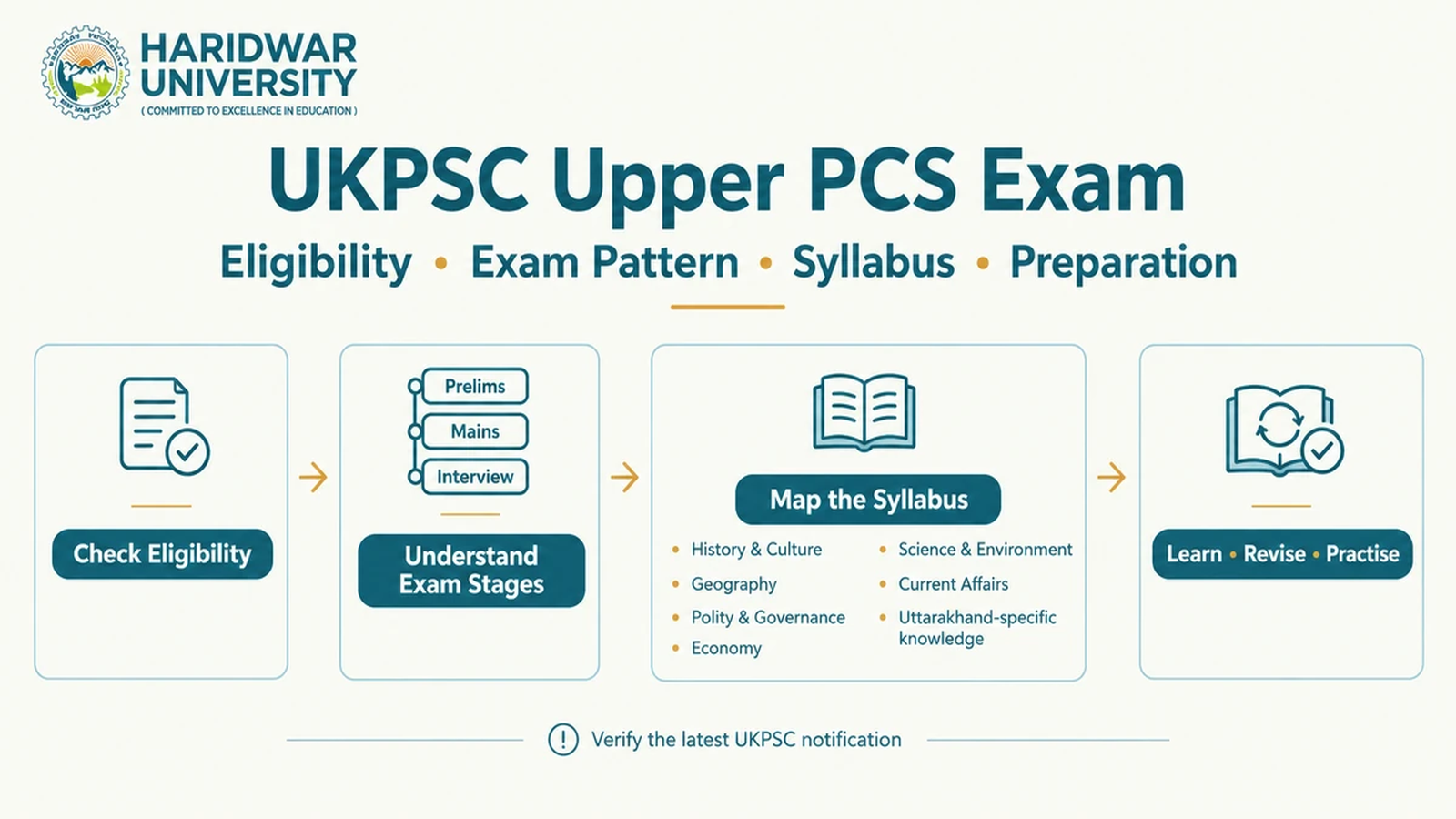
UKPSC Upper PCS Exam: Eligibility, Pattern, Syllabus & Preparation
Mr. Prajwal Chaudhary
Head, Training & Placement, Haridwar University
The UKPSC Upper PCS examination is a premier gateway into Uttarakhand's state civil administration, but preparing successfully demands far more than collecting textbooks or memorising a syllabus list. Aspirants need to understand the formal eligibility rules, three-tier selection stages, state-specific subjects, and the structured habits that reward analytical clarity, factual accuracy, and disciplined revision.
In this guide, I will explain how to approach the UKPSC Upper PCS exam from your very first eligibility audit to building a sustainable study routine. I will also distinguish general competitive exam advice from the strict rules you must verify in official recruitment notices issued by the Uttarakhand Public Service Commission (UKPSC).
Table of Contents
- 1. Understanding the UKPSC Upper PCS Examination
- 2. Checking Eligibility Before Starting Preparation
- 3. Understanding the UKPSC Exam Pattern
- 4. Organising the UKPSC Syllabus
- 5. Building a Practical UKPSC Preparation Strategy
- 6. Using Previous-Year Papers and Mock Tests
- 7. Avoiding Common Preparation Mistakes
- 8. Frequently Asked Questions (FAQs)
- 9. Start With a Clear Plan and Reliable Sources
1. Understanding the UKPSC Upper PCS Examination
UKPSC conducts recruitment examinations for various Uttarakhand government posts. The Combined State Civil/Upper Subordinate Services Examination, commonly called Upper PCS, is distinct from Lower PCS and other specialised recruitment examinations conducted by the commission.
That distinction matters. A syllabus or eligibility rule published for a lecturer, engineering, police or Lower PCS recruitment should not automatically be applied to Upper PCS.
Start with the official UKPSC website. Under recruitment notifications, syllabus, examination calendar and old question papers, candidates can check the documents relevant to their target examination. Read the notification for the exact recruitment cycle, including any corrigendum or amended notice, rather than relying solely on coaching summaries.
My advice is simple: before buying a book, download the relevant notification and syllabus. They define what you need to prepare.
2. Checking Eligibility Before Starting Preparation
Eligibility is not an administrative formality to leave until the online application window opens. It dictates whether you can legally compete for advertised posts and what certificates you must secure in advance.
Do not assume that every post in a combined examination has identical conditions. The commission may specify different requirements for particular services or categories. Likewise, age relaxation is governed by the applicable rules, not by a general statement on an unofficial website.
For a broader understanding of how age cut-off dates, category relaxations and attempt limits work across government recruitment, see Haridwar University's guide to government job age limits and eligibility rules. Use it as background reading, not as a substitute for UKPSC's own rules.
I recommend creating a one-page eligibility checklist and marking each condition against the official notification. If your degree is still in progress, check the exact rule on qualification completion and the crucial date. Do not assume that appearing in the final semester automatically makes you eligible.
3. Understanding the UKPSC Exam Pattern
The UKPSC Upper PCS selection framework is structured across three rigorous stages: the Preliminary Examination (objective screening), the Main Examination (conventional written papers), and the Personality Test (Interview):
The number of papers, marks, duration, negative marking, qualifying requirements and the role of each stage must be taken from the applicable official scheme. These details should never be copied from an older examination without checking whether the rules have changed.
For an additional subject-by-subject reference, candidates can consult the UKPSC syllabus.
Prelims and Mains also demand different habits. Objective papers reward recall, elimination and careful time management. Written papers require candidates to explain, compare and support an argument in a limited space. Preparing for both from the beginning is more effective than waiting until the Prelims result to practise writing.
4. Organising the UKPSC Syllabus
The official syllabus works best when converted from an intimidating multi-page document into a living, subject-wise tracking sheet. Break down your study plan across seven core pillars:
Do not treat this list as a replacement for the official syllabus. It is a way to organise your study after checking the prescribed topics.
For additional reading, the National Digital Library of India provides a searchable collection of educational and research resources across subjects and learning levels. It can help you discover supplementary material, but always ensure that what you study matches the UKPSC syllabus.
For Uttarakhand-related subjects, avoid collecting disconnected facts without context. A better note explains the topic, why it matters to the state, relevant examples and any linked policy or current issue. Keep notes concise enough to revise repeatedly.
5. Building a Practical UKPSC Preparation Strategy
A sustainable, repeatable study routine always outperforms an exhausting 14-hour timetable that burns out after two weeks. Structure your weekly preparation around four cyclic activities:
- Establish Your Baseline: Begin by solving a recent UKPSC Prelims question paper cold. This immediately exposes which subjects you already grasp and which require foundational study from NCERTs and standard reference texts.
- One Primary Source per Subject: Master one standard reference book for each syllabus section before exploring secondary commentaries. Create concise revision notes only during your second reading.
- Dedicate Daily Time to Uttarakhand Knowledge: Set aside 45–60 minutes every single day for Uttarakhand-specific topics and regional news. Postponing state subjects until the final month is the most common reason aspirants miss cutoff margins.
- Active Retrieval Over Passive Reading: Close your study notes and force yourself to explain a concept aloud or write down its core points. Active recall creates long-term neural memory far better than highlighting paragraphs repeatedly.
- Dual-Track Writing Practice: While practicing objective MCQs for Prelims, write at least one timed 150-word answer every other day to internalize structure, relevance, and neat presentation.
- Weekly Progress Audits: Keep a study log documenting completed topics, questions attempted, accuracy percentages, and recurring mistakes.
If you are balancing your preparation alongside your university degree or campus commitments, review Haridwar University’s step-by-step roadmap on preparing for government exams during college and our realistic timeline for UPSC civil services preparation.
6. Using Previous-Year Papers and Mock Tests
Previous-year papers help you understand how the syllabus is tested, not predict the next paper. Use the official UKPSC website to look for available old question papers, answer keys and relevant examination documents.
The 3-Step Question Paper Mastery Loop:
- 1. Attempt Under Exam Conditions: Simulate real exam timing strictly without consulting books or answer keys midway.
- 2. Categorize Every Error: Classify every incorrect or skipped question into one of four buckets: conceptual gap, misreading the prompt, flawed elimination, or reckless guessing.
- 3. Targeted Topic Repair: Immediately re-read the foundational concept for missed questions and solve 5 fresh practice items on that specific subtopic.
Maintain an error log. A question answered incorrectly because you misunderstood a concept requires a different remedy from one missed because you rushed through the wording. Review the log each week rather than simply counting mock-test scores.
For Mains, practise writing answers to a time limit. A useful structure is a direct opening, two or three logically ordered points supported by relevant examples, and a concise closing. The purpose is clarity and relevance, not decorative language.
7. Avoiding Common Preparation Mistakes
Several common missteps create an illusion of intense work without delivering real rank improvements:
A disciplined candidate does not need to study every available resource. The priority is to cover the prescribed syllabus, remember what has been studied and apply that knowledge under examination conditions.
8. Frequently Asked Questions (FAQs)
1. What is the UKPSC Upper PCS examination?
It is the commonly used name for Uttarakhand's Combined State Civil/Upper Subordinate Services Examination. Check the official notification to confirm the services and posts included in a particular recruitment cycle.
2. What educational qualification is required for UKPSC Upper PCS?
The required qualification is specified in the relevant recruitment notification. Check the minimum educational requirement and the date by which the qualification must be completed, including any post-specific conditions.
3. How is the UKPSC Upper PCS examination conducted?
The selection process has conventionally included Prelims, Mains and an Interview. Confirm the current examination scheme, paper details and qualifying rules in the official notification.
4. Is the UKPSC syllabus the same as the UPSC syllabus?
There may be overlap in broad subjects such as history, geography, polity and the economy, but the examinations are not interchangeable. Use the UKPSC syllabus as your primary checklist and give appropriate attention to Uttarakhand-specific topics.
5. How should beginners start UKPSC preparation?
Begin with the official notification and syllabus, check your eligibility, review previous-year papers and make a subject-wise plan. Start with foundational learning and build revision and timed practice into the routine from the beginning.
6. How many attempts are allowed for UKPSC Upper PCS?
Do not rely on a single attempt-limit figure without checking the applicable rules. Verify the current notification and service rules for any attempt restrictions, age limits and category-based relaxations.
7. Where can I find the official UKPSC syllabus and previous-year papers?
Visit the official Uttarakhand Public Service Commission website and check its syllabus, old question papers, recruitment notifications and answer-key sections. Match every document to the examination and recruitment cycle you are preparing for.
9. Start With a Clear Plan and Reliable Sources
UKPSC preparation becomes truly manageable when you replace scattered study with a clear, systematic routine: verify your eligibility, analyze the official examination scheme, map syllabus topics into weekly targets, study consistently, revise actively, and scrutinize your practice mistakes.
The process requires sustained commitment, but a realistic, evidence-based routine gives you a vastly better foundation for success than constantly chasing new books or online predictions. Download the syllabus, set your daily schedule, and start your preparation with clarity.
Excel in Civil Services & Higher Education at Haridwar University
Haridwar University provides comprehensive academic guidance, vast digital library archives, competitive examination mentoring, and degree programmes tailored for holistic career and civil service excellence.