

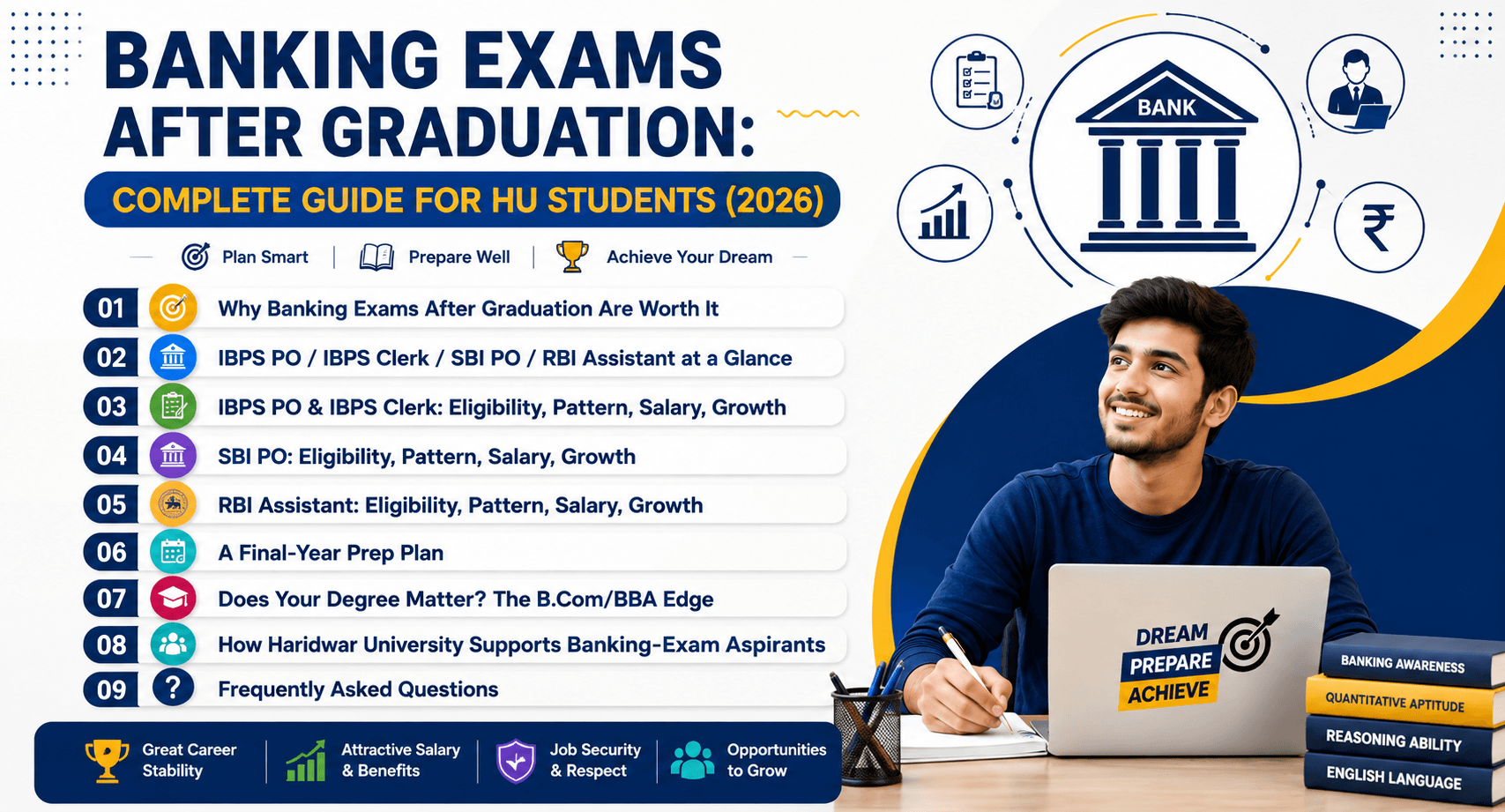
Guide Scope: This guide focuses on four of the most common banking-exam routes for graduating students — IBPS PO, IBPS Clerk, SBI PO, and RBI Assistant. It does not cover SBI Clerk, IBPS RRB, NABARD or RBI Grade B; see those exams' own official notifications separately.
If you're finishing a B.Com, BBA or any other undergraduate degree and want a stable job without more years of study, banking exams after graduation are one of the most dependable government-linked routes available. This guide draws on Haridwar University's own admission and fee pages, plus named, dated sources — the official notifications of IBPS, the State Bank of India (SBI) and the Reserve Bank of India (RBI) — for eligibility, pattern, salary and growth across the exams every graduating commerce or management student should know: IBPS PO, IBPS Clerk, SBI PO, and RBI Assistant.
Table of Contents
1. Why Banking Exams After Graduation Are Worth It
2. IBPS PO / IBPS Clerk / SBI PO / RBI Assistant at a Glance
3. IBPS PO & IBPS Clerk — Eligibility, Pattern, Salary, Growth
4. SBI PO — Eligibility, Pattern, Salary, Growth
5. RBI Assistant — Eligibility, Pattern, Salary, Growth
6. A Final-Year Prep Plan for Banking Exams After Graduation
7. Does Your Degree Matter? The B.Com/BBA Edge
8. How Haridwar University Supports Banking-Exam Aspirants
1. Why Banking Exams After Graduation Are Worth It
Public-sector banking recruitment is one of the few career paths open to graduates of any stream, filled purely on merit through a written exam, with no professional certification required first. A Probationary Officer or clerical hire gets a government-linked pay scale, provident fund and pension benefits, and a defined promotion ladder — a mix most private-sector entry roles at the same experience level don't match.
These recruitments sit within the wider public-sector banking framework overseen by the Ministry of Finance's Department of Financial Services, and this guide focuses on the four exams that account for most of the annual hiring: IBPS PO, IBPS Clerk, SBI PO, and RBI Assistant.
2. IBPS PO / IBPS Clerk / SBI PO / RBI Assistant at a Glance
Here is a comparative breakdown of key public-sector banking entrance exams conducted across India:
| Exam | Conducting Body | Post | Age Limit | Starting Basic Pay |
|---|---|---|---|---|
| IBPS PO (CRP PO/MT-XVI) | IBPS | Probationary Officer | 20–30 years | ₹48,480 / month |
| IBPS Clerk (CRP CSA-XVI) | IBPS | Customer Service Associate | 20–28 years | ₹24,050 / month |
| SBI PO (CRPD/PO/2026-27/09) | State Bank of India | Probationary Officer | 21–30 years* | ₹48,480 / month |
| RBI Assistant | Reserve Bank of India | Assistant (Clerical) | 20–28 years | ₹29,000 / month |
*Age limit as reported against SBI's PO 2026 recruitment; candidates should confirm the exact cut-off date in SBI's own notification before applying. Figures verified as of 1 September 2026.
3. IBPS PO & IBPS Clerk — Eligibility, Pattern, Salary, Growth
IBPS PO (Probationary Officer)
Eligibility: Bachelor's degree in any discipline; 20–30 years of age (per notification released 1 July 2026).
Exam Pattern: Two-stage online format (Preliminary & Main). Mains revised to a longer 170-objective question paper with Descriptive Test, plus a new Personality Test between Mains and Interview.
Salary & Scope: Starting basic pay of ₹48,480/month (in-hand higher with allowances). Indicative 6,715 vacancies across 11 banks.
IBPS Clerk (Customer Service Associate)
Eligibility: Bachelor's degree in any discipline; 20–28 years age band (per notification dated 1 August 2026).
Exam Pattern: Two-tier Prelims–Mains format with a qualifying local-language check. No interview round required.
Salary & Scope: Starting basic pay of ₹24,050/month. Opened for 11,403 posts with clear promotion track toward branch management.
Registration Status: Registration windows have closed as of this guide's publish date: IBPS PO (CRP PO/MT-XVI) and IBPS Clerk (CRP CSA-XVI) registration are not open for new applicants. Track the official IBPS examination portal (ibps.in) for the next PO/MT and CSA notification cycle rather than applying against this one.
4. SBI PO — Eligibility, Pattern, Salary, Growth
SBI's 2026 Probationary Officer recruitment (Advertisement No. CRPD/PO/2026-27/09) opened for 1,500 vacancies, with online registration from 18 June to 8 July 2026. Any graduate, regardless of stream, can apply, subject to the age band in SBI's notification.
- Selection Stages: Selection runs across Preliminary and Main exams, followed by a Phase III round covering a psychometric test, group exercise and interview.
- Compensation: Starting basic pay is ₹48,480 a month; total annual compensation is higher once allowances, medical benefits and provident fund are added, per SBI's own notification.
- Career Progression: Selected officers join in Junior Management Grade Scale-I, a career path that can lead to senior branch and regional leadership roles.
Notice Note: Registration for this cycle closed on 8 July 2026. Aspirants should watch the official SBI Careers Portal for the next PO notification instead of applying against this advertisement.
5. RBI Assistant — Eligibility, Pattern, Salary, Growth
RBI's most recent Assistant recruitment (Panel Year 2025-26) was notified on 16 February 2026 for 650 vacancies.
- Eligibility: Bachelor's degree with at least 50% marks (relaxed to a pass class for SC/ST/PwBD candidates), an age band of 20–28 years as on 1 February 2026, and proficiency in the local language of the office applied for.
- Selection Process: Preliminary exam, Mains exam, and a qualifying Language Proficiency Test (LPT).
- Salary & Scale: Starting basic pay is ₹29,000 a month, rising to a maximum of ₹78,640 with regular increments, per RBI's own notification.
RBI had not announced its next Assistant cycle as of this guide's publish date; aspirants should track the official RBI Opportunities Portal directly for the new notification.
6. A Final-Year Prep Plan for Banking Exams After Graduation
With final-semester exams, campus placement drives and banking-exam preparation competing for the same months, a simple split works best:
Phase 1: Build Core Fundamentals (First Half of Final Year)
- Build fundamental clarity in Quantitative Aptitude, Reasoning Ability, and English Language.
- Maintain a consistent daily routine for General Awareness, banking concepts, and financial news.
- Balance daily college lectures and coursework without falling behind on academics.
Phase 2: Timed Prelims Mocks (8 to 10 Weeks Before Notified Date)
- Shift to timed full-length Prelims mock tests to master sectional time management.
- Maintain an error notebook to diagnose speed bottlenecks and repetitive mistakes.
- Consolidate high-frequency calculation shortcuts and vocabulary notes.
Phase 3: Targeted Mains Preparation (Post-Prelims)
- Shift fully to that specific exam's Mains syllabus rather than spreading revision across all four exams at once.
- Practice descriptive writing (essays & formal letters) for IBPS PO.
- Master computer knowledge modules for RBI Assistant Mains.
Because IBPS, SBI and RBI release dates independently, checking each body's own calendar matters more than following one memorised timeline.
7. Does Your Degree Matter? The B.Com/BBA Edge
None of these four exams restricts eligibility by degree stream — any graduate can apply under the "graduation in any discipline" clause in IBPS's and SBI's notifications.
The B.Com Advantage
Financial accounting, business economics, and quantitative techniques map closely onto the aptitude and banking-awareness sections of these exams, cutting the extra self-study needed. Explore HU's B.Com with AI programme for an aligned commerce curriculum.
The BBA Advantage
A BBA background adds management principles, case analysis, and structured communication skills essential during interview and group-exercise stages in SBI PO and IBPS PO. Explore HU's BBA with AI programme.
8. How Haridwar University Supports Banking-Exam Aspirants
Haridwar University's campus was established in 2010 as Roorkee College of Engineering; university status was conferred under the Haridwar University Act, 2022 (Act No. 16 of 2023).
The university's commerce and management programmes, including B.Com and BBA, are approved by the University Grants Commission (UGC). AICTE's 2024-25 Approval Process Handbook extended AICTE's approval regime to BBA, BCA and BMS programmes nationally, so students should confirm HU's current AICTE approval status for its BBA programme on the university's About Us page alongside its UGC approval.
Tuition Structure (2026–27 Session)
For the 2026-27 academic year, verified as of 1 September 2026 from the official HU Fees and Scholarships page:
- B.Com with AI: Three-year total tuition (inclusive of enrollment, admission, examination and uniform charges) of ₹1,67,000.
- BBA with AI: Three-year total tuition (inclusive of enrollment, admission, examination and uniform charges) of ₹2,12,000.
Scholarship Schemes (Claim Only One)
- Merit Ladder (First Year Only): Tied to JEE rank, Class 12 aggregate/PCM/PCB percentage, or CUET percentile (not applicable to private candidates):
- Above 90% → 80% off tuition
- 80%–90% → 50% off tuition
- 70%–80% → 20% off tuition
- 60%–70% → 10% off tuition
- Girls' Education Waiver: A flat 25% off first-year tuition, with no other condition attached.
- "Other" Category Waiver: 25% off first-year tuition for students with over 60% in Class 12 whose parent is from the Armed Forces, or a Freedom Fighter/Martyr family, or who are HU/RCE alumni, siblings of current students, orphans, or children of university employees.
- Uttarakhand Domicile Waiver: A separate 25% off first-year tuition for Uttarakhand-domicile students who passed Class 12 in 2025 or 2026. This is its own scheme, distinct from the "Other" category, and carries no 60% condition.
- Sports Quota Waiver (All Courses, First Year Only): National-level certificate holders: 50%; State: 30%; District: 20%; School: 10%.
- Academic Excellence Award: ₹5,000 in any semester for scoring 85%+ (not limited to first year).
Scholarship Policy: A student is eligible for only one scholarship scheme — schemes are never combined or blended into one condition. These schemes are drawn directly from HU's fees and scholarships page and should be reconfirmed there, since terms are reviewed each admission cycle.
9. Frequently Asked Questions (FAQs)
Q1: Can a B.Com or BBA graduate apply for IBPS PO or SBI PO?
Yes. Both IBPS PO and SBI PO accept a bachelor's degree in any discipline, so B.Com and BBA graduates are as eligible as any other stream.
Q2: What is the starting salary for an IBPS PO?
IBPS's CRP PO/MT-XVI notification sets a starting basic pay of ₹48,480 a month; in-hand pay is higher once allowances are added and depends on the posting city.
Q3: What is the age limit for IBPS Clerk?
IBPS Clerk (CRP CSA-XVI) requires candidates to be between 20 and 28 years old — narrower than the 20–30 band for IBPS PO.
Q4: How many vacancies were announced for SBI PO in 2026?
SBI's 2026 PO recruitment, under Advertisement CRPD/PO/2026-27/09, opened for 1,500 vacancies. Registration for this cycle closed on 8 July 2026.
Q5: Does RBI Assistant have a language requirement?
Yes. RBI Assistant candidates must show proficiency in the local language of the RBI office they apply to, tested at the Language Proficiency Test stage.
Q6: Is there an interview in the IBPS Clerk selection process?
No. IBPS Clerk selection is a two-tier Prelims–Mains process followed by a language check; unlike IBPS PO, there is no interview.
Q7: Does a B.Com or BBA degree from HU prepare students for these exams?
HU's B.Com and BBA programmes cover accounting, economics and quantitative topics that overlap with the aptitude and awareness sections of these exams.
Q8: Can HU's scholarships be combined for banking-exam-track students?
No. As per HU's fees and scholarships page, a student is eligible for only one scholarship scheme, whether merit-based, category-based or sports-quota.
Q9: Where can students track the next RBI Assistant notification?
RBI had not announced its next Assistant recruitment cycle as of this guide's publish date; the university advises checking RBI's official Opportunities page directly.
10. Plan Your Degree and Preparation
Ready to plan your undergraduate years around a banking-exam-ready degree? Connect with Haridwar University's admissions and career guidance counselors to explore our commerce and management degrees.
Plan Your Banking Career Foundation at HU
Explore B.Com with AI, BBA with AI, scholarship eligibility, and career mentorship.