

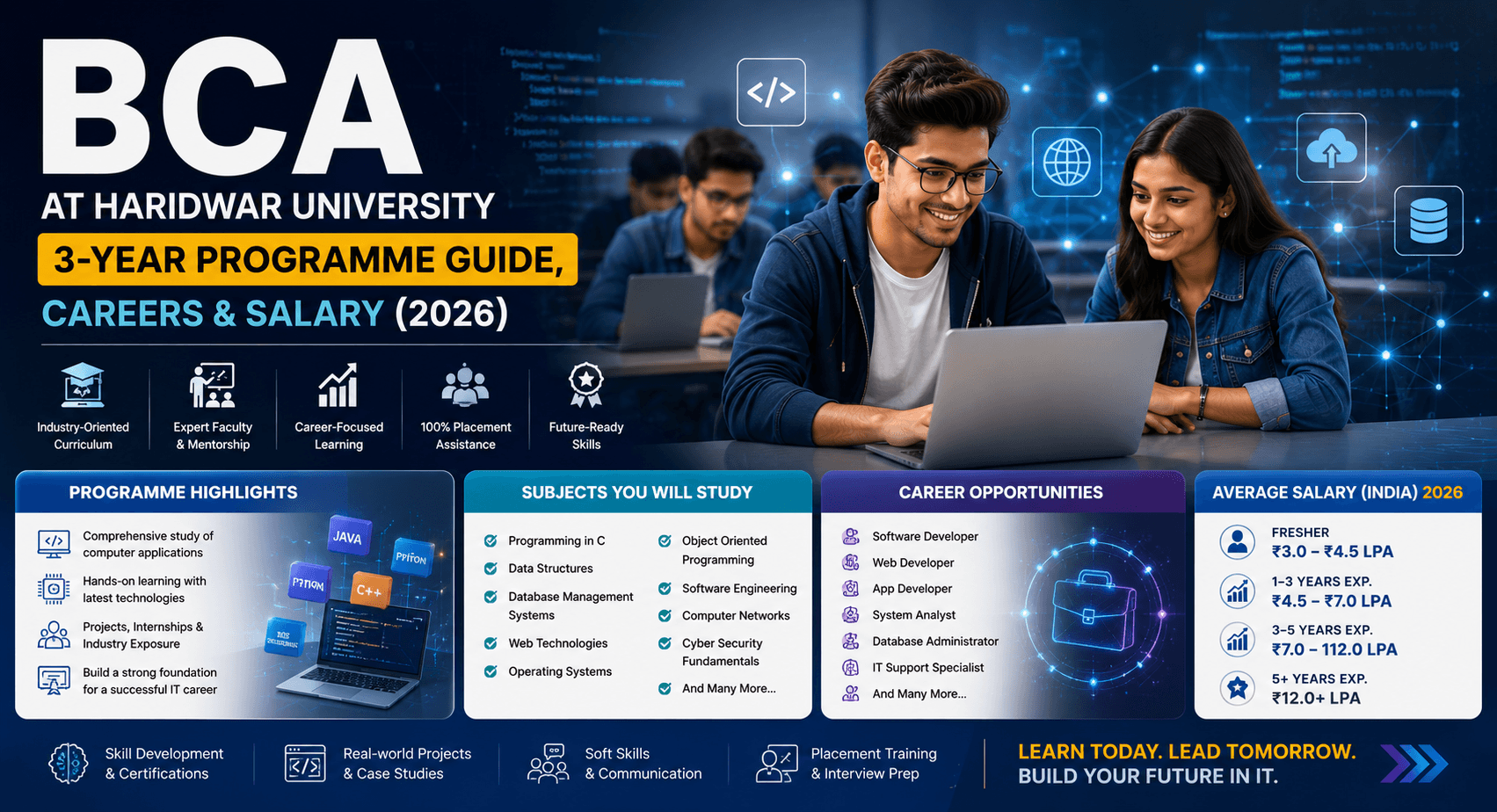
BCA at Haridwar University: 3-Year Programme Guide, Careers & Salary (2026)
Dr. Rohit Kumar
Head of Computer Applications, Haridwar University
Choosing the right undergraduate programme after Class 12 is one of the most important academic decisions for students interested in technology. While engineering remains a popular choice, many students today are looking for programmes that focus on practical computing skills, software development, and faster entry into the IT industry. A Bachelor of Computer Applications (BCA) has become one of the most preferred options for students who want to build careers in software, web development, cloud technologies, data science, and emerging digital fields.
If you are exploring BCA at Haridwar University, this guide covers everything you need to know, including the programme structure, eligibility, curriculum, career opportunities, salary expectations, higher study options, and why it remains a relevant career choice in 2026.
Table of Contents
- 1. BCA at a Glance
- 2. Why Consider a BCA in 2026?
- 3. What Is a BCA Course?
- 4. BCA vs B.Tech: Which Should You Choose?
- 5. BCA Curriculum (Semester-wise)
- 6. Career Opportunities After BCA
- 7. BCA Salary in India (2026)
- 8. Placement Support at HU
- 9. Higher Studies After BCA
- 10. Eligibility, Fees and Admission
- 11. Frequently Asked Questions
BCA at a Glance
Why Consider a BCA in 2026?
Technology is transforming industries ranging from banking and healthcare to retail, manufacturing, education, and government services. As organisations continue expanding their digital infrastructure, the demand for professionals with practical programming, software development, cloud computing, and application development skills continues to grow.
A BCA programme prepares students for these opportunities by combining industry-relevant technical knowledge with practical learning, while also creating pathways for higher studies such as MCA and specialised professional certifications.
What Is a BCA Course?
A Bachelor of Computer Applications (BCA) is a three-year undergraduate programme that equips students with practical skills in programming, software development, databases, networking, and emerging technologies. At Haridwar University, the programme combines classroom learning with practical laboratories, project-based learning, and industry-oriented training.
BCA vs B.Tech: Which Programme Should You Choose?
One of the most common questions students ask after Class 12 is whether they should choose BCA or B.Tech. While both programmes can lead to careers in the technology sector, they differ in their learning approach and career pathways.
A Simple Way to Decide
Choose BCA if you want to:
- Build practical programming and software development skills.
- Enter the IT industry through application development, web technologies, or cloud computing.
- Complete an undergraduate degree in three years and pursue MCA or specialised certifications later.
- Focus primarily on software rather than engineering fundamentals.
Choose B.Tech if you want to:
- Study engineering concepts alongside software development.
- Explore areas such as computer architecture, electronics, and advanced engineering mathematics.
- Pursue careers requiring an engineering degree or higher technical specialisation.
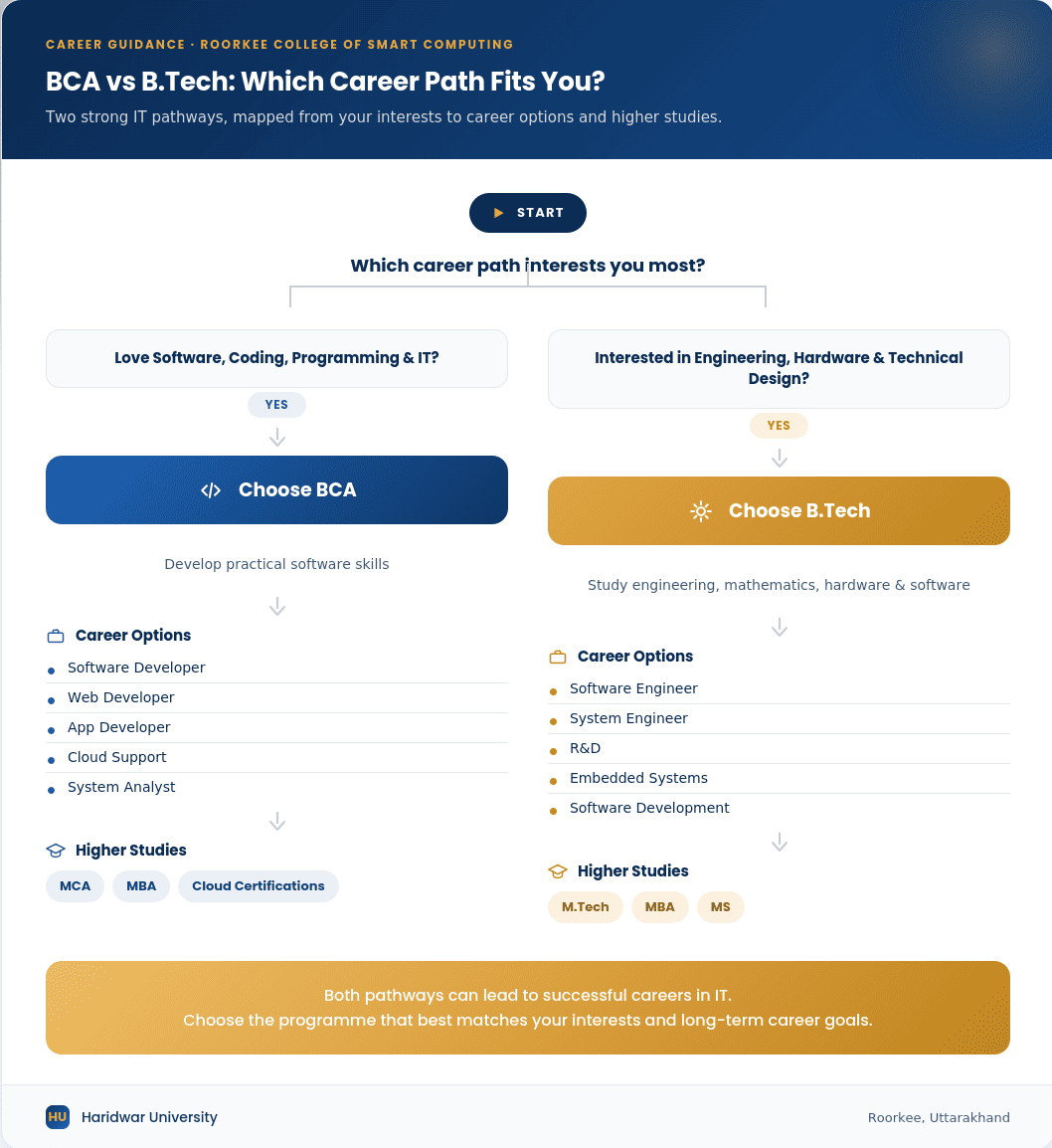
A visual flowchart helping students choose between BCA and B.Tech based on their interests, career goals, learning preferences, and duration of study.
Both BCA and B.Tech offer excellent technology careers. The right choice depends on your interests, learning preferences, and long-term career goals.
BCA Curriculum at Haridwar University (Semester-wise)
The BCA curriculum at Haridwar University is designed to help students progress from fundamental computing concepts to advanced application development. Over six semesters, students gradually build programming knowledge, analytical thinking, database management skills, and practical software development experience.
While individual subjects may be updated to reflect industry requirements, the curriculum generally follows a structured learning path.
The curriculum progresses from programming fundamentals to advanced software development, enabling students to build practical skills before undertaking internships and major projects.
Industry-Oriented Learning and Emerging Technologies
Alongside core computing subjects, the programme introduces students to Cloud Computing, Data Science, and Full Stack Development through practical assignments, laboratory sessions, and project-based learning. Students also gain hands-on experience through programming assignments, mini projects, laboratory sessions, and team-based learning activities that encourage problem-solving and software development practices.
Learning Facilities and Industry Exposure
Students gain practical experience through modern computer laboratories, workshops, internships, and academic collaborations. Partnerships with organisations such as NASSCOM FutureSkills Prime and L&T EduTech further expose students to emerging technologies and industry practices.
Career Opportunities After BCA
BCA graduates can pursue careers in software development, web development, cloud services, application development, databases, testing, and system analysis across the IT industry.
BCA Salary in India (2026)
Salary after BCA depends on several factors, including technical skills, internships, certifications, location, and the organisation a graduate joins. According to AmbitionBox (2026), salary generally grows with experience and specialised skills.
*Approximate salary ranges based on AmbitionBox salary insights and may vary depending on employer, location, technical skills, certifications, and job role.
Students who develop expertise in areas such as cloud computing, full stack development, data science, or artificial intelligence often have access to faster career growth and higher earning potential. Those interested in emerging AI careers can also explore our AI Engineers Salary in India (2026) to understand industry trends and salary expectations. Pursuing an MCA or industry-recognised certifications can further strengthen long-term career prospects.
Placement Support at Haridwar University
Haridwar University provides university-wide placement support through career guidance, aptitude training, mock interviews, resume-building sessions, industry interaction, and campus recruitment activities. According to the university's Training & Placement Cell 2025 report, the university has recorded a 95% placement rate, a highest package of 60 LPA, an average package of 6 LPA, and participation from 1300+ recruiters across various academic disciplines. These are university-wide placement figures, as the university does not publish programme-specific placement statistics for the BCA programme.
Students from computing programmes may have opportunities to interact with recruiters such as TCS, Infosys, Wipro, Accenture, Cognizant, IBM, HCL Technologies, Capgemini, Chetu, Programmers.io, and Radiant Information Technology, among other organisations that participate in university recruitment and industry engagement initiatives. Students can explore the university's Training & Placement Cell for the latest placement activities and recruiter information.
Higher Studies After BCA
While many graduates begin working immediately after completing BCA, others choose to continue their education to develop specialised technical or managerial expertise. Popular options include pursuing an MCA, an MBA, or professional certifications in cloud computing, cybersecurity, artificial intelligence, or data science.
Students interested in advancing their technical knowledge can explore the MCA with AI to build upon the programming and software development skills acquired during BCA.
Eligibility, Fees and Admission
Students interested in pursuing the BCA programme at Haridwar University should meet the university's prescribed admission requirements. Candidates must have passed 10+2 with Physics, Chemistry, and Mathematics (PCM) from a recognised board, securing a minimum of 55% aggregate marks. Admissions are conducted according to the university's guidelines and may include the Haridwar University Admission Entrance Test (HUAET) where applicable. Students can check the latest admission schedule through the Admission Overview.
For the 2026–27 academic session, the tuition fee for the BCA programme is ₹82,000 for the first year, followed by ₹65,000 per year in the second and third years. Eligible students may also apply for merit-based and other scholarships offered by the university. The latest fee structure and scholarship information is available on the Fees & Scholarships page.
Frequently Asked Questions
Is BCA a good career choice in 2026?
Yes. As organisations continue to invest in software development, cloud computing, cybersecurity, artificial intelligence, and digital transformation, graduates with practical computing skills remain in demand across multiple industries.
Can I pursue MCA after completing BCA?
Yes. MCA is one of the most popular higher education options after BCA and allows students to deepen their technical expertise while improving long-term career prospects.
Does Haridwar University provide placement support for BCA students?
Haridwar University provides university-wide placement assistance, including career guidance, aptitude training, industry interaction, internships, and campus recruitment support. The university publishes placement achievements collectively rather than programme-specific placement statistics.
Is BCA equivalent to B.Tech CSE?
No. BCA and B.Tech CSE are different undergraduate programmes. BCA focuses on computer applications, programming, and software development over three years, while B.Tech CSE is a four-year engineering degree covering broader engineering concepts alongside computer science.
What is the BCA fee at Haridwar University?
For the 2026–27 academic session, the tuition fee for the BCA programme is ₹82,000 for the first year and ₹65,000 per year for the second and third years. Students can also explore scholarships through the Fees & Scholarships page.
Do I need PCM for BCA at Haridwar University?
Yes. According to the university's eligibility criteria, applicants must have passed 10+2 with Physics, Chemistry, and Mathematics (PCM) from a recognised board with a minimum of 55% aggregate marks.
What is the highest package offered at Haridwar University?
According to the university's Training & Placement Cell, Haridwar University has recorded a highest package of 60 LPA. These are university-wide placement figures, as programme-specific placement statistics for BCA are not published.
Can BCA graduates work abroad?
Yes. BCA graduates can pursue international career opportunities after gaining relevant technical skills, work experience, or higher qualifications such as an MCA or globally recognised certifications in areas like cloud computing, software development, and cybersecurity.
What is the difference between BCA and B.Sc. IT?
Both programmes prepare students for careers in the IT industry, but their curriculum and focus may differ. BCA generally emphasises programming, software development, and computer applications, while B.Sc. IT often includes a broader study of information technology concepts, networking, and systems. Students should compare the curriculum and career goals before choosing a programme.
Begin Your Computing Journey with Haridwar University
A successful career in technology begins with building the right skills and practical experience. Whether your goal is to become a software developer, cloud professional, application developer, or pursue higher studies such as MCA, the BCA programme at Haridwar University is designed to provide a strong academic foundation together with industry-oriented learning.
Ready to take the next step?
Explore the BCA Programme → Apply Online →