

BCA vs B.Tech CSE at Haridwar University: Which Course Is Right for You?
Dr. Rohit Kumar
HOD – Computer Applications, Haridwar University
Every admission season, I sit across the table with dozens of Class 12 students and their parents, and the same question comes up almost word for word: BCA vs B.Tech CSE at Haridwar University — which one should you pick? Both lead into computer science. Both open doors into the IT industry. But the similarities pretty much end there. Duration, cost, math load, and where you can land ten years down the line differ quite a bit between the two, and honestly, there's no single right answer here. It depends on your stream, your budget, how much engineering mathematics you're willing to sit through, and how soon you want that first paycheck.
This guide walks through the real differences between BCA and B.Tech CSE at Haridwar University: syllabus depth, fees, career roles, salary ranges, and what happens after graduation if you want to go further with an MCA or M.Tech. I've thrown in a couple of alumni journeys from each stream too, plus answers to the nine questions students ask me most during counselling sessions.
What You'll Learn in This Guide
- Full side-by-side comparison table: duration, syllabus, fees, roles, salary, and best-fit student
- When to choose BCA — faster entry, less math-heavy path
- When to choose B.Tech CSE — deeper foundation, higher ceiling
- MCA after BCA vs M.Tech after B.Tech: which postgraduate route fits you
- Why Haridwar University offers both — and how to decide
- Typical HU alumni outcomes from each stream
- 9 frequently asked questions
Full Comparison Table: BCA vs B.Tech CSE at Haridwar University
Here's the side-by-side breakdown parents usually ask for first — save it, print it, whatever helps.
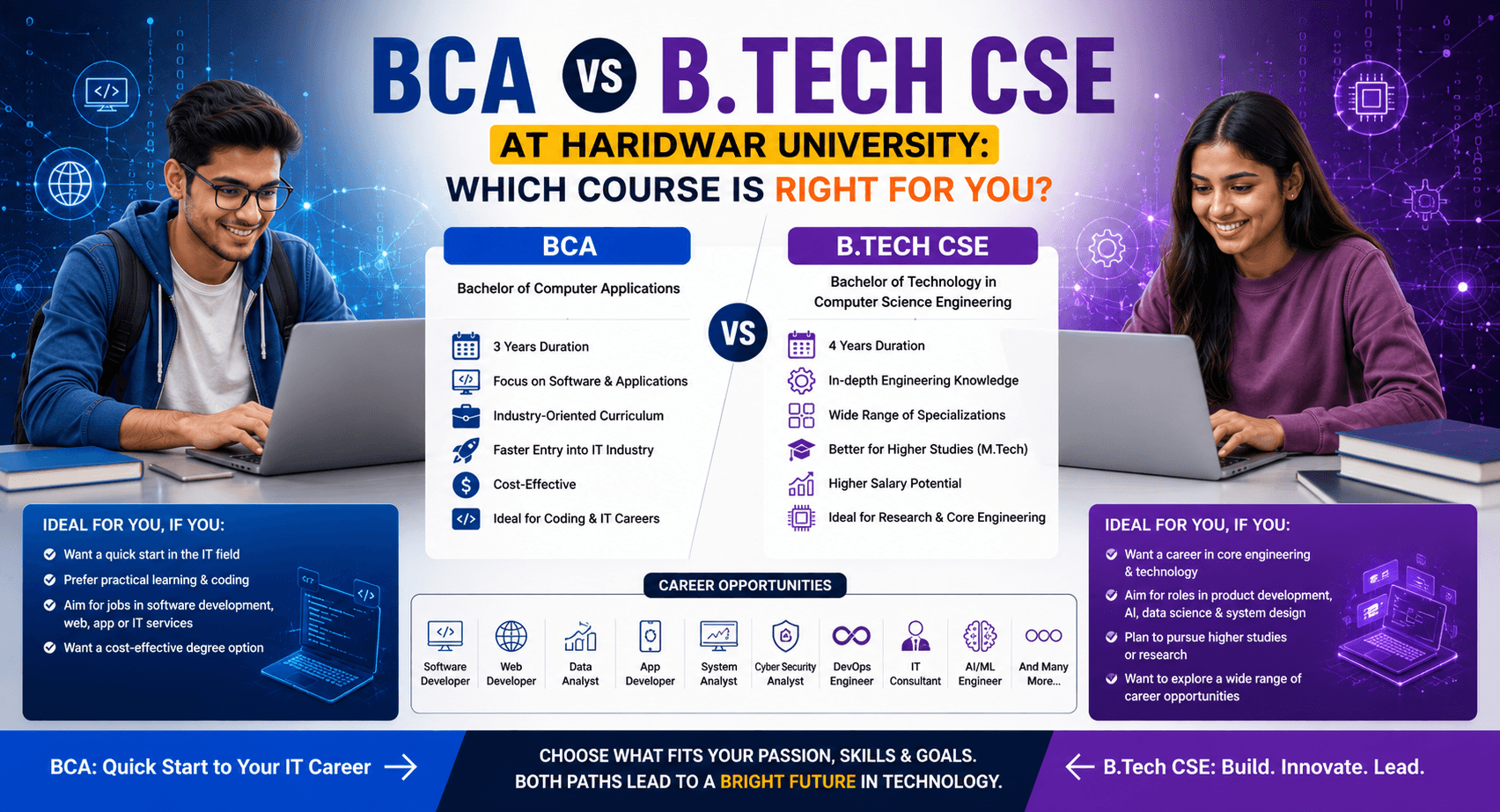
| Parameter | BCA at Haridwar University | B.Tech CSE at Haridwar University |
|---|---|---|
| Duration | 3 years (6 semesters) | 4 years (8 semesters) |
| Entry stream | Open to Science, Commerce & Arts (any stream after Class 12) | Science stream with Physics, Chemistry/CS and Mathematics |
| Maths intensity | Lighter — applied maths, statistics, logical reasoning | Heavy — engineering maths, discrete structures, digital design |
| Syllabus depth | Application-focused: programming, DBMS, web technology, data science electives | Foundational + application: core CS engineering, electronics basics, deeper algorithms & systems |
| Approx. fees (HU) | ≈ ₹92,000 (Year 1) + ₹75,000 × 2 ≈ ₹2.42 lakh total | ≈ ₹1.27 lakh (Year 1) + ₹1.10 lakh × 3 ≈ ₹4.57 lakh total |
| Core career roles | Software developer, web developer, data analyst, IT support, QA tester, ERP executive | Software engineer, systems engineer, AI/ML engineer, cloud engineer, cyber-security analyst, R&D roles |
| Starting salary range | ≈ ₹2.5–4.5 LPA (entry level, India) | ≈ ₹3.5–8 LPA (entry level, India; higher in product & core-engineering roles) |
| Eligibility for PSU/technical exams | Limited — many core-engineering PSU exams require a B.Tech/B.E. | Eligible for GATE, PSU recruitment, and technical services exams |
| Higher-study pathway | MCA, MBA, MSc (CS), certifications | M.Tech, MS abroad, MBA, GATE-based PSU/PhD routes |
| Best-fit student | Wants an early, less math-heavy start in IT/software with faster entry into jobs | Wants a deep engineering foundation, research/product roles, and a higher long-term ceiling |
Fee figures are indicative and based on the current fee structure published on the Haridwar University BCA with Data Science page and B.Tech CSE fee guidance; always confirm the latest figures on the official admissions page before applying.
When to Choose BCA (Faster Entry, Less Math-Heavy)
1. Faster Entry
If you want to start writing code and building real projects without waiting around, BCA gets you there faster. At Haridwar University, the three-year course skips the heavy first-year theory dump most engineering programmes lean on and puts you straight into programming languages, database management, and web technologies. Electives like Data Science, Python, and R show up later, once you've got the basics down. Graduate a year ahead of your B.Tech friends, and that head start compounds — more work experience, an earlier salary, a faster climb.
2. Less Math-Heavy
BCA also doesn't gatekeep by stream. Commerce and Arts students walk in just as easily as Science students at Haridwar University, as long as they've cleared 60% in Class 12 — no Physics-Chemistry-Maths filter to get past first. That's a real relief for students who already know they want a software career but dread four more years of engineering mathematics. And don't assume that makes it a lesser degree: a BCA graduate with a solid final-year project or a decent internship on their resume can compete for the same entry-level developer and analyst roles as an average B.Tech graduate.
Choose BCA if:
- You come from a non-Science stream or want to avoid heavy engineering mathematics
- You want to enter the job market a full year earlier than a B.Tech graduate
- You are drawn to applied programming, web development, or data analytics rather than core hardware/electronics
- You are budget-conscious — BCA's total fee is roughly half that of B.Tech CSE at HU
- You plan to strengthen your profile later with an MCA, an industry certification, or an MBA
Explore the BCA with Data Science curriculum at HU to see the full semester-wise syllabus and placement partners.
When to Choose B.Tech CSE (Deeper Foundation, More Roles, Higher Ceiling)
Deeper Foundation
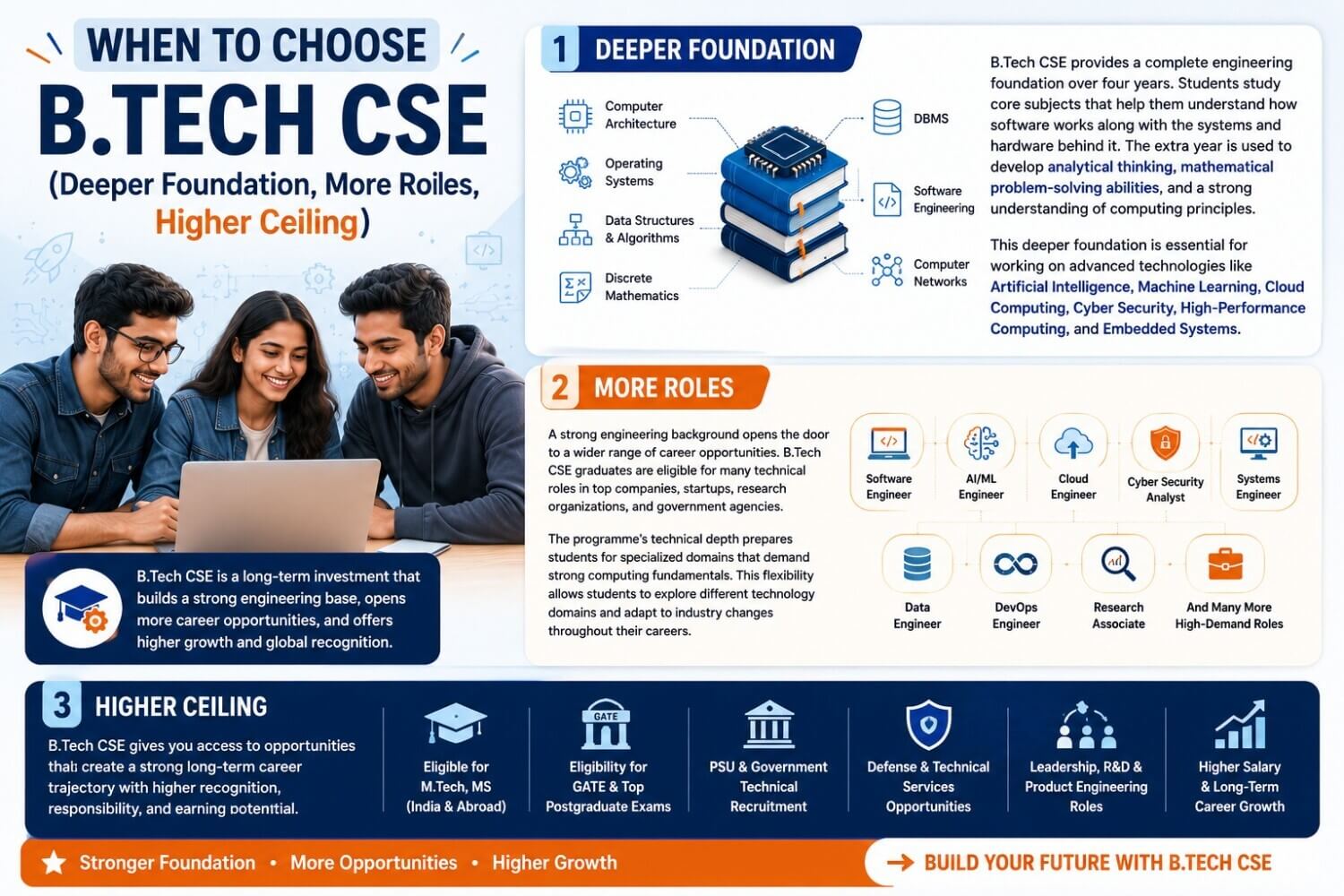
Depth is really what B.Tech CSE is selling. Where a shorter, application-focused degree teaches you to build things, B.Tech CSE spends four years making sure you understand why they work — computer architecture, operating systems, data structures, algorithms, DBMS, software engineering, networks, discrete mathematics, the whole stack. That extra year over BCA isn't padding. It goes into sharpening the analytical and mathematical thinking that actually matters once you're neck-deep in advanced work — artificial intelligence, machine learning, cloud computing, cybersecurity, high-performance computing, embedded systems. Surface-level knowledge runs out fast in those areas. Learn more about the B.Tech CSE programme at Haridwar University.
More Roles
An engineering background simply opens more doors. Plenty of technical roles specifically ask for an engineering qualification, and that filters in B.Tech CSE graduates for jobs at multinational companies, startups, research labs, and government agencies that a non-engineering degree can't touch. We're talking Software Engineer, AI/ML Engineer, Cloud Engineer, Cyber Security Analyst, Systems Engineer, Data Engineer, DevOps Engineer, Research Associate — the list keeps growing as new specialisations open up. Employers hiring for genuinely complex engineering problems tend to reach for B.Tech candidates first, which gives graduates room to pivot between technology domains as the industry shifts, instead of getting boxed into one track.
Higher Ceiling
Think of B.Tech CSE as the long-term bet. B.Tech CSE at HU is an AICTE-approved engineering programme, which is exactly why most prestigious postgraduate routes — M.Tech and MS degrees, both in India and abroad — either prefer or flat-out require it. It also keeps GATE, PSU recruitment, defence technical services, and government engineering positions on the table, none of which are open to a non-engineering graduate. In the private sector, that same degree tends to become the foundation for leadership roles, research positions, and the kind of pay that comes with product-based companies. Technology keeps shifting under everyone's feet, and it's the engineers with strong fundamentals who adapt fastest into specialised, strategic roles rather than getting left behind. If you're up for a demanding four years and want to keep every door open, B.Tech CSE is the pathway with the higher ceiling.
MCA Pathway from BCA vs M.Tech from B.Tech
Your postgraduate route is often decided the moment you pick your undergraduate degree, so it's worth planning both ends of the journey together.
BCA → MCA
MCA is the obvious next stop after BCA — a 2-year programme that goes deeper into software development, systems design, and emerging-tech electives. Do the maths and a BCA plus MCA lands you at a postgraduate-equivalent standing in 5 total years, same as a straight B.Tech. If you want flexibility early but still want that master's qualification before you start working, this is the route.
B.Tech → M.Tech
M.Tech runs 2 years and is usually reached through GATE. Students aiming at R&D, teaching, PSU technical grades, or a PhD down the line tend to go this way. Since B.Tech already builds the core engineering depth, M.Tech graduates can jump straight into specialised, research-heavy roles instead of catching up on fundamentals.
Bottom line: BCA to MCA is about flexibility and a faster start with a postgraduate finish. B.Tech to M.Tech is about squeezing out maximum technical depth and staying eligible for research and PSU roles.
Haridwar University Offers Both — Here's How to Decide
Not many universities in Uttarakhand run both BCA and B.Tech CSE with modern specialisations on the same campus, but HU does — same placement infrastructure, same industry tie-ups (NASSCOM Foundation, IBM/TCS advanced-technology programmes), same guaranteed campus internship exposure, whichever course you pick.
So the choice really isn't about campus quality — both programmes share the same placement cell and faculty ecosystem. It comes down to your stream eligibility, your budget, and where you want to be in five years. Recruiters at HU's placement drives have included names like Wipro, Byju's, and Chetu, with the highest package on record touching ₹85 LPA, and students in either stream qualify for HU's merit-based fee concessions and the Academic Excellence Award (₹5,000 for scoring 85%+ in a semester).
Still not sure which one fits? Talk to the admissions team about your Class 12 marks, stream, and what actually interests you — they'll map you to the right programme and can even advise on switching specialisations (such as Data Science or Cyber Security) within your chosen degree before you commit to a final elective track.
View HU's full B.Tech and BCA admissions process for entrance exam details, HUAET dates, and scholarship eligibility.
Typical HU Alumni Outcomes from Each Stream
From BCA: An Early Start into Software Development
One recent HU BCA graduate (Data Science specialisation) came in straight from a Commerce background in Class 12 — no coding experience, no engineering exam behind them. Through HU's EduSkills partnership and a run of hands-on data analytics projects, they landed a Data Analyst role within weeks of the campus placement drive, a full year ahead of their B.Tech peers. The MCA route is still sitting there whenever they want to go back for it.
From B.Tech CSE: Building Toward a Core Engineering Career
A B.Tech CSE graduate (Cyber Security specialisation) took the longer road — four years building up networks, systems, and security fundamentals, with industrial visits and NASSCOM-aligned coursework along the way. Cleared GATE in the final year, walked into a Systems/Security Engineer role, and still has M.Tech or a PSU application sitting on the table if they want either later.
These are composite stories built from the outcomes HU's placement cell tracks across recent batches — your own results will depend on how you perform academically, which specialisation you pick, and how seriously you take your internships.
Ready to Choose Your Path?
Whichever route you land on, HU's placement cell, scholarships, and industry partnerships stick with you all the way from admission to your first job offer.
Explore BCA at HU → Explore B.Tech CSE at HU →
Frequently Asked Questions
- Is BCA easier than B.Tech CSE at Haridwar University?
Not exactly "easier," but definitely lighter on the maths. BCA is more application-focused, so it feels more approachable if you're coming from a non-science stream. B.Tech CSE piles on core-engineering and mathematics coursework, but that's precisely what gives it the deeper technical foundation. For a broader look at BCA as a degree option beyond HU, Shiksha's BCA course guide is a useful reference. - Can a Commerce or Arts student join B.Tech CSE at HU?
No, and this trips up a lot of students. B.Tech CSE needs a Science background — Physics, Mathematics, Chemistry or Computer Science in Class 12 — plus clearing JEE Main or the HUAET entrance route. BCA has none of that; any stream can apply. - Which course has better placement packages at Haridwar University — BCA or B.Tech CSE?
B.Tech CSE grads generally start higher and get a wider shot at core-engineering, R&D, and product-based roles. That said, BCA grads are already earning for a full year before their B.Tech peers even graduate, and with a specialisation like data science, they can still land strong packages. - Can BCA graduates do MCA after Haridwar University?
Yes, and it's honestly the most common next step. HU offers direct progression from BCA into MCA, so you end up with a master's-level qualification in about the same total time it'd take to finish a B.Tech and pick up a couple of years of work experience. - Is B.Tech CSE better than BCA for higher studies abroad?
For MS programmes and GATE-based entry into IITs/NITs, yes — a B.Tech carries more weight. That doesn't shut the door on BCA graduates, though; they typically go abroad through a master's in computer applications or an MBA/MSc route instead. - What is the fee difference between BCA and B.Tech CSE at HU?
Roughly ₹2.42 lakh for the full BCA (3 years) versus ₹4.57 lakh for B.Tech CSE (4 years). The gap mostly comes down to the extra year plus a more lab-intensive engineering curriculum. - Does Haridwar University offer specialisations within these programmes?
Yes — HU runs BCA with Data Science, and B.Tech CSE with Data Science and Cyber Security tracks. Either way, you can shape your degree around where the industry's actually hiring. - Which course is better for a government job aspirant?
B.Tech CSE, hands down, if the goal is technical PSU recruitment or a GATE-based route. BCA graduates aren't locked out of government jobs entirely — Bank IT Officer, SSC CGL technical posts, that sort of thing — but the core-engineering PSU exams specifically ask for a B.Tech/B.E. - Can I switch from BCA to B.Tech CSE later at Haridwar University?
Not directly, no — there's no lateral switch between the two degrees. But a BCA graduate can pursue an MCA to reach an equivalent postgraduate standing, and separately, HU's B.Tech CSE does accept lateral entry into the second year for eligible diploma holders.
Take the Next Step
Still on the fence? That's fine — most students are at this stage. Our admissions counsellors at Haridwar University can walk you through eligibility, fees, scholarships, and placement records for both programmes, in person or over a call.