


B.Pharm at Haridwar University (2026): Curriculum, Fees, Eligibility & Career Options
Dr. Deovrat Kumar
Head of Pharmacy, Haridwar University
Choosing the right pharmacy college is an important decision for students planning a career in healthcare and pharmaceutical sciences. Beyond earning a degree, students should evaluate the curriculum, practical training, laboratories, industry exposure, placement support, and career opportunities offered by the university.
B.Pharm at Haridwar University is a four-year undergraduate programme that combines pharmaceutical sciences with practical learning to prepare students for careers in the pharmaceutical, healthcare, research, and clinical sectors. This guide covers the programme curriculum, eligibility, fees, laboratories, career opportunities, higher education pathways, and placement support to help students make an informed decision.
Table of Contents
- Why Choose B.Pharm After 12th?
- B.Pharm at Haridwar University: Programme Overview
- Who Can Apply? Eligibility and Programme Duration
- B.Pharm vs D.Pharm: What's the Difference?
- Semester-wise Curriculum
- Practical Learning and Laboratory Exposure
- Industry Exposure and Professional Learning
- Why Practical Training Matters in Pharmacy
- Understanding PCI Approval
- Fees and Scholarships
- Career Options After B.Pharm
- Placement Support and Industry Connections
- Higher Education After B.Pharm
- Why Consider Haridwar University for B.Pharm?
- Frequently Asked Questions
- Is B.Pharm at Haridwar University the Right Choice?
Why Choose B.Pharm After 12th?
Healthcare remains one of the fastest-growing industries in India and worldwide. Increasing demand for medicines, biotechnology, healthcare services, and pharmaceutical research has created opportunities for qualified pharmacy graduates across multiple sectors.
Unlike many traditional undergraduate programmes, B.Pharm combines scientific knowledge with practical skills that can lead to diverse career options after graduation.
Students generally choose B.Pharm because it offers:
- Career opportunities across pharmaceutical, healthcare, and life sciences industries
- Practical laboratory learning throughout the programme
- Industry-oriented curriculum with hands-on training
- Opportunities for internships and industrial exposure
- Multiple higher education pathways, including M.Pharm, MBA, and research programmes
- Eligibility for careers in both private organisations and government sectors
For students interested in science but looking beyond conventional engineering or medical pathways, B.Pharm provides a balanced combination of healthcare knowledge, laboratory practice, and professional development.
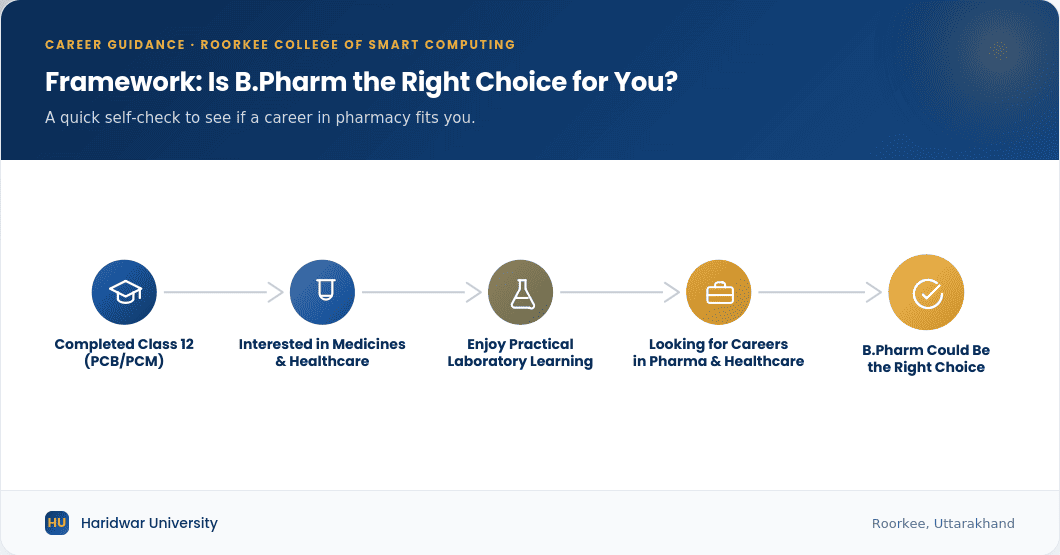
A simple framework to help students decide whether B.Pharm matches their interests and future career aspirations.
B.Pharm at Haridwar University: Programme Overview
Haridwar University offers a four-year Bachelor of Pharmacy (B.Pharm) programme designed to build a strong foundation in pharmaceutical sciences through classroom learning, laboratory training, and industry-oriented education. Students study subjects such as pharmaceutical chemistry, pharmacology, pharmaceutics, pharmacognosy, pharmaceutical analysis, and hospital pharmacy while developing practical skills through laboratory work and academic projects.
Students seeking admission can apply through the university's admission process, including the HUAET Entrance Examination, along with other applicable eligibility criteria published by the university.
Who Can Apply? Eligibility and Programme Duration
Understanding eligibility criteria and programme requirements is an important step before applying.
Programme Duration
- Degree: Bachelor of Pharmacy (B.Pharm)
- Duration: 4 Years (8 Semesters)
- Academic Pattern: Semester System
Eligibility Criteria
To be eligible for admission to the B.Pharm programme at Haridwar University, candidates must satisfy the following general requirements:
- Passed Class 12 (10+2) or equivalent examination from a recognised board.
- Physics and Chemistry as compulsory subjects along with Mathematics or Biology.
- Minimum percentage requirements specified by the university during the admission cycle.
- Candidates appearing for their Class 12 board examinations are also eligible to apply, subject to fulfilling admission criteria at the time of counselling.
B.Pharm vs D.Pharm: What's the Difference?
Many students confuse B.Pharm with D.Pharm. While both programmes belong to pharmaceutical education, they differ significantly in duration, depth of study, and career opportunities.
| Feature | B.Pharm | D.Pharm |
|---|---|---|
| Programme Type | Undergraduate Degree | Diploma Programme |
| Duration | 4 Years (8 Semesters) | 2 Years |
| Level of Study | Comprehensive theoretical & practical learning | Foundational technical training |
| Career Scope | Pharmaceutical manufacturing, QA/QC, R&D, regulatory affairs, clinical research, hospitals, sales & marketing | Community pharmacies, hospitals, retail pharmacy |
| Higher Education | Eligible for M.Pharm, MBA, research programmes | Can pursue B.Pharm through lateral entry where applicable |
Students planning long-term careers in pharmaceutical sciences, research, healthcare, or management generally prefer B.Pharm because it offers broader academic and professional opportunities.
Semester-wise Curriculum
The B.Pharm curriculum progresses from basic pharmaceutical sciences to advanced subjects covering drug development, patient care, quality assurance, research, and professional practice. While individual subjects may be updated periodically, the programme generally follows the structure below.
| Semester | Learning Focus |
|---|---|
| Semester I | Human Anatomy & Physiology, Pharmaceutical Analysis, Pharmaceutics, Pharmaceutical Inorganic Chemistry, Communication Skills, Practical Laboratory Work |
| Semester II | Pharmaceutical Organic Chemistry, Pathophysiology, Physical Pharmaceutics, Computer Applications in Pharmacy, Environmental Sciences, Laboratory Experiments |
| Semester III | Pharmaceutical Microbiology, Medicinal Chemistry, Pharmacognosy, Pharmaceutical Engineering, Practical Sessions |
| Semester IV | Pharmacology, Pharmaceutical Organic Chemistry, Physical Pharmacy, Research Methodology, Practical Training |
| Semester V | Industrial Pharmacy, Pharmaceutical Jurisprudence, Pharmacology, Medicinal Chemistry, Hospital & Clinical Pharmacy |
| Semester VI | Biopharmaceutics, Pharmacokinetics, Quality Assurance, Herbal Drug Technology, Industrial Exposure |
| Semester VII | Instrumental Methods of Analysis, Pharmacy Practice, Novel Drug Delivery Systems, Elective Subjects, Seminar |
| Semester VIII | Project Work, Industrial Training, Comprehensive Viva, Professional Practice |
The curriculum combines scientific knowledge with practical training to prepare students for careers across the pharmaceutical and healthcare sectors.
Practical Learning and Laboratory Exposure
Practical learning is integrated throughout the programme through the Pharmaceutics Laboratory, Chemistry Laboratories, Research Laboratories, and Virtual Laboratory facilities. Students gain hands-on experience in dosage form design, pharmaceutical formulation, dispensing pharmacy, quality assurance, and laboratory techniques through practical sessions, projects, and seminars.
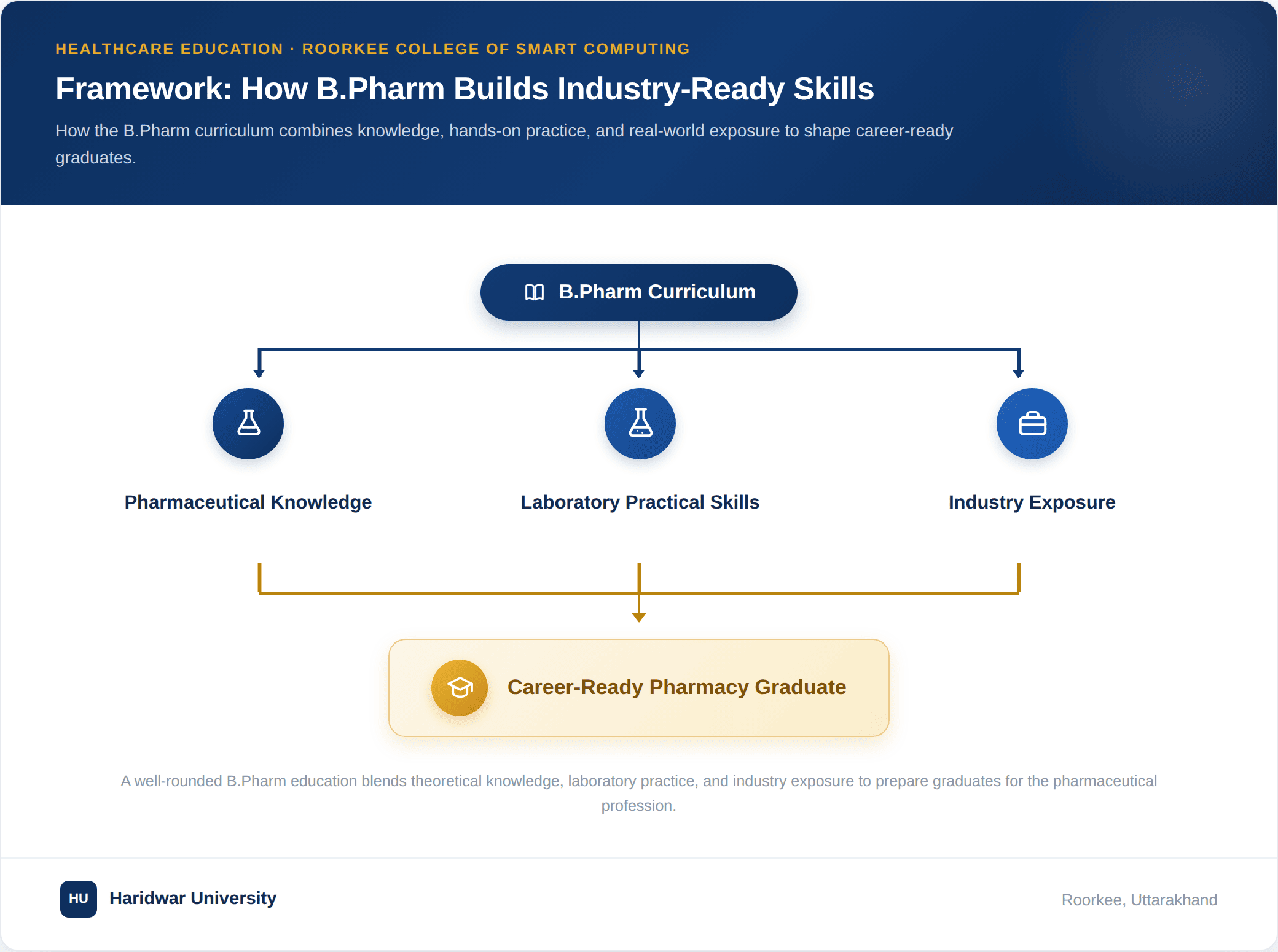
The B.Pharm programme combines classroom learning, laboratory practice, and industry exposure to prepare students for careers in the pharmaceutical and healthcare sectors.
Industry Exposure and Professional Learning
Classroom learning is strengthened through industry interaction, expert sessions, seminars, industrial visits, and internship opportunities. Haridwar University also supports practical exposure through industry collaborations and partnerships, helping students understand pharmaceutical manufacturing, quality standards, regulatory practices, and current healthcare trends.
These experiences complement academic learning and help students develop workplace readiness before graduation.
Why Practical Training Matters in Pharmacy
Pharmacists play an important role throughout the healthcare system, from medicine manufacturing and quality testing to patient safety and regulatory compliance. Because of this, employers often value graduates who can combine theoretical understanding with practical laboratory skills.
A well-structured B.Pharm programme helps students develop competencies in:
- Drug formulation and dosage development
- Pharmaceutical quality control
- Laboratory documentation and reporting
- Good manufacturing practices (GMP) awareness
- Analytical and problem-solving skills
- Professional ethics and patient safety
- Scientific communication and teamwork
These skills prepare graduates for careers across pharmaceutical manufacturing, hospitals, clinical research organisations, healthcare companies, regulatory bodies, and other life sciences sectors.
Understanding PCI Approval
When exploring pharmacy colleges, students often come across the term PCI approval. The Pharmacy Council of India (PCI) is the statutory body responsible for regulating pharmacy education and maintaining educational standards for pharmacy programmes in India.
Haridwar University's B.Pharm programme is approved by the Pharmacy Council of India (PCI). Students are encouraged to refer to the latest information published by the university and the Pharmacy Council of India for any regulatory updates.
At the time of writing, prospective students are encouraged to refer to the university's latest admission information and the official Pharmacy Council of India website for the most up-to-date regulatory information.
If you're interested in how technologies such as Artificial Intelligence are influencing pharmaceutical research, manufacturing, and healthcare, explore AI in Pharmacy.
Fees and Scholarships
Before choosing a B.Pharm programme, understand both the cost of education and the financial support available during the course.
According to the latest fee structure published by Haridwar University, the B.Pharm programme fee is:
| Academic Year | Tuition Fee |
|---|---|
| First Year | ₹1,27,000 |
| Second Year | ₹1,10,000 |
| Third Year | ₹1,10,000 |
| Fourth Year | ₹1,10,000 |
Apart from the fee structure, eligible students can also explore fees and scholarships offered by the university under applicable admission policies.
Scholarships may be available based on:
- Academic performance
- Merit criteria
- Entrance examination performance
- Other categories notified by the university
Since fee structures and scholarship policies may be updated periodically, applicants should always refer to the latest information published by the university before applying.
Career Options After B.Pharm
A B.Pharm degree prepares graduates for careers across pharmaceutical manufacturing, hospitals, healthcare organisations, clinical research, regulatory affairs, and retail pharmacy. Career growth depends on skills, experience, and continuous professional learning.
Common career options include:
| Career Role | Primary Responsibility | Typical Salary Range (India)* |
|---|---|---|
| Pharmacist | Dispensing medicines and patient counselling | ₹3–5 LPA |
| Production Executive | Manufacturing and production operations | ₹3.5–6 LPA |
| Quality Assurance Executive | Ensuring medicine quality and regulatory compliance | ₹4–7 LPA |
| Drug Safety Associate | Monitoring medicine safety and adverse events | ₹4–7 LPA |
| Clinical Research Associate | Managing and monitoring clinical studies | ₹4–8 LPA |
| Medical Representative | Product promotion and healthcare engagement | ₹3–6 LPA + incentives |
| Regulatory Affairs Executive | Documentation and regulatory approvals | ₹4–7 LPA |
| Pharmaceutical Sales Manager (Experience) | Business development and product strategy | ₹6–10 LPA |
*Typical salary ranges are indicative estimates for India based on publicly available data from AmbitionBox, industry job portals, and market trends (2026). Actual salaries vary depending on employer, location, skills, experience, and job responsibilities.
Career growth depends on practical skills, internships, communication abilities, continuous learning, and professional experience alongside academic performance.
Placement Support and Industry Connections
Choosing a pharmacy college is not only about academics. Students also evaluate placement support, career guidance, internship opportunities, and industry exposure before making a decision.
Haridwar University supports students through placement preparation, aptitude development, resume building, mock interviews, personality development, and career counselling.
Students also get opportunities to interact with recruiters through campus recruitment drives, internships, industrial visits, expert lectures, and placement activities organised by the university.
According to the university's published placement statistics across all academic programmes, students benefit from:
- 10,000+ placement offers
- 1,300+ participating recruiters
- Opportunities across multiple salary bands
- Dedicated placement assistance and career development support
The university's recruiter network spans organisations from technology, healthcare, pharmaceutical, consulting, engineering, and manufacturing sectors. Across university recruitment activities, students have opportunities to interact with recruiters such as Sun Pharma, Cipla, Lupin, Mankind Pharma, Alkem Laboratories, TCS, Infosys, Wipro, HCL Technologies, Tech Mahindra, and Capgemini, among many other organisations. Programme-specific placement statistics for B.Pharm are not published separately by the university.
Students can explore the university's placement overview and recruiter network to learn more about placement activities across programmes.
Higher Education After B.Pharm
Many graduates choose to continue their education after B.Pharm to develop specialised knowledge or expand their career opportunities. Popular options include M.Pharm, Pharm.D (Post Baccalaureate), MBA in Healthcare or Pharmaceutical Management, and postgraduate studies in clinical research, regulatory affairs, or pharmaceutical sciences.
Students interested in international careers can also pursue higher studies or pharmacy licensing pathways in countries such as the USA, Canada, the UK, and Australia, subject to their respective licensing requirements, including NAPLEX (USA) and PEBC (Canada) where applicable.
Why Consider Haridwar University for B.Pharm?
Every student has different career goals. Some aim for pharmaceutical manufacturing, while others plan to work in hospitals, research laboratories, or healthcare organisations.
Students considering B.Pharm at Haridwar University can evaluate the programme based on factors such as:
- Industry-oriented curriculum
- Practical laboratory learning
- Experienced faculty guidance
- Academic seminars and workshops
- Industry interactions and collaborations
- Placement preparation support
- Scholarship opportunities for eligible students
- HUAET admission pathway and transparent admission process
Evaluating these factors alongside personal interests and career goals can help students make an informed decision about their pharmacy education.
Frequently Asked Questions
What is the duration of the B.Pharm programme?
The Bachelor of Pharmacy programme is a four-year undergraduate degree divided into eight semesters.
Who can apply for B.Pharm at Haridwar University?
Students who have completed Class 12 with the required qualifying subjects and satisfy the university's eligibility criteria can apply.
Is NEET required for B.Pharm admission?
No. Admission to the B.Pharm programme does not require NEET. Candidates should satisfy the university's published eligibility criteria and complete the applicable admission process.
What does the B.Pharm curriculum cover?
The curriculum generally includes pharmaceutical chemistry, pharmaceutics, pharmacology, pharmacognosy, pharmaceutical analysis, microbiology, quality assurance, hospital pharmacy, practical laboratory work, and project-based learning.
What is the fee for the B.Pharm programme at Haridwar University?
According to the latest published fee structure, the tuition fee is ₹1,27,000 for the first year and ₹1,10,000 per year from the second to the fourth year. Applicants should verify the latest fee details before admission.
Does B.Pharm include practical laboratory training?
Yes. Laboratory sessions form an important part of the programme and help students develop practical skills in pharmaceutical sciences throughout the course.
What career opportunities are available after B.Pharm?
Graduates may pursue careers in pharmaceutical manufacturing, hospitals, clinical research, quality assurance, regulatory affairs, healthcare companies, pharmaceutical sales, and many other healthcare sectors.
Can students pursue M.Pharm after completing B.Pharm?
Yes. M.Pharm is one of the most popular higher education options for students who wish to specialise in pharmaceutical sciences or pursue research and academic careers.
Does Haridwar University provide placement support?
Yes. The university offers placement assistance, career guidance, training programmes, and opportunities to interact with recruiters through placement activities conducted across the university.
Is B.Pharm at Haridwar University the Right Choice?
Choosing the right B.Pharm programme involves much more than comparing course names. Students should carefully evaluate the curriculum, laboratory facilities, practical learning opportunities, industry exposure, placement support, faculty, fee structure, and future career pathways before making a decision.
Haridwar University's B.Pharm programme is designed to combine academic learning with practical experience, helping students build the knowledge and professional skills required in today's pharmaceutical and healthcare industries.
Apply for B.Pharm. at Haridwar University
Take the first step towards a rewarding career in pharmaceutical sciences and healthcare.
Apply Now