

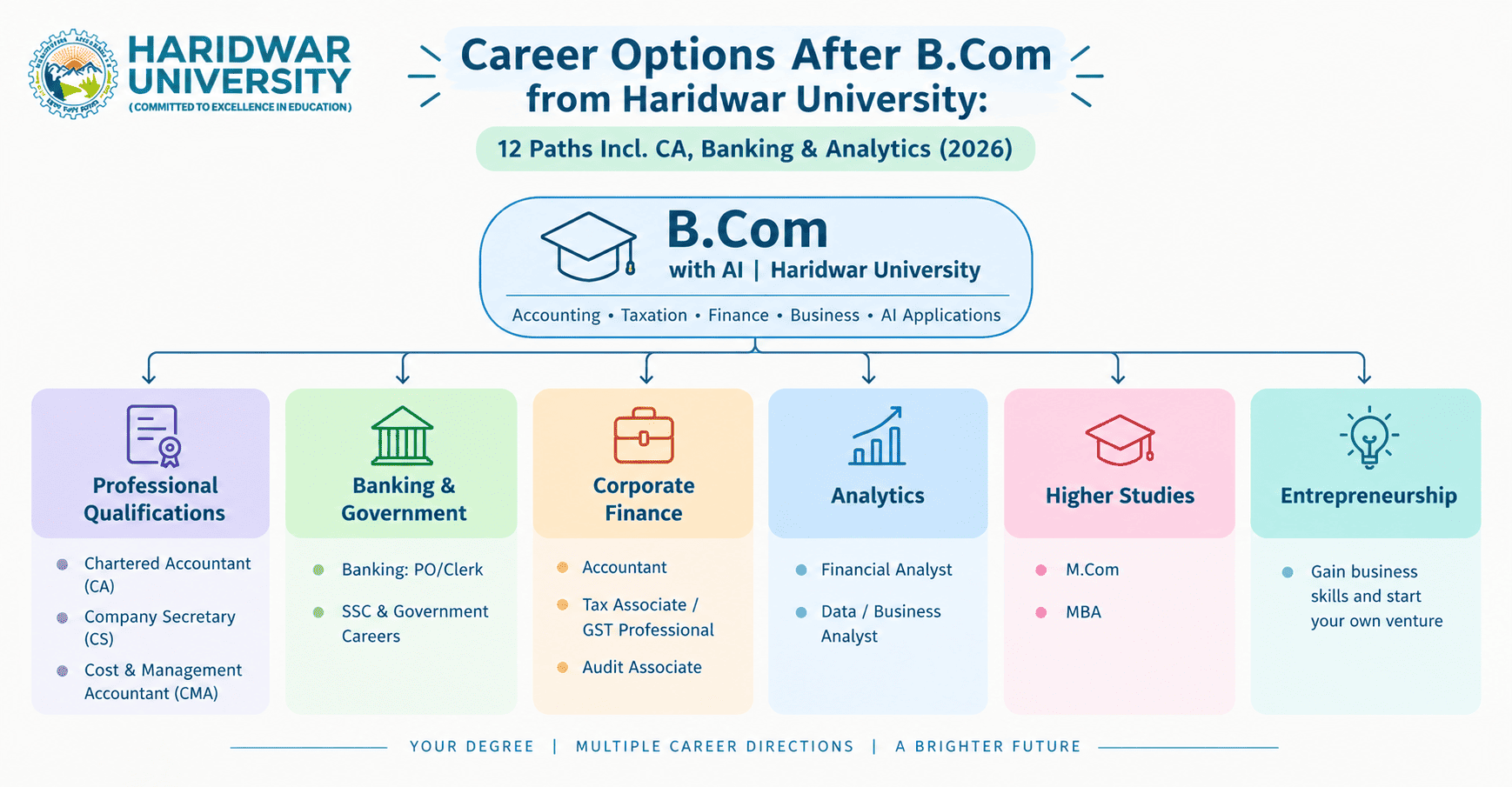
A Bachelor of Commerce (B.Com) degree does not restrict you to a single predefined job role. In my experience mentoring students through campus recruitments and postgraduate career transitions, commerce graduates generally evaluate three primary pathways: entering direct professional employment, pursuing high-tier professional qualifications, or advancing into specialized higher education.
At Haridwar University, our undergraduate commerce curriculum is delivered as B.Com with AI within the Roorkee College of Business Studies, situated alongside BBA with AI and MBA with AI. This three-year honours programme integrates traditional financial accounting with contemporary artificial intelligence and data-driven business applications.
While this combination of core financial acumen and AI literacy provides a decisive advantage, ultimate career success depends on how deliberately you build upon that foundation. Below is an exhaustive breakdown of 12 realistic career routes available to commerce graduates in 2026.

Table of Contents
1. Summary of 12 Career Paths After B.Com
The table below summarizes the key qualifications, entry requirements, and compensation bands across all 12 disciplines.
*Disclaimer: Salary figures reflect prevailing market-reference guides (Naukri, PayScale 2026) and official government notification pay scales. They do not constitute guaranteed placement figures. Actual compensation depends on personal competency, employer, certifications, and location.
2. Detailed Breakdown of Each Career Pathway
1. Chartered Accountant (CA)
For a commerce graduate desiring an apex career in auditing, statutory taxation, or corporate financial reporting, CA remains the premier benchmark. Under the Institute of Chartered Accountants of India (ICAI) Direct Entry Route, commerce graduates with at least 55% aggregate marks can bypass the Foundation level and register directly for CA Intermediate.
Following provisional registration and completion of the mandatory eight-month study period, candidates appear for the Intermediate examination, followed by two years of practical articleship training and ICITSS compliance before sitting for CA Final.
2. Company Secretary (CS)
Governed by the Institute of Company Secretaries of India (ICSI), this profession concentrates on company law, board governance, secretarial audits, and statutory compliance. B.Com graduates are directly eligible for the CS Executive Programme.
The programme incorporates 21 months of structured practical training. It is an outstanding route for students whose analytical strengths lean toward legal interpretation and regulatory compliance rather than numerical ledger balancing.
3. Cost & Management Accountant (CMA)
Administered by the Institute of Cost Accountants of India (ICMAI), CMA focuses on costing systems, management accounting, pricing strategy, operational audits, and corporate budgeting.
Graduates qualify for direct entry into the Intermediate Course and must complete 15 months of mandatory practical training across cost accounting, taxation, and ERP systems. CMAs are indispensable across manufacturing, heavy engineering, and supply-chain enterprises.
4. Banking: Probationary Officer (PO) & Clerk
Public sector banking examinations conducted by IBPS and State Bank of India (SBI) represent a time-tested, stable avenue. Starting basic pay scales for 2026 notifications include:
- IBPS PO & SBI PO: Starting basic pay of ₹48,480/month (gross CTC approximately ₹8.5–₹10 LPA including DA, HRA, and perks).
- IBPS Clerk / Customer Service Associate: Starting basic pay of ₹24,050/month.
- RBI Assistant: Starting basic pay of ₹29,000/month.
A B.Com degree provides immediate familiarity with commercial terms, balance sheets, and quantitative modules tested in these competitive evaluations.
5. SSC CGL & Government Finance Services
The Staff Selection Commission Combined Graduate Level (SSC CGL) examination recruits officers across central ministries, the Comptroller and Auditor General (CAG), Central Board of Direct Taxes (CBDT), and CBIC.
Posts range from Level 4 (₹25,500 basic) up to Level 8 (₹47,600 basic) for roles such as Assistant Audit Officer (AAO) and Assistant Accounts Officer — posts where commerce graduates hold a significant competitive advantage in Paper-II financial electives.
6. Corporate Accountant
The most immediate direct-employment route after graduation. Responsibilities include daily journal vouchers, accounts payable/receivable, payroll reconciliation, and statutory return filings.
While entry-level packages range around ₹3–5 LPA, professionals who master ERP environments (SAP FICO, Oracle ERP Cloud) and advanced Excel functions transition rapidly into Senior Accountant and Finance Controller brackets earning ₹12–20 LPA+.
7. Tax Associate / GST Professional
Under statutory provisions established by the Central Board of Indirect Taxes and Customs (CBIC), commerce graduates are eligible to register as official GST Practitioners.
Whether consulting for corporate accounts or practicing independently, tax associates managing direct corporate taxes and monthly GSTR-1/3B filings command an indicative market package of ₹5–9 LPA.
8. Audit Associate
Audit associates support statutory audit testing, internal controls assessments, process audits, and Sox compliance for large consulting and chartered firms.
Freshers start around ₹4–7 LPA. While statutory audit signing authority requires full CA qualification, working as a specialized audit associate offers unmatched exposure to enterprise operational processes.
9. Financial Analyst
For analytical minds eager to go beyond historical bookkeeping into forecasting and strategic valuation. Analysts build three-statement financial models, analyze EBITDA margins, assess discounted cash flows (DCF), and prepare investor presentations.
Entry compensation ranges from ₹4–8 LPA, scaling past ₹15–18 LPA at mid-management levels for those pursuing the CFA charter alongside their work.
10. Data or Business Analyst (The AI Advantage)
This is where Haridwar University's B.Com with AI degree becomes a game-changer. Rather than remaining purely academic, graduates learn to pair fundamental accounting knowledge with data tools: SQL queries, Power BI dashboards, Python for data manipulation, and automated machine learning workflows.
Entry packages span ₹4–9 LPA. Having both commercial domain fluency and technical data extraction skills makes you vastly more employable than a general coder who does not understand balance sheets.
11. Higher Studies: M.Com or MBA with AI
If immediate employment is not your aim, higher studies allow you to target executive leadership bands. M.Com deepens academic research and collegiate teaching credentials, whereas an MBA shifts your scope to strategic finance, business analytics, human resources, or marketing.
At HU, students can transition smoothly into our accredited MBA with AI Programme, featuring dedicated specializations in Finance, Business Analytics, and Marketing.
12. Entrepreneurship & Fintech Startups
A commerce background provides vital literacy in cash flow management, unit economics, working capital, and tax compliance — the exact failure points of most early-stage startups.
Whether launching a boutique bookkeeping and taxation consultancy, an e-commerce brand, or a financial technology tool, students can leverage government schemes such as the Startup India Seed Fund Scheme (SISFS) for prototype proofing and seed capital.
3. How I Would Choose Between These 12 Paths
Avoid the common mistake of asking only, “Which path pays the highest starting salary?” Instead, align your choice with the day-to-day work you genuinely find engaging:
- If you love accounting precision, audits, and taxation: Target CA, CMA, Corporate Accounting, or GST advisory.
- If you prefer corporate governance and legal compliance: CS is your strongest pathway.
- If you seek job security and structured promotion ladders: Prepare for Banking (PO/Clerk) or SSC CGL.
- If you thrive on predictive numbers and valuation: Work toward becoming a Financial Analyst.
- If you enjoy technology, algorithms, and business metrics: Leverage Data or Business Analytics.
- If you aspire to executive management: Pursue an MBA with AI.
- If you crave commercial autonomy: Build your own venture through Entrepreneurship.
4. How Haridwar University Can Support Your Next Step
At Haridwar University, our Training & Placement Office works closely with commerce students from their very first semester. We facilitate:
- Comprehensive campus recruitment drives with leading banking, fintech, IT, and auditing recruiters.
- Dedicated skill-development workshops covering advanced Microsoft Excel, Power BI, TallyPrime, and financial modelling.
- Mentorship sessions for competitive examinations (IBPS, SBI, SSC) and professional guidance for CA/CS/CMA direct entry.
- Curricular integration with AI and business analytics tools at Roorkee College of Business Studies.
To explore other high-growth career avenues for commerce graduates, read our published guide on Digital Marketing Career After BBA/B.Com.
5. Frequently Asked Questions (FAQs)
Can I do CA after B.Com from Haridwar University?
Yes. Under ICAI's Direct Entry Route, commerce graduates with at least 55% aggregate marks are exempt from CA Foundation and can register directly for CA Intermediate, subject to the prescribed study period and practical training requirements.
Can I pursue CS after B.Com?
Yes. ICSI's current eligibility norms permit graduates in any discipline (excluding fine arts) to enroll directly into the CS Executive Programme without appearing for CSEET, followed by 21 months of practical training.
Is B.Com with AI useful for banking careers?
Yes. While banking examinations (IBPS PO, SBI PO, RBI Assistant) accept graduates from all streams, commerce students have an organic advantage in quantitative aptitude, banking awareness, and ledger concepts.
What salary can I expect after B.Com?
Entry-level general accounting and audit roles typically start around ₹3–5 LPA in India. However, specializing in business analytics, financial modeling, or qualifying for CA/CMA/PO positions elevates compensation to ₹6–12 LPA+.
Is CA the only good career after B.Com?
No. CA is an exceptional route, but it is far from the only one. B.Com graduates thrive in CS, CMA, banking, SSC CGL, corporate taxation, data analytics, MBA leadership tracks, and independent entrepreneurship.
Is CMA easier than CA after B.Com?
CA and CMA focus on different domains. CA centers heavily on financial accounting, taxation, and statutory audit, whereas CMA emphasizes cost control, management accounting, and pricing strategy. The choice depends on your specific career orientation rather than perceived difficulty.
What does B.Com with AI add to a commerce degree?
B.Com with AI pairs core commerce principles (accounting, taxation, business law) with modern technological competencies (data analytics, Python, automated financial reporting). This equips graduates for contemporary analytics and fintech opportunities that traditional commerce degrees overlook.
6. Explore B.Com with AI at Haridwar University
Haridwar University's B.Com with AI is a three-year undergraduate programme designed to prepare future-ready finance and business leaders. For full curriculum structures, merit scholarship options (up to 80% tuition waiver), and eligibility details, visit the official Roorkee College of Business Studies Page and Fees & Scholarships Page.
Launch Your Commerce & Finance Career at HU
Admissions are open for B.Com with AI (3-year total fee ₹1,67,000). Benefit from expert corporate mentorship, dedicated placement training, and modern analytics labs.